ETF Momentum Returns While Global Uncertainty Remains Elevated
15th January 2026 • 11mins read
This Week’s Recap
- Bitcoin rallies past $97,000 as investors seek haven assets: Bitcoin rose above $97,000 as flows and risk appetite improved. The move also lifted some crypto linked equities, alongside the broader rally described in the report. Markets are watching whether the move holds as macro and policy catalysts develop.
- U.S. spot bitcoin ETFs pull in $750 million in strongest day since October: U.S. spot Bitcoin ETFs recorded about $753.7 million in net inflows on January 13, 2026. The article describes this as the strongest single day since October. Investors are tracking whether sustained creations continue to support spot demand
- North American hours become the strongest window for Bitcoin returns, reversing late 2025 trend: The report says Bitcoin’s recent gains have been led by performance during North American trading hours. It frames this as a reversal versus the pattern seen in late 2025. The piece links the shift to where returns are being generated, rather than a single isolated catalyst.
- Metaplanet just 5% away from restarting share sales for bitcoin buying: Metaplanet shares moved toward the 637 yen trigger that would reactivate moving strike warrants. The article says that reactivation could unlock additional capital for Bitcoin purchases. The next step is whether the trigger level is reached and the financing mechanism resumes.
- Bitdeer overtakes MARA as largest bitcoin miner by ‘managed hashrate’ metric: Bitdeer reported 71 EH/s of total hashrate under management, including 55.2 EH/s of self mining hashrate, plus hosted rigs. The report notes MARA’s disclosed capacity at 61.7 EH/s, and adds that the metrics may not be directly comparable. The follow up is how each firm reports and standardizes hashrate figures in future disclosures.
- Ethereum staking hits all-time high with almost 30% of ETH supply locked: Staked ether reached about 36 million ETH, or close to 30% of supply, according to The Block. The increase was described alongside expanding institutional staking and ETF related activity. The next watch item is whether the staked share keeps rising as market conditions shift. (
- Ethereum co-founder Vitalik Buterin warns decentralized stablecoins still have deep flaws: Vitalik Buterin said key design issues in decentralized stablecoins remain unresolved. He highlighted problems tied to benchmarks, oracle risk, and incentive design around yield and staking. The follow up is whether new designs address these trade offs without adding new systemic risks.
- Bank of Italy economist sends out warning on Ethereum’s role in financial system: A Bank of Italy economist warned that a sharp ether price collapse could impair Ethereum’s ability to function as settlement infrastructure for financial activity. The analysis frames Ethereum’s growing financial role as a channel for potential spillovers if the token economics destabilize. The next step is how regulators and market participants incorporate this kind of network level risk into oversight and risk management.
- Ripple steps up Europe licensing drive with preliminary Luxembourg EMI clearance: Ripple said Luxembourg’s CSSF issued preliminary authorization related to an electronic money institution license. Ripple positioned the development as part of expanding regulated payments and stablecoin services across Europe. The next milestone is whether Ripple secures the full approval and any passporting pathway tied to EU rules.
- Ripple wins UK regulatory approval from Financial Conduct Authority: Ripple’s UK subsidiary gained FCA registration under the UK’s money laundering regulations framework, according to CoinDesk. The move strengthens Ripple’s compliance footing as the UK builds out a broader crypto regime. The next step is how Ripple uses the approval to expand regulated payments activity in the UK market.
- Coinbase pulls support from crypto market structure bill: Coinbase CEO Brian Armstrong said the company cannot support the current draft of the Senate crypto market structure bill. He pointed to issues including how the bill treats tokenized equities, CFTC authority, and stablecoin rewards. The next step is whether lawmakers revise the text enough to regain Coinbase support.
- JPMorgan CFO says stablecoin yield looks like a parallel banking system: JPMorgan CFO Jeremy Barnum warned that yield bearing stablecoin products resemble banking activity without the same prudential safeguards. He said JPMorgan will compete, while arguing that interest like payments in stablecoins raise safety and regulatory concerns. The follow up is how Senate negotiations treat stablecoin rewards and whether any limits make it into the final text.
- JPMorgan expects crypto inflows to rise further in 2026 after record $130 billion in 2025: JPMorgan analysts said capital inflows into crypto markets could increase further in 2026 after nearly $130 billion of inflows in 2025. The note linked the outlook to institutional participation and a clearer regulatory environment. The next watch item is whether policy progress and product expansion sustain the pace of allocations.
- Franklin Templeton turns money market fund into stablecoin reserve vehicle: Franklin Templeton updated a money market fund so it holds only short term U.S. Treasuries with maturities under 93 days. CoinDesk reported the change positions the fund for use as a stablecoin reserve vehicle. The next step is whether issuers and institutions adopt the structure for reserve management at scale.
- World’s largest custodial bank BNY to offer tokenized deposits for institutional investors: BNY said it will offer tokenized deposits that mirror client deposit balances on a blockchain based platform. The initiative targets institutional use cases such as settlement, collateral, and payments on digital rails. The next step is uptake by clients and how tokenized deposits integrate with broader tokenized market infrastructure.
- DZ Bank wins MiCA approval to roll out retail crypto trading across Germany: DZ Bank said it secured a MiCA license to offer retail crypto trading services in Germany. The bank said the approval supports a rollout of its digital asset offering via cooperative banks. The next step is the pace of distribution and client uptake once the platform is live.
- Alpaca raises $150 million Series D, pushing valuation to $1.15 billion: Alpaca raised $150 million in a Series D round that values the company at about $1.15 billion. The Block described Alpaca as brokerage infrastructure used by firms building products like trading and investing experiences. The next step is how the company deploys the capital across expansion, product build, and regulated market access.
- Chainalysis report reveals impersonation and AI crypto scams surpass cyberattacks: Chainalysis estimated scammers stole up to $17 billion in 2025, with impersonation and AI enabled tactics highlighted as a major driver. CoinDesk reported that scam and fraud activity against individuals has grown, and may exceed losses from cyberattacks. The next step is whether enforcement and platform controls measurably reduce scam revenue in 2026.
- Monero climbs to new high of $687 as crypto surveillance tightens: Monero rose to a new all time high above $687, according to the report. The article linked demand to tighter regulation and investor interest in privacy preserving assets. The follow up is whether exchanges and regulators respond with additional restrictions that impact liquidity.
- Sui Layer 1 stalls for hours as developers rush to restore network: Sui experienced a network stall that paused block production for hours, according to The Block. Core developers posted updates indicating they were working to restore the chain, and onchain activity showed a halt in processed transactions. The next step is the post mortem, including the root cause and any changes to prevent repeat incidents.
Bitcoin Market Analysis
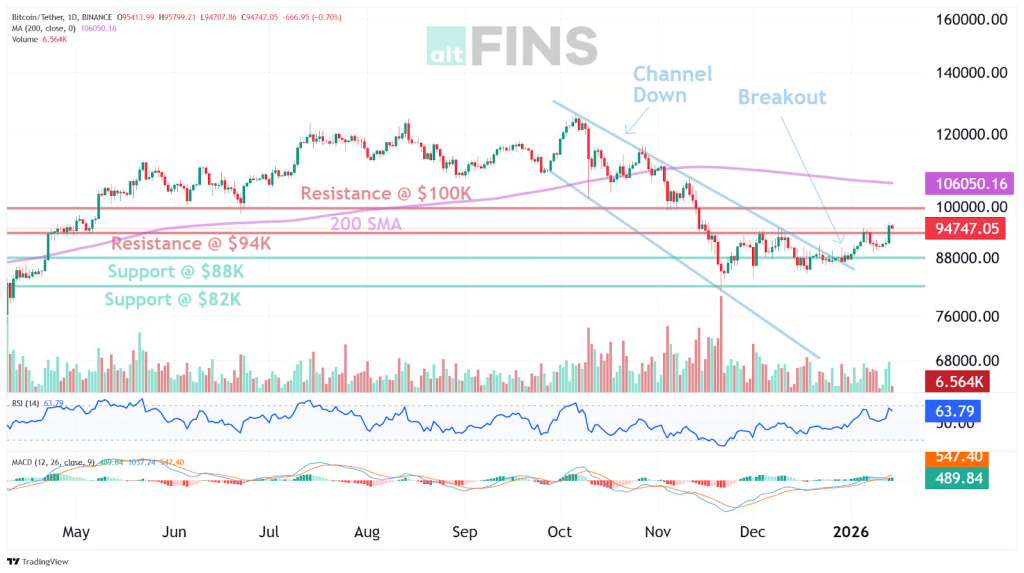
Bitcoin advanced over the past week, with price rising 5.67% to trade near $96,949 after a weekly high of $97,937 and a low of $94,548. The range expansion confirmed a shift away from the prior consolidation, while closes near the upper end of the range indicated improving bid control. Distance from the prior cycle peak remained material at roughly 23.5% below the $126,218 all time high, keeping the broader recovery incomplete despite the near term advance.
Source: https://altfins.com/technical-analysis
Technical conditions were recorded as constructive but not extreme. RSI (14) held at 63.79, confirming neutral momentum with no overbought signal. MACD remained positive at 1,455, supporting trend continuation, while ATR at 2,585 defined a still elevated but stable volatility regime. Price was held above short term moving averages, while the 200 day average near $106,050 remained overhead, indicating that long term trend resistance had not yet been reclaimed.
Market structure was defined by a completed break above the $94,000 resistance zone, which had capped price through much of the prior range. That level was converted into first support, with secondary supports identified at $88,000 and $82,000. Upside reference levels were set at $100,000 and then $107,000, based on prior distribution zones. Invalidation of the current structure was defined by acceptance below $91,000, which would negate the breakout and reintroduce downside risk.
Source: https://sosovalue.com/assets/etf/us-btc-spot
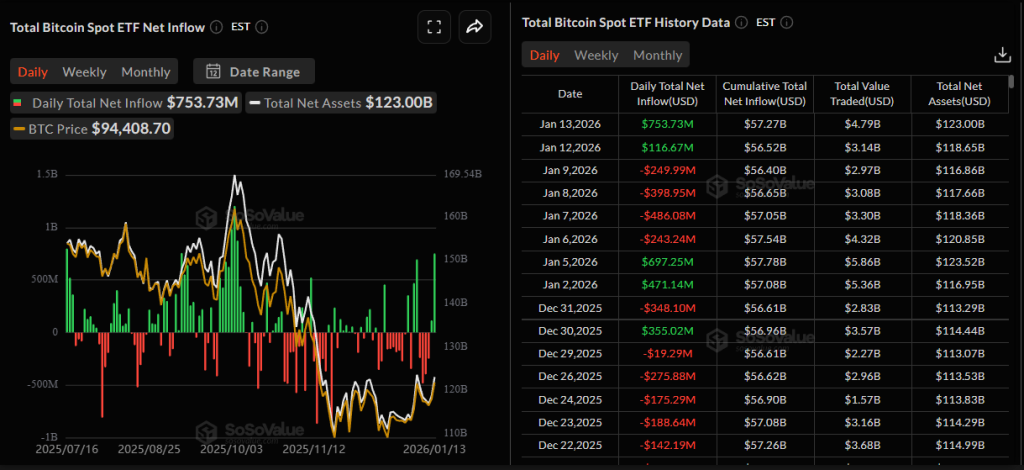
Spot ETF flows provided a supportive backdrop. A single day inflow of $753.73 million was recorded on January 13, lifting total net assets to $123.00 billion and marking the strongest daily creation since October. Over the past seven sessions, net flows summed to a modest +$189 million, reflecting recovery after earlier outflows. Short term momentum improved, with the most recent three sessions net positive, indicating that higher prices were being accompanied by renewed spot demand rather than distribution.
The broader narrative remained aligned with the technical setup. Bitcoin was traded above $97,000 as improved risk appetite and a haven framing were cited, while performance leadership was shifted toward North American trading hours after the late 2025 pattern was described as weaker in that window. Corporate accumulation optionality was highlighted by Metaplanet being positioned roughly 5% below a 637 yen trigger that could reactivate its warrant mechanism and reopen equity funded bitcoin purchases. Mining sector dynamics were also reported through Bitdeer’s disclosed operating metrics, and the “managed hashrate” framing was compared against MARA’s disclosed capacity, although direct comparability was noted as uncertain due to differing definitions. Collectively, the week was characterised by a technically confirmed breakout attempt being supported by flows and narrative, with confirmation being dependent on sustained acceptance above reclaimed levels.
Ethereum Market Analysis
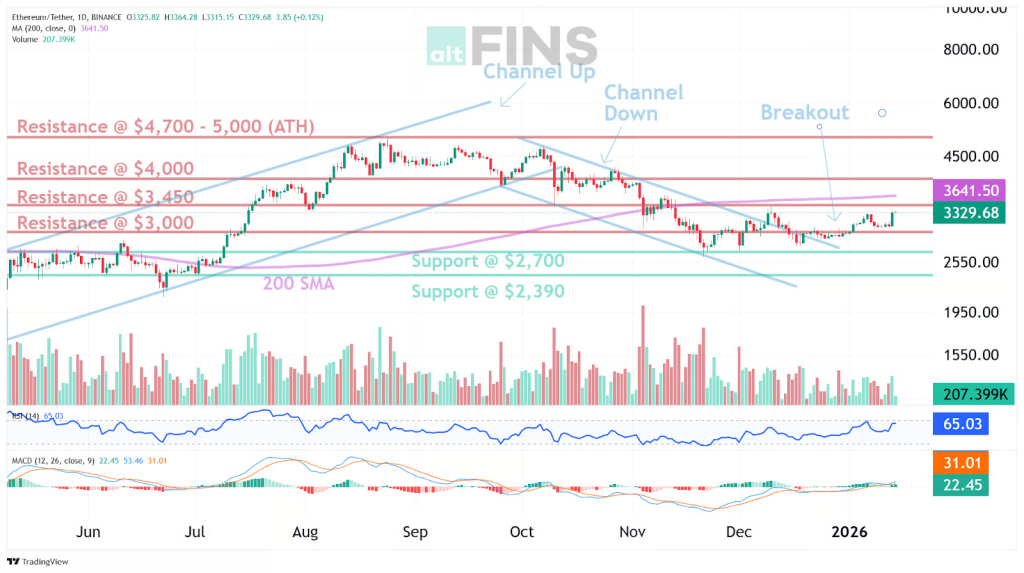
Meanwhile, over the seven days, ETH was recorded with a weekly open of 3,341.59 and a weekly close of 3,356.99, while a weekly high of 3,374.07 and a weekly low of 3,184.00 were registered. A net close to close gain of 4.35% was posted from 3,217.05 to 3,356.99, with the recovery being concentrated after the early week drawdown. A higher close sequence was printed into midweek, and the range was kept contained below the early January swing high, which left upside progress defined but unfinished.
Source: https://altfins.com/technical-analysis
Momentum conditions were kept constructive, with RSI being observed in the low to mid 60s, and with overbought readings not being registered under standard 70 thresholds. A positive MACD state was maintained, with the MACD line being held above its signal line, while the histogram was kept positive, which aligned with the net weekly advance. Realized daily volatility was reflected by ATR readings around 108 to 120, and a current range close to 1.03 times ATR was indicated, which framed the week as active but not disorderly. Bollinger envelopes were shown with an upper band around 3,366.64 and a lower band around 2,869.58 under one common parameter set, while alternative parameterizations have been observed in wider placements, so band precision should be treated as indicator set dependent.
Key levels were reaffirmed through repeated interaction, with 3,000 having been reclaimed and then retested, and with that level being treated as the primary pivot for the current structure. Overhead supply was defined at 3,450, and additional resistance was set at 4,000, with the 3,450 zone being reinforced by proximity to the 200 day simple moving average near 3,641.50. Support was identified at 2,700, with a secondary support zone at 2,390, and a deeper structural failure would be signaled if daily settlement were to be sustained below those levels. A channel down structure has been mapped on the higher time frame, while a short term up condition, a neutral medium term condition, and a strong down long term condition have been flagged, so a range to breakout framework has been kept as the appropriate lens.
Source: https://sosovalue.com/assets/etf/us-eth-spot
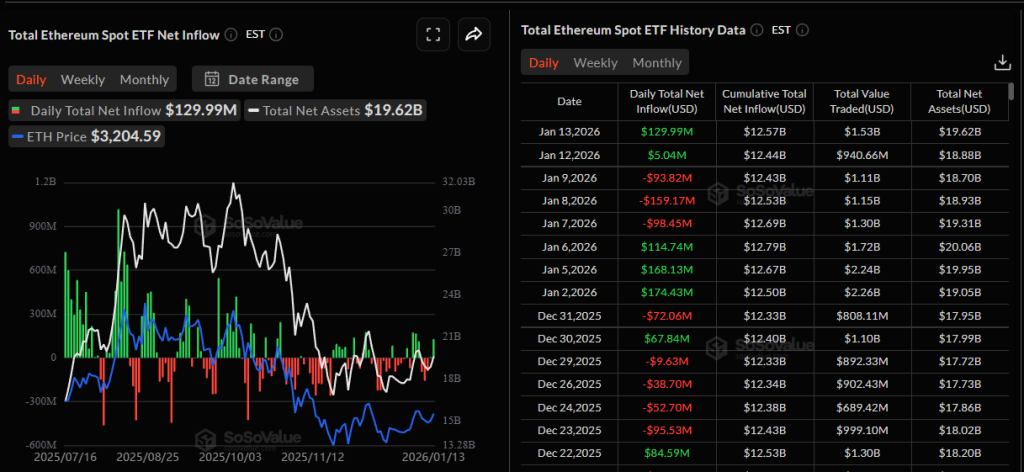
In spot ETF flow data, a net inflow of 66.46 million was recorded across the latest seven trading sessions shown, with the largest daily inflow being logged at 168.13 million and the largest daily outflow being logged at 159.17 million. A three session net of 41.21 million was registered over the final three sessions shown, as a reversal from prior outflows was captured into the period end. Total net assets were marked at 19.62 billion on the latest date shown, and a 18.70 billion to 20.06 billion band was observed across the displayed window, while approximately 9.99 billion in total value traded was summed over those same sessions. Price sensitivity around 3,450 and the 200 day average zone has therefore been framed against improving flow impulse, while any causal linkage should be treated as unconfirmed.
On fundamentals and positioning, an all time high in staked ETH has been reported at roughly 36,000,000 ETH, representing close to 30% of supply, and a continued rise has been treated as the main watch item because liquid float dynamics are altered as staking share rises. Unresolved design risks in decentralized stablecoins have been emphasized by Vitalik Buterin, with benchmark selection, oracle risk, and incentive design around yield and staking being highlighted as persistent constraints, which has kept stablecoin architecture as an active risk variable rather than a settled layer. A network level risk framing has also been warned by a Bank of Italy economist, where a sharp ether price collapse has been described as a potential impairment to Ethereum’s ability to function as settlement infrastructure for financial activity, and an institutional risk management lens has been added to the same token economics already expressed in price and volatility. No additional macro catalysts, including tariffs, policy, China responses, or DXY specific drivers, have been confirmed within the provided inputs for the week, so price, flows, and protocol specific narratives have been treated as the primary verified drivers.
ETF Momentum is Back
ETF flows returned to the foreground as the market moved out of the post-October drawdown and the November to December consolidation and into a phase where regulated demand is re-emerging. U.S. spot Bitcoin ETFs recorded approximately $753.7 million of net inflows on January 13, 2026, described as the strongest single day since October, while Bitcoin advanced from the low $90,000s into the high $90,000s. The signal is not the magnitude of a single print, it is the behavioural shift versus the prior regime, flows cooled materially after October and price reflected that pause through range-bound trade, whereas the mid-January pickup reintroduces a measurable allocation channel.
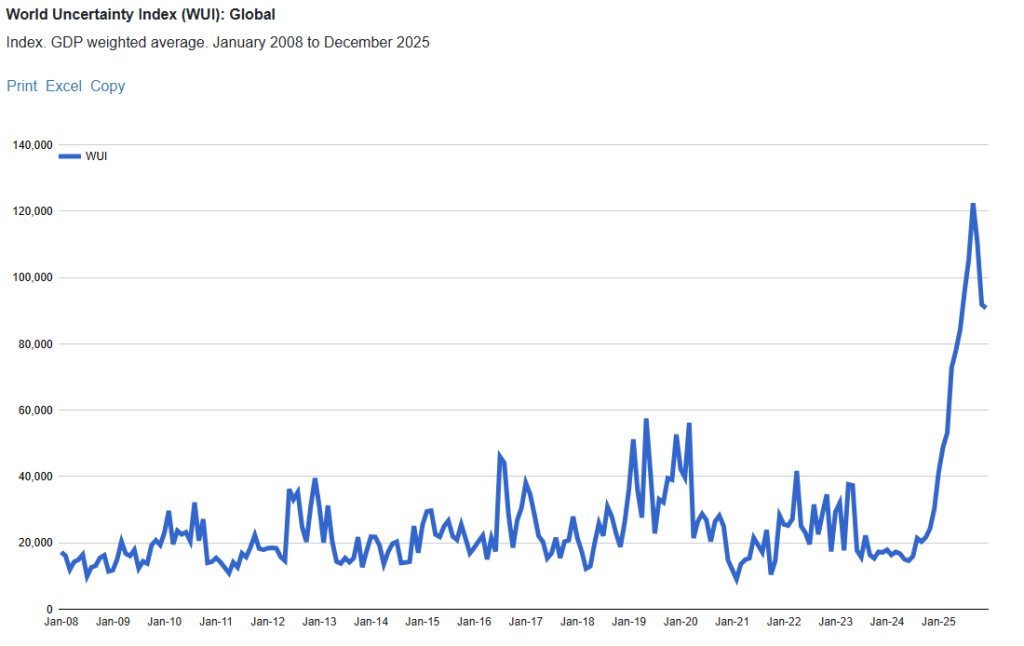
In parallel, the macro and geopolitical backdrop remained uncertainty-heavy. Early January was dominated by concentrated headlines tied to Venezuela and Iran, particularly around energy supply, sanctions enforcement, and regional security. These themes are the types of inputs that tend to be captured in policy-focused uncertainty measures because they increase ambiguity around government actions, trade flows, and inflation sensitivity through energy markets. The objective framing is contextual, uncertainty indices are not designed to assign causality to individual events, but the broader headline environment remained consistent with elevated policy and geopolitical risk.
Source: https://worlduncertaintyindex.com/
When uncertainty is matched to Bitcoin, the comparison is regime-level rather than day-by-day. The World Policy Uncertainty Index (WPUI), Global is a GDP-weighted monthly series constructed by text-mining Economist Intelligence Unit country reports, so it is best used to characterise the underlying policy uncertainty backdrop rather than short-term market moves. A pronounced step-up into 2024 and 2025, followed by partial easing into late 2025, leaving uncertainty structurally elevated relative to most of the 2008 to 2023 period. In that setting, the January reacceleration in ETF inflows and the concurrent price advance are most appropriately interpreted as allocations re-engaging as uncertainty moved off extremes, with persistence in flows remaining the key variable for whether this develops into a sustained allocation phase.
Mark Your Calendars
Economic Data Releases:
- January 23, 2026 (Friday): PCE and Core PCE index
Token Unlock
- January 16, 2026 (Friday): Arbitrum (ARB) unlocks $20.12 M (1.86 % of market cap)
- January 16, 2026 (Friday): DBR (DBR) unlocks $11.03 M (14.81 % of market cap)
- January 17, 2026 (Saturday): TRUMP (TRUMP) unlocks $278.00 M (11.95 % of market cap)
- January 18, 2026 (Sunday): Ondo (ONDO) unlocks $778.11 M (57.23 % of market cap)
- January 20, 2026 (Tuesday): LayerZero (ZRO) unlocks $42.42 M (6.36 % of market cap)
- January 20, 2026 (Tuesday): Plume (PLUME) unlocks $24.20 M (39.75 % of market cap)
- January 22, 2026 (Thursday): MBG (MBG) unlocks $10.08 M (12.13 % of market cap)