
Rate Cut Pause Keeps Macro Sensitivity High as Bitcoin and Ethereum Consolidate
29th January 2026 • 10mins read
This Week’s Recap
- Strategy purchasedUS$264 million in Bitcoin last week: Strategy added 2,932 BTC for aboutUS$264.1 million, at an average price ofUS$90,061 per coin. CoinDesk reported the buy was disclosed alongside Michael Saylor commentary about continued accumulation. The purchase lifted Strategy’s reported Bitcoin holdings further, reinforcing the corporate treasury bid during a volatile macro tape. (CoinDesk)
- BitGo stock jumps in NYSE debut after pricing IPO atUS$18: BitGo priced its IPO atUS$18 per share and traded higher in early NYSE action, per CoinDesk. Reuters reported the deal raised aboutUS$212.8 million and the stock opened atUS$22.43, implying a multi-billion dollar valuation on debut. BitGo trades on the NYSE under ticker BTGO, making this a key public markets signal for crypto infrastructure appetite. (CoinDesk)
- BlackRock files for iShares Bitcoin Premium Income ETF: BlackRock filed an S-1 for a Bitcoin “premium income” product that uses a covered call approach tied to IBIT exposure, according to CoinDesk. The SEC filing describes a portfolio that can include bitcoin, IBIT shares, cash, and written options premiums. The structure targets option premium income, which can reduce upside participation versus a spot-only exposure. (CoinDesk)
- Fidelity is set to launch its stablecoin, Fidelity Digital Dollar (FIDD): Fidelity announced FIDD and said it will be issued by Fidelity Digital Assets, National Association, with availability for retail and institutional users in the coming weeks. CoinDesk reported the token will run on Ethereum and framed it as a major TradFi entry into stablecoin issuance. Fidelity stated FIDD is valued at aUS$1 redemption price and can be purchased and redeemed through Fidelity Digital Assets, subject to eligibility. (Fidelity Digital Assets)
- Citi sounds the alarm on “address poisoning” scams flooding Ethereum: Citi analysts cited patterns consistent with address-poisoning campaigns, where attackers send tiny transfers from lookalike addresses to bait future mistaken sends. CoinDesk reported Citi observed that most new Ethereum transactions in the dataset were underUS$1, a pattern the bank linked to scam behavior enabled by low fees. The report positions the activity spike as potentially scam-driven rather than organic usage growth. (CoinDesk)
- Ethereum upgrade sparks activity spike, but JPMorgan doubts it will last: JPMorgan said Ethereum’s Fusaka upgrade reduced fees and coincided with higher transactions and active addresses. The bank questioned whether the rebound would persist, citing past patterns where post-upgrade activity gains faded. The note frames the move as a short term boost rather than proof of durable demand growth. (CoinDesk)
- Grayscale files for ETF tracking Binance’s BNB token, following VanEck’s bid: Grayscale filed to launch a spot ETF designed to track BNB, the native token of the BNB Chain. The filing positions BNB as a potential next wave of regulated token exposure after bitcoin and ether products. The registration materials describe the trust structure intended to hold BNB and issue shares linked to the token’s value. (CoinDesk)
- Optimism governance approves OP token buyback plan tied to Superchain revenue: The plan directs 50% of net Superchain sequencer revenue toward recurring OP buybacks over a 12 month period. Optimism’s published proposal describes monthly buybacks, with the program framed as a value capture mechanism linked to network economics. The approval gives markets a concrete rule for how a portion of protocol revenue may flow back into OP purchases. (CoinDesk)
- Dogecoin Foundation backed 21Shares DOGE ETF launches on Nasdaq: 21Shares launched a Dogecoin ETF under ticker TDOG, and it began trading on Nasdaq, according to 21Shares and Decrypt. The product is structured to give investors exchange traded exposure while holding DOGE in custody on a 1:1 basis. The launch is a notable expansion of the US spot crypto ETF slate into a memecoin asset. (21Shares)
- SEC to dismiss Gemini Earn lawsuit with prejudice after full investor recovery: The SEC agreed to dismiss its enforcement action against Gemini related to the Earn program, with prejudice, according to The Block and Reuters. Reuters reported the dismissal followed full recovery of investor assets, which came through the Genesis Global Capital bankruptcy process. The outcome closes a high profile US enforcement case tied to yield products offered during the prior cycle. (theblock.co)
- Trump sues JPMorgan and Jamie Dimon forUS$5 billion over alleged “debanking”: The lawsuit alleges JPMorgan closed accounts tied to Donald Trump and his businesses for political reasons after January 2021. JPMorgan said the suit has no merit, and the dispute has become part of a broader US political debate about banks using “reputational risk” to end relationships. (CoinDesk)
- Elliptic says the ruble pegged A7A5 stablecoin surpassedUS$100 billion in transaction volume: Elliptic reported A7A5 has processed overUS$100 billion in aggregate onchain transaction value in under a year, with activity observed across Ethereum and Tron. Elliptic’s write-up describes A7A5 as being used to route flows into USDT markets, and notes that sanctions and exchange controls affected its trajectory. (CoinDesk)
- SEC and CFTC reschedule a joint event on “harmonization” in crypto oversight: The SEC press release sets a public, joint session focused on aligning how the two agencies approach crypto market oversight. The notice includes the event title, time window, and agenda framing it as US “financial leadership” in the crypto era. (SEC)
- UBS explores offering crypto investing to select private banking clients: Reuters reported UBS is assessing crypto investment access for some private banking clients in Switzerland, initially focused on bitcoin and ether. The report said UBS was selecting partners to support the offering, with potential expansion to other regions depending on demand and regulatory conditions. (Reuters)
- Coinbase prediction markets go live in all 50 US states via Kalshi: The Block reported Coinbase expanded access to event contracts nationwide through its partnership with CFTC regulated Kalshi. CoinDesk described the rollout as prediction market access for US customers built on Kalshi’s market infrastructure. (theblock.co)
- Fed leaves rates unchanged at 3.50% to 3.75%: The Federal Reserve held its policy rate steady at 3.50% to 3.75%, citing “somewhat elevated” inflation and a stabilising labour market. Reuters reported the decision followed three straight rate cuts, with two governors dissenting in favour of another cut. The pause reset near term rate cut expectations and kept macro sensitivity high for risk assets, including crypto. (Reuters)
- Illicit crypto flows hit a recordUS$158 billion in 2025, TRM Labs says: A TRM Labs report cited by the Financial Times said illicit crypto transactions reachedUS$158 billion in 2025, up 145% from 2024. The report said illicit activity was about 1.2% of total crypto transaction volume, slightly lower than the prior year’s share. It highlighted sanctions driven activity and nation state usage as key contributors to the rise. (Financial Times)
- UK advertising watchdog bans Coinbase ads as “irresponsible”: The UK’s Advertising Standards Authority banned a set of Coinbase adverts after ruling they trivialised crypto investment risks. CoinDesk reported the regulator said the campaign implied crypto could be a simple response to financial pressures while lacking adequate risk framing. The decision increases compliance pressure on crypto marketing in the UK, especially around risk warnings and messaging tone. (CoinDesk)
- Tether aims to allocate up to 15% of its portfolio to physical gold: Reuters reported Tether’s CEO said the firm plans to allocate 10% to 15% of its investment portfolio to physical gold. The report said Tether holds about 130 metric tons of gold and has been adding to its holdings, with storage in Switzerland. The shift matters for stablecoin reserve optics, as Tether positions gold alongside Treasuries and other reserve assets. (Reuters)
- WisdomTree expands tokenized fund access to Solana: WisdomTree said it is extending its tokenized funds ecosystem to Solana, enabling access through its WisdomTree Connect and WisdomTree Prime platforms. CoinDesk reported the move supports both institutional and retail pathways as part of a multi-chain rollout. The announcement adds another regulated asset manager to the Solana tokenisation stack, alongside broader RWA distribution efforts. (CoinDesk)
Bitcoin Market Analysis
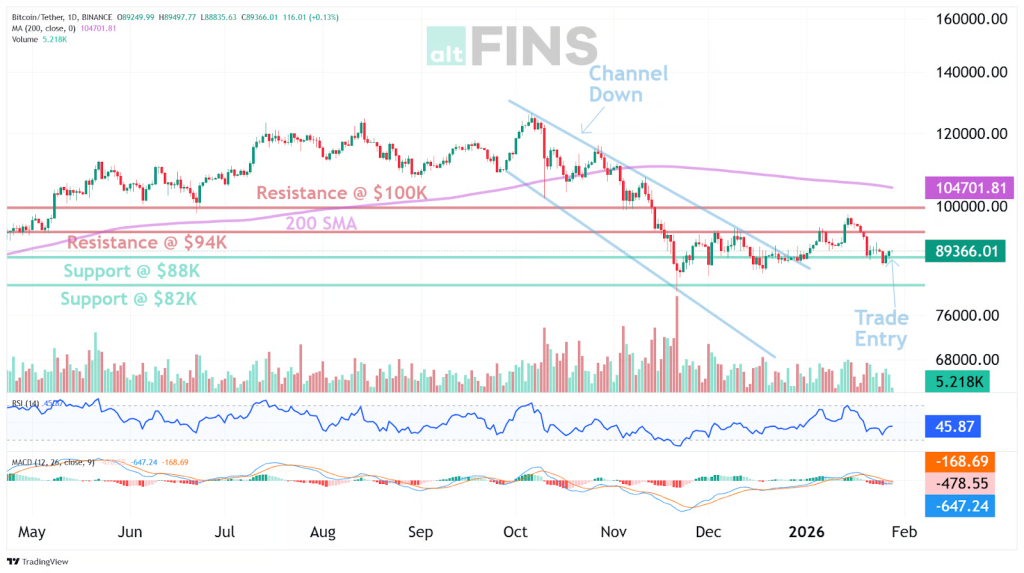
Bitcoin was traded in a narrow net range over the past seven sessions, with daily opens and closes clustered around the highUS$80,000s despite a sharp midweek downdraft. A weekly high ofUS$91,185.7 was printed on January 23, 2026, and a weekly low ofUS$86,092.1 was printed on January 25, 2026, producing a 5,093.6-point range. The period began with an open ofUS$89,433.1 on January 22, 2026, and ended with a close ofUS$89,253.2 on January 28, 2026, for a close to close change of -267.3, or -0.30%. The heaviest single day displacement was registered on January 25, 2026, when a close ofUS$86,642.0 was recorded after anUS$89,254.7 open, and that air pocket was subsequently retraced into theUS$88,000 toUS$90,000 area.
Source: https://altfins.com/crypto-screener/btc-bitcoin
Downtrend conditions were reinforced by the trend stack, with a Strong Down short term trend, a Down medium term trend, and a Strong Down long term trend being registered. Momentum was still marked as bearish, with MACD remaining below its signal line, yet an inflection signal was suggested by rising histogram bars, which has historically been associated with a slowing of downside impulse rather than a confirmed reversal. RSI(14) was held in neutral territory in the mid 40s, and neither overbought nor oversold conditions were indicated under the 30 to 70 convention. Volatility was reflected by an ATR reading of 2,364.63, and price was contained within Bollinger Bands spanningUS$85,328.09 toUS$97,263.12, with no band breaks being flagged. Broad moving average pressure was maintained by declining short and intermediate averages, while the longer horizon context was complicated by an upward sloping 200 day measure nearUS$104,701.81 that remained well above spot, keeping longer term mean reversion distance elevated.
A channel down structure was previously in place and a breakout has been identified as a potential reversal signal, though confirmation has been contingent on sustained acceptance above nearby resistance rather than a single impulse move. Support has been located atUS$88,000, with a secondary support zone identified atUS$82,000, and the polarity framework has been treated as applicable where prior resistance has been converted into support. Resistance has been located atUS$94,000, with a higher resistance band identified atUS$100,000, where prior supply has been concentrated and where a round number effect has historically been observed. A near term advance towardUS$94,000 toUS$100,000 could only be supported by continued defense of 88,000 and by higher daily closes, while downside continuation would be implied if daily closes were registered below 88,000, in which case a move toward 82,000 would be the next mapped zone, and that level would be treated as the next major invalidation line for the pullback buyer thesis.
Source: https://sosovalue.com/assets/etf/us-btc-spot
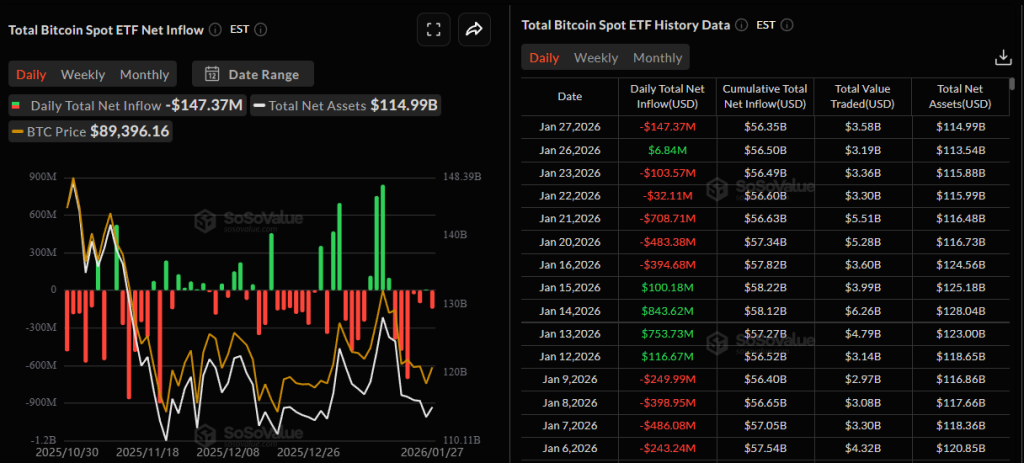
Institutional flow conditions were characterised by net spot ETF outflows across the window that has been captured, with a summed net flow of –US$1.47 billion across the dated sequence shown from January 20 to January 27, 2026. The largest daily outflow was recorded at – US$708.71 million on January 21, 2026, and a negative three day bias was maintained across the most recent three entries shown, with – US$103.57 million on January 23, +US$6.84 million on January 26, and – US$147.37 million on January 27, for a net – US$244.10 million. Cumulative net inflows were reduced from US$57.34 billion to US$56.35 billion across that sequence, and total net assets were reduced from 116.73 billion to 114.99 billion, while total value traded summed to US$24.22 billion for the dated set. A mixed tape was therefore implied, where price stabilization near support was being attempted while marginal spot ETF demand was being withdrawn on net.
A corporate treasury bid was reinforced by the disclosure that 2,932 BTC were added for about US$264.1 million at an average price of US$90,061, and additional institutional productisation was signaled by an S-1 filing for an income ETF structure using a covered call overlay tied to IBIT exposure. Public markets appetite for crypto infrastructure was also highlighted by the NYSE debut of BitGo after an IPO priced at US$18, with an opening print at US$22.43 and proceeds of about US$212.8 million being reported, and these developments were treated as consistent with continued institutional engagement even while spot ETF outflows were being registered.
Ethereum Market Analysis
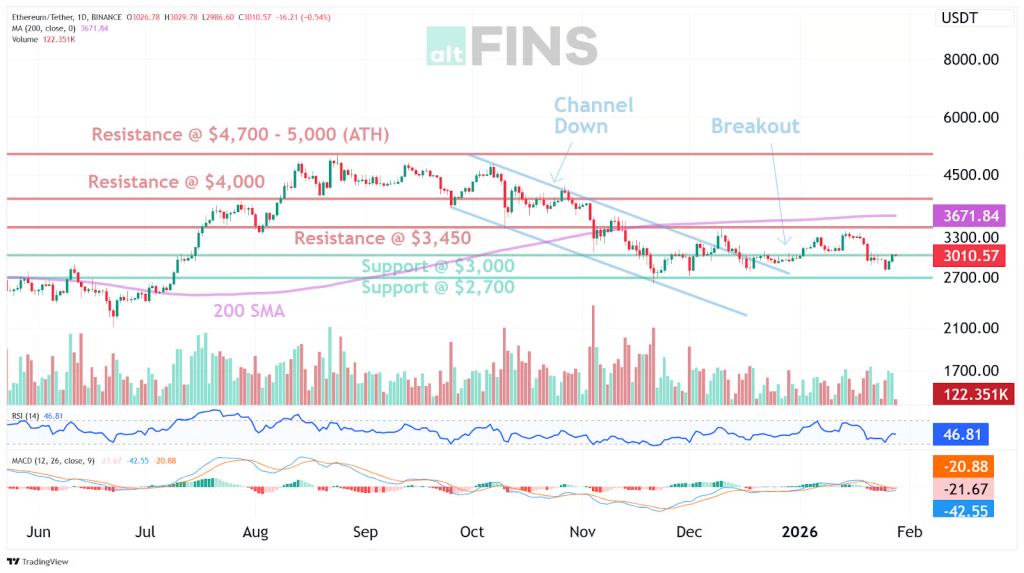
Over the past week, ETH was last observed around the US$3,000 handle, with a weekly performance of about 0.38% having been recorded. A seven day high of US$3,044.94 and a seven day low of US$2,982.59 were reported, which defined a tight range around a psychologically important round level. The latest daily candle values provided were O US$3,026.78, H US$3,029.78, L US$2,986.60, C US$3,010.57, which placed the close marginally above the US$3,000 area after an intraday dip below it. From this tape, consolidation was indicated rather than trend extension, since both extremes were left intact and repeated interactions were kept inside the same band. Range resolution was therefore left unconfirmed, because a decisive close outside the seven day extremes was not provided.
Source: https://altfins.com/crypto-screener/btc-bitcoin
Trend and momentum conditions were reported as weak, with short, medium, and long trend labels having been marked as strong down. RSI-14 was at 46.81, and MACD values were reported with the line below the signal, alongside a histogram value of -20.88, while ATR at 122.03. Bollinger Bands at US$2,767.23 on the lower band and US$3,426.56 on the upper band, and the 200 day simple moving average near US$3,671.84. With RSI held in the neutral zone and MACD remaining in a bearish configuration, downside pressure was indicated, while any improvement in the histogram was best treated as deceleration rather than reversal confirmation. With ATR near 122, daily risk was implied to be material relative to the current range, so follow through was required before directional conviction could be justified.
Key levels were defined by a resistance zone at US$3,450 and a broader overhead supply region tied to the 200 day average near US$3,600, with a higher resistance reference at US$4,000. Support was defined as a US$2,700 to US$3,000 demand zone, with the nearest support emphasis placed at 2,700 and invalidation defined at 2,580. This framework was supported by the repeated defence and retest behaviour seen around US$3,000, alongside the clear separation from the 3,450 to 3,600 overhead band. A constructive transition case was supported only if a reclaim and hold above 3,450 was achieved on a closing basis, while a continuation case was supported if acceptance below 2,700 was established. A hard risk boundary was therefore maintained at 2,580, because a break and hold below that level would invalidate the stated pullback buy structure
Source: https://sosovalue.com/assets/etf/us-eth-spot
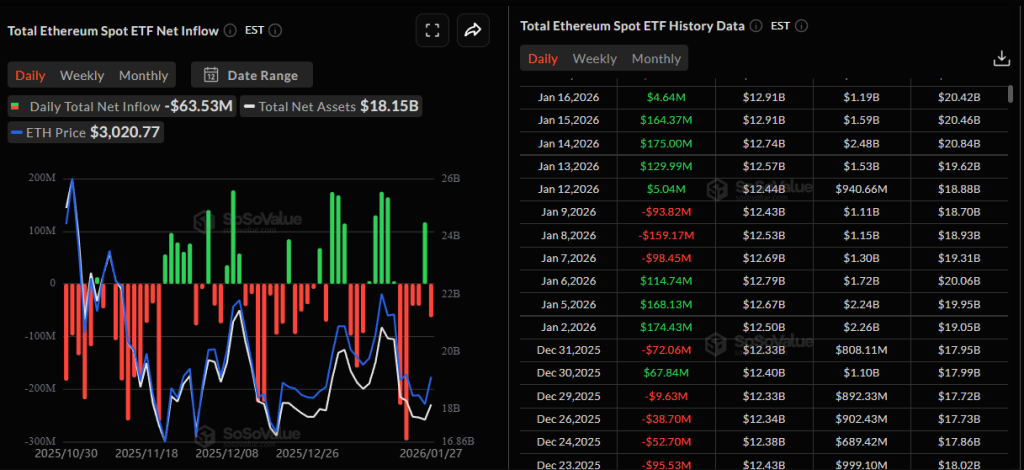
ETF flow conditions over the most recent seven sessions provided were recorded as a net outflow of approximately US$553.08 million. The largest single day outflow in that window was recorded as – US$297.51 million, and the largest single day inflow was recorded as + US$116.99 million, with total net assets last reported atUS$18.15 billion and cumulative total net inflow last reported at US$12.36 billion. Over the most recent three sessions shown, flows were recorded as – US$41.74 million, +US$116.99 million, and – US$63.53 million, which summed to a modest net inflow of about US$11.72 million across those three observations. From these facts, positioning was characterised as choppy and headline sensitive, with persistent net outflow pressure across the broader window having been only partially interrupted by a single strong inflow day. A durable improvement signal was therefore not established by the flow set alone, since persistence, not isolated reversals, was required.
Several narrative drivers were reported as relevant to Ethereum’s near term backdrop. A dollar stablecoin initiative branded as Fidelity Digital Dollar was announced as being issued by Fidelity Digital Assets, National Association, with a US$1 redemption framework and Ethereum deployment having been described, which was consistent with continued traditional finance experimentation on Ethereum rails, as set out in FIDD terms. Address poisoning activity was flagged by bank analysts as a potential driver of elevated low value transactions, so activity spikes were not allowed to be treated as clean demand signals without further decomposition, as outlined in the Citi warning. Post upgrade fee reductions and coincident activity increases were also described, while durability was questioned by another bank, so the activity uplift was not allowed to be treated as structurally permanent without persistence evidence, as captured in the JPMorgan note. Macro drivers such as tariffs, policy, China responses, and DXY moves were not provided in a verifiable, specific form within the available inputs, so those links were left uncertain and were not asserted beyond the general risk sensitivity already embedded in the flow and volatility backdrop.
January Rate Cut
The Fed holding the target range at 3.50% to 3.75% is a pause after action, not a reversal, and Powell’s framing in his opening remarks makes that clear. He described inflation as “somewhat elevated,” the labour market as showing signs of stabilisation, and the economy as entering 2026 on a firm footing. He also anchored the decision in context, noting the committee had already lowered the policy rate by 75 basis points over the prior three meetings, and is now positioned to judge the timing of any further adjustments based on data.
The details matter because they show what the Fed is watching, not just what it did. Powell highlighted resilient consumer spending and continued business investment, while housing remained weak, and he noted the temporary federal government shutdown likely weighed on activity and could reverse as conditions normalise. On labour, he cited 4.4% unemployment in December and low job gains, including an average decline in total payrolls over the past three months alongside gains in private payrolls, which he linked to both demand and slower labour force growth. On inflation, he cited estimated 12 month PCE inflation of 2.9% and core PCE of 3.0% through December, and said elevated readings largely reflect goods inflation boosted by tariffs, while services disinflation appears to be continuing.
The market signal is less the hold itself and more the path becoming conditional, reinforced by a split decision and a message that the Fed is not rushing. Reuters’ account of the 10-2 vote and the pushback in near term cut expectations matters because it raises the importance of each inflation and labour release as a gating input. Put simply, Powell’s line that the Fed is not in a hurry to cut further keeps macro sensitivity high, because the next move depends on evidence that inflation is cooling fast enough without labour conditions deteriorating.
Mark Your Calendars
Economic Data Releases:
- February 6, 2026 (Friday): U.S. employment report and U.S. employment Rate
Token Unlock
- January 31, 2026 (Saturday): SUI (SUI) unlocksUS$60.94 M (1.15 % of market cap)
- February 1, 2026 (Sunday): EIGEN (EIGEN) unlocksUS$12.25 M (8.88 % of market cap)
- February 4, 2026 (Wednesday): XDC (XDC) unlocksUS$32.45 M (5.00 % of market cap)
- February 5, 2026 (Thursday): ENA (ENA) unlocksUS$29.67 M (2.31 % of market cap)
- February 5, 2026 (Thursday): HYPE (HYPE) unlocksUS$336.27 M (2.79 % of market cap)
- February 6, 2026 (Friday): BERA (BERA) unlocksUS$38.85 M (41.70 % of market cap)