
Bitcoin Accumulation During Tension
12th March 2026 • 9mins read
This Week’s Recap
- Strategy buys another 17,994 BTC for $1.3 billion, bringing total holdings to 738,731 BTC: Another 17,994 BTC was disclosed as having been purchased for about $1.28 billion, bringing Strategy’s total bitcoin holdings to 738,731 BTC. The accumulation was said to have been financed through recent capital raises, further expanding the company’s lead among publicly disclosed corporate bitcoin holders.
- Kraken secures a Federal Reserve master account for its Wyoming-chartered bank: A Federal Reserve master account was granted to Kraken Financial, the company’s Wyoming-chartered bank, giving it direct access to the central bank’s payment infrastructure. The approval was described as the first such access extended to a digital asset bank in the United States.
- Trump formally nominates pro-Bitcoin Kevin Warsh to lead the Federal Reserve: Kevin Warsh was formally nominated by President Donald Trump to serve as the next chair of the Federal Reserve when Jerome Powell’s term ends. The nomination was sent to the Senate on March 4, 2026, and a confirmation fight was reported to be taking shape almost immediately.
- Bitcoin’s mined supply hits 20 million, leaving fewer than 1 million BTC left to be issued: Bitcoin’s circulating mined supply was reported to have crossed the 20 million mark, leaving fewer than 1 million BTC still to be created under the network’s fixed issuance schedule. More than 95% of the total 21 million supply was therefore described as already having entered circulation.
- Nasdaq partners with Kraken parent to link tokenized equities to blockchain rails: A partnership was announced between Nasdaq and Payward, Kraken’s parent company, to build infrastructure connecting tokenized equities with blockchain-based markets. A gateway for moving tokenized shares between regulated venues and onchain rails was said to be part of a broader push toward round-the-clock securities trading.
- Strike secures New York BitLicense: A BitLicense and Money Transmitter License were granted to Strike by the New York State Department of Financial Services, clearing the company to expand its bitcoin services in the state. Access to buying, selling, recurring purchases, and bitcoin-linked payments was said to have been opened to New York residents through the approval.
- Core Scientific secures up to $1 billion loan facility from Morgan Stanley: A financing facility of up to $1 billion was secured by Core Scientific from Morgan Stanley, with an initial $500 million closing already completed. The capital was said to be intended for growth initiatives, refinancing flexibility, and the company’s broader expansion across digital infrastructure.
- Vitalik Buterin introduces DVT-Lite to simplify institutional Ethereum staking: A simplified validator model called DVT-Lite was presented by Vitalik Buterin as a way to reduce the technical complexity of distributed Ethereum staking. Broader institutional participation was described as more achievable under the approach, with the Ethereum Foundation already reported to be using the design in its own staking setup.
- Bitmine lifts its Ethereum treasury to 4.53 million ETH: Ethereum holdings were raised by Bitmine to 4,534,563 ETH, giving the company one of the largest known corporate ether treasuries in the market. The position was said to represent about 3.76% of total ETH supply, with more than 3 million ETH also reported as staked.
- Ethereum ETF flows continue to lag BTC, reinforcing a clear institutional demand gap: Ether ETF demand was described as continuing to trail bitcoin by a wide margin, with heavier and more persistent outflows reported across recent months. A weaker institutional bid for ETH was therefore presented as one of the clearest signals in the current crypto allocation split.
- First U.S. spot Polkadot ETF launches, issued by 21Shares: The first U.S. spot Polkadot ETF was launched by 21Shares under the ticker TDOT, adding another single asset crypto fund to the American market. Broader regulated access to DOT exposure was said to have been created through the listing without requiring direct token custody.
- Solana spot ETFs surpass $1 billion milestone in inflows: Spot Solana ETFs were reported to have drawn more than $1 billion in cumulative inflows, despite a steep decline in SOL’s market price since launch. Institutional interest was nevertheless described as having remained unusually strong relative to the asset’s size and broader market conditions.
- Bitwise XRP ETF becomes the largest XRP ETF in America with $289 million in assets: Bitwise’s XRP ETF was reported to have become the largest XRP fund in the United States after assets climbed to about $289 million. Leadership in the category was said to have been secured as fresh inflows lifted the fund ahead of domestic rivals.
- Goldman Sachs emerges as the top disclosed XRP ETF holder: Goldman Sachs was identified in regulatory filings as the largest disclosed holder of spot XRP ETFs, with positions spread across several issuers. A deeper level of traditional finance participation in the XRP ETF market was thus seen as having been signaled by the disclosure.
- Western Union teams with Crossmint to support stablecoin payouts on Solana: A partnership was announced between Western Union and Crossmint to support USDPT, a Solana-based stablecoin tied to the company’s new Digital Asset Network. Stablecoin transfers were said to be linked with Western Union’s global payout network, allowing digital dollars to be converted into local cash through hundreds of thousands of locations.
- SocGen-FORGE deploys its MiCA-compliant EURCV stablecoin on Stellar: EUR CoinVertible, the MiCA-compliant euro stablecoin issued by SocGen-FORGE, was deployed on Stellar as part of a wider multichain expansion strategy. Broader access to tokenized euro payments and digital asset settlement was said to have been targeted through the move.
- Jito Foundation acquires SolanaFloor: SolanaFloor was acquired by the Jito Foundation after the platform was shut down following a security incident tied to its parent organization. A relaunch under new ownership was said to be planned, with ecosystem data and media coverage expected to be restored.
- Zcash Open Development Lab raises $25 million: More than $25 million in seed funding was raised by Zcash Open Development Lab to support protocol development and privacy-focused wallet infrastructure. The round was presented as a major backing event for the Zcash ecosystem after the formation of the new development entity.
- Cardano payments roll out across 137 SPAR stores in Switzerland: ADA payments were enabled across 137 SPAR supermarkets in Switzerland through an integration with DFX.swiss and its Open Crypto Pay system. Grocery purchases were said to be processable directly from native Cardano wallets, marking one of the network’s clearest retail payment deployments to date.
- SEC submits framework to the White House on applying securities laws to crypto: An interpretive framework was submitted by the SEC to the White House outlining how existing federal securities laws could be applied to digital assets and related transactions. A token classification approach was reported to be central to the document, with clearer jurisdictional boundaries said to be under review.
- SEC and CFTC signal deeper cooperation through joint crypto oversight: Deeper coordination on crypto oversight was signaled by the SEC and CFTC through planned joint meetings on product applications and a shared process for coordinated engagement. A more unified regulatory path for firms operating across both agencies’ jurisdictions was described as the goal of the effort.
- Pakistan’s parliament passes the Virtual Assets Act of 2026: The Virtual Assets Act of 2026 was passed by Pakistan’s parliament, with formal authority granted to the Pakistan Virtual Assets Regulatory Authority to license and supervise the sector. Stronger anti money laundering controls and clearer oversight of service providers were said to be established under the law.
- Florida passes a state-level stablecoin bill: A state level regulatory framework for stablecoins was approved by Florida lawmakers, making the state one of the first in the country to move ahead with dedicated oversight. Licensing, consumer safeguards, and alignment with emerging federal standards were said to be built into the measure.
- FDIC clarifies that stablecoins will not receive deposit insurance: Payment stablecoins were clarified by the FDIC as not being eligible for federal deposit insurance under the GENIUS Act framework. Proposed rulemaking was said to be planned so that tokenized deposits and stablecoins would be treated differently for insurance purposes.
Bitcoin Market Analysis
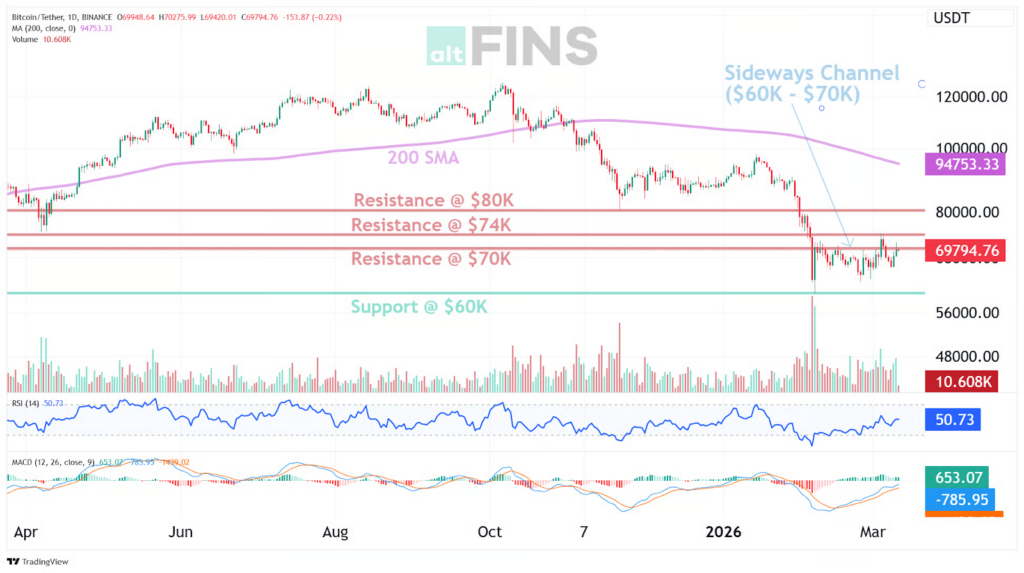
Bitcoin was carried through a volatile but contained week, with trade held inside a broad recovery band after a sharp washout into the lower end of the recent range had been absorbed. The weekly high was set at $71,777 on March 10, while the weekly low was set at $65,622 on March 8. A rebound from the lower boundary was therefore established, but acceptance above $70,000 was not secured, and the week was left defined by repeated hesitation just below range resistance.
Source: https://altfins.com/technical-analysis
The technical structure remained mixed, but some improvement was seen beneath the surface. A sideways channel between $60,000 and $70,000 was preserved, while the broader medium term and long term trend was still held as down. Momentum was modestly improved, as a bullish MACD crossover remained in place and RSI stayed near neutral, with no overbought or oversold signal being given. Bollinger bands were placed near $63,793 on the lower side and $72,095 on the upper side, while ATR near $3,343 suggested that volatility was elevated but still orderly. Shorter moving averages had begun to firm, while most medium and longer moving averages were still sloping lower. A developing base could therefore be argued, but a confirmed reversal could not yet be established.
The level structure stayed clean and actionable. Support continued to be anchored at $60,000, and that zone remained the principal invalidation area for any constructive swing view. Resistance stayed concentrated at $70,000 first, then $74,000, with a broader overhead cap near $80,000. As long as price remained trapped inside the channel, a neutral range regime had to be respected. If a retreat toward $60,000 were to be seen, a more attractive risk reward profile would likely be restored for a return toward the top of the band. If acceptance above $70,000 were to be secured, a move toward $74,000 would become the next clear expectation. If $60,000 were to fail on a closing basis, the present base building case would be materially weakened.
Source: https://sosovalue.com/assets/etf/us-btc-spot
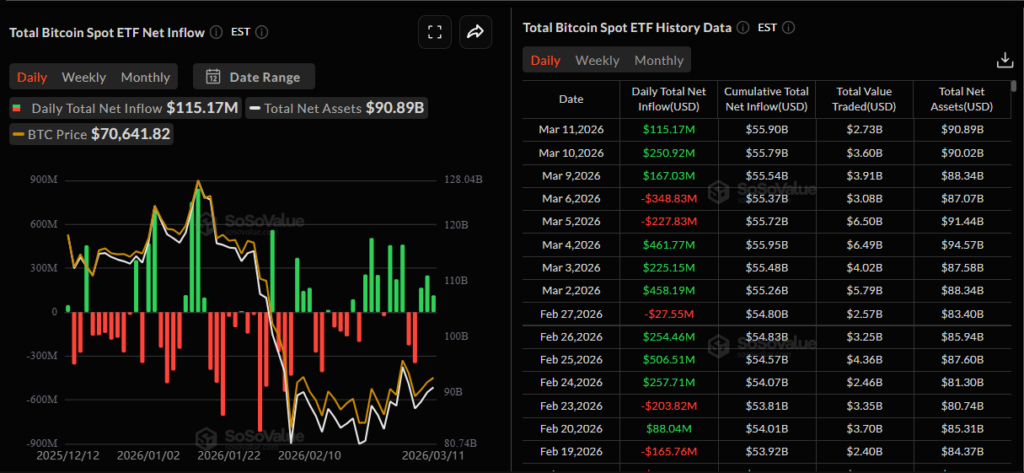
Spot Bitcoin ETF demand remained supportive on balance, though it was not delivered in a straight line. Net inflows of $225.15 million were recorded on March 3, $461.77 million on March 4, then outflows of $227.83 million and $348.83 million were posted on March 5 and March 6 before demand recovered with inflows of $167.03 million on March 9, $250.92 million on March 10, and $115.17 million on March 11. Across those seven trading days, net inflows of about $643.38 million were accumulated, while the latest three day run added about $533.12 million. The strongest daily addition was seen on March 4, while the heaviest withdrawal was seen on March 6. Total net assets were shown near $90.89 billion by March 11. Institutional demand was therefore still being expressed, but selectively, which fit the present structure well: support was being supplied beneath Bitcoin, but full trend confirmation was still absent.
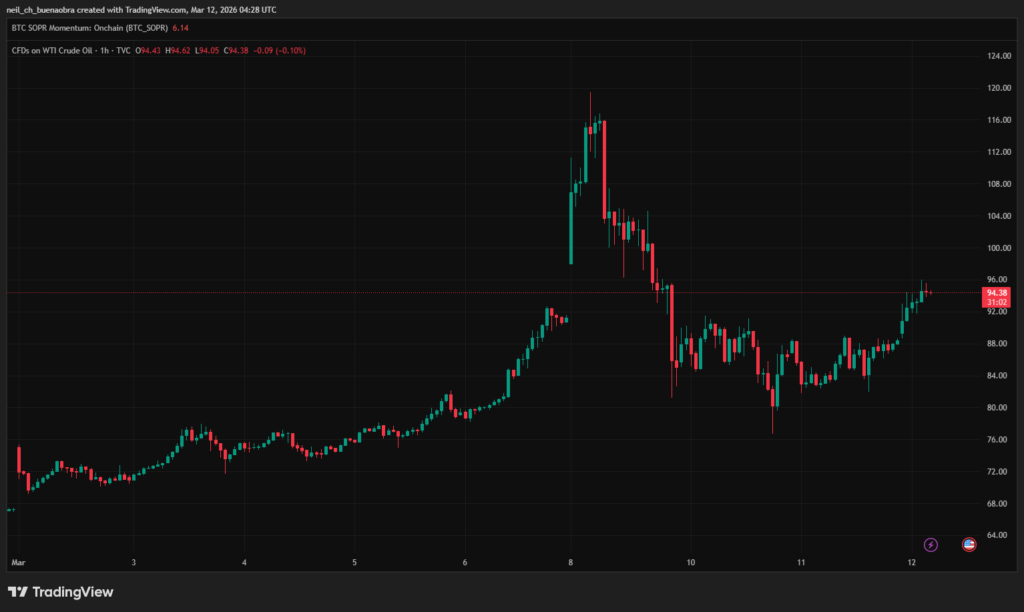
The broader backdrop remained unsettled. Oil was first pushed sharply higher by Gulf tensions, then briefly softened, and was lifted again as shipping risk returned and the dollar firmed on renewed inflation concern. That combination mattered because Bitcoin was not being repriced in isolation. It was being carried inside a market still sensitive to energy shocks, dollar strength, and policy uncertainty. The rebound from the weekly low into the $70,000 area was therefore notable not because strength was dominant, but because resilience was preserved while macro conditions remained difficult. A neutral range with a constructive undertone was the cleaner reading than a full trend reversal.
WTI Crude Oil Price Action, March 2026
Source: https://www.tradingview.com/chart/
The news flow was supportive in tone, even if immediate price confirmation was still incomplete. Strategy buying was disclosed at 17,994 BTC for about $1.28 billion, lifting total holdings to 738,731 BTC and reinforcing the corporate accumulation theme. Fed access was granted to Kraken Financial’s Wyoming-chartered bank, a step that deepened crypto’s connection to core payment rails. A formal Warsh nomination was sent to the Senate, which kept policy expectations in view at a time when rate sensitivity remained high. The 20 million mined milestone was also crossed, leaving fewer than 1 million BTC still to be issued, which strengthened the scarcity case without changing near term trading mechanics. Taken together, those drivers favored the view that a floor may be in the process of being built, but the chart still required a sustained move above $70,000 before that stronger narrative could be fully expressed in price
Ethereum Market Analysis
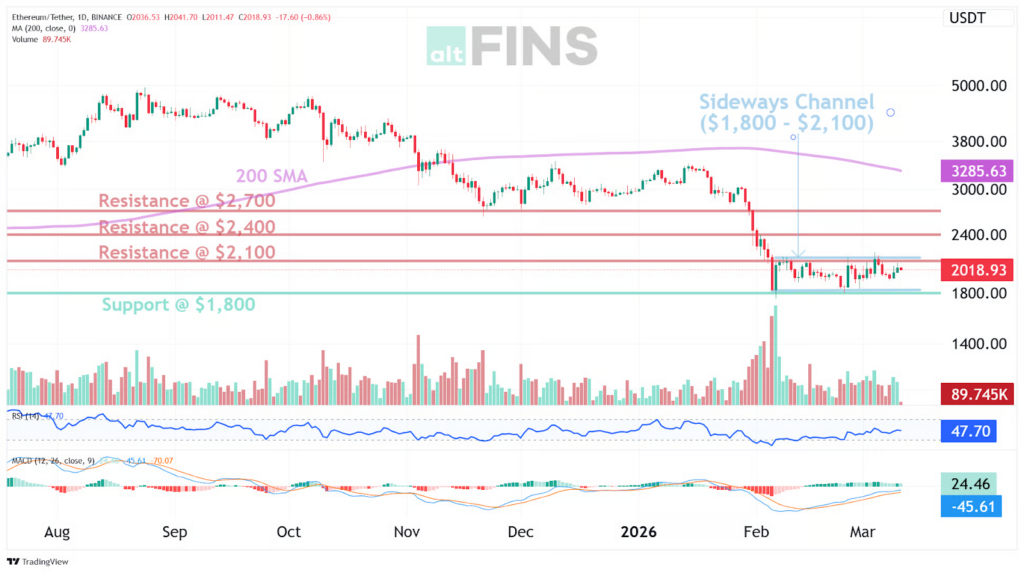
Ethereum was opened near $2,073 on March 6 and was marked near $2,044 by March 12, leaving a modest weekly decline after a volatile path through the range. A weekly high near $2,093 and a weekly low near $1,918 were set, and a sharp drop into early March was followed by a partial recovery into the middle of the week before softer trade returned. A rebound was therefore preserved, but a trend reversal was not. The week was defined less by directional strength than by repeated rotation inside a contained band.
Source: https://altfins.com/technical-analysis
That behavior was reinforced by the technical structure. A sideways channel between $1,800 and $2,100 was maintained, with price held close to the upper half of the band but not yet accepted above resistance. RSI remained neutral, with RSI 14 near 49, and no overbought or oversold condition was established. MACD remained constructive, with a bullish crossover still in place, but that signal was set against a broader downtrend across the medium and long horizons. ATR near 125 indicated that a meaningful expansion in range would likely follow any confirmed break, while Bollinger Bands near $1,853 and $2,125 showed that compression had tightened around the current market. Near term moving averages were mixed, but the deeper stack remained weak, which left the short term stabilization intact while the higher time frame damage stayed unresolved.
The important levels were kept clear. Immediate support was established near $2,000, with major structural support near $1,800. Immediate resistance was established near $2,100, followed by a more consequential barrier near $2,400, and heavier long term overhead pressure remained far above near the 200 day average. So long as price was contained between $1,800 and $2,100, indecision was being signaled. A break above $2,100 would improve the recovery structure and would expose $2,400 as the next relevant upside test. A break below $1,800 would invalidate the range thesis and would restore the primary downtrend as the dominant framework. The bearish case would, in turn, be weakened by sustained acceptance above $2,100 and would be materially challenged by a move through $2,400.
On present evidence, a neutral to bearish expectation was warranted. The channel itself was neutral, but channels formed inside established downtrends are often resolved in the direction of the prior move. That risk was not removed by the recent bounce. Momentum had improved, and a short covering extension could still be produced if $2,100 were reclaimed, yet the broader structure had not been repaired. Until a confirmed break was delivered, range behavior was more defensible than trend conviction. Any stronger directional claim would not be justified by the present structure.
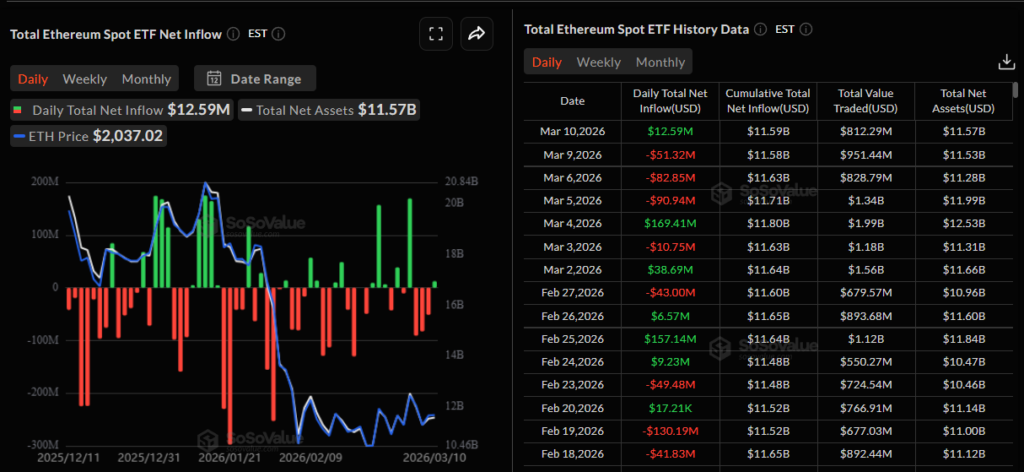
Source: https://sosovalue.com/assets/etf/us-eth-spot
Institutional flow did not materially improve that picture. Over the visible seven day window, spot ETH ETF flows remained slightly negative in aggregate, despite a strong inflow day of $169.41 million on March 4. The latest three day sequence also remained net negative, which implied that demand had not yet been rebuilt on a sustained basis. Total net assets near $11.57 billion remained substantial, but the flow profile stayed uneven and was not yet aligned with a durable breakout case. A move through $2,100 would therefore be better trusted if accompanied by several consecutive inflow days, while a loss of $1,800 would be made more credible if outflows were resumed and net assets were softened further.
The broader narrative stayed mixed. A DVT-lite push strengthened the long term staking case by lowering operational complexity around validator setup, and a Bitmine buildup added a conspicuously bullish treasury signal through the expansion of a very large corporate ETH position. Those developments supported the structural case for Ethereum, but they did not offset the near term demand shortfall implied by the ETF gap, where ETH allocation remained far behind bitcoin in regulated fund demand. A firmer dollar, elevated oil, and unstable trade policy were also present in the macro background, and a direct weekly impact on ETH could not be isolated with confidence, though broader risk appetite was plainly restrained.
Demystifying Bitcoin’s Move Despite Tension
Bitcoin has been reacting more to changes in fear than to the fact that tension exists. When the situation has looked like it could get worse, oil has been reported to jump hard, and bitcoin has been reported to drop at the same time, including a move toward $66,000 on a day when oil was described as surging toward $120. That pairing has been used to make a simple point, bitcoin has not acted like a perfect “war safe place” during the shock moments. It has tended to sag when the mood turns sharply negative, then recover when the panic slows down.
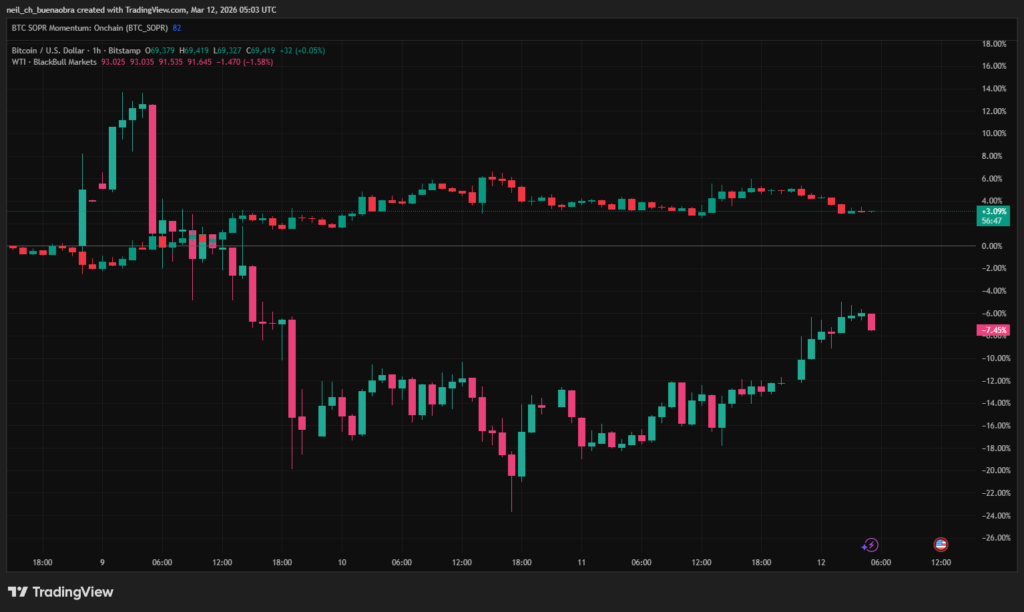
Bitcoin and Oil Price Action
Source: https://www.tradingview.com/
The bounces have made more sense when the fear has cooled, even a little. When oil has stopped climbing or has pulled back, and when the US dollar has eased after being strong, bitcoin has been reported to rebound back toward $70,000. The conflict has still been there, but the market’s guess about what happens next has shifted from “this could explode” to “maybe the worst case is less likely today.” That small change in expectations has often been enough to lift bitcoin for a stretch.
Another part of the story has been steady buying that shows up even during ugly weeks. Strategy’s purchase of 17,994 BTC for about $1.28 billion has been pointed to as an example of demand that can soak up selling when headlines are rough. It has not meant that one buyer controls the market, but it has helped explain why dips have been met with support instead of turning into a long slide. When that kind of demand sits under price, rebounds can feel stronger than people expect.
The “why is it going up right now” feeling has also been explained by timing and crowded bets. When many people expect a drop, the market can become one sided, and once selling slows, a bounce can pick up speed as those bearish bets get closed and sidelined buyers step in. That can make a move look like confidence, even if it is mostly a reset after fear. So the clean takeaway has been this, bitcoin has been pushed down on shock days when oil fear spikes, then pulled back up on relief days when fear cools, with steady demand helping the rebounds stick.
Mark Your Calendars
Economic Data Releases:
- March 18, 2026 (Wednesday): FOMC interest-rate decision
- March 18, 2026 (Wednesday): Fed Chair Powell press conference
Token Unlock
- March 12, 2026 (Thursday): APT (APT) unlocks $10.67 M (0.69 % of market cap)
- March 13, 2026 (Friday): WBT (WBT) unlocks $4.52 B (27.77 % of market cap)
- March 15, 2026 (Sunday): CONX (CONX) unlocks $15.38 M (1.54 % of market cap)
- March 20, 2026 (Friday): ZRO (ZRO) unlocks $54.24 M (5.64 % of market cap)