Treasury Buybacks Ignite a Bitcoin Short Squeeze
20th August 2026 • 9 mins read
This Week’s Recap
- Bitcoin surged past $68,000, liquidating $1.4 billion in short positions: The Treasury said it would at least double the size of its long-bond buybacks, from $2 billion to $4 billion per operation in the 10-to-20-year and 20-to-30-year sectors. Falling long yields cut the opportunity cost of holding non-yielding assets, and traders positioned for more range-bound trading were forced to cover fast.
- Ripple’s prime brokerage arm raised $275 million in its debut bond sale: The senior unsecured notes carry an 8.25% coupon and a BBB rating from KBRA, an investment-grade label rare among crypto prime brokers. The raise takes Ripple Prime’s debt financing to $475 million in three months as it expands US clearing and financing services.
- HSBC and Standard Chartered completed the first live transaction on Swift’s blockchain-based ledger: The pilot connects each bank’s own tokenized-deposit system through a shared ledger that matches and nets obligations before settling through existing payment rails. Seventeen banks across six continents are testing the setup, aimed at 24/7 cross-border payments without replacing current regulatory oversight.
- FASB proposed letting certain stablecoins count as cash equivalents: The draft standard does not redefine cash equivalents; it adds examples showing when a dollar-pegged token qualifies, provided its liquid reserves match circulating tokens and can be redeemed for dollars on demand. Comments are open until November 19 before FASB sets an effective date.
- A chain of six software bugs let an attacker drain Maya Protocol’s MAYAChain pools: A distorted liquidity pool let the attacker withdraw 48.87 million CACAO tokens after depositing almost nothing, then swap them for Bitcoin, Ether, and other assets sitting in the protocol’s pools. CACAO’s price collapsed nearly 89% in the process, turning a roughly $1.7 million direct theft into an $11 million hit to the protocol.
- Bybit said AI tools helped block more than $700 million in potential losses: The exchange’s systems scanned roughly 1,500 assets and flagged over 100,000 alerts, stopping more than 30,000 suspicious withdrawals in the first half of 2026. The disclosure comes a year after Bybit lost $1.46 billion to North Korea’s Lazarus Group, the largest crypto exchange hack on record.
- Ethena and FalconX launched a $1 billion facility to diversify USDe’s backing: The special-purpose vehicle deploys assets behind the stablecoin into overcollateralized institutional loans for trading, treasury management, and payments. It gives Ethena a return source outside perpetual-futures funding rates, which can compress or flip negative whenever leveraged crypto demand cools.
- China’s central bank tripled its digital yuan operator roster this year: The PBOC approved eight more lenders this week, including Ping An Bank and five city commercial banks, taking the total from 10 at the start of 2026 to 30 now. None of the new entrants will switch on customer-facing e-CNY services immediately; they still need to finish technical preparations.
- Cantor Fitzgerald opened institutional block trading in Kalshi’s prediction markets: The bank is acting as an introducing broker for roughly 3,000 institutional clients, letting them negotiate large event-contract trades at a single price away from Kalshi’s central order book, with Susquehanna providing liquidity. It is one of the first full-service investment banks to offer that access on a CFTC-regulated exchange.
- Injective received SEC registration as a transfer agent for tokenized securities: The registration lets an Injective-affiliated entity maintain ownership records for tokenized real-world assets with the same legal standing as Computershare or Broadridge. Paired with its Injective Mint issuance platform, it is designed to reconcile onchain transactions with the authoritative ownership database that securities law still requires.
- National Bank of Canada disclosed $6.4 million spread across four Bitcoin ETFs: The largest position was $5.31 million in the ProShares Bitcoin ETF, with smaller stakes in Fidelity’s, Grayscale’s, and Grayscale’s Mini Bitcoin Trust. A separate $330,000 position in Bitwise’s XRP ETF rounded out the Canadian lender’s crypto exposure as of the June 30 filing date.
- BNB Chain’s BEP-675 proposal cut validator execution time from 125 milliseconds to 15: The change lets block builders submit fully executed blocks directly instead of forcing validators to re-execute the same transactions, lifting testnet throughput 88% to 2,324 transactions per second. The mainnet’s Pasteur hard fork is scheduled for August 25 and is expected to include the upgrade.
- Nexo launched regulated crypto-backed credit lines in Australia: Clients can borrow Australian dollars or stablecoins against their crypto holdings at rates from 0.9% to 21.9%, with funds available within 24 hours and no fixed term. Nexo is registered with AUSTRAC as a virtual asset service provider, one of the few platforms offering regulated crypto-backed lending in the country.
- A separate technical read puts Bitcoin’s next target as high as $76,000: The setup depends on Bitcoin clearing the $70,000 zone that lines up with its 200-day moving average, the more immediate resistance test in the current chart read. RSI readings above 90 on short timeframes suggest a pause is just as likely as an immediate continuation.
Bitcoin Market Analysis
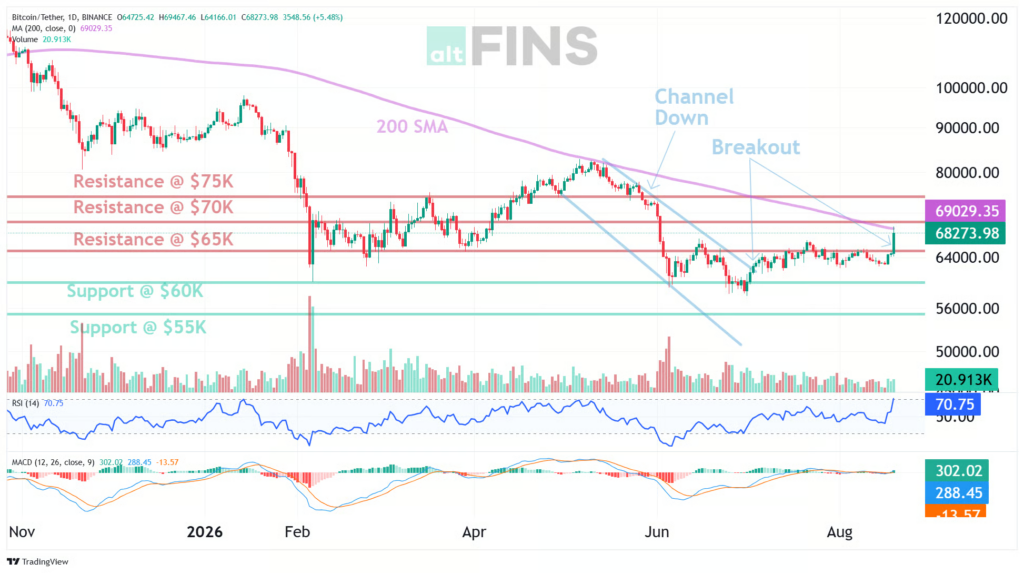
Bitcoin opened the seven-day window at $63,491 on August 14 and traded near $69,696 early Thursday, a 9.77% gain. The week stayed calm before it wasn’t: daily moves stayed under 3% through Tuesday, then Wednesday alone added 7.12% and pushed the session close to $69,335 after an intraday spike to $70,000. Thursday’s still-open candle has added another 0.52%.
Source: https://altfins.com/technical-analysis
The Treasury said it would at least double the size of its long-bond buybacks, raising the maximum operation size in the 10-to-20-year and 20-to-30-year sectors from $2 billion to at least $4 billion. Long-term yields fell on the news, and traders who had been positioned for more of the same range-bound chop were caught leaning the wrong way. Roughly $1.4 billion in short positions were liquidated within hours, and the unwind did most of the week’s lifting.
AltFins now reads the move as a bullish breakout from a Channel Down pattern, with price clearing the $65,000 resistance that had rejected several attempts over the past month. The next target lines up with the 200-day simple moving average near $69,000, a level Bitcoin has not closed above since its slide from the October all-time high of $126,217.71. A clean daily close above that average would be the first real signal that the medium-term downtrend has actually turned, rather than just bounced.
Source: https://sosovalue.com/assets/etf/us-btc-spot
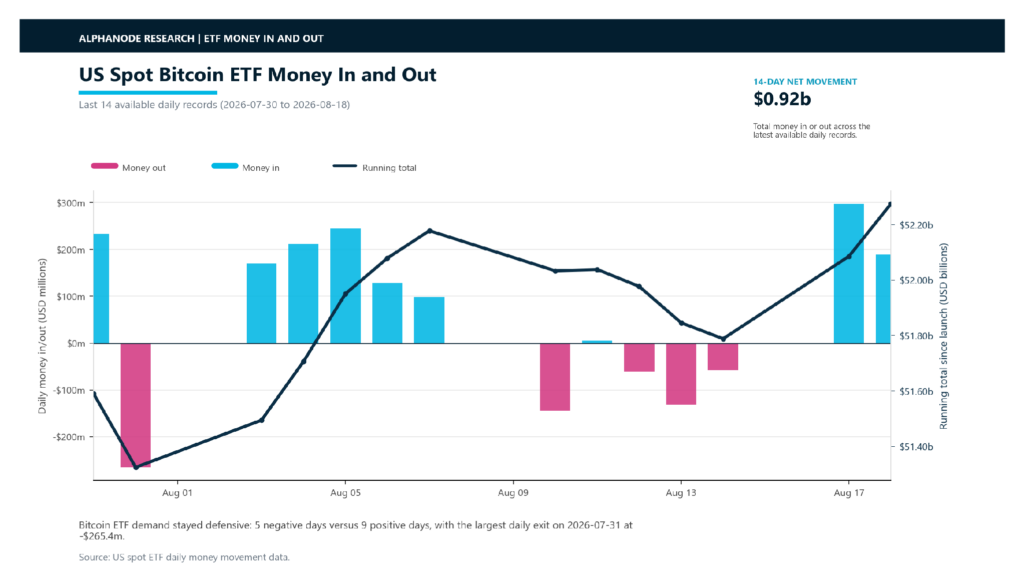
US spot Bitcoin ETFs added $918.4 million across the latest 14 available sessions, split across nine positive days and five negative ones. Money left twice in early August, including a $265.4 million single-day outflow on July 31, before $297.6 million came back in on August 17 and $189.3 million more followed on August 18, the most recent settled session. Net assets closed that window at $79.30 billion, still one session behind the price move that followed.
Momentum indicators are stretched enough to warrant some caution. RSI-14 sits at 78 and the 9-day reading is at 90.1, both deep in overbought territory, while the stochastic measure is pinned at 95.9 within its recent range. A separate technical read puts the next target as high as $76,000 if the breakout holds, but a pause to absorb supply near $70,000 would not be unusual before that level comes into range.
Ripple’s prime brokerage unit raised $275 million in its debut bond sale this week, an 8.25% coupon that KBRA rated investment grade, taking its debt financing to $475 million in three months as it builds out US clearing and financing services. National Bank of Canada’s latest 13F disclosed $6.4 million spread across four Bitcoin ETFs plus a smaller $330,000 XRP ETF stake, a modest but real data point for how a regulated Canadian lender is choosing to hold exposure.
Ethereum Market Analysis
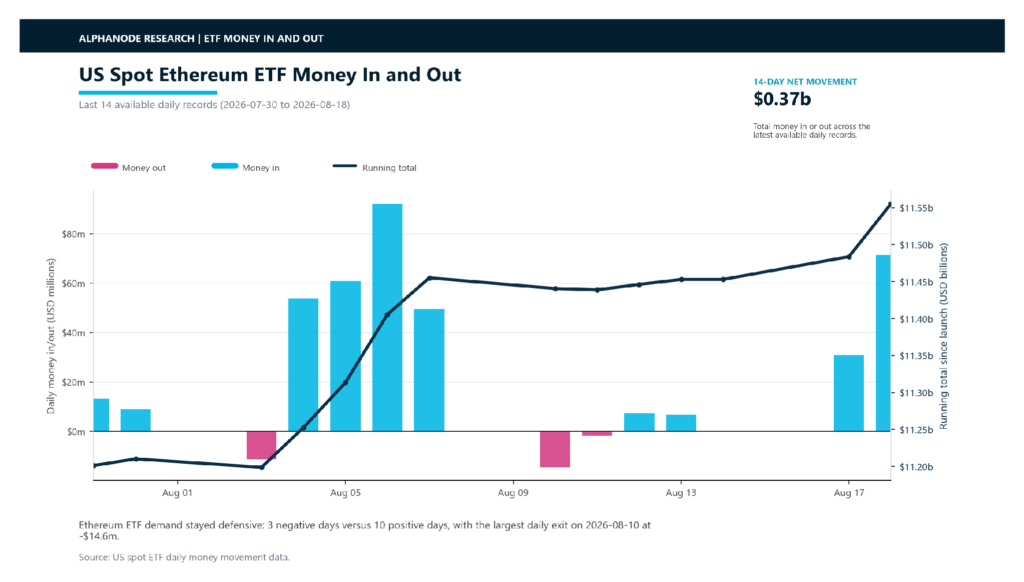
Ether’s ETF story led its own price action this week. US spot Ether funds took in $367.3 million across the latest 14 available sessions, with ten positive days against three negative ones, the strongest ratio of the two assets. Net assets closed at $10.83 billion and cumulative inflows reached $11.56 billion, with $71.5 million arriving on August 18, the most recent settled session.
Source: https://altfins.com/technical-analysis
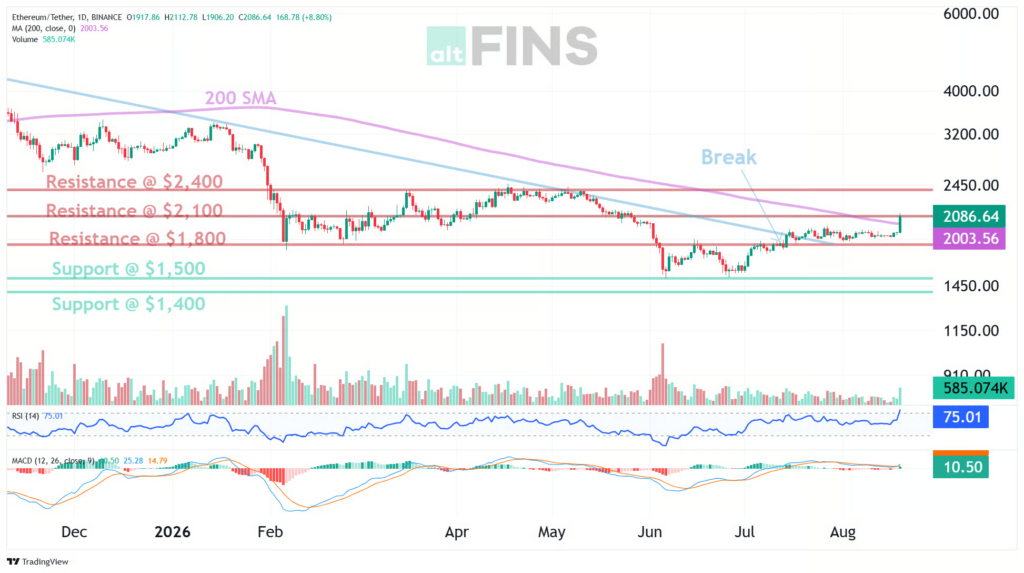
Price did the rest. ETH opened the window at $1,886 on August 14 and traded near $2,266 early Thursday, a 20.13% gain that outran Bitcoin by more than double. Wednesday supplied nearly the entire move: a single session added 17.46% and pushed price to an intraday high of $2,334 before settling at $2,253, with Thursday’s still-open candle adding another 0.58%.
AltFins treats the reclaim of $1,800 and the break above its descending trendline as a resistance breakout, with a stated target zone of $2,100 to $2,200 that Wednesday’s spike has already cleared. The medium-term trend has flipped to Up while the long-term trend is still rated Neutral, a split that leaves Ethereum’s chart less unanimously bullish than the headline move sugges
Source: https://sosovalue.com/assets/etf/us-eth-spot
Momentum is stretched further here than in Bitcoin: RSI-14 sits at 88, deep enough to be flagged Very Overbought, and AltFins logged an unusual volume spike alongside the breakout. The Bollinger range has widened to $1,701 through $2,152, meaning Wednesday’s high already traded well outside the band. $1,800 is now the level to hold; a slip back below it would put the reclaimed breakout in question, with structural support waiting at $1,500.
Ethena and FalconX launched a $1 billion facility that deploys assets backing the USDe stablecoin into overcollateralized institutional loans, run through a special-purpose vehicle that FalconX originates and services. The structure gives Ethena a return stream that does not depend on perpetual-futures funding rates, which compress or turn negative whenever demand for leveraged crypto exposure cools. USDe’s backing is becoming less of a single bet on basis trades staying profitable.
Vitalik Buterin’s latest roadmap update elevated quantum safety alongside privacy, naming Poseidon binary trees as a priority structure for the network’s long-term security design. The timing sits oddly against this week’s price action: Ethereum can rally 20% on a liquidity story while its core developers are still weighing which cryptographic primitive should protect the chain a decade from now. Both time horizons are real, and only one of them shows up in a candlestick.
Tokenized Securities Got Their Paperwork
Injective Institutional Services became an SEC-registered transfer agent this week, giving it official authority to maintain ownership records and process transfers for securities, the compliance layer that has to exist before a tokenized stock or bond can carry the same legal standing as one held through Computershare or Broadridge. The application was first flagged in July at the Injective Summit in Washington, and the registration became effective August 19.
Source: https://injective.com/blog/sec-transfer-agent
Tokenized securities typically carry two separate ledgers: a blockchain record showing who holds the token, and an authoritative ownership database that satisfies securities law. Without the second ledger, the first one is just a receipt. Injective’s registration lets one entity operate both, reconciling onchain transfers against the legal record instead of leaving that gap to a third party.
The company plans to pair the transfer-agent function with Injective Mint, its platform for issuing and managing tokenized assets. If it works as designed, an investor could buy a tokenized share, trade it on Injective, and hold a claim that a court would recognize the same way it recognizes a brokerage statement. That is the unglamorous plumbing tokenization needs before it moves past pilot programs.
Ethena Found a Second Engine for USDe
FalconX and Ethena launched a $1 billion warehouse financing facility this week that routes assets backing the USDe stablecoin into overcollateralized institutional loans for trading, treasury management, and payments. The facility runs through a bankruptcy-remote special-purpose vehicle: FalconX originates and services the loans, collateral sits with qualified third-party custodians, and Ethena holds a first-priority security interest.

Source: https://www.falconx.io/newsroom/falconx-partners-with-ethena-on-1-billion-warehouse-financing-facility-to-expand-institutional-lending-capacity
USDe has leaned on funding-rate arbitrage since launch, capturing the spread between spot and perpetual-futures markets to back its peg. That trade works when demand for leveraged long exposure is strong and funding rates stay positive. It works less well, or not at all, when that demand cools and funding rates compress toward zero or turn negative, which has happened repeatedly across past cycles.
The new facility gives Ethena a return stream tied to institutional credit rather than crypto-derivatives positioning. It will not replace the basis trade, but it reduces how much of USDe’s backing depends on one mechanism holding up. A stablecoin’s hardest test arrives in the quarter its primary yield source breaks; this week Ethena added a second one before that happens.
Mark Your Calendars
Economic Data Releases:
- August 26, 2026 (Wednesday): PCE Price Index
Token Unlock
- August 20, 2026 (Thursday): ZRO (ZRO) unlocks US$22.15 M (4.40% of released supply).
- August 20, 2026 (Thursday): KAITO (KAITO) unlocks US$11.33 M (7.63% of released supply).
- August 25, 2026 (Tuesday): H (H) unlocks US$23.23 M (7.92% of released supply).