AI Steals The Spotlight
28th May 2026 • 10 mins read
This Week’s Recap
- Mystery Bitcoin whale dumps $1.3 billion in BlackRock IBIT: A single 29.2 million-share block trade was absorbed without a disorderly price break, giving the ETF market a real liquidity test.
- Bitcoin tanks to $74,300 as spot ETFs bleed $2.26 billion in two weeks: The outflow streak marked one of the roughest institutional demand windows since the spring rally began to fade.
- Bitcoin demand gauge sinks to its weakest level since December: CryptoQuant’s measure turned negative, showing spot buyers were no longer absorbing supply with the same force.
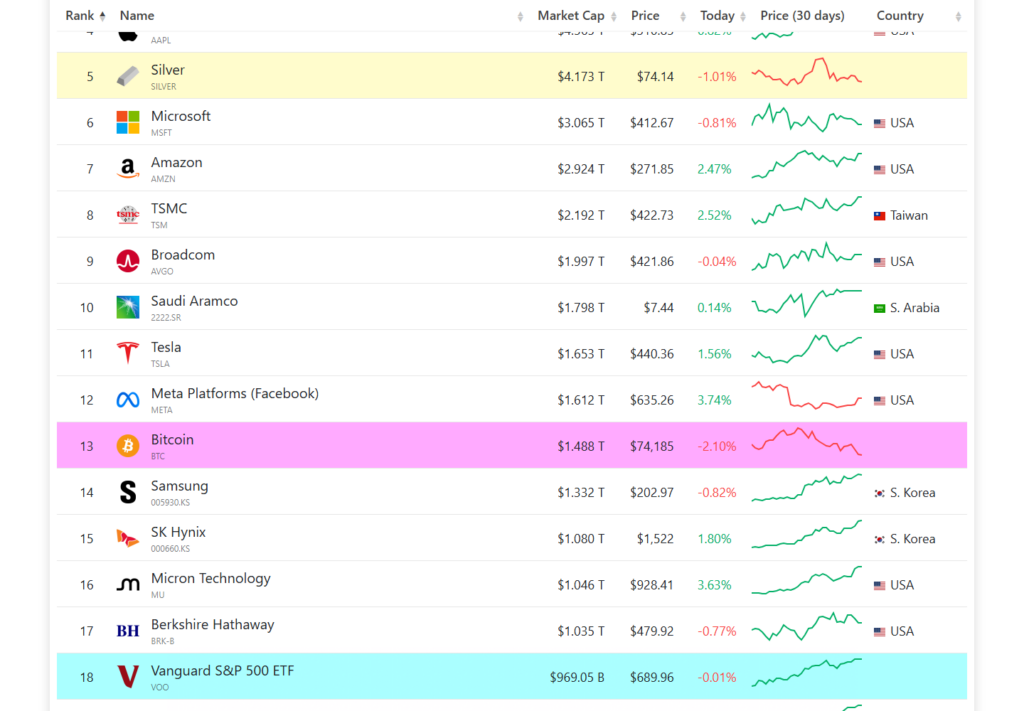
- Bitcoin slips to the 13th largest global asset as AI semiconductors accelerate: Semiconductor giants and precious metals pulled capital away from BTC while the AI trade kept setting records.
- CME Group to launch 24/7 crypto futures trading: The regulated venue will move to seven-day crypto futures trading on May 29, closing one of the last structural gaps between crypto and institutional derivatives.
- Mastercard secures New York BitLicense for digital asset strategy: The payments company can now push further into stablecoin, tokenized deposit, and digital asset payment infrastructure.
- Block begins stablecoin rollout for 60 million Cash App users: Stablecoin access reached 25% of the user base first, with full availability expected by week’s end.
- Stablecoin market value hits a record $322 billion: The sector now exceeds the official foreign exchange reserves of dozens of countries, intensifying the banking and policy fight around digital dollars.
- Stablecoin market value exceeds the FX reserves of 95 nations: The growth kept stablecoins at the center of the payments story even as BTC and ETH weakened.
- BIS Project Agora moves to real-value testing: Major central banks are now testing tokenized money settlement on blockchain rails for cross-border payments.
- DTCC plans to bring tokenized assets to Stellar: The infrastructure giant plans to connect tokenized stocks and Treasuries to Stellar in early 2027.
- Banca Sella becomes the first Italian bank to offer crypto under MiCA: Bank of Italy approval gives the private bank a route to offer custody and transfer services.
- Jefferies predicts a $1 trillion market for crypto IPOs: The bank expects public listings to cluster around financial infrastructure rather than pure token speculation.
- Elon Musk could control a $3.3 billion Bitcoin treasury in a potential Tesla-SpaceX merger: A combined balance sheet would create the fifth-largest corporate BTC holder.
- SpaceX reveals 18,712 Bitcoin holdings in IPO filing: The filing placed the company among the largest public corporate holders with a stash valued around $1.29 billion.
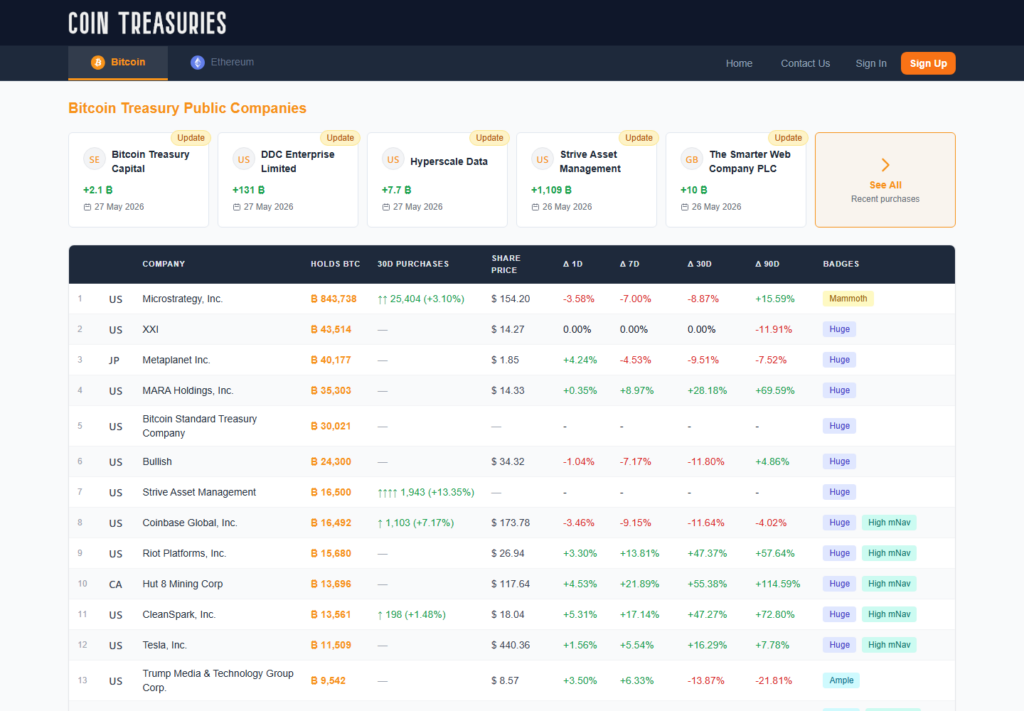
- Strive acquires 1,109 BTC worth $85 million: Vivek Ramaswamy’s firm lifted total holdings to 16,500 BTC while its stock climbed sharply over three months.
- Strategy taps cash reserve to retire $1.5 billion in convertible debt: The firm reduced aggregate debt to $6.7 billion after repurchasing notes at a discount.
- Trump Media moves 2,650 BTC to Crypto.com: The transfer raised sale-risk questions around the firm’s remaining 6,889 BTC.
- Bitmine buys 111,942 ETH worth $237 million: The company bought into ETH weakness even as some market voices argued for slowing treasury accumulation.
- Ethereum faces a 12-month deadline for native privacy: Developers are racing to ship privacy features while the market rewards assets with built-in confidentiality.
- Aave loan book reaches $10.9 billion against a $2.9 trillion corporate credit market: DeFi lending still lacks the underwriting depth needed to compete with bank-scale credit.
- Base launches an AI tool for ChatGPT to manage wallets: The Base MCP tool lets AI clients interact with wallets and DeFi apps using an emerging standard.
- TrapDoor campaign targets DeFi supply chains: Researchers found 34 malicious packages and 384 related versions aimed at developer credentials.
- StablR freezes tokens after a $13.5 million exploit: A compromised multisig wallet let an attacker mint unbacked stablecoins and net $2.8 million.
- UK sanctions HTX over alleged Russian financial ties: Major exchanges increased transfer scrutiny after the UK accused HTX-linked routes of helping sanctions evasion.
- UK sanctions Huobi and a ruble stablecoin issuer: Britain applied banking-style sanctions to crypto networks for the first time.
- Spain blocks Polymarket and Kalshi over gambling laws: The platforms were blocked for operating without local licenses and lacking safeguards for minors.
- Hyperliquid launches macro outcome prediction markets: The DEX now lets traders bet on inflation and rate decisions using validator-settled event contracts.
- Spot HYPE ETFs absorb 1% of market cap in 10 days: Hyperliquid’s ETF debut outpaced early BTC and ETH launches by capturing 1.04% of market value.
- RWA market hits $51 billion in market cap: Bernstein data showed tokenized private credit leading the sector, with Figure managing $18 billion in assets.
Bitcoin Market Analysis
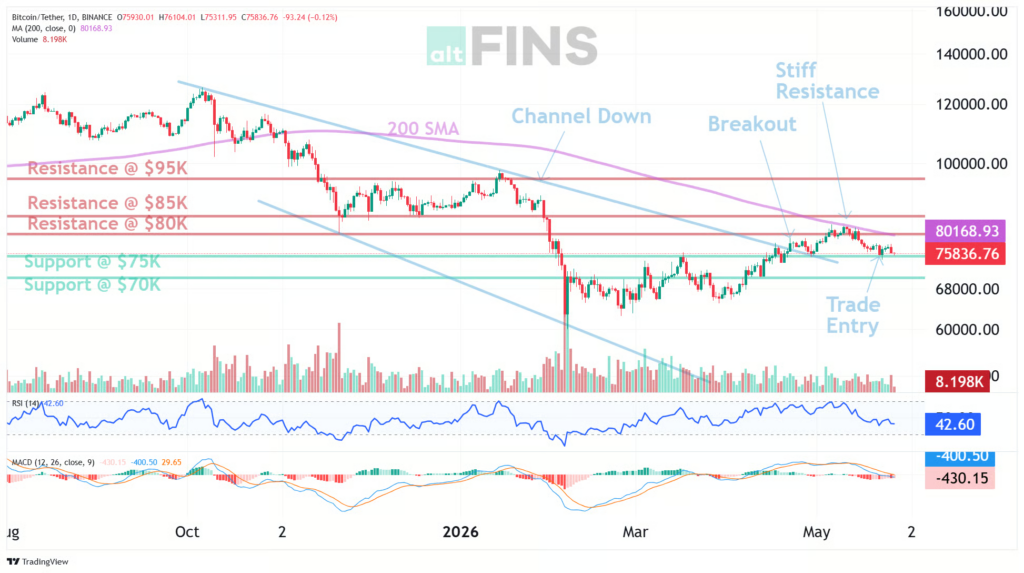
Bitcoin’s chart weakened while the ETF market absorbed the week’s cleanest liquidity test. Price sat near $74,444 at the latest reading, down about 4% over the week, after losing the short-term strength that had followed the earlier channel breakout. The old $75,000 breakout area is now the market’s first argument. If buyers can keep defending it, the reversal case survives. If it gives way, the chart quickly starts looking back toward $70,000.
Source: https://altfins.com/technical-analysis
The support map is narrow enough to matter. Nearest support sits at $70,000, then $66,000, while resistance is stacked at $80,000 and $85,000. Bitcoin has already been rejected twice in the $80,000 to $83,000 zone, where the 200-day average also sits. That makes the next reclaim attempt more important than the last one, because repeated failures at the same band start to train sellers to act sooner.
Momentum has rolled over. Short-term trend is marked Strong Down, medium-term trend is Down, and long-term trend is Neutral, which is a weaker mix than the headline “bullish reversal” setup suggests. RSI-14 remains neutral near 38, but shorter oscillators are oversold and MACD has flipped bearish. The market is washed out enough for a bounce, yet not firm enough to call that bounce durable.
Source: https://sosovalue.com/assets/etf/us-btc-spot
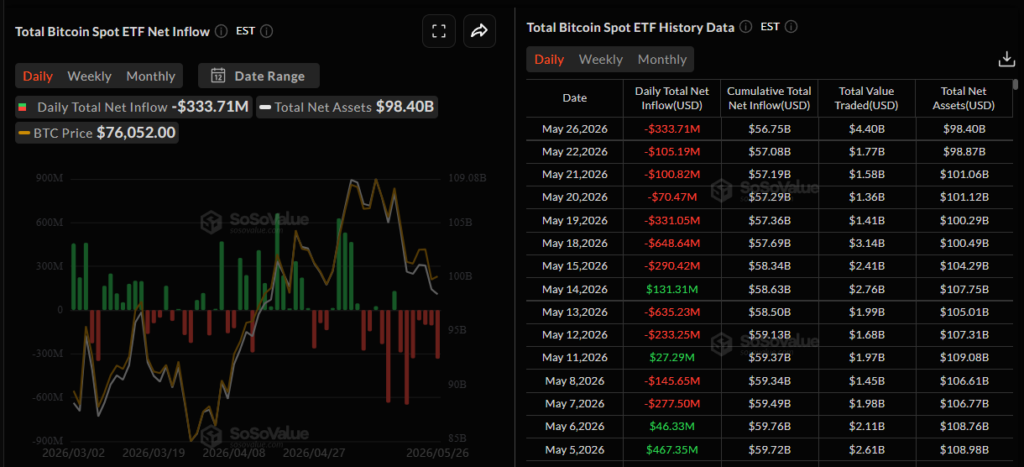
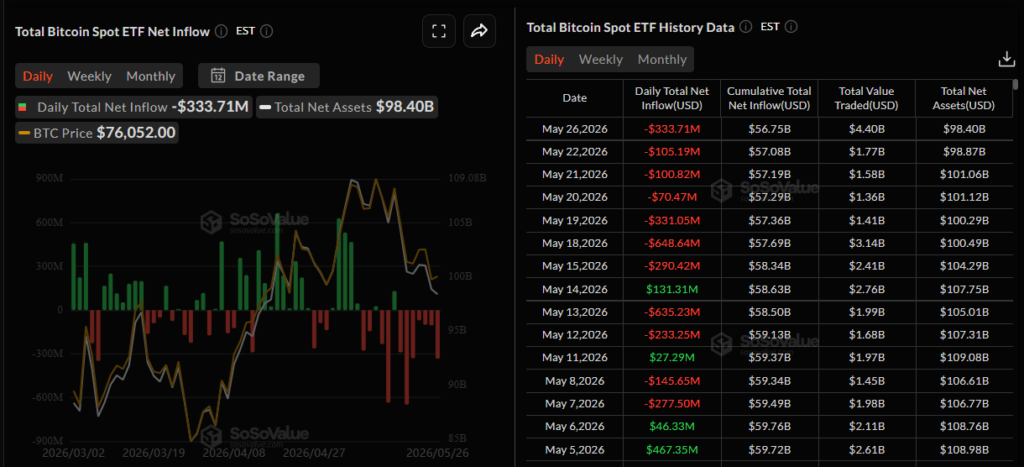
ETF flows explain why the chart feels heavy. Spot Bitcoin ETFs lost $333.7 million in the latest session, with $4.4 billion traded and total net assets down near $98.4 billion. Cumulative net inflow still stands at $56.75 billion, so the wrapper remains a deep pool of demand over the full cycle, but the marginal buyer stepped back this week. The $1.3 billion IBIT block sale was absorbed cleanly, which is a better sign than the outflow number alone. It showed depth. It did not show fresh demand.
Corporate BTC signals were split. Strive bought 1,109 BTC, SpaceX disclosed 18,712 BTC, and a possible Tesla-SpaceX combination would put a $3.3 billion Bitcoin treasury under one corporate roof. Trump Media moved 2,650 BTC to Crypto.com, which pulled the other way because transfers to exchange venues always raise sale-risk questions. Treasury buying is still there. It is no longer the only visible balance-sheet story.
Bitcoin now needs a cleaner catalyst than “institutional adoption continues.” The market already knows the ETF wrapper works. It just watched IBIT absorb size. The harder question is whether spot demand returns while AI equities, gold, and semiconductor names are pulling the same pool of capital. A daily close back above $80,000 would change the tone quickly. Until then, $75,000 is a defense line, not a launchpad.
Ethereum Market Analysis
Ethereum’s week started with a balance-sheet buyer and ended with a weaker chart. Bitmine bought 111,942 ETH worth $237 million, but spot price still slipped toward $2,025 and ETH fell nearly 5% over the week. The purchase gives the market a clear corporate treasury story. The price action says that story has not been enough to absorb the selling yet.
Source: https://altfins.com/technical-analysis
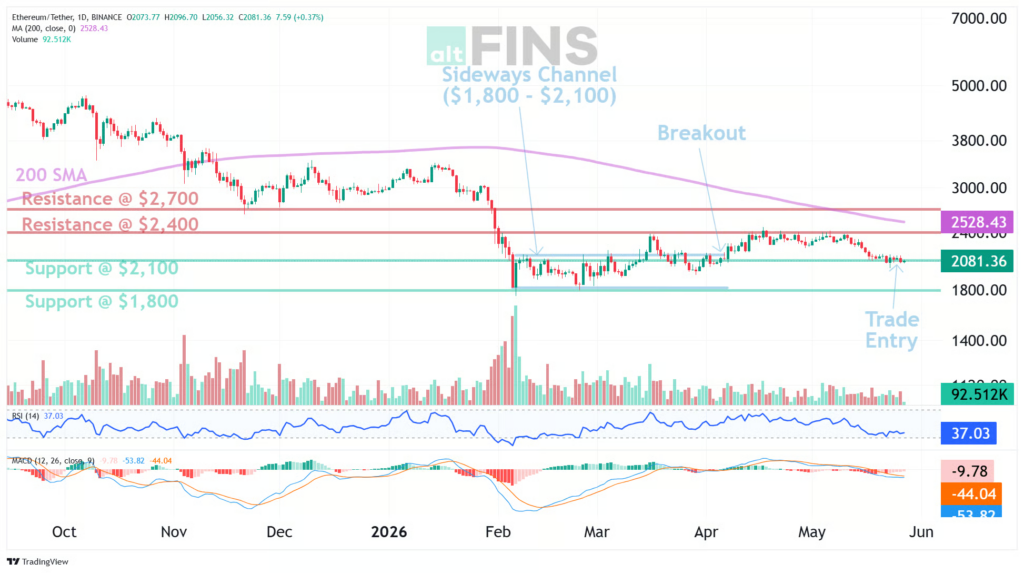
The technical structure is more fragile than Bitcoin’s. ETH is marked Strong Down across the short and medium-term readings, with the long-term trend also Down. Momentum has been bearish for 28 days since MACD crossed below its signal line, and shorter oscillators are oversold. RSI-14 sits near 32, still neutral by the standard 30 to 70 convention, but close enough to the lower boundary that buyers need to show up soon if the $2,000 area is going to hold.
Support is thinner here. The nearest support zone is $1,800, while resistance sits at $2,400 and then $2,700. The trade setup still leaves room for a pullback entry near $2,100 in a broader reversal attempt, but ETH is now trading below that area, so the old setup has become a test of damage control. A clean move back above $2,100 would help. A failure there leaves $1,800 as the level the market will start pricing around.
Source: https://sosovalue.com/assets/etf/us-eth-spot
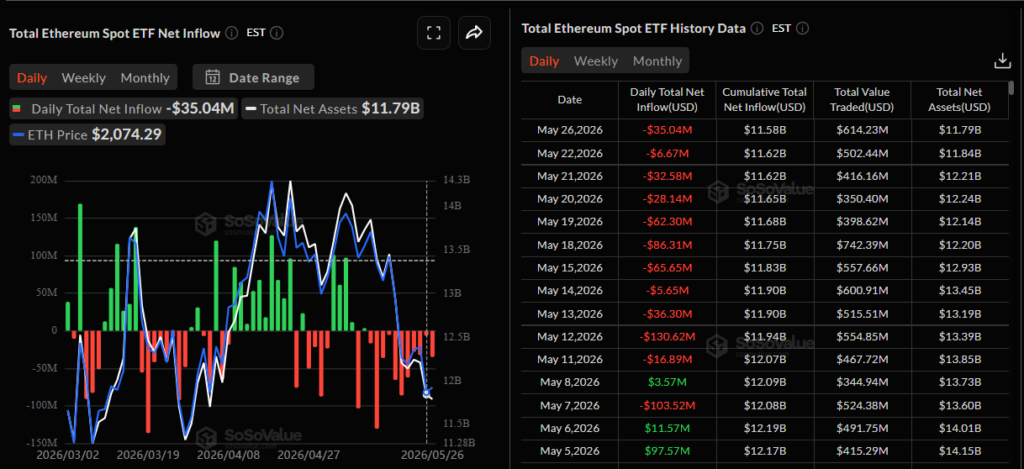
Spot ETH ETF flows gave no help. The latest session showed $35 million in net outflows, $614 million in value traded, $11.79 billion in net assets, and $11.58 billion in cumulative net inflow. Those are not panic numbers, but they are not a bid either. ETH needs ETF persistence more than one-off treasury buying because the chart is already leaning lower.
The better Ethereum story is still infrastructure. Base launched an AI-facing tool for ChatGPT wallets and DeFi apps, and Aave’s loan book reached $10.9 billion, even if DeFi remains tiny beside the $2.9 trillion US corporate credit market. Ethereum is still where much of the credit, wallet, and application work clusters. That has not translated into a strong ETH bid this week.
Privacy may become the next narrative test. Ethereum developers face a 12-month push for native privacy while markets reward chains and assets that can offer confidentiality without pushing users out of regulated rails. That is a real product question, not just a branding one. For next week, the market needs ETH to reclaim $2,100 before the story can move back toward $2,400. Below that, Bitmine’s buy looks like support in the background, not control of the tape.
ETF Demand Cracks Under A Real Liquidity Test
Bitcoin’s ETF market had its first serious gut check in weeks. Spot funds bled $2.26 billion over two weeks, and the latest daily print showed another $333.7 million leaving the category. That would have been enough for a clean risk-off story by itself. Then IBIT took a $1.3 billion block trade, turning a flow problem into a liquidity test.
Source: https://sosovalue.com/assets/etf/us-btc-spot
The block sale did not break the market. BlackRock’s fund absorbed 29.2 million shares with limited price impact, and The Block reported that the trade helped lift total Bitcoin ETF volume to $4.4 billion. That says the wrapper can handle size even when demand is weak. It also says high volume is not automatically bullish. Turnover can mean buyers are stepping in, or it can mean large holders are using liquidity to leave.
The useful distinction is depth versus direction. Depth looked fine because a $1.3 billion print did not disorder the market. Direction looked poor because flows were still negative, the two-week outflow stack was large, and Bitcoin was sitting near support. A market can be liquid and still weak. That was the week’s uncomfortable lesson.
The next signal is persistence. One or two inflow days would matter less than a steady run that starts repairing the two-week damage. Until that appears, the ETF complex is acting like a pressure valve rather than a support beam. Bitcoin can still bounce from $75,000, but the ETF tape has stopped doing the heavy lifting for now.
AI Is Winning The Marginal Dollar
Bitcoin did not sell off in a vacuum. BTC slipped to the 13th largest global asset because the capital race moved elsewhere. Micron crossed a $1 trillion market value as the memory-chip trade caught another AI bid, while TSMC and Broadcom moved ahead of Bitcoin by market capitalization. Crypto was no longer the only high-beta story with institutional access.
Source: https://companiesmarketcap.com/assets-by-market-cap/
That rotation changes the burden of proof for Bitcoin. ETF access is no longer enough, because almost every competing trade has a liquid wrapper now. AI stocks are offering earnings momentum, index weight, policy support, and a story investors understand quickly. Bitcoin is offering a tested ETF market, a weakening demand gauge, and a chart sitting on support.
The comparison is not about whether AI is “better” than Bitcoin. It is about where the marginal dollar had a reason to move this week. AI had upside revisions and visible equity-market leadership. Bitcoin had outflows and a technical defense line. When both trades compete for the same risk budget, the cleaner momentum story tends to win first.
That also frames what BTC needs next. A reclaim of $80,000 would help the chart, but the bigger repair would be a turn in flows while AI remains hot. If Bitcoin can stabilize while the strongest competing trade keeps running, that would say holders are no longer being pulled away by every better-performing theme. Until then, the AI trade is not background noise. It is the benchmark Bitcoin is failing to beat.
Corporate Treasuries Split Into Buyers And Sellers
The corporate Bitcoin story stopped looking one-way. Strive bought 1,109 BTC, SpaceX disclosed 18,712 BTC, and a possible Tesla-SpaceX combination would create one of the largest corporate Bitcoin holders in the world. Those are still strong accumulation signals. They just no longer own the whole narrative.
Source: https://cointreasuries.net/
Trump Media moved 2,650 BTC to Crypto.com while sitting on reported crypto losses, and Strategy used cash to retire $1.5 billion of convertible debt rather than adding another headline purchase. Neither move proves forced selling. Both change the tone. Treasury companies are no longer just simple spot buyers. They are also balance-sheet managers.
That matters for how the market reads corporate flows. A new purchase is easy to price. A debt retirement says management is protecting the structure around the BTC stack. An exchange transfer from a corporate-linked wallet creates a question the market cannot answer without disclosure. These are different signals, and they should not be flattened into one adoption bucket.
Ethereum had its own version through Bitmine, which bought 111,942 ETH worth $237 million as price fell below $2,200. That was a cleaner accumulation headline than the BTC treasury mix, but ETH still weakened. Corporate demand can soften a drawdown. It cannot always reverse one, especially when ETF flows and broader risk appetite are pointed the other way.
The next phase of the treasury trade will be judged by funding discipline. Companies that can buy without stressing the balance sheet will still get credit. Companies that move coins toward exchanges, lean on complex financing, or carry large mark-to-market losses will face a different market reaction. The treasury bid is alive. It is becoming more selective.
Mark Your Calendars
Economic Data Releases:
- May 29, 2026 (Friday): US trade balance, wholesale inventories, and Chicago PMI
- June 5, 2026 (Friday): US employment report and unemployment rate
Token Unlock
- May 29, 2026 (Friday): B2 (B2) unlocks 7.6% of float
- May 31, 2026 (Sunday): GUN (GUN) unlocks 17.5% of float
- June 1, 2026 (Monday): EIGEN (EIGEN) unlocks 5.0% of float
- June 1, 2026 (Monday): P (P) unlocks 15.5% of float
- June 2, 2026 (Tuesday): M (M) unlocks 4.3% of float
- June 3, 2026 (Wednesday): STO (STO) unlocks 9.5% of float
- June 3, 2026 (Wednesday): WET (WET) unlocks 83.9% of float