
The Fed Hikes And Clarity Act Dies
17th September 2026 • 9 mins read
This Week’s Recap
- The Federal Reserve raised rates 25 basis points to 3.75%-4.00%: The FOMC voted unanimously, and its statement tied the move to inflation that “remains elevated” and domestic spending that has stayed resilient. Chair Kevin Warsh had pointed this way at Jackson Hole in late August, which is why the 10-year yield had already climbed roughly a quarter point before the meeting and why Bitcoin barely moved on the announcement itself.
- The House Ways and Means Committee advanced a crypto tax bill 38-5: The Digital Asset Tax Certainty Act is the first federal crypto tax framework to clear a committee, and it arrived one day after the Clarity Act failed. It sets a $10 de minimis exemption for network and transaction fees, extends wash sale rules to digital assets, and treats mining and staking rewards as ordinary income when received. Lawmakers dropped an earlier plan to defer those taxes, so the timing question that most affects validators went unresolved.
- Celsius sued BitMEX for $495 million over March 2020 liquidations: The bankruptcy estate filed against five BitMEX entities on September 12, covering 1,325.84 BTC that Celsius lost in a single March 12 liquidation and 5,034.33 BTC lost the next day by investment fund JST, whose claims were assigned to the estate. The complaint’s core allegation is structural: BitMEX controlled both the system deciding when customers were liquidated and the insurance fund that grew from those liquidations.
- The DOJ charged two former Robinhood engineers with front-running listings on Hyperliquid: Prosecutors allege Hefu Chai and Huaisong Xiang used a private Slack channel carrying planned listing information to open long positions on Hyperliquid before Robinhood’s announcements, each clearing more than $50,000. Charging the trades as commodities fraud because they happened in perpetual futures, not spot tokens, pushes insider trading enforcement into decentralised derivatives for the first time.
- Deutsche Bank moved close to launching institutional crypto custody in Europe: The service will hold Bitcoin and Ether alongside a narrow set of tokens including USDC, EURC and the euro-denominated EURAU, built on infrastructure from Swiss provider Taurus and aimed at corporates, asset managers, hedge funds and sovereign institutions. BaFin clearance still stands between the bank and a live launch.
- Zcash holders voted 99.9% to cut block times to 25 seconds: Nearly 2.4 million ZEC of roughly 3.6 million eligible took part, with 98.9% keeping the Bitcoin-style halving schedule and 99.3% backing a fast NU7 rollout that drops anything unfinished by September 30. Only coins held in the Ironwood shielded pool could vote, and ballots were encrypted and split into 16 pieces so validators could tally the result without learning who voted or how much they held.
- Bitcoin Core 32 entered final testing: The release brings faster block validation, changes to fee handling and a fix for a wallet flaw, with general availability expected in October.
- Payward plans to offer US clients perpetual futures on Hyperliquid: Kraken’s parent would route the contracts through Bitnomial, the CFTC-designated exchange and clearinghouse it agreed to buy for up to $550 million in April, with NinjaTrader Clearing carrying client accounts. No registered US exchange has deployed a market on Hyperliquid before, and co-CEO Arjun Sethi framed the plan as Payward “holding the keys and carrying the regulatory obligations.” No launch date was given.
- Ethiopia cut Bitcoin miners to 23% of their contracted power: El Nino reduced reservoir inflows by 20%, and the state utility stepped miners down to 75%, then 50%, then 23% while prioritising households and industry. Miners supplied 35% of the utility’s revenue last fiscal year and drew close to a third of national electricity output, so the cut costs Ethiopia real money. A reassessment lands in October.
- Standard Chartered projected Arbitrum at $10 by the end of 2030: The bank’s four-year target implies a roughly 70-fold gain from current levels, resting on the argument that Ethereum layer-2 networks capture a growing share of settlement activity.
- TON mini-apps passed 100 million monthly active users: Telegram’s in-chat application layer reached the kind of scale most standalone crypto products never approach, and it held through a choppy quarter for token prices.
- NEAR’s chain abstraction crossed 50 million lifetime operations: The milestone tracks cumulative use of the protocol’s cross-chain signing infrastructure, which lets an account on one network control assets on another without a bridge.
- Theo launched a tokenised silver product backed by $40 million in active leases: The thSLVR token is collateralised by industrial silver leases, so holders earn lease income on top of their exposure to the metal itself.
- Aave governance weighed emergency freeze powers for active exploits: The proposal would let Guardians pause a vulnerable pool without disclosing the vulnerability first, trading transparency for response time during an ongoing attack. That tradeoff is the whole debate, since public disclosure of an unpatched flaw invites copycats.
- Italy opened an investigation into a government email breach linked to the Revolut data leak: Authorities are examining more than 650 cases of abused certified email accounts, the legally binding channel Italy uses for official correspondence.
Bitcoin Market Analysis
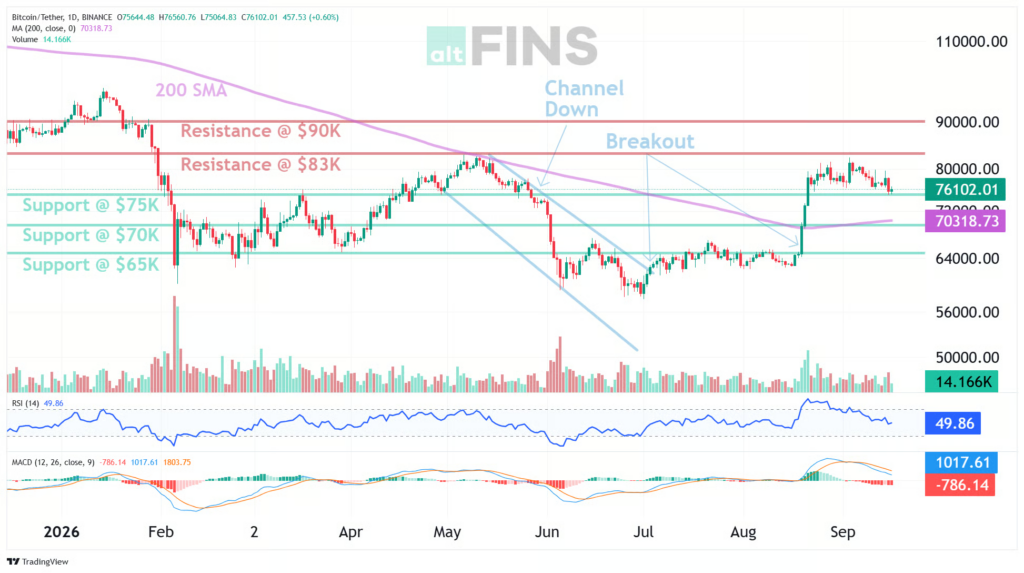
Bitcoin opened the week at $76,569 on Friday and sat at $76,704 by Thursday’s still-forming session, a 0.18% move that took seven days of noise to accomplish. Friday itself ran to $79,890, the week’s high, before settling at $77,226. Saturday added 0.07%, Sunday gave back 0.57%, and Monday climbed 1.75% to $78,189. Tuesday broke the pattern: price fell 3.25% to $75,644 and touched $74,968 along the way, the lowest print in twenty days. Wednesday recovered 0.74% as the Fed decision landed, Thursday another 0.65%. The $4,922 gap between Friday’s high and Tuesday’s low is 6.4% of where the week started.
Source: https://altfins.com/technical-analysis
The moving averages disagree by timeframe, which is the clearest read on where Bitcoin sits. Price closed 0.02% under the five-day average, 0.57% under the ten-day and 1.72% under the twenty-day, so the short-term trend points down. The longer averages tell the opposite story: Bitcoin trades 6.26% above its 50-day average, 13.15% above the 100-day and 8.99% above the 200-day at $70,374. The chart still frames an uptrend with resistance at $83,000 and the $65,000 to $70,000 zone as the floor buyers would defend.
Momentum has cooled further than price has. RSI-14 fell to 31.2, close enough to the 30 line that another red session would tip Bitcoin oversold, while RSI-25 at 47.9 sits near neutral. The MACD line at 902.73 sits below its 1,624.66 signal for a histogram of negative 721.93, a crossover now 28 days old and losing signal value. ATR-14 of $1,885 is about 2.5% of spot, so that range covered roughly 2.6 ATRs, busy but short of a dislocation. Tuesday’s $74,968 low punched through the $75,216 lower Bollinger Band before closing back above it, a wick that usually marks a flush.
Source: https://sosovalue.com/assets/etf/us-btc-spot
Zoom out and the drawdown looks less dramatic than the week felt. Bitcoin remains 39.56% below its $126,217.71 all-time high from October 6, 2025, now 346 days ago, and 32.01% above its 52-week low of $57,793.56. A $76,704 close sits nearer the middle of the past year’s range than either boundary. The one-month gain of 18.51% and the three-month gain of 20.71% both survived this week intact, which is the context that matters for a 0.18% weekly change.
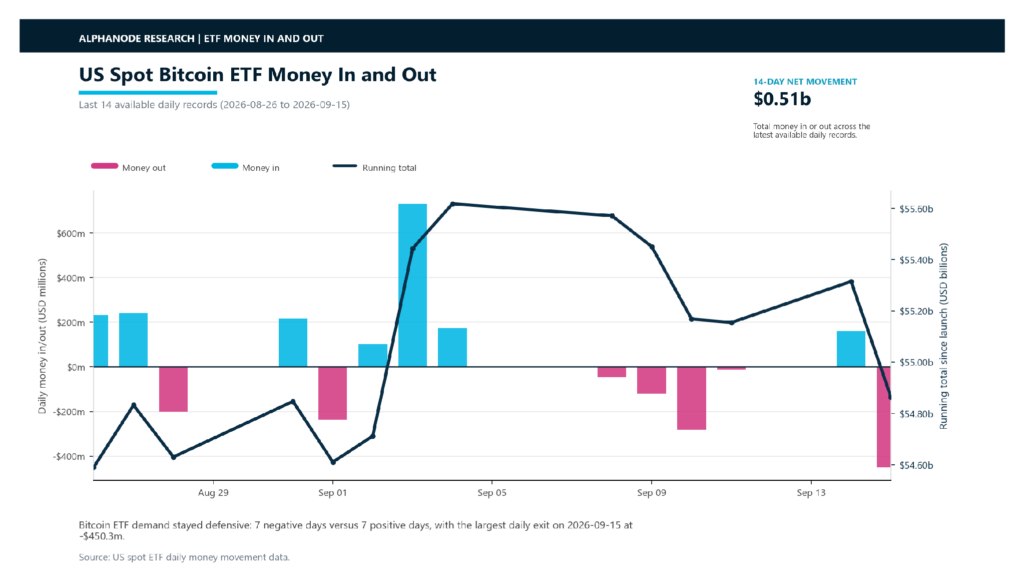
ETF demand split almost evenly and ended positive anyway. The fourteen sessions from August 26 to September 15 produced seven positive days against seven negative ones for a net $506.4 million, closing with $95.72 billion in net assets and $54.86 billion of cumulative inflows since launch. The distribution inside that window did the work: a $730.9 million inflow on September 3 was large enough to carry the whole period, and September 15’s $450.3 million exit was the only outflow big enough to threaten it. Two days accounted for most of the movement; the other twelve largely cancelled out.
What moved Bitcoin this week was Washington, in both directions and on consecutive days. The Clarity Act’s cloture motion failed 49-50 on Tuesday afternoon, and $571 million of long positions were liquidated in the next 24 hours, roughly $190 million of it in Bitcoin alone. Spot ETFs shed $450.3 million from the same session. The Fed’s hike the following day barely registered by comparison, which says something about what this market is actually pricing. Tuesday’s $74,968 low and the $75,216 lower band now sit together as the level that matters; holding above them keeps the medium-term uptrend and the 30-day average at $77,702 in reach. A close below $74,968 would put the 50-day average at $72,187 back into the conversation and turn a policy disappointment into a genuine test of the summer rally.
Ethereum Market Analysis
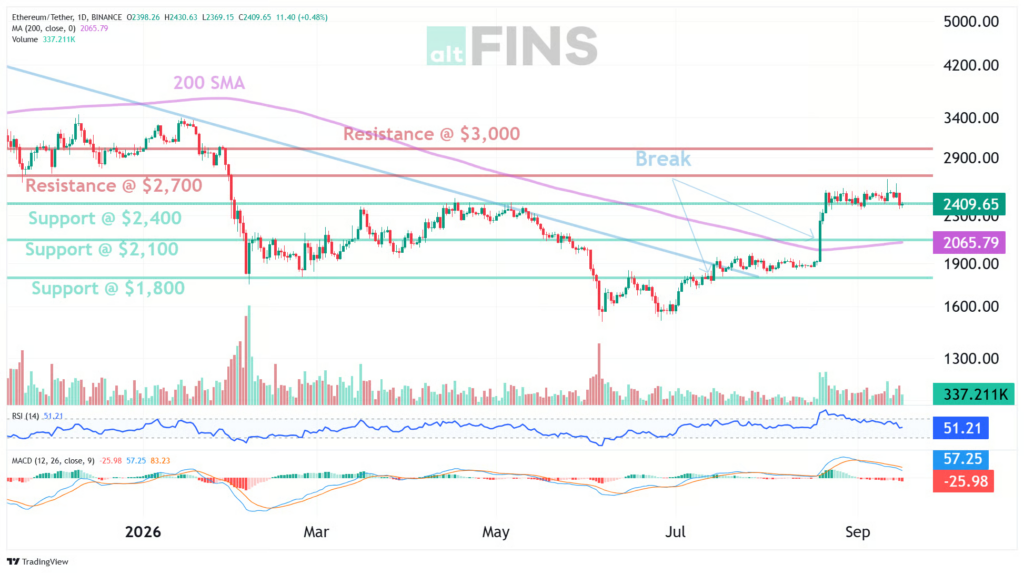
Ether spent the week inside the $2,400 to $2,700 band it has traded since clearing its descending trendline and the 200-day average, and on Tuesday it briefly lost the floor. The sideways channel is a neutral structure by design, one that rewards buying near support and selling near resistance instead of chasing a direction, and the chart marks $2,400 as the nearest support with $2,100 beneath it and $2,700 overhead before $3,000. Tuesday’s $2,359 low slipped under that support and closed back inside at $2,398. The range held, but only just.
Source: https://altfins.com/technical-analysis
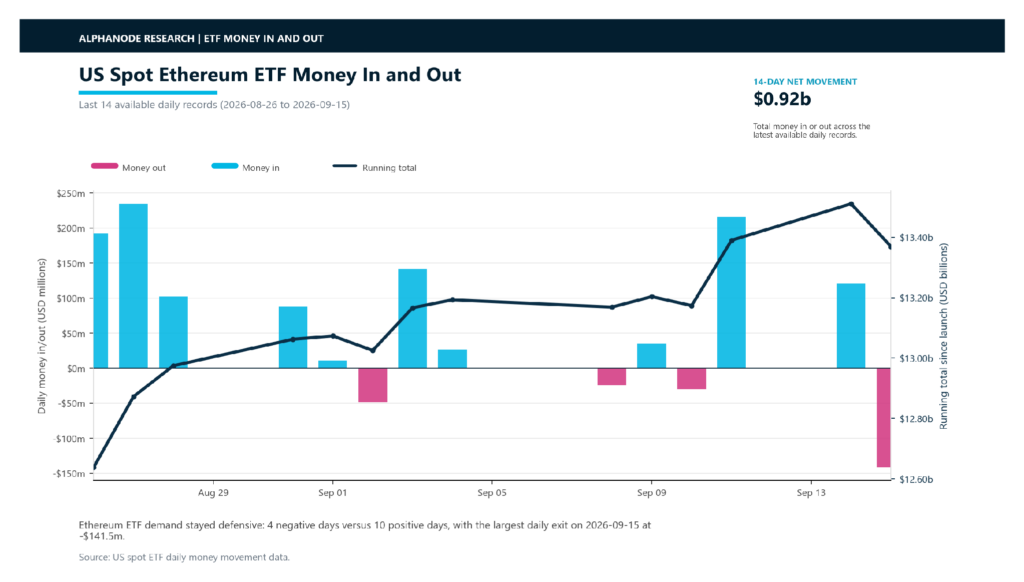
The ETF story is where Ether separates from Bitcoin. Spot Ether funds took in $924.1 million across the fourteen sessions from August 26 to September 15, with ten positive days against four negative ones, while the far larger Bitcoin complex managed $506.4 million over the same stretch. Ether funds hold $15.42 billion in net assets against Bitcoin’s $95.72 billion, so roughly a sixth of the asset base attracted nearly twice the money. September 15 cost them $141.5 million, and even that was a third of the Bitcoin exit on a day when both assets fell together.
Price action was choppier than Bitcoin’s in both directions. Ether opened Friday at $2,438 and jumped 3.21% to $2,516 on a $2,666 high, the week’s best level. Saturday added 0.38%, Sunday took back 1.93%, and Monday recovered 1.56% to $2,516 again. Tuesday erased all of it with a 4.67% drop to $2,398, the sharpest single-day decline of either asset this week. Wednesday and Thursday clawed back 0.83% and 0.79% to finish at $2,437, one dollar below where the week began. The $307 spread between Tuesday’s low and Friday’s high amounts to 12.6% of the opening price, double Bitcoin’s proportional range.
Source: https://sosovalue.com/assets/etf/us-eth-spot
Measured against Bitcoin, Ether gave a little back. The ETH/BTC ratio slipped from roughly 0.03258 at Friday’s close to 0.03177 by Thursday, so this week’s flat print came with mild underperformance after a month of the opposite. Ether still leads on every longer window: up 27.08% over one month against Bitcoin’s 18.51%, and 42.43% over three months against 20.71%. The cycle drawdown remains steeper, at 51.07% below the $4,956.67 all-time high set on August 24, 2025, though Ether also sits 61.10% above its 52-week low of $1,505.52, a wider recovery than Bitcoin has managed from its own trough.
Momentum readings are milder here than on the Bitcoin chart. RSI-14 at 43.2 stayed well clear of oversold while Bitcoin’s approached 31, and RSI-25 at 48.7 is effectively neutral. The MACD histogram of negative 25.22 against a 51.83 line and 77.05 signal shows a bearish crossover without much force behind it. ATR-14 of $90.43 runs about 3.7% of spot, a higher volatility budget than Bitcoin’s 2.5%, and the week’s range consumed roughly 3.4 of those units. Tuesday’s $2,359 low broke the $2,383 lower Bollinger Band before price recovered into the band by Thursday.
Ether’s ecosystem took a competitive hit this week that had nothing to do with price. Circle switched on Arc’s public mainnet on Wednesday, an EVM-compatible layer-1 where gas is paid in USDC and eleven institutions including BlackRock, DTCC, Visa and Mastercard produce the blocks. Stablecoin settlement has been one of Ethereum’s anchor use cases, and a purpose-built chain backed by the firms that already clear traditional markets is a direct claim on it. Ether’s near-term levels are unchanged by any of that: reclaiming $2,464, the 20-day average, would repair the week’s damage, while a second break of $2,359 would open the $2,100 support zone that has not been tested since July.
Crypto’s Biggest Bill Died Over Ethics Language
The Clarity Act did not fail on substance. Negotiators had spent months settling how the SEC and CFTC would divide oversight of digital assets, what registration would require, and how anti-money-laundering rules would apply, and Senate Republicans released a finalised 630-page text on September 14 that incorporated 126 changes Democrats had asked for. What could not be settled was ethics: an enforceable ban on the president and senior officials profiting from crypto while writing its rules, a demand that hardened after President Trump disclosed more than $1.4 billion in crypto income for 2025. The final text added ethics language enforceable by state attorneys general. It moved no votes. The cloture motion failed 49-50 on September 15, eleven short of the sixty needed and one short of even a simple majority, with no voting Democrats in favour and several Republicans against.
Source: https://www.coinglass.com/LiquidationData
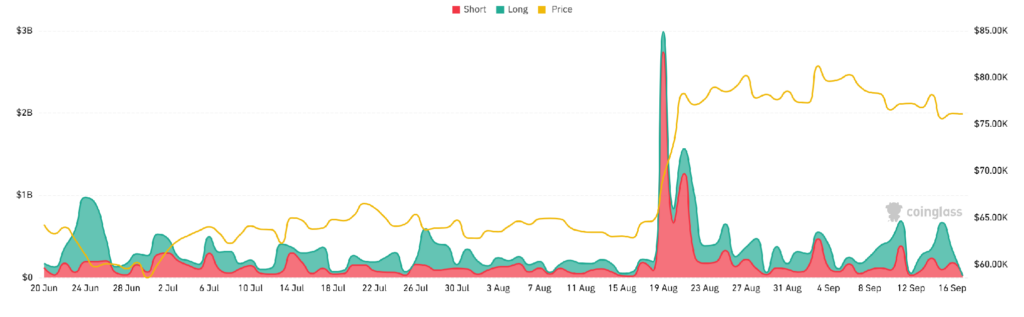
The chart shows what the market did with that information. Long liquidations, the green area, climbed through the second week of September and spiked into the vote while Bitcoin’s price line fell from roughly $80,000 toward $76,000. The $571 million flushed in 24 hours was the heaviest since August 22, and the composition matters: Bitcoin and Ether longs accounted for about $190 million each, with XRP at $30 million and Solana at $22 million. Set against the August 19 episode, when total liquidations cleared $3 billion in a single day, this was a moderate event. It was also a one-sided one. Traders had positioned for the bill to pass, and the August spike shown on the left of the chart is a reminder of how much further this can go when positioning is heavier.
Legislation is now a 2027 question at the earliest, and the practical consequence is that US crypto firms keep operating under enforcement-by-litigation with no statutory framework behind it. The one piece of forward motion came from a different committee entirely: the House Ways and Means panel advanced the Digital Asset Tax Certainty Act 38-5 the very next morning. Tax treatment is a narrower prize than market structure, and it does not answer who regulates a spot exchange. It does suggest the appetite in Congress is for pieces small enough to pass rather than a single bill carrying everything.
Source: CoinGlass, Bitcoin Price vs. Cryptocurrency Liquidation, daily long and short liquidations against Bitcoin price, data through September 16, 2026.
BlackRock and Visa Are Now Producing Blocks
Circle turned on Arc’s public mainnet on September 16 with a validator set that reads like a list of the institutions that already run traditional market plumbing: BlackRock, DTCC, Galaxy, ICE, Mastercard, MoneyGram, SBI Group, Standard Chartered, Sumitomo Corporation, Visa and Worldpay. Eleven founding validators, more than 100 applications live on day one, and gas denominated in USDC instead of a volatile native token. Consensus runs on proof of authority for now, with a proof-of-stake transition targeted for 2027. Circle completed a genesis mint of 10 billion ARC tokens in the same week while stating plainly that the mint is not a commitment to launch the token publicly. Jeremy Allaire called Arc “the single most significant launch in Circle’s history since USDC itself,” a large claim from a company whose stablecoin settles trillions.

Source: https://explorer.arc.io/
The network data backs the throughput claim. Arc is producing blocks every 0.5 seconds at a gas cost under one cent, and has processed 15,104,149 transactions across 1,657,235 addresses. The daily-transaction line in the panel is the part worth studying: it runs flat along the bottom for months and then turns almost vertical at the right edge, reaching 7.76 million transactions in a day. Arc existed before this week in a quieter permissioned form. Opening it to the public is what produced the step change, and network utilisation of 14.96% says there is a good deal of headroom left before any of this is stressed.
What makes Arc awkward for existing chains is who is assembling it. The incumbents are building this settlement layer themselves, from the inside. DTCC clears US securities. ICE owns the New York Stock Exchange. Visa and Mastercard move most of the world’s card payments. Those firms validating a chain where stablecoins settle is a different proposition from a bank piloting a token on someone else’s network, and it lands in the same month that Deutsche Bank moved toward custody and the US Senate declined to pass a market structure bill. Private infrastructure is being built faster than the rules that would govern it.
Source: Arc Mainnet block explorer (Blockscout), live network statistics captured September 17, 2026.
Mark Your Calendars
Economic Data Releases:
- September 24, 2026 (Thursday): US international transactions and international investment position for the second quarter.
- September 29, 2026 (Tuesday): US job openings and labor turnover survey for August.
- September 30, 2026 (Wednesday): US GDP third estimate for the second quarter.
- September 30, 2026 (Wednesday): US personal income and outlays, including the August PCE price index.
Token Unlock
- September 20, 2026 (Sunday): Bedrock (BR) unlocks US$26.27 M (18.68% of released supply).
- September 20, 2026 (Sunday): LayerZero (ZRO) unlocks US$25.46 M (4.22% of released supply).