
Bitcoin Breaks Higher as CLARITY Momentum Builds
23th July 2026 • 7 mins read
This Week’s Recap
- The CLARITY Act moved from legislative stalemate to a final ethics fight: The White House said President Trump had accepted restrictions intended to address conflicts of interest, but Democrats had not yet seen the language. The Senate has less than three weeks to finish the bill before the election recess. Traders can price a path to passage now, although the missing text still carries most of the political risk.
- Bitcoin broke above $66,000 with three supports lining up at once: Asian chip stocks rebounded, Brent crude eased toward $88.58, and five straight ETF inflow days brought more than $600 million back into US spot funds. Spot crypto volume remained subdued. The July 28-29 Federal Reserve meeting is the next test of whether the breakout has conviction behind it.
- US spot Bitcoin ETFs recorded their longest inflow streak since May: Monday added $226.9 million and took the five-session total to about $727.3 million. The run cut year-to-date net outflows below $5 billion and helped BTC reclaim the $65,000-$65,500 zone. A sustained hold above that band would separate easing sell pressure from a broader return of institutional demand.
- Strategy chose liquidity over another Bitcoin purchase: The company sold more than 2.7 million MSTR shares for roughly $263.5 million and lifted its dollar reserve to $3.225 billion. Its 843,775 BTC position stayed unchanged for a second week. Preferred-stock dividends and a more complex financing structure are now shaping capital allocation alongside the Bitcoin thesis.
- BitMine redirected cash from Ether purchases into its own shares: BitMine added 7,430 ETH, worth about $14 million, while repurchasing roughly 5.5 million shares at an average $15.62. It still holds about 5.78 million ETH, close to 4.8% of circulating supply. The slower buying pace shows how quickly an ETH treasury strategy can become subordinate to the company’s equity valuation.
- Hut 8 locked in a $9.8 billion AI lease and fully commercialised its Beacon Point site: The 15-year agreement covers 352 megawatts in the second phase and doubles the tenant’s footprint to 704 megawatts. Hut 8 shares rose as much as 17%, pulling other miner-linked compute stocks higher. Power access is becoming the asset investors value, with Bitcoin mining one use among several.
- Augustus raised $180 million to compete at the stablecoin clearing layer: Tiger Global led the round at a $1 billion valuation. Augustus plans to connect traditional payment systems with programmable, round-the-clock settlement instead of issuing its own token. Conditional approval for a US national bank charter gives the model more weight than another stablecoin infrastructure pitch.
- Twenty One Capital dropped Strike from its proposed three-way merger: Jack Mallers stepped down as CEO to return to Strike, which will remain independent. Tether-controlled Twenty One installed Raphael Zagury and may still pursue a two-way combination with Elektron Energy. The reset shows the execution risk in combining treasury assets, mining and financial services under one listed vehicle.
- Movement Labs entered Chapter 11 after its token-launch controls failed: The filing listed less than $500,000 in assets, more than $1 million in liabilities and fewer than 1,000 creditors. A market-making agreement had allowed 66 million MOVE tokens to be sold one day after launch, followed by a price collapse, a Binance ban and a buyback. Token distribution mechanics became a solvency problem.
- Russia created a regulated crypto market while preserving its domestic payment ban: From September 1, exchanges and depositories will operate through a special registry, and retail purchases will be capped near $3,800 per licensed intermediary each year. Qualified investors retain broader access. The law also permits limited foreign-trade settlement, giving crypto a formal role where sanctions have constrained conventional payment routes.
- The UK Parliament opened an inquiry into banks refusing crypto businesses: Lawmakers are examining account denials and closures affecting digital-asset firms. Licensing alone cannot produce a functioning market when regulated companies still struggle to access deposits, payroll and payment rails. The inquiry puts bank conduct alongside crypto regulation as a constraint on UK competitiveness.
- Brazil gave regulators 60 days to draft a tokenised-securities framework: The CVM will address custody, official ownership records, transaction reversibility and liability across a local real-world-asset market worth about $2.34 billion. A broader review runs for 120 days. The hard questions have shifted from whether assets can be tokenised to who controls the record and absorbs losses when the system fails.
- The Bank of Korea scheduled live CBDC transactions with nine banks: September’s second pilot phase will use central-bank infrastructure while commercial banks issue and manage deposit tokens. The test includes major lenders such as KB Kookmin, Shinhan, Hana and Woori. Korea is building public digital-money rails at the same time its banks prepare for won-backed stablecoin competition.
- Cardano’s Van Rossem upgrade transferred protocol control to onchain governance: The move to protocol version 11 was the network’s first upgrade proposed, debated and ratified entirely by its community. It lowers smart-contract execution costs and prepares Cardano for the planned Ouroboros Leios scaling upgrade. Users will see little immediate change, but the network has proved it can alter its own rules without founder-led coordination.
- Grayscale filed to take Worldcoin into the US ETF market: The S-1 extends the ETF pipeline beyond Bitcoin and Ether into a token tied to digital identity and proof-of-personhood. Approval would test whether regulators will accept a more complex token model inside the familiar fund wrapper. For issuers, the filing expands the addressable product set; for investors, it adds another layer of protocol and governance risk.
Bitcoin Market Analysis
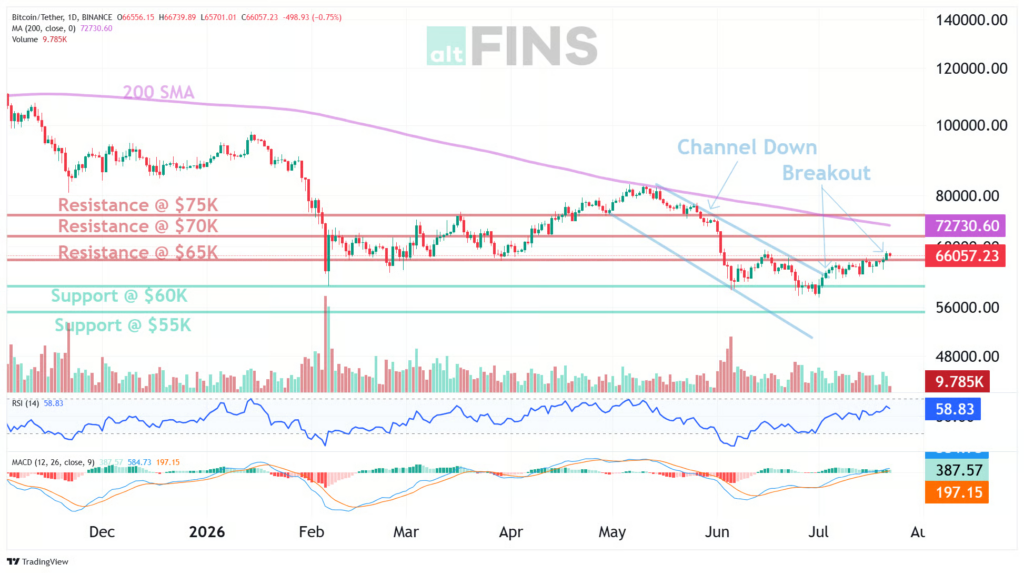
Bitcoin looked different this week because it finally got through a level that had been acting like a ceiling. The latest BTC input put price near $66,128 on July 23, down only 0.03% on the day and up 2.07% over the week, after repeated rejections near $65,000 earlier this month. Bitcoin is still 47.61% below the October 6, 2025 high near $126,218. Buyers are now defending a reclaimed breakout zone instead of begging for one.
Source: https://altfins.com/technical-analysis
The chart is better at the front end than underneath. Short-term direction is up, medium-term direction is neutral, and long-term direction is still strongly down in the input set. MACD remains positive, RSI-14 is neutral, and price is sitting under the upper Bollinger Band near $66,437. The level map is simple enough: support sits near $60,000, then $55,000, while resistance comes in at $70,000 and then $75,000. That makes $70,000 the first real proof point. A break above $65,000 helped. A hold above it matters more.
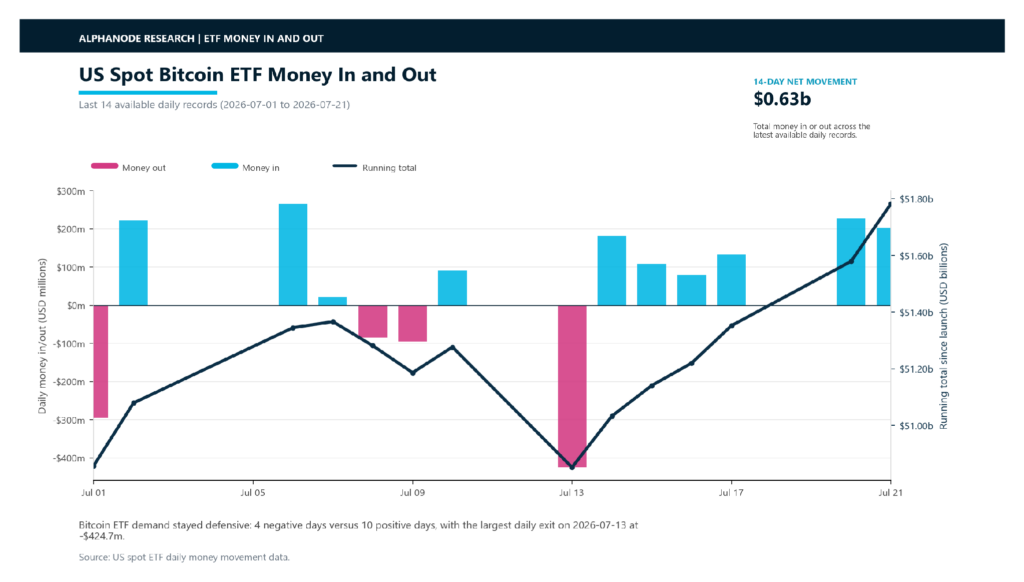
ETF demand supported the move instead of fighting it. The latest 14 available SoSoValue records show $630.2 million entering US spot Bitcoin ETFs from July 1 through July 21, with 10 positive days against 4 negative days. The latest two prints were strong at $226.9 million on July 20 and $203.1 million on July 21, lifting net assets to $80.94 billion and cumulative net money entering the funds to $51.78 billion. ETF buyers are supporting the move without carrying the whole market. The late-June drag has turned into a tailwind for now.
Source: https://sosovalue.com/assets/etf/us-btc-spot
The harder part of the Bitcoin story is who is buying and who is stepping back. Strategy’s decision to raise cash reserves to $3.2 billion without adding more BTC showed more balance-sheet caution than the market had grown used to. Miners told a similar story from another angle. Hut 8’s $9.8 billion AI lease showed where management teams think the next revenue stream is. Bitcoin mining still matters. Investors are now being asked to value a second business alongside it.
The policy backdrop improved more than the balance-sheet backdrop did. The CLARITY Act ethics deal gave Bitcoin a clearer Washington headline than it had a week ago, and the five-day run of money entering Bitcoin ETFs gave buyers a cleaner near-term demand story. Those two things fit together. Bitcoin trades better when the rulebook looks closer and the fund channel stops leaking.
The risk is that this market still sits under a long shadow. Oil near $90, tariff threats, and fresh caution from public-company BTC buyers can stall a breakout quickly. If buyers hold $65,000 and press through $70,000, the next leg has room. If $70,000 rejects and economic fear takes the lead again, Bitcoin can slip back into the same frustrating range it just escaped. This week improved the setup. It did not settle the case.
Ethereum Market Analysis
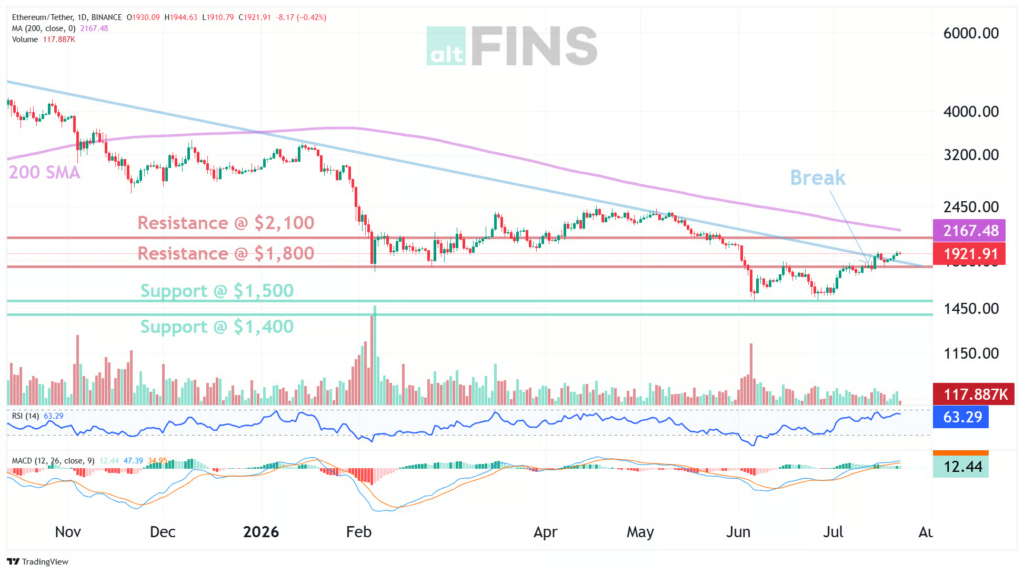
Ethereum’s week was cleaner in the ETF data than it was on the chart. The latest ETH input put price near $1,934 on July 23, almost flat on the day and up 0.86% over the week. The structure underneath it improved after ETH reclaimed $1,800 and held above it. ETH is still 60.98% below the August 24, 2025 high near $4,957, so the move remains a recovery trade, not a full trend change.
Source: https://altfins.com/technical-analysis
The chart tells a more measured story than Bitcoin’s. Short-term direction is up, medium-term direction is neutral, and long-term direction is still strongly down. RSI-14 is neutral, MACD is positive, and faster oscillators are already leaning hot after the rebound. Support sits at $1,500, then $1,400. Resistance is higher at $2,100. That makes ETH’s next test less crowded than Bitcoin’s. The market does not need to clear several layers at once. It needs to show that $1,800 stays reclaimed and that buyers can push into the $2,100 area without fading immediately.
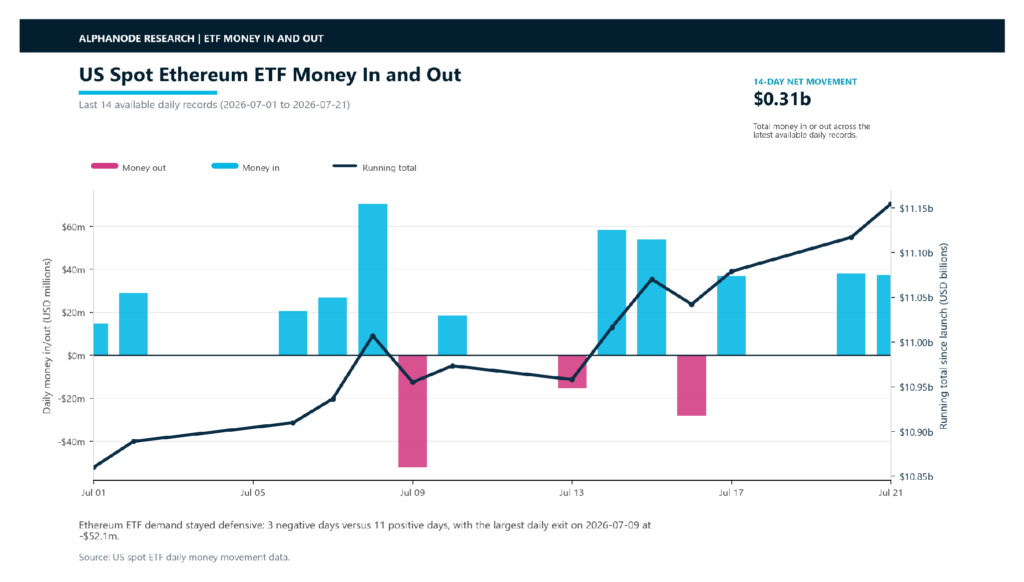
Money entering ETFs gives ETH its best weekly argument. Across the latest 14 available SoSoValue records, US spot Ether ETFs took in $309.4 million, with 11 positive days and only 3 negative days. The most recent prints were $38.1 million on July 20 and $37.5 million on July 21, which lifted net assets to $10.48 billion and cumulative net money entering the funds to $11.15 billion. Bitcoin’s dollar total is larger. Ethereum’s streak is steadier. That is why ETH has looked better in the fund channel even when price has moved more quietly.
Source: https://sosovalue.com/assets/etf/us-eth-spot
The company-level ETH story was less comfortable. BitMine slowed its Ether purchases to buy back $86 million of stock, adding only 7,430 ETH last week as it neared a 5% supply-ownership goal. The treasury bid remains active, while equity-market signaling takes priority when management teams think their own stock is cheap. Public-company demand for ETH still depends on those companies’ share prices.
Ethereum also has a different narrative mix than Bitcoin. There was no single Washington headline carrying ETH this week. Instead, ETH kept getting help from ETF money entering the funds, a less damaged chart, and the broader idea that more financial products will sit on chain if policy friction keeps easing. That is slower than a Bitcoin breakout. It is also less dependent on one price level or one corporate buyer.
ETH has the cleaner short-term path if the market mood stays constructive. A hold above $1,800 followed by a move through $2,100 would put price and ETF demand in the same direction. The main risk is not some hidden technical trap. It is that large ETH buyers are already showing more caution while the broader market is still exposed to oil, tariffs, and policy disappointment. Ethereum is improving. It still needs follow-through.
The CLARITY Act Becomes the Week’s Lead Policy Trade
The CLARITY Act mattered this week because it stopped feeling abstract. The White House-backed ethics deal gave traders something concrete to price, and Treasury Secretary Bessent’s “1-yard-line” line made the timeline feel close. That is a stronger catalyst than another vague promise about long-term innovation.
The market also had a reason to believe the policy story could affect prices quickly. Bitcoin was already pressing into resistance, ETF money was already turning positive, and public-company buyers had stopped giving the market easy reassurance. In that setup, a better Washington headline does more than improve sentiment. It fills the gap left by more cautious balance sheets.
Policy momentum can reverse faster than chart momentum. Senate timing, ethics language, and election-year politics can still slow the bill even after a cleaner headline week. The CLARITY story helped spark the move. It has not locked in the outcome.
Miners Chase AI Revenue While Balance Sheets Tighten
The miner story has become less about hash rate and more about capital allocation. Hut 8’s $9.8 billion AI lease shows how aggressively listed miners are trying to attach themselves to AI compute demand. They are not doing that because Bitcoin mining suddenly got easy. They are doing it because investors will pay more for a growth story tied to AI infrastructure than for a pure mining multiple.
That strategy has a real appeal. AI contracts can diversify revenue and give miners a way to use power, land, and data-centre experience outside the token cycle. It also has a cost. Big leases, long buildouts, and capital-market dependence can tighten the very balance sheets that made these firms interesting when Bitcoin was rising.
Miners sit inside Bitcoin’s supply plumbing and its equity narrative. If the AI pivot works, investors can stop valuing miners as simple proxies for BTC. If it strains capital or execution, the same companies can become another source of stress. This week, the market chose to like the ambition. It has not yet tested the bill.
Mark Your Calendars
Economic Data Releases:
- July 28, 2026 (Tuesday): FOMC meeting begins
- July 29, 2026 (Wednesday): FOMC rate decision and press conference
- July 30, 2026 (Thursday): GDP (Advance Estimate), 2nd Quarter 2026
Token Unlock
- July 25, 2026 (Saturday): Humanity (H) unlocks about $15.84 million (8.6% of reported circulating supply)
- August 1, 2026 (Saturday): Sui (SUI) unlocks about $10.48 million (0.34% of reported market cap), with approximately $1.51 million emitted over the next 7 days
- August 5, 2026 (Wednesday): Ethena (ENA) unlocks about $15.48 million (1.97% of reported market cap)
- August 5, 2026 (Wednesday): Succinct (PROVE) unlocks about $40.66 million (104.17% of reported market cap)
- August 6, 2026 (Thursday): Hyperliquid (HYPE) unlocks about $590.44 million (2.42% of reported market cap)