
Crypto Retreats While Wall Street Keeps Buying
3rd September 2026 • 8 mins read
This Week’s Recap
- Twenty-one global banks agreed to build a jointly owned dollar stablecoin: Citi, Goldman Sachs, Bank of America, UBS, Deutsche Bank, MUFG and more than a dozen other institutions across North America, Europe, East Asia, the Middle East and Africa are forming a new company to issue a regulated dollar token built for GENIUS Act and MiCA compliance. A euro-denominated token is next on the group’s list, and a first-half-2027 launch would put a bank-owned stablecoin directly against Circle and Tether.
- New Jersey asked the Supreme Court to settle who regulates prediction markets: The state’s 332-page cert petition follows a Third Circuit ruling that event contracts are CFTC-regulated derivatives, filed the same week a Ninth Circuit decision found states can treat them as sports betting. The circuit split gives the Court a cleaner reason to take the case than a single lower-court ruling would.
- Ethena launched a self-custodial neobank app on Avalanche: Ethena Pay pays up to 6% APY across three tiers and up to 10% cashback, live in more than 50 countries on iOS after starting with roughly 400 early-access users. The tiered structure rewards larger balances rather than offering a flat headline rate, a design built to hold deposits rather than just attract them.
- Wyoming added Chainlink verification to its state-issued stablecoin: The state’s Stable Token Commission adopted Chainlink’s Proof of Reserve for FRNT, requiring verified reserves before new tokens can be minted. The Secure Mint gate closes off the kind of infinite-mint failure that has hit smaller stablecoin projects, and it builds on FRNT’s move of $15 billion in onchain value to Chainlink’s CCIP earlier in August.
- Remixpoint sold every altcoin it held to go Bitcoin-only: The Japan-listed firm liquidated 901 ETH, 13,920 SOL, 1.19 million XRP and 2.8 million DOGE for roughly $5.5 million, booking a $737,000 gain, and now holds about 1,506 BTC. A single-asset treasury is a bet that simplicity beats diversification once a company decides Bitcoin is the balance-sheet asset it wants to defend.
- OpenAI said its newest model crossed a critical cybersecurity threshold: Astra found two new vulnerabilities and chained operating-system flaws into root access without step-by-step human guidance, the first OpenAI model to reach that mark under the company’s own Preparedness Framework. OpenAI is restricting the most dangerous capabilities to a small number of partners, but exchanges and custodians should treat autonomous exploit generation as a live threat model rather than a future one.
- Adam Back put another $8.8 million into Capital B: The private placement, priced at a 15.4% premium, funds 376 BTC toward a 3,521 BTC target and lifts Back’s stake to 17.77%. Capital B now ranks 26th among public Bitcoin treasury companies, evidence that the treasury-company model still has fresh capital behind it even after two years of imitators.
- Bitcoin liquidations topped $100 million as US strikes hit Iran: Total crypto liquidations reached $431 million on August 31, split roughly $100 million in Bitcoin and $130 million in Ether, before a further $91 million in Bitcoin longs were wiped out on September 2. Bitcoin absorbed the geopolitical shock without breaking its monthly uptrend, but leveraged positioning is doing the moving now, not spot demand.
- The Senate scheduled a September 15 vote on the CLARITY Act: Majority Leader John Thune filed cloture on the market-structure bill as SEC Chair Paul Atkins said he expects it to reach the president’s desk. The SEC is drafting its own rules in parallel in case the bill falls short of the 60 votes it needs, giving the industry a fallback even if Democratic support does not materialize.
- July hiring data showed the labor market losing momentum: Hires fell to 5.054 million against 5.072 million separations, and nonfarm payrolls for the month were revised to a 23,000 decline against a forecast 80,000 gain. Two months of prior revisions cut a combined 103,000 jobs, pulling the three-month average payroll gain down to about 20,000 and adding pressure on the Fed heading into its September meeting.
- The Dutch central bank moved 86 tonnes of gold out of North America: New York and Ottawa’s combined share of Dutch reserves fell from roughly 51% to 37% between March and August, with London’s share rising to 32.1%. Central banks repositioning physical gold over “geopolitical unrest” is the same instinct driving flows into Bitcoin, just moving at a much slower, more deliberate pace.
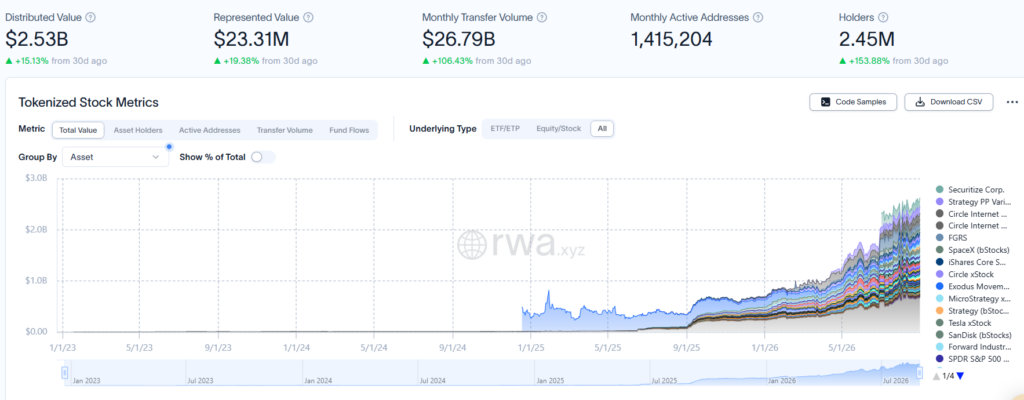
- Tokenized stock transfer volume jumped 415% in 30 days to $29.5 billion: Holders of onchain equities climbed to as many as 2.45 million, up more than 150% over the same month, according to RWA.xyz data. The growth predates this week’s LSE announcement, suggesting tokenized equities were already accelerating before any single exchange made the trend official.
Bitcoin Market Analysis
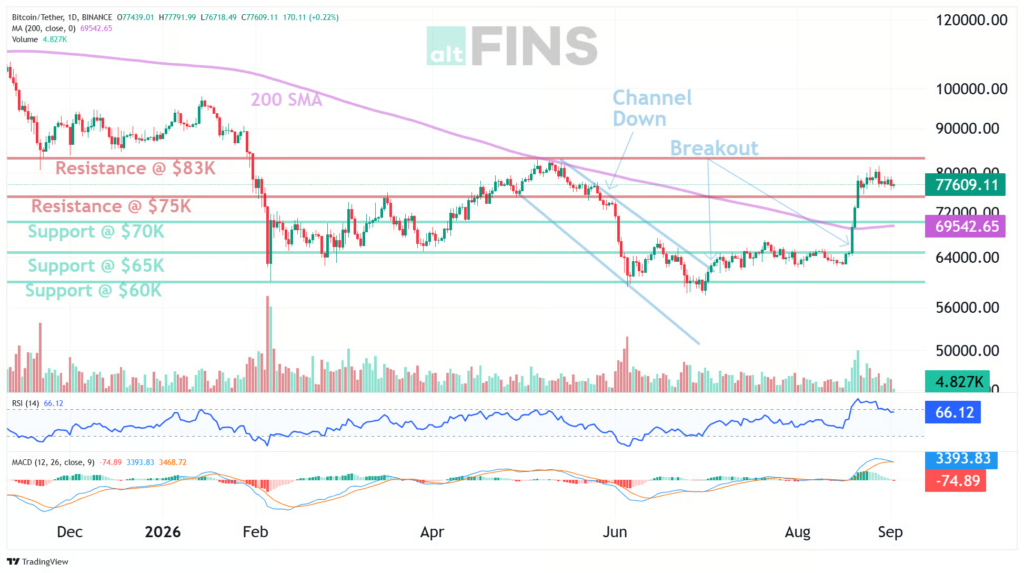
Bitcoin opened the week at $79,024 on August 27 and closed September 2 at $77,433, a 2.01% decline. Friday added 1.55% before Saturday erased it with a 3.00% drop to $77,846, the week’s sharpest single move. The next four sessions chopped in a tighter band: Sunday gained 0.49%, Monday lost 0.70%, Tuesday added 1.16%, and Wednesday gave back 1.45% to $77,439. Wednesday’s early high reached $81,479 before sellers pushed price down to a $76,264 low by Thursday, a $5,215 span equal to roughly 6.6% of the opening price. Unlike the prior week’s one-directional breakout, this was a give-back week: every session that added ground was followed within a day or two by one that took some of it away.
Source: https://altfins.com/technical-analysis
The chart still reflects last month’s advance more than this week’s pullback. Spot sits 11.35% above the 200-day simple moving average at $69,542, 13.59% above the 50-day average, and 4.79% above the 20-day average at $73,891. But the shorter averages have flipped: price is now 0.57% below the five-day average and 1.24% below the ten-day average, the first time in weeks the immediate trend has turned down against the medium-term one. AltFins still frames the broader picture as a confirmed uptrend after the earlier break above $70,000 and the 200-day average, with the $65,000 to $70,000 band marked as the structural support and $83,000 as the next resistance test.
Momentum diverges sharply depending on the lookback window, which is itself the story. RSI-14 sits at 70.5, still on the strong side, but RSI-9 has dropped all the way to 39.7, showing that the short-term trend has already cooled even as the longer measure has not caught up. MACD has turned bearish on the crossover, with the line at 3,379 against a 3,465 signal and a histogram of negative 86, the first negative reading after last week’s strong positive run. ATR-14 of $2,900 works out to roughly 3.7% of spot, so the week’s full range was equivalent to about 1.8 ATRs, an ordinary pullback rather than a breakdown.
Source: https://sosovalue.com/assets/etf/us-btc-spot
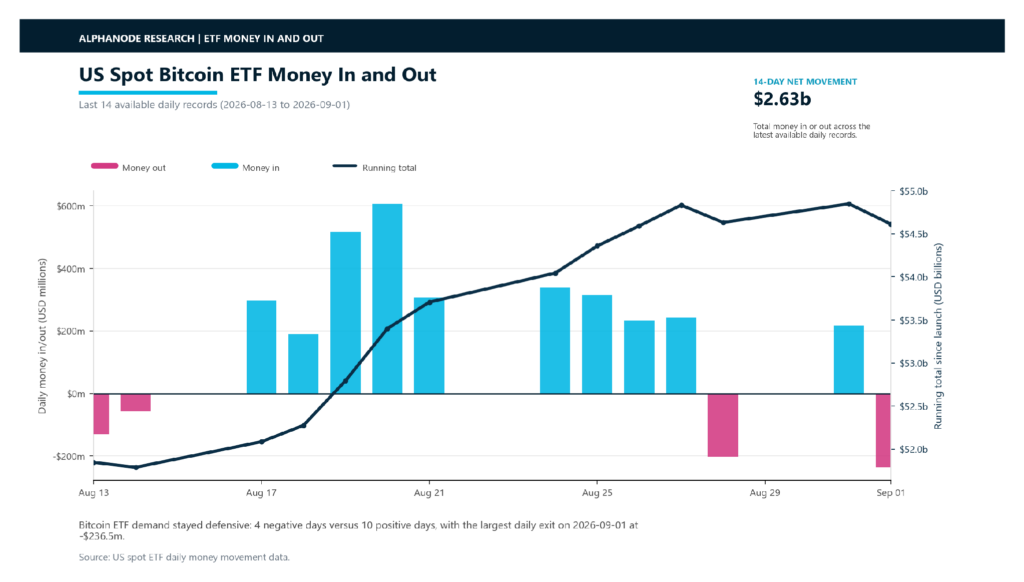
US spot Bitcoin ETFs still bought Bitcoin through this stretch, just less consistently than the prior week. The 14-session window from August 13 to September 1 produced 10 positive days against 4 negative ones for a net $2.63 billion, with net assets ending at $97.12 billion and cumulative inflows since launch at $54.61 billion. The negative days cluster at the edges: a small pullback on August 13 to 14, then the week’s two exits on August 28 (negative $201.8 million) and September 1 (negative $236.5 million, the largest single outflow in the dataset). Positive days in between, including $606.3 million on August 20 and $337.6 million on August 24, were large enough to keep the period net positive despite the September 1 exit landing right as spot tested its weekly low.
Bitcoin absorbed a geopolitical shock without losing its monthly trend. US strikes on Iran triggered $431 million in crypto liquidations on August 31, with roughly $100 million of it in Bitcoin positions, and a further $91 million in BTC longs were liquidated on September 2 near the $76,000 level. Both events landed inside this week’s normal trading range rather than forcing a break of it, which says more about how leveraged the move was than about spot conviction either way. A market that shrugs off a Middle East strike but still gives up 2% on ETF profit-taking is pricing macro risk and crowded positioning very differently.
Next week brings the August jobs report on September 4, producer prices on September 10 and consumer prices on September 11, with the Fed’s September 15 to 16 meeting sitting just beyond the report window. A close that holds the $76,264 low and the reclaimed $73,000 to $75,500 band would keep the medium-term uptrend intact and leave $81,000 to $83,000 as the next test on any data-driven bounce. A break below $73,000 would put the 20-day average in play for the first time since the breakout began, and would shift the conversation from a pause inside an uptrend to a genuine correction.
Ethereum Market Analysis
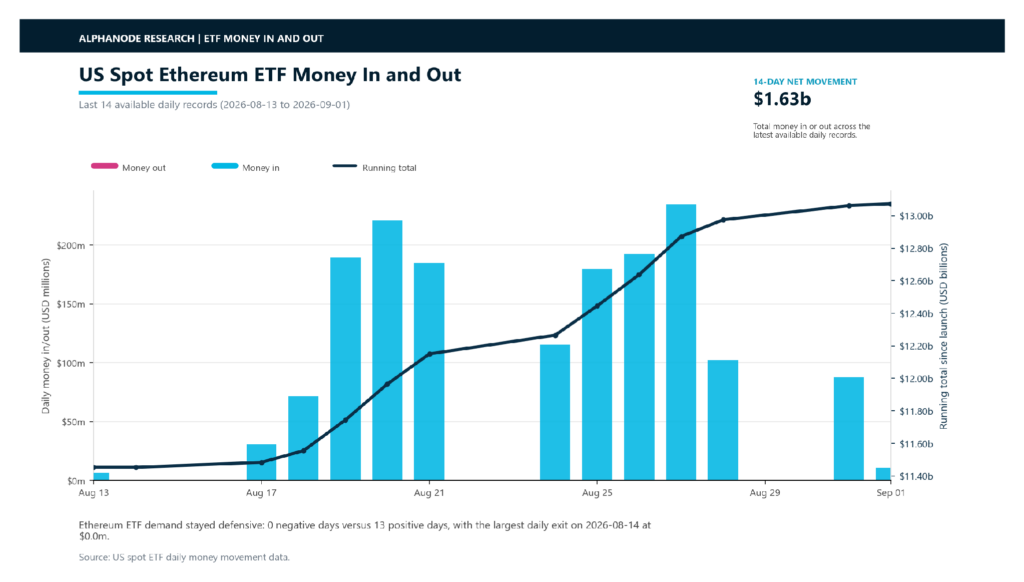
Ether’s ETFs told a cleaner story than its price did. US spot funds recorded 13 consecutive positive days across the full 14-session window from August 13 to September 1, the only negative mark a flat $0 print on August 14, for $1.63 billion in net inflows. Net assets rose from $10.57 billion to $15.21 billion over the period, and cumulative inflows since launch reached $13.07 billion. The pace did slow into the close: September 1’s $11.0 million was the smallest daily print of the entire streak, a fraction of the $220.8 million and $234.5 million days from two weeks earlier. Consistency, not size, is what carried Ether’s tally through a week when price gave up ground.
Source: https://altfins.com/technical-analysis
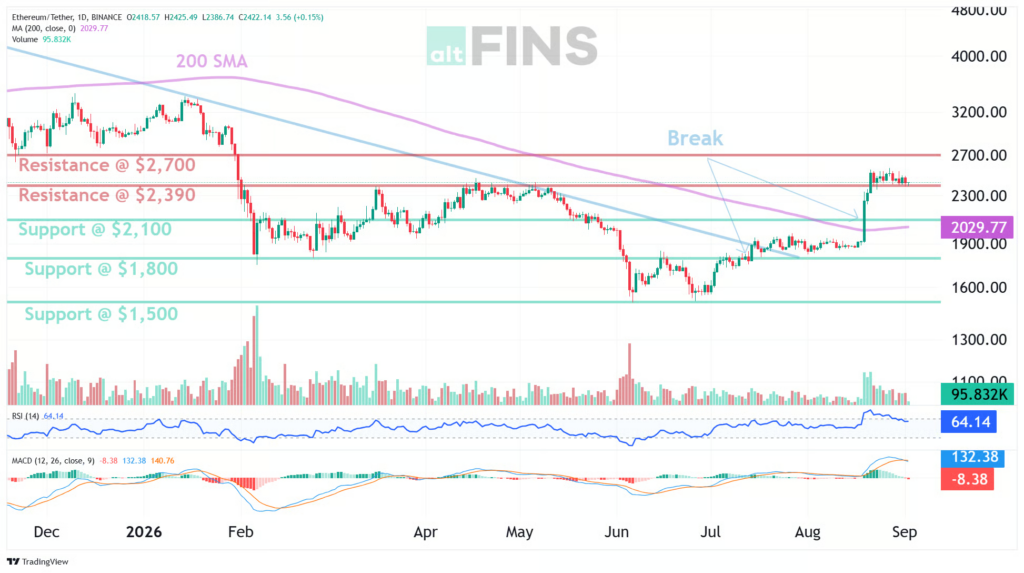
Price moved the other way. Ether opened at $2,507 on August 27 and closed September 2 at $2,396, a 4.40% decline that outpaced Bitcoin’s drop by more than double. The week’s high of $2,567 came early, on Thursday the 27th, before Friday’s 2.71% slide to $2,443 set the tone. Saturday and Sunday clawed back some ground, Monday added another 2.10%, but Tuesday and Wednesday each fell more than 1.9%, dragging the close down to a $2,356 low on the final session. The $211 range between high and low equaled 8.4% of the opening price, a narrower proportional swing than Bitcoin’s but concentrated almost entirely to the downside after Thursday.
AltFins still reads the setup as constructive further out. Its curated view has Ether clearing its descending trendline and the 200-day average, calling $2,400 the nearest resistance and marking $2,000 to $2,100 as the level buyers would want to see tested on any deeper pullback, with $1,500 and $1,400 as support further below. The moving averages back that framing: spot remains 4.20% above the 20-day average, 16.62% above the 50-day average and 18.07% above the 200-day average, even after a week that felt worse than those numbers suggest.
Source: https://sosovalue.com/assets/etf/us-eth-spot
Momentum is cooling from a lower base than Bitcoin’s, which leaves Ether more room before it becomes genuinely overbought again. RSI-14 sits at 59.3 against Bitcoin’s 70.5, and RSI-9 has fallen to 37.9, mirroring Bitcoin’s short-term pullback in relative terms. MACD flipped negative on the crossover here too, with a histogram of negative 10 against a 130 line and 140 signal. ATR-14 of $114 is about 4.8% of spot, meaning this week’s full range covered less than two ATRs, ordinary volatility rather than a breakdown in the making.
Ether’s underperformance shows up plainly against Bitcoin. The ETH/BTC ratio slipped from roughly 0.03173 at the week’s open to 0.03094 at the close, a 2.5% relative decline that tracks almost exactly with the gap between the two assets’ weekly returns. Ethena’s new payments app is a reminder that stablecoin and DeFi activity keeps building on and around Ethereum’s ecosystem even when ETH itself lags; Ethena Pay’s yield and cashback tiers depend on infrastructure that still settles largely on Ethereum rails, whatever chain the app-layer branding points to.
The same September calendar that frames Bitcoin’s next move applies here, with one addition: a Senate vote on the CLARITY Act is scheduled for September 15, a day before the Fed’s decision. Market-structure clarity would matter more for Ethereum than for Bitcoin, given how much of the ecosystem’s value sits in staking, DeFi collateral and tokenized assets that a plain spot-Bitcoin framework does not address. A close back above $2,450 would repair some of this week’s damage and put the $2,567 high back in range; a slide through $2,356 would open the door toward the $2,300 area where the 20-day average currently sits.
London Joins the Race to Tokenize Stocks
The London Stock Exchange is putting its name behind tokenization rather than watching from the sidelist. Its new agreement with Payward, Kraken’s parent company, will build a 24/5 venue called LSE 24 for tokenized UK equities, targeting a 2027 launch. A 133-year-old exchange partnering with a crypto-native company to run round-the-clock equity trading is a bigger signal than another startup launching a tokenized-stock product, because LSE has regulatory standing and issuer relationships that a new entrant would need years to build.
Source: https://cointelegraph.com/news/london-stock-exchange-partners-kraken-for-tokenized-uk-stocks
The data behind the deal shows why LSE moved now. RWA.xyz figures cited alongside the announcement put the total value of tokenized stocks onchain at $2.53 billion, up 15% in 30 days, with monthly transfer volume up more than 100% to $26.79 billion and holders climbing 154% to 2.45 million. A separate RWA.xyz dataset published days earlier showed even faster growth in transfer activity, up 415% to $29.5 billion in a month. Whichever exact figure holds by the time LSE 24 launches, the direction is the same: tokenized equities went from a niche product to a market growing faster than most crypto-native sectors in the space of one quarter.
Execution risk is still real. A 2027 target gives LSE more than a year to navigate UK securities law, custody standards and market-maker onboarding before a single share trades on the new venue, and Kraken’s own parent company has already pushed back an unrelated IPO to 2027. Tokenization has produced plenty of pilots that never scaled past a press release. What LSE brings that a pilot doesn’t is distribution: existing issuers, existing investors and an incumbent’s incentive to make sure the successor market doesn’t get built entirely without it.
Wall Street Quietly Piles Into XRP ETFs
Goldman Sachs’ latest 13F filing shows a bank that spent the quarter buying into an asset class it mostly avoided outright ownership of. Its XRP exposure across six ETFs, including funds from Bitwise, Franklin, Canary and Grayscale, rose to $87.4 million, an $83.1 million increase and the largest jump of any institutional filer in the category. Investment advisers as a group hold roughly $120 million of the $183 million in XRP ETF exposure disclosed so far, meaning Goldman alone accounts for close to half of the professionally managed money in the space.
Source: https://sosovalue.com/assets/etf/us-xrp-spot
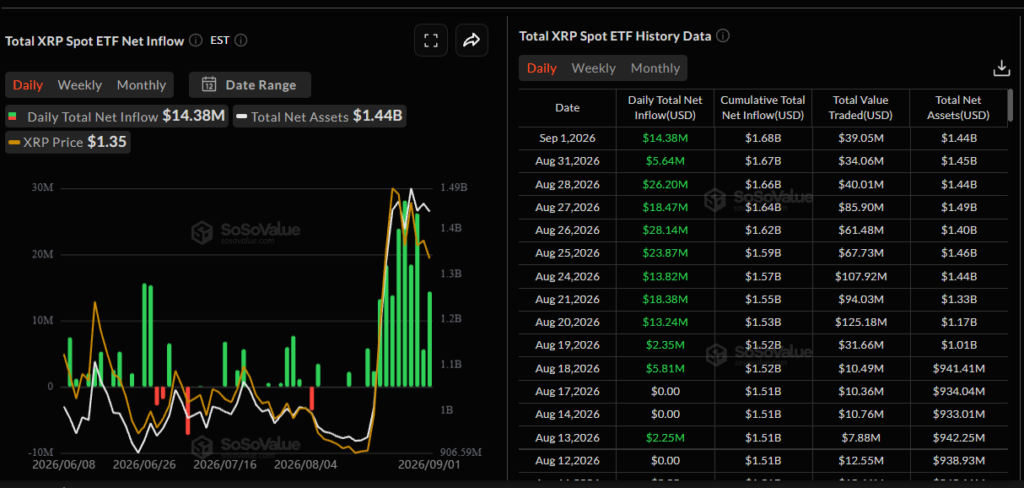
The flow data backs up the filing. SoSoValue’s dashboard shows US spot XRP ETFs pulling in $14.38 million on September 1 alone, part of an eleven-session run of positive days that pushed cumulative net inflows since the November launch to $1.68 billion. The daily chart shows a clear inflection in the final days of August, when net inflows jumped from single-digit millions to $18 million, then $26 million, coinciding with the period Goldman’s position would have been building. Total net assets across the five tracked funds now sit at $1.44 billion, equal to about 1.7% of XRP’s total market capitalization.
None of this makes XRP a Bitcoin or Ethereum-style institutional holding yet. The dollar figures are a fraction of what flows through BTC and ETH funds in a single day, and a single quarter’s 13F filing is a snapshot, not a commitment. But a bulge-bracket bank building a nine-figure position through regulated wrappers, rather than staying on the sidelines the way most large banks have with altcoins, is exactly the kind of incremental legitimacy that XRP’s backers have spent years arguing was coming.
Mark Your Calendars
Economic Data Releases:
- September 10, 2026 (Thursday): CPI and Core CPI.
Token Unlock
- September 5, 2026 (Saturday): Ethena (ENA) unlocks US$25.53 M (1.92% of released supply).
- September 6, 2026 (Sunday): Hyperliquid (HYPE) unlocks US$35.06 M (0.19% of released supply).