There is a hard date inside the soft date. Most Australian financial professionals know the Digital Assets Framework commences on 9 April 2027. Far fewer know that ASIC has set 30 June 2026 as the cliff for licensing applications. Providers of financial services involving digital asset financial products that miss it face civil and criminal penalties under financial services law, including fines of up to ten percent of annual turnover [1]. The window is shorter than the public conversation suggests.
What is the 30 June 2026 deadline?
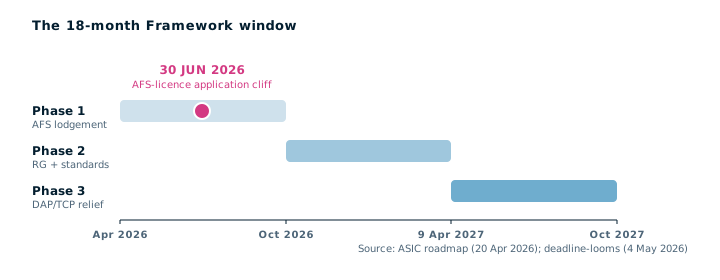
The 30 June 2026 deadline is the date by which providers of financial services involving digital asset financial products must apply for the relevant ASIC licence (or notify ASIC of an intention to apply). On the same date, the class no-action position attached to ASIC Information Sheet 225 — the regulatory comfort that has let some digital asset businesses run without strict licensing while the Framework was being drafted — expires [1][2].
The deadline sits in the first phase of ASIC’s 18-month implementation roadmap, published on 20 April 2026. Phase 1 (April to October 2026) is the consultation and licensing-application phase. Phase 2 (October 2026 to April 2027) is when the new Regulatory Guide for digital asset platforms and tokenised custody platforms will be released. Phase 3 (April to October 2027) is when DAP and TCP operators will lodge applications for the new authorisations created by the Act, and run under regulatory relief while ASIC processes them. Full ASIC enforcement begins after that [3].
The 30 June deadline is a Phase 1 event. The DAP and TCP applications come later. Providers that confuse the two timelines miss the point: the question on 30 June is not whether you have the right Framework category yet. The question is whether you have the right financial services licence at all.
Who does this apply to?
This applies to anyone whose business involves financial services in relation to digital asset financial products. ASIC’s wording is broad. “Providers of financial services involving digital asset financial products” captures spot exchanges, custodians, brokers, asset managers, lenders, and platforms operating any of the financial-product-style services described in INFO 225 [1][2].
The practical filter is simple. If your operation deals with digital assets that fall within the existing meaning of a financial product under the Corporations Act 2001 (Cth), or with services in relation to those products, you are inside the deadline. The Framework will create new categories from 9 April 2027 (digital asset platforms and tokenised custody platforms), but the 30 June 2026 deadline is governed by the existing financial services regime, not the new categories.
Providers outside the perimeter still need to confirm where they sit. ASIC has been explicit that the period between Royal Assent and commencement is a transition window with active obligations, not a grace period before them [3].
What licensing options does the deadline cover?
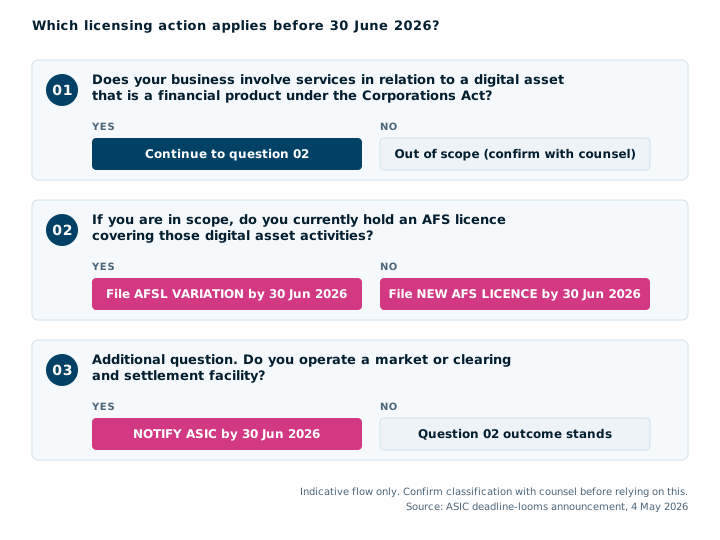
The deadline applies to four licensing actions, depending on the provider’s existing position [1]:
- A new Australian Financial Services (AFS) licence — for providers that have been running without an AFSL and now sit within scope.
- A variation to an existing AFS licence — for providers that already hold an AFSL but whose authorisations do not currently cover the digital asset financial products they offer.
- Notification of intention to apply for an Australian Market Licence — for operators of trading venues that meet the relevant threshold.
- Notification of intention to apply for a Clearing and Settlement (CS) facility licence — for operators of clearing and settlement infrastructure.
The first two (AFS new and AFS variation) are the most common path for digital asset providers. A platform that lists, executes, or holds digital asset financial products will typically need either a new AFSL or a variation that adds the relevant authorisations. The Market Licence and CS facility paths apply to a smaller set of venues and infrastructure providers.
The Framework’s new DAP and TCP authorisations are not part of the 30 June lodgement. Those become available in Phase 3 of the roadmap, beginning at commencement on 9 April 2027 [3]. The 30 June deadline is about the existing AFS regime — providers must be inside that regime, then move into the new DAP or TCP category from commencement onward.
What happens to providers that miss the deadline?
Missing the deadline exposes providers to civil and criminal penalties under financial services law. ASIC’s published wording sets the upper bound at fines of up to ten percent of annual turnover [1]. The penalty range extends to court-ordered disgorgement, banning orders against responsible managers, and, in serious cases, criminal prosecution.
Beyond the penalty, the practical loss is regulatory comfort. Until 30 June 2026, the INFO 225 class no-action position has functioned as the implicit licence — providers inside its perimeter could run without facing immediate ASIC enforcement, on the understanding that they were working toward a compliant position [2]. After 30 June, that comfort is gone. Providers outside a current AFS authorisation, with no application or notification on file, are exposed to the full enforcement posture of the Corporations Act 2001 (Cth) and the Australian Securities and Investments Commission Act 2001 (Cth).
The downstream effect is also commercial. Platforms that lose their regulatory comfort lose their banking relationships, their adviser distribution, and their institutional counterparties. A missed deadline is rarely a single-line consequence. It cascades.
How does this affect financial advisers?
The deadline reshapes adviser due diligence on the platforms they recommend. The Framework does not rewrite the best interests duty, the safe harbour, or the Statement of Advice regime [4]. It changes the facts an adviser must reasonably consider when a client raises digital assets. Until 30 June 2026, adviser due diligence on a digital asset platform could reasonably defer to the INFO 225 class no-action position. After 30 June, it cannot.
Adviser due diligence after 30 June 2026 reasonably extends to verifying that any digital asset platform recommended has either lodged an AFS licence application by the deadline or sits inside an existing AFSL with the relevant authorisations. Platforms that miss the cliff move outside the perimeter advisers should reasonably be recommending. 15,469 financial advisers were on the ASIC Financial Advisers Register as at 20 November 2025 [5]. Every one of them faces the same 30 June filter on the platforms they consider for client recommendations from 1 July onwards.
What should providers do this month?
The window is six weeks. The action set is concrete:
- Determine which licensing path applies. New AFS licence, AFS variation, Market or CS notification of intent. AFS new or AFS variation is the more common path for digital asset providers that hold financial products at the asset or service level. Market Licence and CS facility paths apply to a smaller set of trading venues and clearing infrastructure operators.
- Engage counsel and an authorised licence consultant. ASIC AFSL applications take months to prepare even in the best case. By the deadline, providers need either a lodged application or a clear notification of intent. Lodging an incomplete application is not a placeholder — ASIC will assess the substance.
- Identify responsible managers. Each AFSL nominates RMs against the authorisations sought. For digital asset financial products, ASIC will look for relevant experience and competence in the specific products and services proposed.
- Map services to authorisations. AFSL conditions are granular. A spot-only execution venue requires a different authorisation set than a custodial-style platform offering both execution and holding. The mapping must be complete at lodgement.
- Document the financial-resources position. Phase 2 of the roadmap will produce the new financial requirements regime for DAPs and TCPs. By 30 June, the existing requirements under Regulatory Guide 166 (cash and net tangible assets) apply [3]. Providers should be at least within the existing thresholds before lodging.
- Prepare for the post-commencement variation. From 9 April 2027, providers that have lodged an AFSL by the deadline will need to lodge a further variation to add the new DAP or TCP authorisations under the new categories.
ASIC’s contact for engagement is `fintech@asic.gov.au`. The fastest signal a provider can send right now is direct engagement.
How does this fit with the rest of the Framework rollout?
The 30 June deadline is the first of four dated events that providers and advisers should map. ASIC’s roadmap structures the period from Royal Assent (8 April 2026) to full enforcement (October 2027) across three six-month phases [3]:
| Date | Event | What changes |
|---|---|---|
| 30 June 2026 | INFO 225 class no-action position expires; AFS licence applications and Market/CS notifications due | Providers must have lodged an AFS licence application or be inside an existing AFSL covering their services |
| October 2026 | Phase 2 begins | ASIC publishes the new Regulatory Guide for DAPs and TCPs and finalises the standards instruments |
| 9 April 2027 | Framework commences | DAP and TCP categories activate; Phase 3 licensing window opens; AFCA jurisdiction over relevant disputes attaches |
| October 2027 | Full enforcement begins | Phase 3 licensing relief ends; ASIC’s full supervisory posture applies |
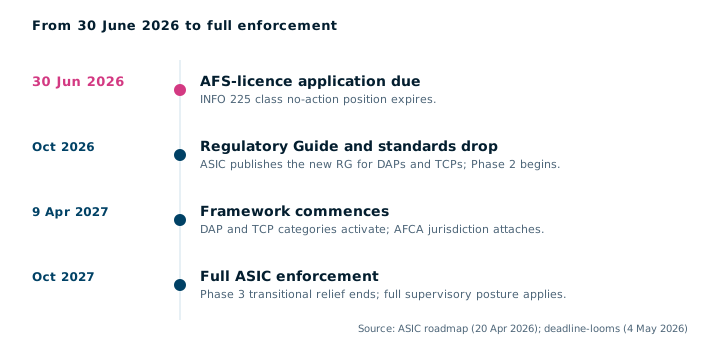
The first event is the most operationally consequential. Phase 2 produces guidance, but it does not impose a new compliance cliff for providers already inside the AFS perimeter. Commencement adds the new categories, but DAP and TCP operators run under regulatory relief during application processing. October 2027 is the end of the relief, not its beginning. The 30 June deadline is the only date that decides whether a provider is inside or outside the regulatory perimeter at all.
What about the new DAP and TCP authorisations?
The new authorisations come later. The Act creates two defined categories: digital asset platforms (DAPs) and tokenised custody platforms (TCPs), each with its own obligations under sections 912BE (asset-holding standards) and 912BF (transactional and settlement standards) [3]. Both categories will be administered by ASIC, drawing on the principles in Regulatory Guides 133 (custody), 166 (financial requirements), and 126 (compensation).
Providers do not lodge for these authorisations on 30 June. The DAP and TCP licensing window opens at commencement on 9 April 2027 and runs through October 2027 under regulatory relief. The path for most providers is therefore two-stage: lodge an AFS application (or variation) by 30 June 2026, then add the DAP or TCP authorisation from 9 April 2027 onward and become a DAP or TCP operator under the new regime.
The intervening 12 months are when the substantive standards get written. Stakeholder roundtables, the industry advisory group, and ASIC’s draft Regulatory Guide all run in Phases 1 and 2. Providers that engage early with ASIC’s consultation will see their operational realities reflected in the standards. Providers that wait will work to standards drafted around someone else’s.
Common questions
Does the 30 June deadline apply if our digital asset is not a “financial product”?
The deadline applies if the services involve a digital asset financial product. The classification of the underlying digital asset under the Corporations Act 2001 (Cth) is the gating question. ASIC INFO 225 sets out the analytical framework. Where the asset itself is not a financial product but the services around it (managed investments, derivatives, lending) are, the services trigger the licensing requirement. Providers uncertain about classification should obtain a written legal opinion before 30 June. ASIC has been explicit that the existing INFO 225 framework continues to apply through the transition window [2].
Can we lodge a partial application by 30 June and complete it later?
ASIC’s deadline-looms announcement specifies “apply for” the relevant licence or “notify ASIC of an intention to apply” [1]. A partial application is not a notification of intent, and a notification of intent is not an application. Providers should treat the deadline as requiring either a substantive lodged application (with the supporting material that lets ASIC assess it) or a documented written notification of intent under the Market or CS facility regime. Providers should not assume that a materially incomplete lodgement satisfies either standard. Confirm the lodgement standard with counsel before relying on a placeholder filing.
What about providers that are already AFSL holders but whose authorisations don’t quite cover digital asset products?
Those providers sit inside the AFS variation path. The variation must be lodged by 30 June 2026. The existing AFSL does not provide cover for digital asset financial products outside the scope of the existing authorisations. ASIC has not signalled any forbearance for AFSL holders that have not extended their authorisations to capture digital asset activities they are already conducting.
Does the 30 June deadline apply to wholesale-only providers?
The deadline applies to providers of financial services involving digital asset financial products. The wholesale/retail distinction affects the licence conditions and the consumer protection requirements that follow, not the question of whether the provider must be inside the licensing regime at all. Wholesale-only providers are not exempt from holding an AFS licence; they are exempt from some retail-facing obligations. The 30 June deadline still applies.
What happens to existing platforms that miss the deadline?
Providers that miss the deadline are exposed to civil and criminal penalties under financial services law, including fines up to ten percent of annual turnover, and to ASIC enforcement action that may include banning orders against responsible managers and court-ordered disgorgement [1]. The practical operational consequences are larger: lost banking relationships, lost adviser distribution, and lost institutional counterparties typically follow loss of regulatory comfort.
How does the 30 June deadline relate to AUSTRAC registration?
AUSTRAC registration as a digital currency exchange or virtual asset service provider is a separate regime from the Corporations Act licensing addressed by the 30 June deadline. AUSTRAC registration covers AML/CTF obligations under the Anti-Money Laundering and Counter-Terrorism Financing Act 2006 (Cth). Providers may need both AUSTRAC registration and an AFS licence (or variation), depending on their services. Holding one does not satisfy the other.
Where does this fit with the new DAP and TCP categories under the Framework?
The 30 June deadline addresses the existing AFS regime. The new DAP and TCP authorisations under the Framework activate at commencement on 9 April 2027. Providers take a two-step path: lodge an AFS application or variation by 30 June 2026, then add the DAP or TCP authorisation from 9 April 2027 onwards under Phase 3 regulatory relief and become a DAP or TCP operator under the new regime. Both steps matter. Skipping the first means there is no underlying licence for the second to attach to.
Where to start
Alpha Node is the regulated digital asset infrastructure layer Australian advice practices partner with: execution, custody, wholesale funds management, wholesale advice, and commercial lending. Practices engage the digital asset market without building the stack themselves [6].
If you are a provider, an adviser, or counsel weighing how to respond to the 30 June 2026 deadline, the appropriate next step is a conversation.
Book a partnership conversation →
Sources
- ASIC, “Deadline looms for digital asset businesses to apply for a licence”, 4 May 2026. https://www.asic.gov.au/about-asic/news-centre/news-items/deadline-looms-for-digital-asset-businesses-to-apply-for-a-licence/ ↩
- ASIC Information Sheet 225, “Digital assets: Financial products and services” (no-action letter dated 29 October 2025; expiry 30 June 2026). https://www.asic.gov.au/regulatory-resources/digital-transformation/digital-assets-financial-products-and-services/ ↩
- ASIC, “ASIC’s roadmap for digital assets law reform implementation”, 20 April 2026. https://www.asic.gov.au/about-asic/news-centre/news-items/asic-s-roadmap-for-digital-assets-law-reform-implementation/ ↩
- Corporations Act 2001 (Cth) s 961B; FASEA Code of Ethics. https://www.legislation.gov.au/C2004A00818/latest/text ↩
- ASIC Financial Advisers Register snapshot, 20 November 2025 (15,469 relevant providers authorised). https://www.asic.gov.au/regulatory-resources/financial-services/financial-advice/financial-advisers-register/ ↩
- Alpha Node Global, regulatory authorisations. Alpha Node X Pty Ltd (ACN 689 717 422; AUSTRAC VASP 100903039); Alpha Node Capital Pty Ltd (ACN 603 150 634; AFSL 479974; AUSTRAC VASP 100612840-001); Alpha Node Capital Management Pty Ltd (ACN 675 404 047; CAR 1308193 of Alpha Node Capital; AUSTRAC VASP 100895147-001); Alpha Node Advisors Pty Ltd (ACN 154 320 000; AFSL 416956; AUSTRAC VASP 100282425-001); Alpha Node Finance Pty Ltd (ACN 675 410 116; Credit Representative 556504 of Fair Loans Foundation Pty Ltd, ACL 378968). https://alphanode.global/regulatory/ ↩