
Japan Rate Hike Builds Macro Pressure
18th December 2025 • 11mins read
This Week’s Recap
- Crypto investors show caution and shift to new strategies after a crash: Reuters reported investors moved toward more cautious positioning after a steep drawdown from the prior cycle high, with greater focus on hedging and drawdown control across ETFs, derivatives, and crypto-linked equities.
- Macro analysts warn Bitcoin could drop below $70K if Japan turns hawkish: Cointelegraph reported commentary linking downside risk in BTC to a potential Bank of Japan hike and a yen carry unwind, with $70,000 to $72,500 framed as a key downside zone.
- Bitfinex says spot volumes are down 66% in a market “lull”: Cointelegraph reported Bitfinex flagged a 66% drop in spot volumes from earlier peaks, with traders stepping back amid weaker flows and macro uncertainty.
- Bitcoin miners lean into renewables as margins tighten: Cointelegraph reported miners are pursuing renewable power to lower operating costs as hash price compressed toward levels described as near breakeven.
- J.P. Morgan Asset Management launches its first tokenized money market fund on Ethereum (MONY): J.P. Morgan Asset Management announced MONY, a tokenized money market fund available on the public Ethereum blockchain, distributed via its Morgan Money platform. The firm said the fund invests in traditional U.S. Treasury securities and fully collateralized Treasury repos, and that qualified investors can subscribe and redeem using cash or stablecoins. J.P. Morgan also said tokenization adds features like transparency and peer to peer transferability, with potential for broader onchain collateral use.
- BitMine adds about $140.58 M of ETH to its treasury, per onchain analysts: CoinMarketCap reports that onchain analysts attributed a 48,049 ETH purchase (about $140.58 M) to BitMine, and notes the firm has not officially confirmed the specific transaction. The same report says BitMine disclosed it holds 3,967,210 ETH purchased at an average price of $3,074, valuing the treasury at roughly $11.6 B at then current prices. The article also states BitMine bought 240,711 ETH in early December and has a long term goal of reaching 5% of circulating ETH supply.
- Coinbase pushes into stock trading and event contracts, partners with Kalshi: Reuters reports Coinbase said it will let users trade stocks and event contracts, as it broadens beyond crypto trading to compete more directly with brokerages. Reuters also reports Coinbase partnered with Kalshi for the event contracts rollout, and said it plans to launch tokenized stocks in coming months. Coinbase separately published product details saying stock trading and prediction markets are rolling out in the U.S., with stock trading in USD or USDC inside the main Coinbase app.
- Solana absorbs a 6 Tbps DDoS attack without downtime, CryptoSlate reports: CryptoSlate reports Solana faced a DDoS attack that peaked around 6 terabits per second and did not take the network offline. The report frames the outcome as a resilience signal versus earlier periods when congestion and outages were common discussion points. CryptoSlate also notes the market focus was less on drama and more on whether infrastructure performance held under stress, and in this case it did.
- U.S. regulator grants initial approval for crypto firms to launch national trust banks: Reuters reports the OCC gave conditional approvals involving Circle and Ripple for new national trust bank charters, and conditional approvals for BitGo, Paxos, and Fidelity Digital Assets to convert state trust charters into national ones. Reuters reports these charters would allow the firms to manage and hold assets and facilitate payments, but would not allow them to take deposits or make loans. Reuters also reports that final approvals are still required before the trust banks can begin operating.
- Senate punts crypto market structure bill to next year: CoinDesk reported the Senate would not hold a market-structure markup hearing this month, pushing the timeline into next year. The delay keeps core issues like oversight boundaries and legislative sequencing unresolved heading into early 2026.
- U.S. SEC gives implicit nod for tokenized stocks: CoinDesk reported DTCC said a subsidiary received an SEC no-action letter tied to offerings of tokenized real-world assets. The piece frames this as a concrete step toward regulated tokenization services for traditional securities on approved blockchains.
- Visa unveils a global Stablecoins Advisory Practice: Visa announced a consulting offering (via Visa Consulting & Analytics) to help clients with stablecoin strategy, use cases, and implementation. It positions stablecoins as a payments and treasury design problem, not just a crypto product, with Visa packaging advisory support alongside its settlement work.
- FDIC proposes GENIUS Act procedures for banks seeking to issue payment stablecoins: The FDIC announced a proposal to establish application procedures for FDIC-supervised institutions that want to issue payment stablecoins through a subsidiary. The move signals a shift from abstract policy debate to operational gatekeeping, defining how issuers would seek approval under the new framework.
- Bank of Canada says stablecoins should be backed by high-quality liquid assets: Reuters reported the Bank of Canada’s view that stablecoins should be regulated, pegged one-to-one, and backed by high-quality liquid assets such as treasury bills or government bonds. The message is that stablecoin credibility is being treated as a balance-sheet and redemption discipline issue, aligned with traditional money-like safeguards.
- TerraUSD creator Do Kwon sentenced to 15 years over $40 billion crypto collapse: A US federal judge sentenced Terraform Labs co founder Do Kwon to 15 years in prison over fraud tied to TerraUSD and Luna. Reuters reports prosecutors argued the Terra crash caused billions in losses and helped trigger a broader cascade of failures across the crypto market. The ruling is a high visibility precedent for how US courts are treating claims made around stablecoin mechanics and investor disclosures.
- CFTC withdraws “actual delivery” interpretive guidance for certain retail crypto transactions: The CFTC issued a notice withdrawing its prior interpretive guidance that had explained how it evaluated “actual delivery” in certain retail commodity transactions involving some digital assets. The document states the withdrawal is intended to reevaluate the guidance in light of how spot and connected derivatives markets have evolved, and that the earlier framework provided limited value and could conflict with current Commission work. Practically, this is a market structure headline because it signals a reset of how the agency frames a key definitional test that has influenced venue design and compliance posture.
- DTCC begins limited on chain Treasury test on Canton Network: DTCC said it will use the Canton Network for a pilot tied to its Depository Trust Company tokenized securities management service, focused on US Treasury related workflows. The release frames this as a controlled test with existing market participants, aimed at representing and managing entitlements in tokenized form while staying inside traditional post trade rails. It is a concrete step in the “tokenization as settlement plumbing” direction, because it puts a mainstream FMI at the center of an on chain pilot rather than a sidecar proof of concept.
- YouTube stablecoin payouts: Cointelegraph reports that YouTube added an option for US creators to receive payouts via PayPal’s PYUSD stablecoin. The significance is distribution, creator payouts are a high frequency, mainstream payment flow, so even “optional rail” support matters for stablecoin legitimacy as a consumer settlement instrument. The operational detail to track is whether usage concentrates in specific creator segments or corridors, because that determines whether PYUSD becomes a meaningful on platform unit of account or stays a niche withdrawal method.
- Binance offers up to $5 million for tips on fraudulent token “listing agents”: Binance announced a reporting portal for complaints about fraudulent intermediaries claiming to facilitate token listings, with potential rewards per case up to $5 million. The exchange positions this as an enforcement style program aimed at discouraging pay to list scams and improving integrity around the listing process. For readers, it is a venue risk headline because it highlights how much value is perceived to sit in primary listings, and how aggressively top venues are now policing that surface area.
Bitcoin Market Analysis
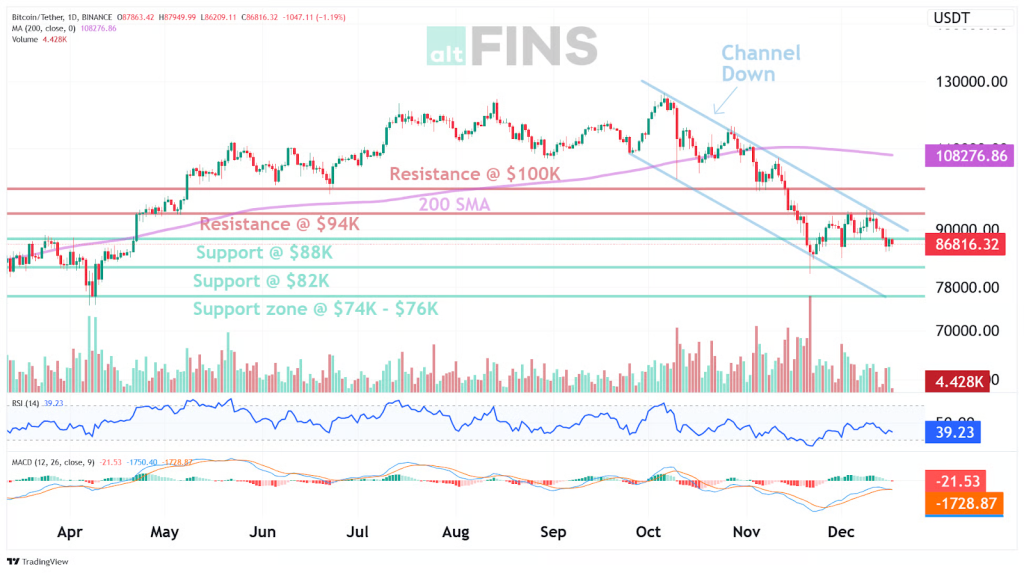
Bitcoin was traded lower across the last seven calendar days, with a weekly high of 92,744.6 and a weekly low of 85,228.8 being registered inside the window. A close-to-close decline from 90,272.0 to 86,832.5 was recorded over the period, a drop of 3,439.5 points, or about 3.81%, and the low was printed midweek before a partial recovery was attempted. A brief push back toward 90,000 was observed, but the week was still closed below prior support pivots, so the rebound was not converted into a sustained reversal.
Source: https://altfins.com/technical-analysis
A strong downtrend regime was indicated across short, medium, and long horizons, and bearish momentum was reinforced by a negative MACD reading. RSI conditions were kept neutral, with RSI-14 shown near 39.23, so oversold conditions were not confirmed by RSI even while several oscillators were flagged as oversold. Volatility was reflected by ATR near 3,629.66, and the Bollinger envelope was framed by a lower band near 85,570.29 and an upper band near 94,130.33, placing the week’s low close to the lower volatility boundary. A breakdown below the 200-day simple moving average was treated as a regime change, and price action was contained inside a downward channel, with rejection having been recorded near the channel’s upper boundary and around 94,000, so trend continuation remained the dominant read until a structural break was confirmed.
Key levels were defined by repeated interaction and were kept clean by hierarchy. Resistance was centered on 94,000, with 100,000 positioned as the next higher objective only if acceptance above 94,000 was achieved and sustained after a channel breakout. Support was defined at 82,000, with additional reference levels being carried at 88,000 and a broader 74,000 to 76,000 support zone, so downside protection was not concentrated at a single figure. Invalidation of the prevailing bearish structure was best represented by a decisive break above channel resistance with sustained trade above 94,000, while longer-horizon trend repair was most credibly supported by a reclaim of the 200-day moving average region, which was shown near 108,276.86 in the same indicator set. Until those conditions were met, upside attempts were most consistently framed as corrective moves inside a broader drawdown structure.
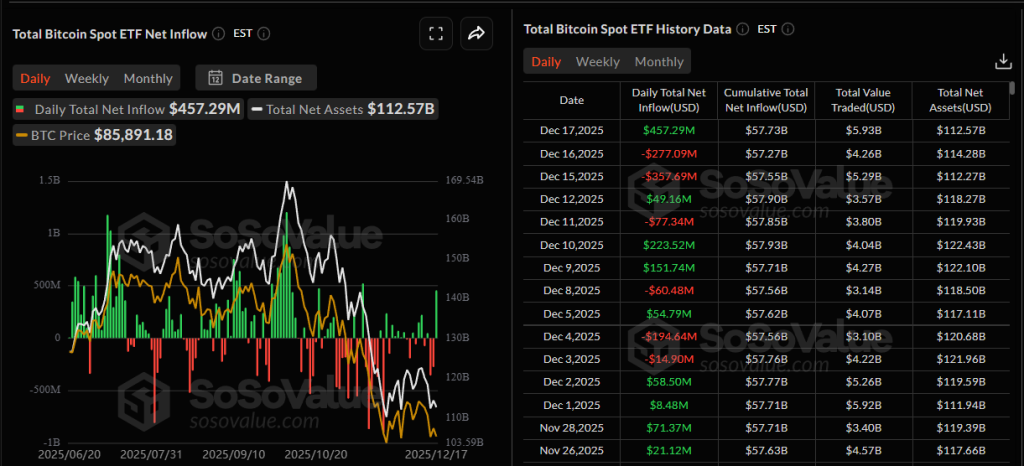
ETF flow conditions were recorded as choppy rather than directional. The largest daily inflow was shown near $457.29 million, while the largest outflow was shown near $357.69 million, and the seven-session net was slightly positive at about $169.59 million, so marginal net support was present but was not delivered in a smooth sequence. A two-day outflow sequence was followed by a large rebound day, which improved short-term flow momentum without establishing persistence, and total net assets were shown to have been reduced from about $122.10 billion to about $112.57 billion across the dates presented, indicating that price and flow effects were not aligned to a simple accumulation narrative.
Source: https://sosovalue.com/assets/etf/us-btc-spot
Macro and microstructure drivers were kept dominant in the week’s tape. A short squeeze was described during the move back toward 90,000, with more than $120 million in short liquidations having been triggered over roughly four hours, so positioning sensitivity was exposed even while the broader trend was kept bearish. A shift toward more cautious positioning and greater emphasis on hedging and drawdown control was described after the steep drawdown from the prior cycle high, which aligned with a reported 66% drop in spot volumes from earlier peaks and a market described as being in a lull. Downside risk was framed as being tied to a potential Bank of Japan hawkish turn and a yen carry unwind, with 70,000 to 72,500 cited as a key downside zone in that framing, while miner strategy was described as being pushed toward renewable power as margins tightened near breakeven conditions. No quantified detail on tariffs, China responses, or DXY levels was provided within the supplied inputs, so those catalysts were not incorporated beyond that limitation.
Ethereum Market Analysis
ETH was marked down over the seven day window from Dec 11 through Dec 17, with price moving from a 3,324.10 open at the start of the period to a 2,833.42 close at the end. A 7 day high of 3,326.96 and a 7 day low of 2,792.22 were printed inside that range, and a -12.46% close to close decline was registered. The tape was characterised by lower closes into the latter half of the week, and the low was set late in the window rather than early.
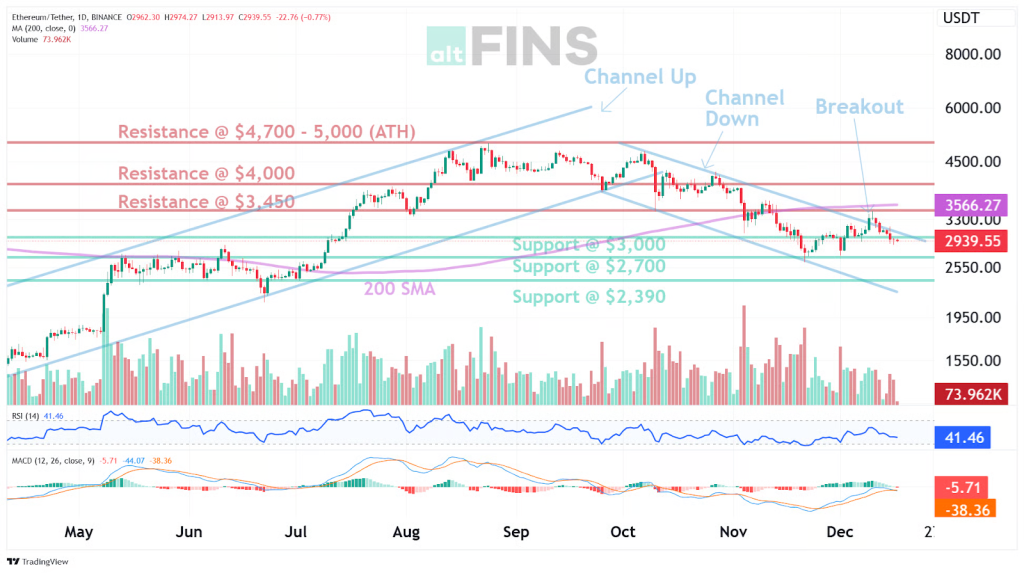
Short term momentum was signalled as weak rather than extreme. RSI (14) was shown near 41.46, so oversold conditions were not confirmed by RSI alone, even as downside pressure remained evident. MACD was kept negative, and bearish momentum was reinforced by that positioning. ATR was indicated near 182.01, and Bollinger Bands were framed with an upper band near 3,326.91 and a lower band near 2,781.15, with price being held inside the envelope rather than being forced through either boundary.
Market structure was framed by a channel down pattern, with a decision zone having been defined overhead. The key rejection area was placed at the 3,450 horizontal level, where confluence was also noted with the 200 day SMA near 3,566.27. While that zone remains unrecovered on a closing basis, a confirmed trend reversal cannot be stated from structure alone. A nearer resistance shelf was also placed at 3,000, which was left as the first reclaim required before higher resistance could be tested.
Support was mapped first at 2,700, then at 2,390, and those zones were left as the nearest downside references for invalidation of any rebound attempt. A close above 3,000 would be required for stabilisation to be validated, while a sustained break and hold above 3,450, with the 200 day SMA being recovered thereafter, would be required for a regime shift to be supported by the stated framework. If 2,700 were to be lost, the base would be weakened by definition, and 2,390 would be left as the next material support in the map.
Source: https://sosovalue.com/assets/etf/us-eth-spot
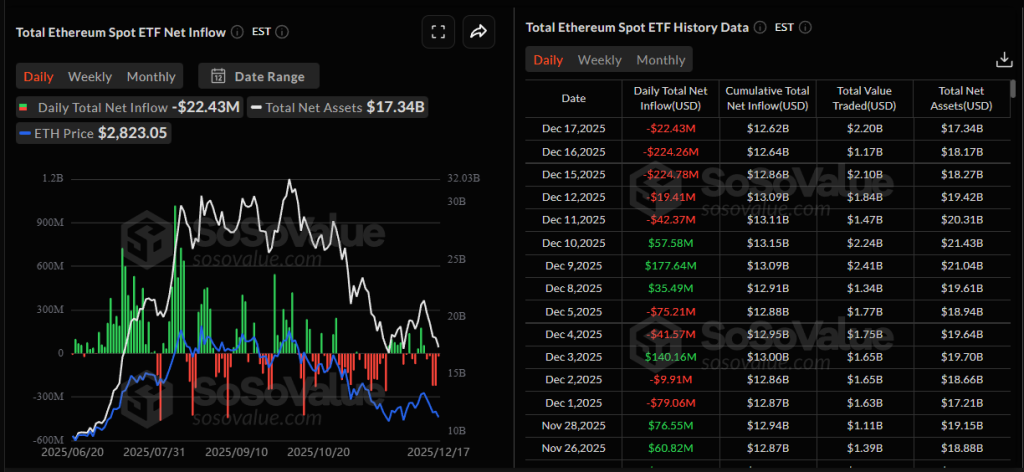
Spot ETH ETF flow conditions were defined by net outflows across the listed sessions, with -$533.25M recorded in aggregate across Dec 11, Dec 12, Dec 15, Dec 16, and Dec 17. The largest daily outflow in that set was -$224.78M, and three day flow momentum across Dec 15 to Dec 17 was kept negative at -$471.47M, while total net assets were reduced from $20.31B to $17.34B over the same endpoints. In parallel, a tokenized money market fund, MONY, was launched on public Ethereum rails by J.P. Morgan Asset Management, with U.S. Treasuries and Treasury collateralised repos described as underlying exposures and cash or stablecoin subscription and redemption described for qualified investors. Corporate treasury demand was also highlighted in reporting as a 48,049 ETH purchase, about $140.58M, being attributed by onchain observers to BitMine, but that specific transaction was not confirmed by the firm, while disclosed holdings of 3,967,210 ETH at an average cost of 3,074 and a stated long term objective of reaching 5% of circulating ETH supply were cited. No verified macro drivers, including tariffs, policy shifts, China responses, or DXY catalysts, were provided in the inputs, so attribution to those factors could not be made.
Japan Rate Hike Expectations
Rate pricing has been positioned around a Bank of Japan move at the December 18 to 19, 2025 meeting, with a quarter point step to 0.75% from 0.5% treated as the central expectation and the decision window set for early December 19 GMT. Into the meeting, the yen’s day to day behavior has been reactive to the policy path implied by guidance, with the currency clawing back some losses as the two-day meeting began, while broader markets stayed in wait mode for confirmation. In that same window, crypto price action was not a clean macro repricing and was instead described as modestly positive on the day while policy decisions were pending.
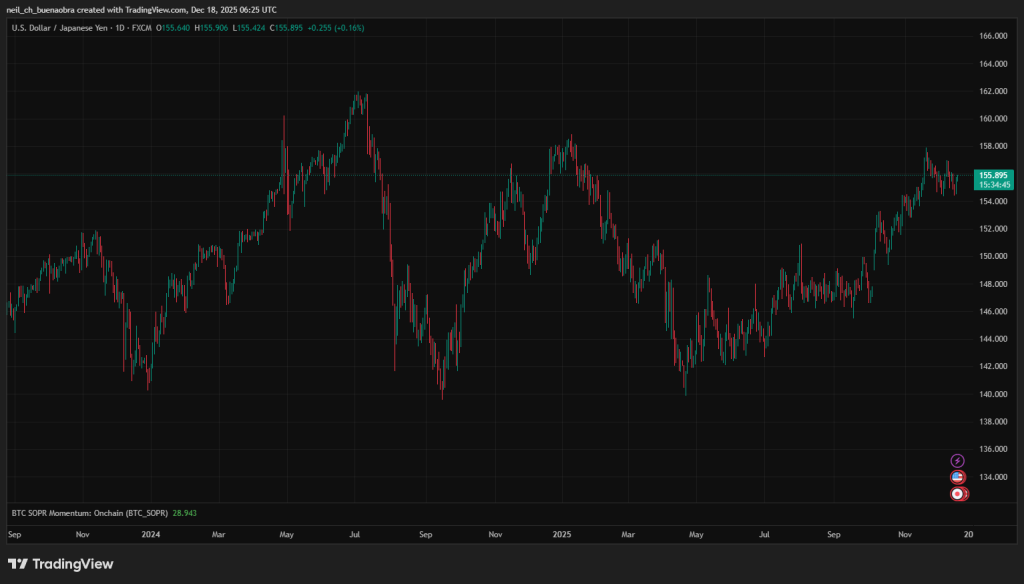
Source: https://www.tradingview.com/chart/2siDZm6r/?symbol=FX%3AUSDJPY
The clearest “reaction” has been concentrated in Japanese rates. The 10 year JGB yield has been cited at an 18 year high around 1.97%, and it was also shown near 1.98% on December 18, 2025, which kept the focus on domestic yield repricing rather than on a single FX print. Policy signaling has been framed around allowing long term rates to be market determined, while retaining the option to respond if moves become rapid and inconsistent with fundamentals, which keeps the rates channel as the primary transmission line being watched. The result is a setup where the market is reading both the rate decision and the tolerance for higher yields as the core inputs, with fiscal concerns layered into the same yield move.
In crypto, the most visible reaction has been microstructure driven rather than macro directional. A sharp push back toward $90,000 was accompanied by roughly $120 million in short liquidations over about four hours, which is consistent with a tape that is being governed by leverage sensitivity around known event risk. In practice, the Japan linkage has been expressed less as a standalone crypto catalyst and more as a funding and FX condition that can tighten or relax risk appetite at the margin, so the read has stayed anchored to yen and JGB repricing, with crypto reacting through positioning.
Mark Your Calendars
Economic Data Releases:
- December 19, 2025 (Friday): Bank of Japan Rate Decision
Token Unlock
- December 20, 2025 (Saturday): LayerZero (ZRO) unlocks $33.42 M (6.79 % of market cap)
- December 25, 2025 (Thursday): XPL (XPL) unlocks $10.68 M (4.52 % of market cap)