
A Big Win for Regulatory Clarity
19th March 2026 • 8mins read
This Week’s Recap
- SEC declares major crypto tokens are digital commodities, not securities: A long-awaited interpretation was issued by the SEC on March 17, 2026, and major tokens including Bitcoin and Ether were broadly framed as commodities rather than securities under the new guidance. A clearer market structure backdrop was signaled, although the move was also described as short of permanent statutory change while Congress continues to debate broader crypto legislation.
- BlackRock’s staked Ethereum ETF launches with strong first day volume and assets: BlackRock’s iShares Staked Ethereum Trust ETF was launched with just over $100 million in initial assets, and roughly $15 million to $15.5 million in first-day trading volume was recorded. A notable institutional step for Ethereum exposure was marked by the debut, even as the opening session remained well below the scale seen in BlackRock’s earlier bitcoin ETF launch.
- U.S. Bitcoin ETFs post the longest inflow streak of 2026: A seven-day run of net inflows was posted by U.S. spot Bitcoin ETFs, making it the longest streak seen so far in 2026. More than $1.16 billion was added over that stretch, and renewed institutional demand was underscored as bitcoin recovered alongside broader crypto market strength.
- Ethereum targets 98% faster bridge finality with new Fast Confirmation Rule: A proposed Fast Confirmation Rule is being tested by Ethereum developers to reduce bridge and exchange deposit confirmation times from about 13 minutes to roughly 13 seconds. A major improvement in user experience and cross-layer infrastructure efficiency was targeted, with the change described as achievable without a hard fork.
- Bitcoin enters a large options concentration around $75,000: A heavy concentration of bitcoin options activity was built around the $75,000 strike, with March expiry positioning described as a key near-term driver of volatility. A break above that level was seen as capable of forcing dealer hedging higher, while rejection there was framed as a setup for renewed downside pressure.
- Fed prepares capital rules that could heavily penalize bank Bitcoin holdings: New U.S. capital rules were being prepared in a way that could leave direct bank bitcoin exposure facing especially punitive treatment under Basel-style risk weighting. Broader bank capital reforms were also being revised by regulators, and future institutional participation in bitcoin markets was cast into doubt if the harsher treatment is preserved.
- Citigroup cuts Bitcoin price target: Citigroup’s 12-month bitcoin target was cut to $112,000 from $143,000 as stalled U.S. crypto legislation reduced confidence in near-term regulatory catalysts. A more cautious institutional outlook was signaled, with bitcoin also described as vulnerable to a much deeper drawdown in a recession scenario.
- Metaplanet secures $255 million for additional Bitcoin accumulation: About $255 million was raised by Tokyo-listed Metaplanet through a share placement and warrant structure designed to fund additional bitcoin purchases. The company’s treasury strategy was extended materially by the financing, with total potential funding framed as rising to about $531 million if the warrants are exercised.
- U.S. Senate moves to ban CBDC issuance until 2030: A provision blocking issuance of a U.S. central bank digital currency through the end of 2030 was passed by the Senate as part of a broader housing bill on March 12. A major policy signal against a digital dollar was sent, although the measure still faces further legislative hurdles before any restriction becomes law.
- PayPal expands PYUSD stablecoin to 70 countries: PayPal USD was expanded to users across 70 markets on March 17, extending access to millions of consumers and merchants beyond its earlier footprint. A broader push into cross-border payments and stable purchasing power was signaled as stablecoin utility was carried further into mainstream payments rails.
- Mastercard agrees to acquire stablecoin firm BVNK for up to $1.8 billion: An agreement to acquire stablecoin infrastructure firm BVNK for up to $1.8 billion was announced by Mastercard, with as much as $300 million tied to contingent payments. A major endorsement of stablecoin infrastructure was delivered by one of the world’s largest payment networks, and deeper integration between fiat and blockchain-based transactions was put into view.
- USDC surpasses USDT in transfer volume: USDC was reported to have overtaken USDT in adjusted transfer volume for the first time since 2019, with roughly $2.2 trillion processed year to date in 2026 versus about $1.3 trillion for Tether. A notable shift in transactional leadership was reflected, even as USDT continued to hold the larger overall market capitalization.
- XRP holders reach a record 7.7 million as price tests $1.60: A record milestone of more than 7.7 million XRP Ledger holders was reached as network activity accelerated and the token tested the $1.60 level. Strength in user growth and address participation was highlighted, although the price move was also accompanied by questions over whether momentum can be sustained.
- Sam Altman’s World partners with Coinbase on human verification for AI transactions: A new AgentKit was launched by World with Coinbase-backed x402 infrastructure to let AI agents prove that they are acting on behalf of real humans. A notable link between identity, AI, and crypto payments was established, with the system designed to support authenticated transactions across websites, APIs, and online services.
- Arizona Attorney General files 20 criminal counts against Kalshi: Twenty criminal counts were filed in Arizona against Kalshi, with the prediction market platform accused of operating an illegal gambling business and allowing election wagering without a license. A serious escalation in state-level enforcement was marked by the case, and fresh scrutiny was placed on the regulatory status of event-based trading markets.
- DeFi trader loses $50 million in a slippage event: Roughly $50 million was erased in a single DeFi swap after a trader executed a large transaction that triggered extreme slippage, leaving only about $36,000 in value. A stark reminder of execution risk in on-chain markets was delivered by the incident, with warnings over trade sizing and liquidity conditions reinforced by the loss.
- Institutional lender BlockFills files for bankruptcy after suspending withdrawals: Chapter 11 protection was sought by BlockFills after customer withdrawals were suspended and about $75 million in losses were reported. Another sign of credit stress in the institutional crypto sector was presented by the filing, with broader concern raised over counterparty risk and market fragility.
- Federal Reserve holds rates steady as war and inflation concerns rise: U.S. interest rates were left unchanged by the Federal Reserve on March 18 as inflation remained elevated and energy-driven risks from the Middle East conflict were watched closely. A more cautious policy stance was signaled, with only one rate cut now projected for 2026 as price pressures were judged to be more persistent.
- Brent crude surges to $110 after Israeli strikes on Iranian gas plant: Brent crude was driven to nearly $110 a barrel after Iranian gas facilities were hit and threats of retaliation against Gulf energy infrastructure were issued by Tehran. Fears of a wider supply shock were intensified, with regional energy security and global inflation expectations both pushed higher.
- Wall Street funds restrict withdrawals as investors rush to exit private credit funds: Withdrawal limits were imposed by several Wall Street-linked private credit funds as redemption requests climbed and investor concern over valuations and liquidity deepened. Growing stress across the sector was reflected, with recession fears and potential loan losses adding to pressure on an asset class that had expanded rapidly.
- Crypto holders in France targeted by violent home invasions and abductions: A series of violent home invasions, kidnappings, and forced crypto transfers has been reported in France as digital asset holders have been increasingly singled out by organized attackers. A worsening personal security risk for visible crypto owners was underscored, with the pattern described as expanding beyond industry insiders into the wider public.
- TOKEN2049 Dubai postponed to 2027 amid security risks: TOKEN2049’s Dubai edition was postponed from April 2026 to April 2027 as regional instability, travel disruption, and safety concerns were judged too severe for the event to proceed. A visible sign of how Middle East conflict is affecting crypto industry operations was delivered by the decision, even as Dubai’s long-term role as a digital asset hub was reaffirmed.
- Nasdaq and NYSE plan blockchain migration for equity markets: A major shift toward blockchain-based equity market infrastructure was advanced after Nasdaq received SEC approval to trade and settle certain securities in tokenized form, while Intercontinental Exchange, the parent of the NYSE, pursued approval for its own platform. One of the clearest institutional endorsements yet for tokenized market structure was signaled, with mainstream equities being brought closer to on-chain rails.
- SEC and CFTC formal coordination to reduce crypto regulatory conflict: A formal memorandum of understanding was announced by the SEC and CFTC to coordinate oversight, support lawful innovation, and reduce regulatory overlap in crypto markets. Greater institutional clarity was created by the move, with a more unified federal approach to market integrity and investor protection being put in place.
- FTX Recovery Trust plans $2 billion creditor distribution starting March 31, 2026: A new distribution round was scheduled by the FTX Recovery Trust for March 31, 2026, with roughly $2 billion expected to be returned to creditors. A material liquidity event for the crypto market was set up by the payout, with sentiment likely to be influenced as recovered funds are returned to claimants.
- Druckenmiller predicts stablecoin dominance in global payments: Stablecoins were described by Stanley Druckenmiller as likely to become the core rails of global payments within the next 10 to 15 years because of their speed and efficiency advantages. A high-profile institutional endorsement of stablecoin infrastructure was delivered by the remarks, with broader mainstream adoption framed as increasingly plausible.
Bitcoin Market Analysis
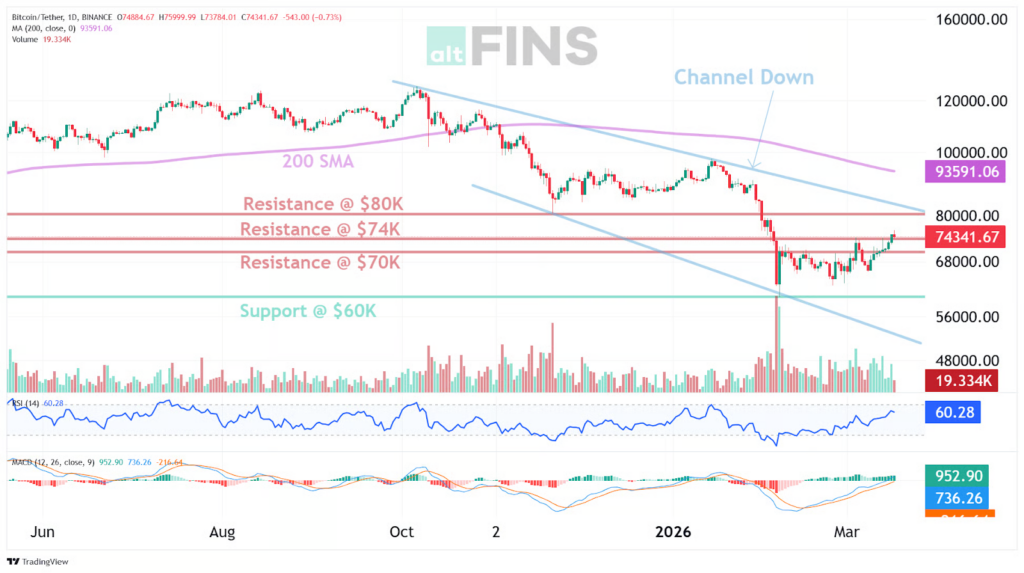
Bitcoin was steadied over the past week after an early dip was reversed and a brief push into the mid $75,000s was registered before trade was pulled back toward the low $71,000s. The seven day window was opened near $70,500, a weekly high of $75,991 was printed on March 17, a weekly low of $70,396 was set on March 13, and the period was finished near $71,200 after a sharp midweek advance was partly retraced. The sequence left a market that was firmer than the intraday volatility implied, yet still below the zone that would be needed for a cleaner structural turn.
Source: https://altfins.com/technical-analysis
The broader technical structure was left unchanged. Price continued to be held inside a descending channel on the daily chart, the 200 day average remained above spot near $93,591, and the longer moving average set continued to point lower even as the shortest averages turned higher. Short term and medium term trend conditions remained neutral, while the long term trend remained strongly down. Momentum was kept constructive but no longer accelerating, with MACD still positive and the histogram fading, while RSI stayed in a neutral band and no overbought or oversold condition was signaled. Bollinger Bands contained trade between roughly $64,979 and $75,038, which left price near the upper half of the recent range without a confirmed expansion.
The main tactical level remained concentrated between $74,000 and $75,000. That band was retested after several prior rejections, and it must still be reclaimed and held before a larger reversal can be argued with confidence. Above that zone, $80,000 was left as the next resistance of consequence because horizontal supply and channel resistance are clustered there. Below spot, the immediate floor was left near $70,000 to $71,000 from the latest pullback lows, while the deeper support zone remained anchored near $60,000. Invalidation for the current recovery would be strengthened by a loss of the recent low area followed by renewed acceptance below $70,000, because the move would then be reduced to another rebound inside a still dominant downtrend. A retest of $80,000 would be favored only if sustained trade above $74,000 is achieved.
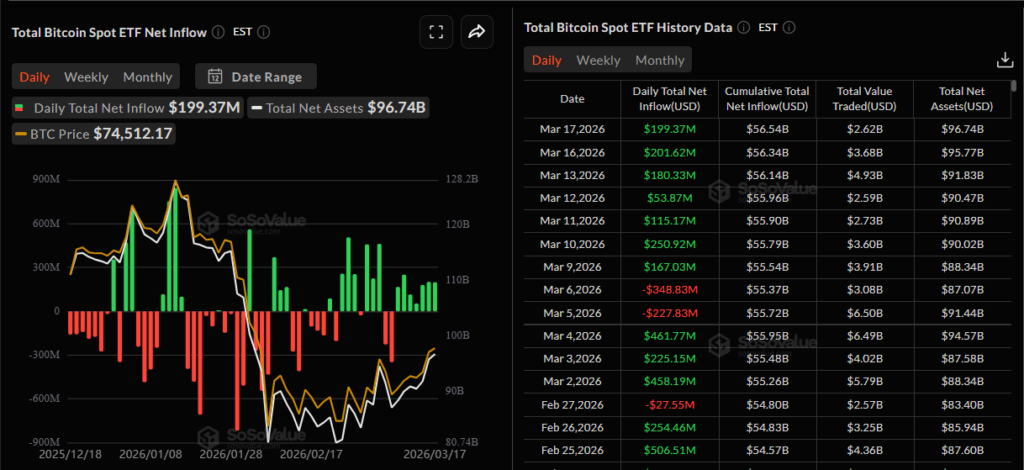
Flow data continued to lean constructive. U.S. spot Bitcoin ETFs extended their inflow streak, and the latest seven day run summed to roughly $1.17 billion in net creations, with the largest daily addition reaching about $250.92 million on March 10. The latest three day stretch also remained positive, which suggested that institutional demand was still being added as price was stabilized near resistance rather than chased only after a breakout. That pattern mattered because the recent rebound was not carried by price action alone. A measure of sponsorship was being supplied underneath the market, and the resilience shown during geopolitical stress was therefore given a firmer base than a simple short covering move.
Source: https://sosovalue.com/assets/etf/us-btc-spot
The policy and corporate backdrop was also improved, though not all of it can yet be treated as decisive. Fresh SEC guidance and a parallel SEC release clarified that many major crypto tokens may be treated as digital commodities rather than securities, which reduced one layer of regulatory uncertainty even though legislation has not been completed. Treasury demand was reinforced when Strategy buying of 22,337 Bitcoin for about $1.57 billion was disclosed, and additional corporate accumulation was supported by Metaplanet funding of roughly $255 million. At the same time, Citi cuts to its 12 month Bitcoin target kept a more cautious institutional tone in view. The claim that new bank capital rules would heavily penalize direct Bitcoin holdings remains uncertain; a broader Basel revision is being prepared, but a Bitcoin specific tightening was not clearly established in the available public record.
A clean weekly reading is therefore left balanced but constructive at the margin. A downtrend was still in force on the higher timeframe, yet improving momentum, persistent ETF inflows, and renewed corporate demand were being assembled beneath price while regulatory clarity was incrementally improved. A large options concentration near $75,000 has also been described in market coverage, so the same zone that already mattered on the chart may exert added influence if price is drawn into it or rejected from it, though the exact concentration cannot be fully verified here from a primary exchange dataset. For now, a market in transition appears to be developing rather than a confirmed reversal. Strength above $74,000 would materially improve the near term outlook and place $80,000 into view, while renewed weakness below $70,000 would leave the broader channel in control and keep $60,000 as the more consequential support.
Ethereum Market Analysis
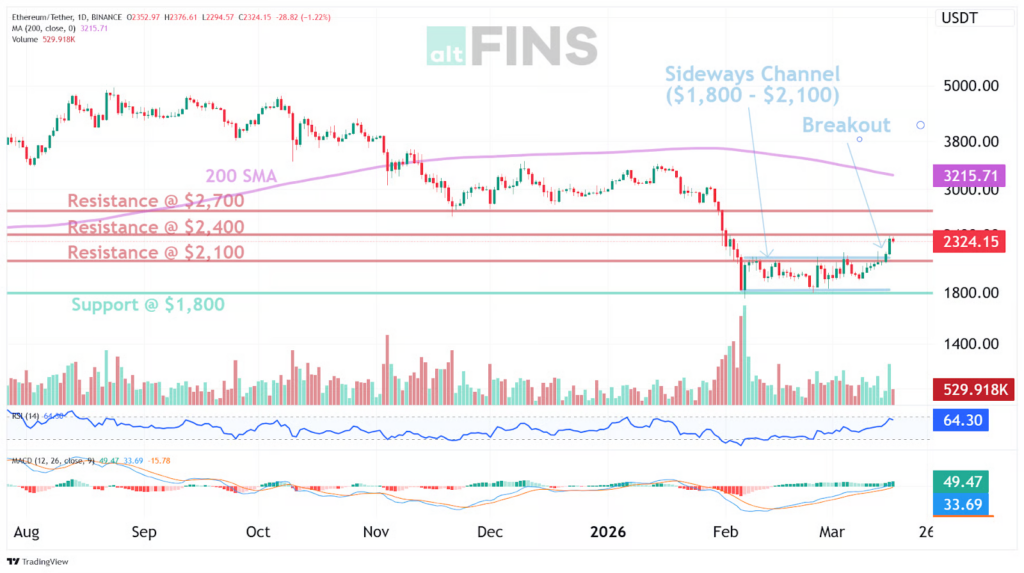
Ethereum was held near $2,200 after a constructive seven day advance from the low $2,070s into the mid $2,300s, with a period high near $2,385 and a period low near $2,063. A gain of roughly 5 percent was produced across the week on closing terms, even after a pullback from the top of the range, which left price still above the $2,100 breakout area that had capped the prior sideways band. That sequence matters because a base between $1,800 and $2,100 was exited to the upside, and the breakout level has not yet been surrendered. A short term reversal has therefore been established, but a fully repaired higher time frame trend cannot yet be claimed.
Source: https://altfins.com/technical-analysis
The technical backdrop has improved, but it has not become uniformly strong. Short dated averages have turned supportive, with the 5 day average near $2,198 and the market holding above it, while the 50 day average near $2,287 still sits overhead and keeps medium term pressure in place. Momentum has been mixed rather than weak: RSI has remained below overbought territory, MACD has stayed negative on one daily read, and the broader indicator set supplied for the week still showed bullish impulse with signs of deceleration. That combination is usually seen when a rebound is intact but still being tested. Volatility has also remained elevated, with ATR near $127, so wide daily swings should be treated as normal rather than exceptional.
The nearest support should be treated as the $2,100 to $2,000 band, because that area now contains the breakout point and the first important retest zone. Below it, $1,800 remains the structural floor that defined the prior range. On the upside, $2,400 stands as the next clear resistance, with $2,700 beyond it as the larger recovery barrier. The practical invalidation point for the current bullish structure would be a decisive loss of $2,000, because that would place price back inside the former congestion area and weaken the case that a genuine escape from the range is underway. Until that occurs, a retest of $2,400 remains the cleaner expectation than an immediate reversal lower.
Source: https://sosovalue.com/assets/etf/us-eth-spot
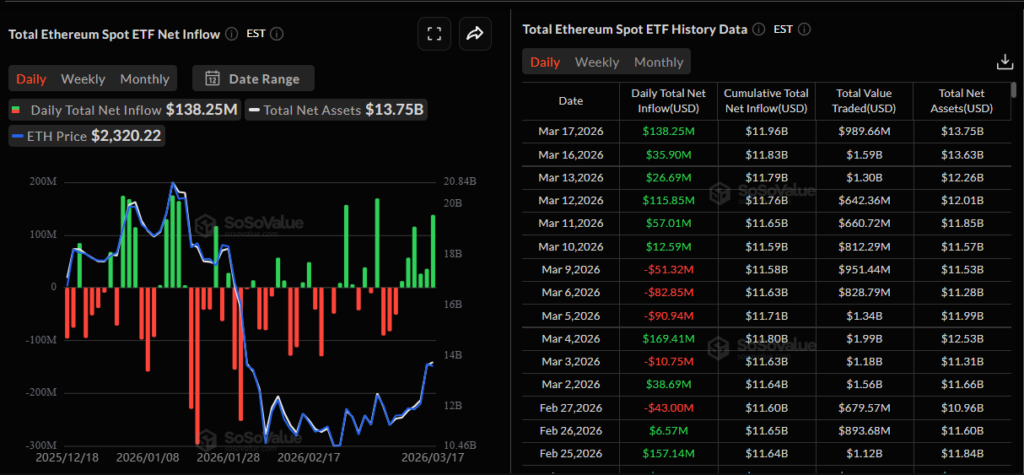
That view has been reinforced by ETF flow. Daily net inflow reached $138.25 million on March 17, and each trading day from March 10 through March 17 was positive in the flow series shown, after heavier withdrawals had dominated parts of late February and early March. Cumulative net inflow rose to about $11.96 billion, while total net assets reached about $13.75 billion. A breakout attempt is generally strengthened when it is accompanied by improving fund flow rather than fading demand, and that condition has now been met. It should still be noted that ETF support can validate a move in the short run without resolving the larger downtrend by itself.
The fundamental backdrop has also turned more constructive. Regulatory overhang was eased by the SEC’s crypto framework, which set out categories for digital assets and was widely interpreted as helpful for Ether’s treatment as a digital commodity within that framework. Institutional access was broadened by BlackRock’s staked ETF, whose launch was accompanied by strong initial activity and fee terms designed to support adoption. Network utility was also supported by Ethereum’s fast confirmation, which has been presented as a path toward materially faster bridge and deposit confirmation. Deployment timing and adoption breadth remain uncertain, so that point should be treated as a developing catalyst rather than a completed change.
Taken together, a credible short term bullish case has been built, but it has been built inside a still fragile higher time frame structure. Price has broken above $2,100, short term trend has improved, ETF inflow has turned supportive, and the news flow has become more favorable. At the same time, medium term trend remains mixed, long term trend damage has not been fully repaired, and resistance at $2,400 has not yet been cleared. The cleanest read is that a reversal attempt is in progress, with $2,400 as the next test, $2,700 as the larger upside hurdle, and $2,000 as the level that would most clearly weaken the present setup.
The SEC’s Crypto Shift in Context
For much of the past several years, the SEC’s relationship with crypto was defined more by enforcement than by a stable classification framework. The agency sued Ripple in December 2020 over XRP, then brought major cases against Binance and Coinbase in June 2023, including claims tied to exchange activity, brokerage functions, clearing, and staking services. In late 2023, the Commission also denied Coinbase’s petition for crypto-specific rulemaking, with then Chair Gary Gensler arguing that existing securities laws already applied to crypto securities markets. That period left the industry operating under a case-by-case approach in which the practical boundaries of regulation were often inferred from lawsuits, settlements, and speeches rather than from a clear taxonomy.
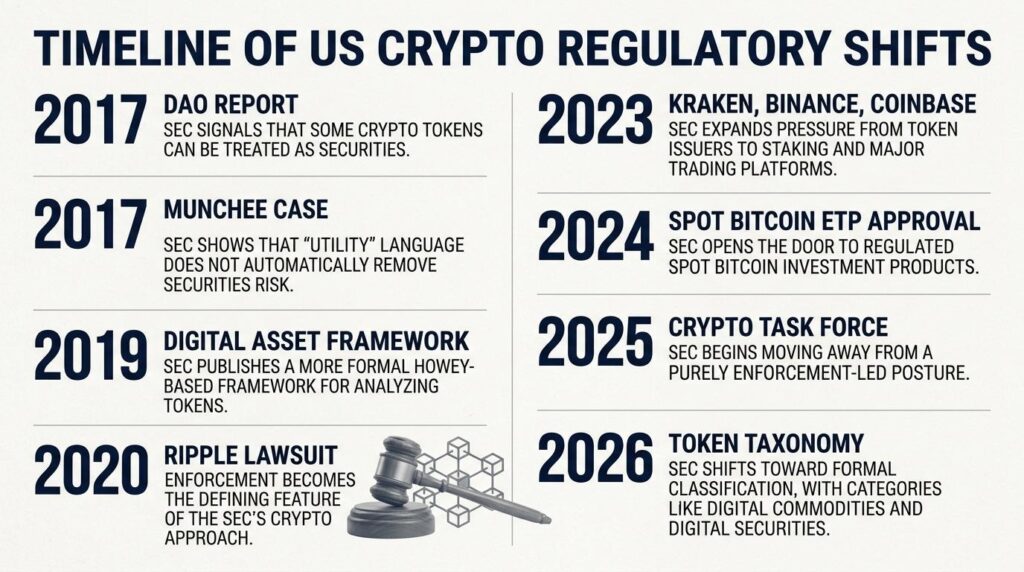
The SEC has now moved toward an explicit interpretive framework. In remarks on March 17, 2026, Chair Paul Atkins said the Commission was implementing a token taxonomy and investment contract interpretation after more than a decade of uncertainty over when crypto assets implicate federal securities laws. The SEC’s related release says the framework creates categories including digital commodities, digital collectibles, digital tools, stablecoins, and digital securities, and it also clarifies the treatment of airdrops, protocol mining, protocol staking, and wrapped non-security crypto assets. At the same time, the CFTC announced a formal memorandum of understanding with the SEC and said it would administer the Commodity Exchange Act consistently with the new interpretation, reinforcing the sense that Washington is moving from overlap and conflict toward coordination.
That does not make the issue fully settled. Atkins himself said lasting reform still depends on Congress, and the SEC release presents the new framework as an interpretation under existing law rather than a permanent statutory rewrite. Even so, the significance is hard to miss: the agency has shifted from an era associated with uncertainty and enforcement-first posture toward one centered on classification, guidance, and interagency alignment. Historically, that makes this week’s move more than a bullish headline. It is one of the clearest signs yet that the SEC is trying to define how crypto fits inside U.S. market structure, rather than leaving that question to be answered mainly through litigation.
Mark Your Calendars
Economic Data Releases:
- March 27, 2026 (Friday): Consumer sentiment (final)
Token Unlock
- March 20, 2026 (Friday): ZRO (ZRO) unlocks $54.50 M (5.64 % of market cap)
- March 24, 2026 (Tuesday): H (H) unlocks $10.85 M (4.19 % of market cap)
- March 31, 2026 (Tuesday): SUI (SUI) unlocks $42.42 M (1.10 % of market cap)