Bitcoin Holds $60,000 as SpaceX Steals Liquidity
18th June 2026 • 11 mins read
This Week’s Recap
- Fed holds rates steady in Warsh’s first decision: the FOMC kept the policy range at 3.50% to 3.75% in a unanimous vote. Warsh also dropped forward guidance, which leaves risk assets more exposed to each inflation and labor print.
- Bitcoin jumps after CPI, then stalls near resistance: May CPI gave traders enough room to defend $60,000, with headline inflation at 4.2% and core inflation at 2.9%. The bounce mattered, but it did not erase the larger downtrend.
- PPI rises to 6.5%: wholesale inflation moved back into focus after a 1.1% monthly increase. That kept the Fed boxed in even as oil-risk relief helped risk assets.
- US-Iran MOU reopens the Strait of Hormuz trade: the preliminary agreement created a 60-day window for a final deal and helped oil fall below $80. Bitcoin rallied on the relief, then faded as rates reclaimed the spotlight.
- SpaceX’s market value challenges Bitcoin’s scale: SpaceX traded as one of the largest public companies in the world, with reports placing its value near twice Bitcoin’s market cap. Crypto had to compete with the biggest equity story on the tape.
- SpaceX tokenized-share demand exposes wrapper risk: several platforms struggled to source enough real shares for synthetic or tokenized exposure. The scramble made the difference between a token and a deliverable claim painfully clear.
- Strategy buys 1,587 BTC: the company spent about $100 million and lifted reported holdings to 846,842 BTC after raising $209 million through stock sales. The buy kept the treasury bid alive through a choppy week.
- Strategy’s STRC preferred stock sinks below par: the $10.5 billion yield product traded near $91.79 against a $100 target value. That discount turned the focus from Bitcoin accumulation to the cost of financing it.
- BlackRock launches BITA covered-call Bitcoin ETF: the new fund sells options to generate monthly premium income and charges a 0.65% sponsor fee. The product gives Bitcoin investors income, but it can cap upside during sharp rallies.
- Kraken launches CFTC-regulated US perpetual futures: eligible professional traders can now access regulated perps across nine assets. Derivatives are moving onshore, which changes where leverage builds.
- Bitcoin buyers add more than 250,000 BTC between $59,000 and $67,000: accumulation returned across retail and whale cohorts during the drawdown. The $60,000 area now has a clearer buyer footprint.
- Bitcoin’s June downturn leaves $8.6 billion in options underwater: only about 20% of June 26 open interest sat in the money. That setup can keep price action jumpy around strike-heavy levels.
- Bank of Japan hikes to 1%: Japan raised rates to the highest level since 1995. A stronger yen can pressure carry trades, and Bitcoin is sensitive when global leverage is being unwound.
- Bitcoin mining difficulty drops about 10%: the network recorded one of its largest negative adjustments as miner margins tightened near breakeven. The cut eases pressure for miners still online but confirms how hard the drawdown hit economics.
- Botanix Labs winds down its Bitcoin Layer 2: users were told to withdraw before July 1 as the project prepares to dissolve. Bitcoin DeFi still needs real demand, more than architecture.
- Metaplanet buys Siiibo Securities: the Japanese Bitcoin holder paid 2.1 billion yen for a regulated securities platform. The deal gives its treasury strategy a financial-product channel.
- Ethereum’s Glamsterdam upgrade enters final development: developers began testing the next major protocol overhaul in a closed environment. ETH needs the roadmap to keep improving while price trades near support.
- BitMine adds $136 million of ETH: the firm used preferred-stock funding to expand its Ethereum treasury. ETH treasury demand is still present, but capital is no longer cheap.
- Lido V3 expands institutional staking: Luganodes integrated stVaults for more flexible validator control. Institutional ETH staking keeps moving toward custom custody and control structures.
- Standard Chartered sets a $100 UNI target: the bank tied the forecast to tokenized assets reaching $4 trillion by 2030. The call put DeFi valuation back into the same conversation as institutional tokenization.
- Ripple invests in Flutterwave: the deal values Flutterwave at $3.2 billion and pushes XRP Ledger rails into African payments. XRP also led 90-day RWA inflows in the week’s source set.
- Moody’s rolls out credit ratings on Solana: ratings are being embedded into blockchain-based securities. That puts familiar credit infrastructure closer to on-chain settlement.
- Coinbase expands into AI advisors, stock options, and pre-IPO markets: the exchange is trying to become a broader financial platform. Crypto exchanges are no longer only competing with each other.
- SEC targets Rule 611: the agency is considering changes to a trade-through rule that has complicated automated market-maker equity trading. A rule change would give tokenized securities a cleaner path.
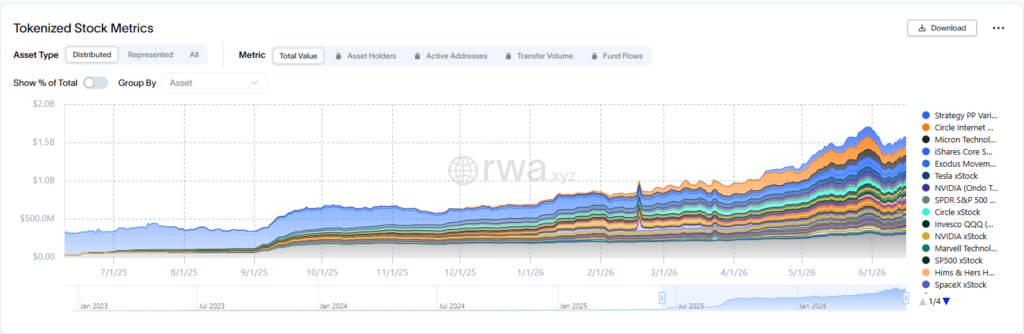
- Tokenized stock volume tops $4.3 billion: on-chain tokenized stock volume hit a record monthly high in the source set. The demand is clear, but the SpaceX scramble showed settlement and share sourcing still matter.
- Humanity Protocol loses $36 million: a private-key compromise tied to a developer machine led to unauthorized token movement and minting. The breach cut through the privacy branding and returned attention to key custody.
- Tether freezes $72 million linked to Monero laundering: Monero spiked after a $120 million on-chain laundering maze drew attention. Stablecoin controls then became part of the enforcement story.
- Polymarket soccer markets wipe out whale positions: the platform recorded $2.46 billion in volume while heavy favorite bets lost money on draws. Prediction markets are becoming large enough for risk management to matter.
- Illinois imposes a 0.2% digital asset tax: the levy applies to business activity involving digital assets in the state. State-level rules can still reshape operating costs even while federal policy moves forward.
- US Congress reaches a CBDC-ban deal through 2030: the ban was folded into a housing bill framework. Stablecoins and tokenized deposits now carry more of the private-sector digital money burden.
Bitcoin Market Analysis
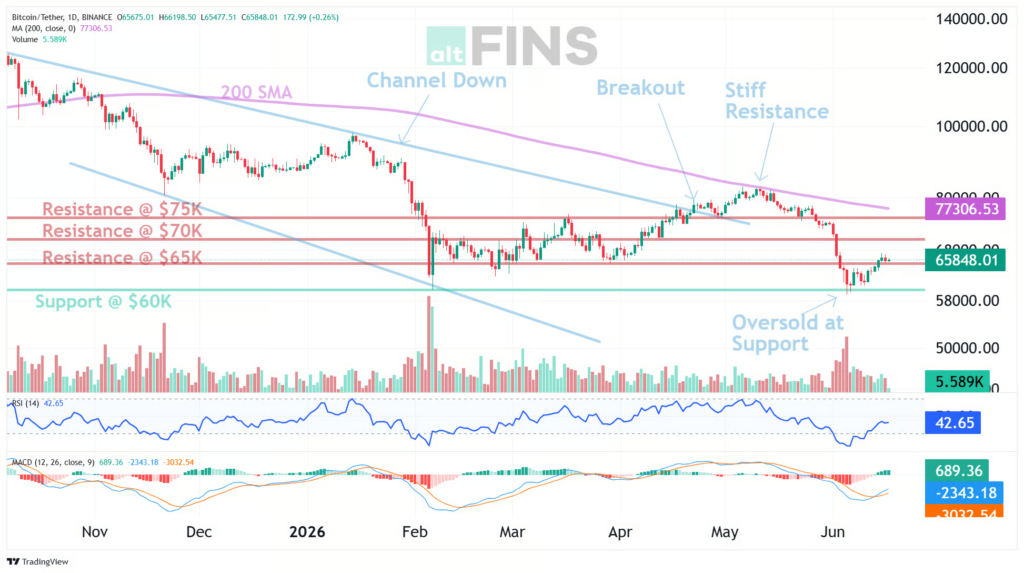
Bitcoin’s week was a fight over whether the $60,000 defense could turn into a real base. Price was last shown near $64,500 after gaining about 4.9% over one week, but it was still down more than 16% over one month and about 26% year to date. The earlier rejection at $80,000 to $83,000 did the damage. BTC fell back toward $60,000, held the zone, and then bounced toward the first resistance at $65,000. The bounce gave buyers room to work, but the chart still carries the memory of two failed attempts near the 200-day average.
Source: https://altfins.com/technical-analysis
The trend readings are still heavy. Short-term trend is down, while medium and long-term trend remain strong down, so the market has not earned a clean reversal label. Momentum improved after a bullish MACD crossover 27 days earlier, and current RSI readings sit in neutral territory after the prior oversold washout. That mix can support a relief move, especially with price close to a well-watched floor. It does not remove the overhead supply. The first test is $65,000, then $70,000. The harder ceiling is still $80,000.
Support is simple, which helps. The nearest support zone is $60,000, and the tactical invalidation level sits around $57,000. A daily close through $60,000 would quickly bring the 52-week low area near $59,100 back into focus, while a break below $57,000 would make the oversold-bounce thesis much harder to defend. The upside path needs a reclaim of $65,000 first, then acceptance above $70,000. Until then, the market is trading a range under a downtrend, even if the short-term tone has improved.
Source: https://sosovalue.com/assets/etf/us-btc-spot
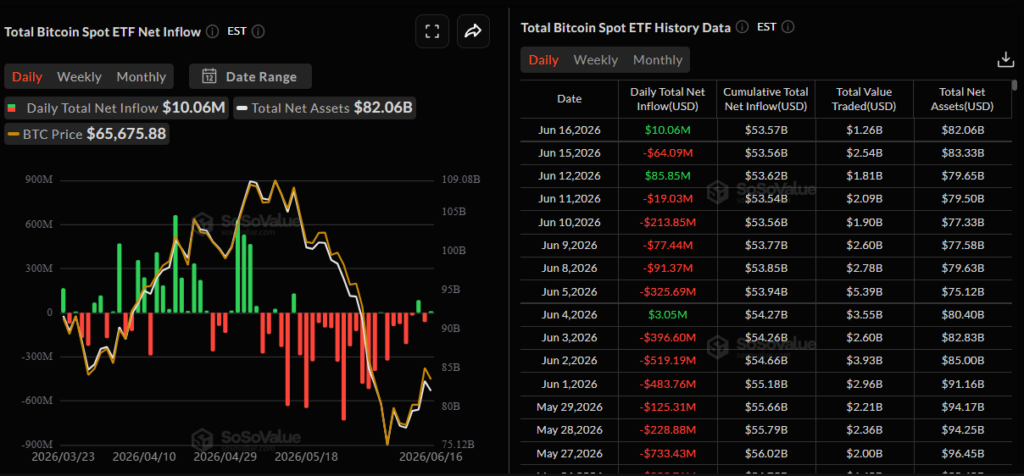
ETF flows matched the uncertainty. The daily prints moved from redemptions above $200 million early in the period to positive closes later, including a small $10 million BTC inflow in the final source block, while net assets moved back above $82 billion. That is better than the five-week outflow story that dominated the prior week, but it is still choppy. Bitcoin does not need perfect ETF demand to bounce. It needs consistent demand to make $60,000 look like accumulation rather than temporary support.
Strategy’s 1,587 BTC purchase gave the market a familiar buyer, and reports of more than 250,000 BTC accumulated between $59,000 and $67,000 put a stronger floor under the recent range. The wrinkle is funding. Strategy’s STRC preferred stock traded below par, BlackRock launched an income ETF that monetizes volatility, and Metaplanet moved to build a Bitcoin financial-products arm. Bitcoin treasury demand is still here, but the market is now asking how that demand is financed and who absorbs the yield risk.
Macro kept the final word. The Fed’s rate hold and dropped forward guidance forced traders to price each data release directly, while the US-Iran MOU only gave temporary relief through oil. SpaceX pulled capital and attention toward equities at the same time the Bank of Japan tightened policy. Bitcoin can keep rebounding from $60,000 if flows stabilize. A leadership move needs $70,000 reclaimed and the macro tape to stop punishing every risk rally.
Ethereum Market Analysis
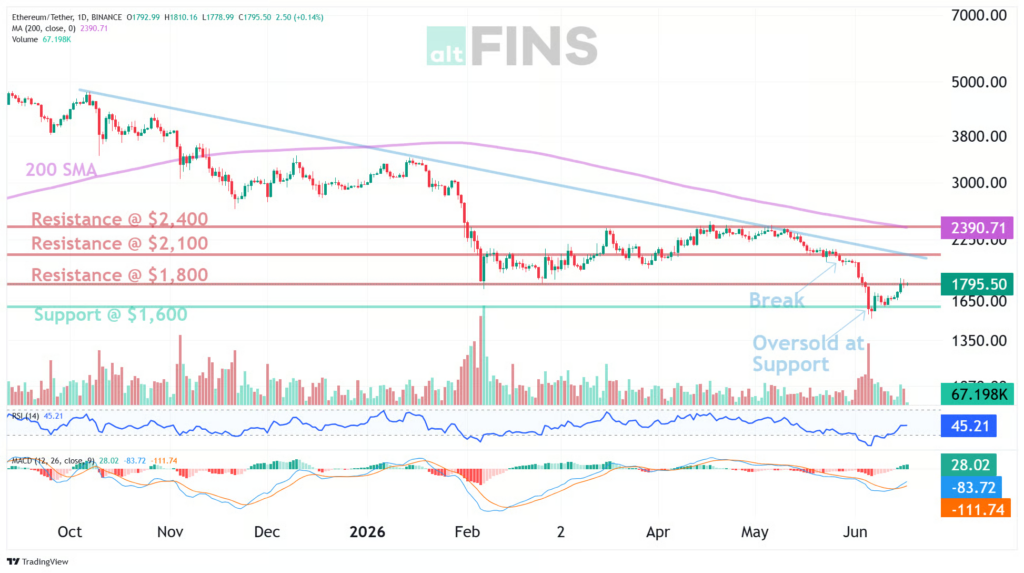
Ethereum’s recovery looked better in percentage terms than Bitcoin’s, but the chart still started from a weaker place. Price was last shown near $1,755, up about 8.3% over one week and down more than 17% over one month. The break below $2,100 and $1,800 put ETH back into a downtrend before buyers arrived near $1,600. That sequence matters because ETH has to repair more levels before the market can treat the bounce as durable. Bitcoin is defending a floor. Ethereum is trying to climb back through broken support.
Source: https://altfins.com/technical-analysis
The current indicator set gives ETH a mixed short-term message inside a poor larger trend. Short, medium, and long-term trend readings are all down or strong down. RSI readings are neutral now, after earlier oversold conditions near support, and MACD turned bullish 27 days earlier. ADX is strong, which means the prevailing trend still carries force. Stochastic RSI is elevated after the bounce, so a quick move into resistance could meet supply before the broader structure improves.
The level map is tight. Support sits at $1,600, with the 52-week low near $1,505 below it. Resistance sits first at $1,800, then $2,100. That gives ETH a cleaner set of checkpoints than BTC: hold $1,600, reclaim $1,800, then prove that $2,100 is no longer a ceiling. A loss of $1,600 would pull the market back toward the cycle-low zone quickly. A close above $1,800 would only start the repair, because the larger downtrend still points lower.
Source: https://sosovalue.com/assets/etf/us-eth-spot
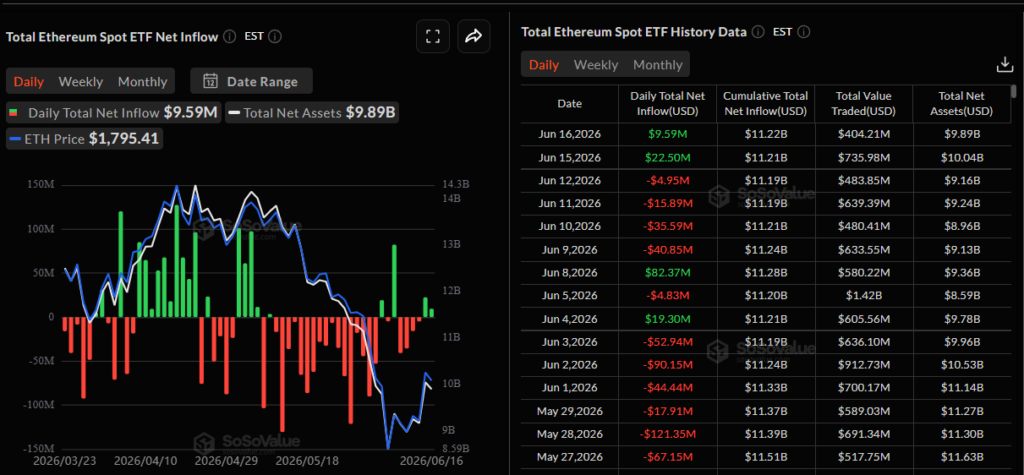
ETF demand helped at the margin but did not change the whole picture. The final source block showed ETH spot ETFs with about $9.6 million of daily inflow, $404 million in value traded, and net assets near $9.9 billion. Earlier blocks showed outflows, then a positive $22.5 million print. That makes the flow tape uneven rather than bearish in a straight line. ETH needs repeated inflows because the price chart is asking for more than one good day.
Ethereum’s stronger argument came from builders and balance sheets. Glamsterdam entered final development, Lido V3 expanded institutional staking through stVaults, and BitMine added ETH after raising preferred-stock capital. Those are useful because they point to protocol development, staking infrastructure, and treasury demand at the same time. The market still discounted them while ETH traded under $1,800. Good narratives need price confirmation.
The pressure came from trust. Humanity Protocol’s $36 million loss was rooted in private-key exposure rather than a complex market move, and Aztec Connect’s abandoned contract exploit added another operational failure to the week. Ethereum benefits when DeFi, tokenization, and stablecoin rails grow. It also carries the reputational cost when those systems break. If ETH holds $1,600 and reclaims $1,800, the market can treat this as an oversold recovery. If it loses $1,600, the institutional ETH story will have to prove it can absorb another round of risk selling.
SpaceX, Tokenized Stocks, And The New Liquidity Test
The week’s best post-ETH story was not another stablecoin rail. It was the collision between one giant equity listing and crypto’s attempt to wrap every tradable thing into a token. SpaceX drew the attention first because the numbers were hard to ignore: a multitrillion-dollar valuation, record IPO demand, intense retail interest, and a market cap that reporters compared directly with Bitcoin. Crypto did not trade in isolation. It had to compete with a new public-market spectacle that promised AI, space, defense, and Elon Musk in one ticker.
Source: https://app.rwa.xyz/stocks
Tokenized equity products then showed their limits. The SpaceX wrapper scramble exposed a basic issue: demand for a token does not guarantee access to the underlying share. When third-party brokers could not source enough stock, some platforms had to cancel or adjust allocations. That is a bad look for a sector selling 24/7 access and instant settlement. The product can be useful, but the backing, legal claim, transfer process, and broker relationship all matter when demand spikes.
The policy side moved in the same direction. SEC attention on Rule 611, Coinbase’s push into stock options and pre-IPO markets, Moody’s credit ratings on Solana, and tokenized stock volume above $4.3 billion all point to a future where traditional assets trade closer to crypto rails. That future is not automatic. It will be won by products that can prove the asset exists, the claim is enforceable, and the market can handle stress without turning into a cancellation queue.
For Bitcoin and Ethereum, the liquidity read-through is blunt. If tokenized stocks become crypto’s most popular product, the industry gains a familiar asset class and a larger user funnel. It also imports equity-market attention cycles directly into crypto venues. This week, SpaceX did not just compete with Bitcoin for capital. It showed how the next crypto growth story may come from selling stocks on-chain after tokens spent years trying to sell themselves.
Mark Your Calendars
Economic Data Releases:
- June 25, 2026 (Thursday): PCE price index and Personal Income and Outlays for May
Token Unlock
- June 20, 2026 (Saturday): LayerZero (ZRO) unlocks about $29.40 million
- June 25, 2026 (Thursday): Humanity Protocol (H) unlocks 269.73 million tokens, valued near $72.40 million
- June 26, 2026 (Friday): Sahara AI (SAHARA) unlocks about 1.03 billion tokens, valued near $35.48 million
- June 30, 2026 (Tuesday): Optimism (OP) unlocks its next core contributor allocation