
Crypto Market Update: Tokenization Leads the Week
26th March 2026 • 7 mins read
This Week’s Recap
- SEC approves Nasdaq move to support tokenized securities trading: Approval was granted for Nasdaq to test tokenized versions of listed stocks and exchange-traded products, with trading and settlement designed to function alongside traditional share infrastructure. A further step was marked for blockchain-based securities on a major U.S. exchange, while settlement was described as remaining tied to existing market plumbing through the Depository Trust Company.
- Morgan Stanley files for MSBT Bitcoin ETF: An amended filing was submitted for a spot Bitcoin ETF under the ticker MSBT, with a $1 million seed structure outlined ahead of a proposed NYSE Arca listing. Launch approval was not yet indicated as final, but another signal was provided that a large Wall Street bank is pressing further into spot Bitcoin fund offerings.
- Strategy set for second-biggest Bitcoin buying quarter despite price slide: First-quarter accumulation was reported at 89,618 BTC, putting Strategy on pace for its second-largest Bitcoin buying quarter even as prices pulled back. Expansion of the company’s treasury position was therefore shown to be continuing during weakness, with only the far larger fourth quarter of 2024 still ahead of it in scale.
- Bitcoin DeFi drawback under attack as OpNet unlocks smart contracts on mainnet: A mainnet launch was carried out by OpNet to bring native smart contracts and DeFi functions directly onto Bitcoin, with bridges and wrapped assets described as less necessary under the model. One of Bitcoin’s long-standing limitations was therefore challenged by an approach aimed at keeping users on the base network while expanding trading, token, and yield activity.
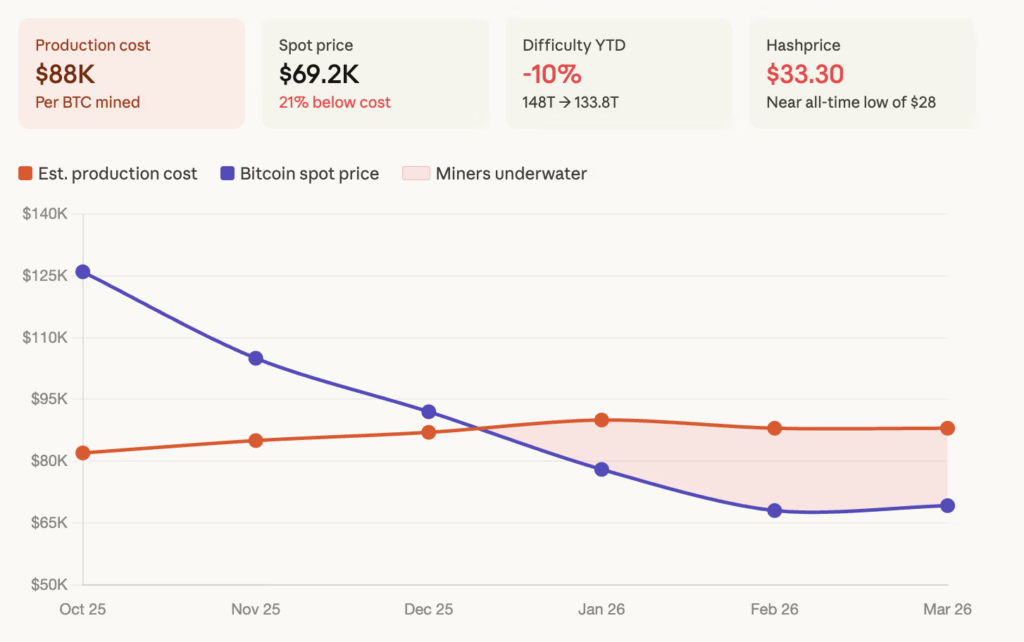
- Bitcoin miners are losing $19,000 on every BTC produced as difficulty drops 7.8%: Average production costs were reported near $88,000 per Bitcoin while market prices remained materially lower, leaving miners roughly $19,000 underwater on each coin produced. Even with mining difficulty falling 7.8%, operating pressure was shown to be severe, reinforcing how margin stress is still being felt across the sector.
- Dormant Bitcoin whale moves $147 million after 13 years: A long-dormant wallet holding about 2,100 BTC was reactivated after more than 13 years, with only a tiny test transfer reported while the bulk of the holdings remained in place. Renewed attention was drawn to early-era Bitcoin addresses, as the stash was valued near $147 million at current prices.
- Bitcoin options signal extreme fear as downside protection premium hits new all-time high: Record demand for downside protection was reported in the Bitcoin options market, with put premiums described as reaching a new all-time high relative to spot exposure. A deeply defensive positioning by traders was signaled even as broader volatility expectations were not described as similarly extreme.
- FTX Recovery Trust to distribute $2.2 billion to creditors in March: A fourth distribution totaling about $2.2 billion was scheduled by the FTX Recovery Trust for March 31, 2026, with another major round of creditor repayments set to be processed through the bankruptcy recovery plan. Progress in the estate’s wind-down was therefore advanced further, with additional dates also outlined for later claimant and equity-related payments.
- Tom Lee’s Bitmine extends buying streak with $138 million ETH purchase: Another large Ethereum purchase worth about $138 million was made by Bitmine, extending a three-week accumulation streak under Tom Lee’s leadership. Continued balance sheet expansion was used to reinforce a view that the broader crypto downturn may be nearing an end despite unrealized losses still being carried.
- Amundi debuts $100 million tokenized fund on Ethereum and Stellar: A new tokenized fund called SAFO was launched by Amundi and Spiko, with the shareholder register hosted on Ethereum and Stellar and the product designed for treasury and collateral management use cases. A further institutional tokenization push was marked by features including near-instant settlement, 24/7 transferability, and access in four currencies.
- Ethereum unveils post-quantum security roadmap for institutions: A new post-quantum security portal and roadmap were released by the Ethereum Foundation, with migration work outlined across the execution, consensus, and data layers. Institutional concerns about long-horizon cryptographic risk were addressed through a phased plan built around cryptographic agility rather than a single disruptive transition.
- NYSE taps Securitize to develop 24/7 tokenized securities platform: Securitize was selected to help build the New York Stock Exchange’s planned tokenized securities platform, with blockchain-based shares of stocks and ETFs targeted as part of the design. Another major U.S. market infrastructure push into tokenization was signaled, with round-the-clock trading and institutional transfer-agent standards placed at the center of the effort.
- Solana Foundation taps Mastercard, Western Union, and Worldpay for institutional developer platform: A new API-based developer platform was launched by the Solana Foundation for institutions and enterprises building payment and financial products on-chain. Early adoption by Mastercard, Western Union, and Worldpay was presented as evidence that Solana is being positioned more directly for enterprise settlement and payments infrastructure.
- Grayscale files for HYPE ETF tracking on-chain perps DEX Hyperliquid: An S-1 registration statement was filed by Grayscale for an ETF that would hold HYPE, the native token of Hyperliquid, the leading on-chain perpetuals exchange. Expanding institutional appetite for exchange-traded exposure beyond the largest crypto assets was highlighted, with decentralized derivatives infrastructure pulled further into the ETF pipeline.
- Backpack launches BP token on Solana with 25% airdrop and no insider allocation: BP was launched by Backpack on Solana with 25% of the 1 billion token supply unlocked for users, while no initial allocation was reserved for founders, team members, or investors. A user-first distribution model was emphasized, with the remaining supply placed under long lockups tied to company milestones and a possible future IPO.
- Cardano Node 10.7.0 upgrade set for release ahead of hard fork: Node 10.7.0 was described as the major release expected to begin ecosystem upgrades ahead of Cardano’s next hard fork, with new features extending beyond hard-fork readiness alone. A critical preparatory phase was therefore signaled for wallet providers, stake pool operators, and tooling teams before broader network activation.
- Aave DAO moves closer to V4 deployment with new proposal: Strong community support was recorded for moving Aave V4 toward Ethereum mainnet, with the proposal advancing through governance after near-unanimous backing. A modular redesign separating shared liquidity from market-specific risk was presented as the core of the upgrade, with a binding onchain vote still required before activation.
- Browser maker Opera seeks 160 million CELO stake: A proposal was put forward for Opera to receive 160 million CELO in place of its prior cash-based arrangement, which would turn the browser company into a major long-term stakeholder in the network. The shift was framed around deeper alignment with Celo’s growth, especially through MiniPay’s existing user and transaction base.
- XRP treasury firm Evernorth discloses $233.7 million impairment: A $233.7 million digital asset impairment for 2025 was disclosed by Evernorth in a SPAC filing, reflecting the gap between acquisition costs and lower market valuations on its XRP holdings. The filing also showed the scale of the firm’s treasury strategy, with hundreds of millions of XRP still tied to its balance sheet and related DeFi plans.
- Solana DApp revenue hits 18-month low: Decentralized application revenue on Solana was reported to have fallen to about $22 million, the weakest level in 18 months and down sharply from roughly $36 million two months earlier. The slowdown was accompanied by more cautious derivatives positioning, with weakening confidence in near-term price support also being reflected in options and perpetuals markets.
- Senators reach compromise on yield to advance crypto market bill: A tentative compromise was reached by key senators over stablecoin yield, clearing a path for the broader crypto market structure bill to keep moving in Congress. One of the main sticking points in the legislation was therefore softened, with the revised draft described as allowing some yield activity under tighter guardrails.
- The SEC explains how it is viewing a crypto security, with most assets treated as non-securities: A formal interpretive release was issued by the SEC to classify how federal securities laws apply to crypto assets and transactions involving them. Five categories were outlined, with four described by SEC Chair Paul Atkins as not being securities, while securities treatment was tied more narrowly to specific fundraising and investment contract circumstances.
- Phantom receives CFTC no-action relief for regulated derivatives: No-action relief was granted by CFTC staff to Phantom for software that connects users, on a self-custodial basis, with registered futures intermediaries and markets. A regulated path into derivatives access through a non-custodial wallet interface was therefore opened, subject to conditions and CFTC oversight.
- CFTC details how digital assets can be used as derivatives collateral in new FAQ: New staff FAQs were issued by the CFTC on March 20, 2026 covering how registrants and registered entities may handle crypto assets and blockchain-related activity. Guidance was included on the acceptance of certain non-security digital assets as margin collateral and on the treatment of payment stablecoins as residual interest, giving firms a clearer compliance framework for derivatives use.
- Circle stock plunges 18% as a new draft of the Clarity Act threatens stablecoin rewards: Circle shares fell as much as 18% after a revised draft of the Clarity Act raised the prospect of stricter limits on stablecoin rewards. Equity pressure was extended to other crypto-linked names as investors reassessed how the draft could constrain one of the sector’s more important consumer growth levers.
- Kentucky bill could mandate recovery mechanisms for hardware wallets: Kentucky House Bill 380 was advanced with language that critics said could require hardware wallet makers to assist with credential resets, raising concerns that recovery features could amount to a backdoor. The measure was shown as having moved to Senate consideration, with the dispute centered on whether consumer protection rules can be imposed without undermining self-custody.
- Tether hires a Big Four auditor for its first full reserves audit: A Big Four accounting firm was hired by Tether to conduct its first full financial statement audit of the reserves backing USDT, marking a step the company had long promised but not previously completed. Greater pressure for transparency was reflected in the move, with the audit framed as covering reserves for the roughly $184 billion stablecoin.
- Coinbase launches stock perpetual futures for non-U.S. customers: Stock perpetual futures were launched by Coinbase for eligible non-U.S. retail traders and institutions, giving round-the-clock synthetic exposure to U.S. equities and ETFs. The contracts were structured as cash-settled products in USDC, with leverage limits outlined as part of Coinbase’s broader international derivatives push.
- BlackRock’s Larry Fink pushes tokenized funds: Tokenization was promoted by Larry Fink in BlackRock’s 2026 annual letter as a way to modernize financial markets and widen access to investing through digital wallets. Tokenized funds were presented as part of a broader case that market ownership should be made more accessible, especially as private markets and new technologies concentrate wealth creation.
- MoonPay releases an open-source wallet standard for AI agents: An open-source wallet framework was released by MoonPay to let AI agents hold funds and execute transactions across blockchains without exposing private keys. Broad industry support was highlighted around the standard, with contributions described from more than 15 organizations and distribution made available through GitHub, npm, and PyPI.
Bitcoin Market Analysis
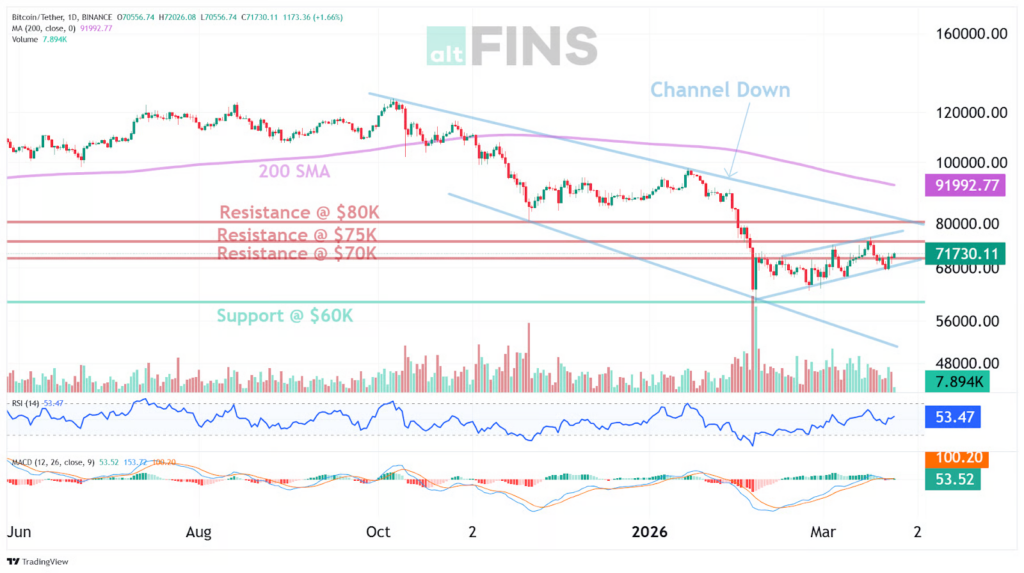
Bitcoin was held in a narrow but still unsettled range over the past seven days. The week opened at $69,921.8 on March 20 and the latest marked level stood near $70,845.7 after a high of $71,978.6 was reached on March 25 and a low of $67,399.4 was printed on March 22. A modest weekly gain was recorded from the March 20 close of $70,517.2 to the latest marked level, but the path was uneven and volatility remained visible inside the range. A stabilisation phase was therefore established, not a decisive directional move.
Source: https://altfins.com/technical-analysis
That price action was kept inside a broader corrective structure. A descending channel remained in force on the larger chart, while a smaller rising channel was preserved from the late March low. The 200 day simple moving average remained well above price near $91,992.77, which kept the longer trend under pressure. Momentum was mixed. RSI remained neutral, not overbought and not oversold, while MACD conditions were softer and a bearish crossover had already been in place. A recovery attempt was therefore being maintained, but a full reversal could not yet be confirmed.
The key levels remained straightforward. The low $70,000 area continued to serve as the first threshold that would need to be reclaimed and held to keep the near-term recovery case intact. Immediate support sat around the daily pivot region near $70,844 and first support near $70,725.7. Overhead, the recent high near $71,978.6 remained the first hurdle, followed by the more significant resistance bands at $75,000 and $80,000. The larger support zone remained anchored near $60,000. If the short-term rising structure were lost, the recovery case would be weakened materially. If $75,000 were reclaimed, meaningful pressure would begin to be applied to the broader downtrend.
Source: https://sosovalue.com/assets/etf/us-btc-spot
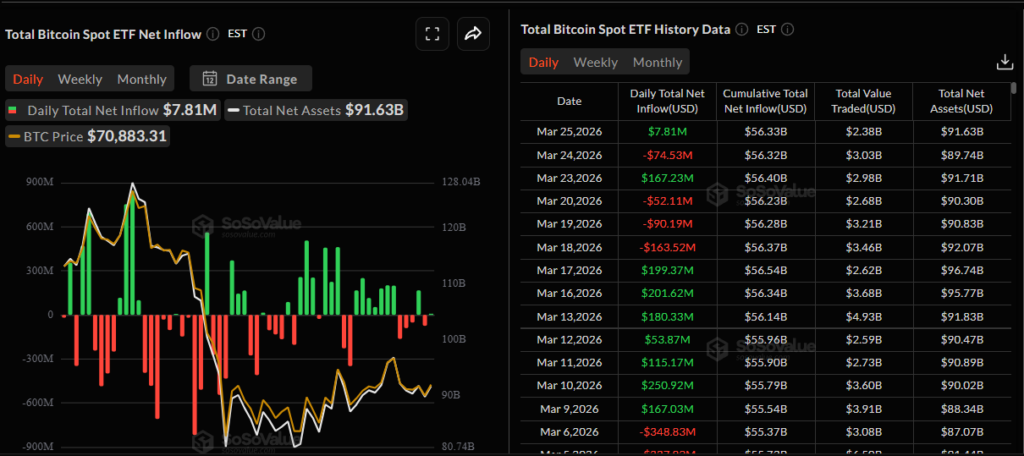
ETF flow data added caution rather than confirmation. Net inflow of $7.81 million was recorded on March 25, after an outflow of $74.53 million on March 24 and a stronger inflow of $167.23 million on March 23. Earlier in the same stretch, outflows of $52.11 million, $90.19 million, and $163.52 million were also recorded, partly offset by inflows of $199.37 million and $201.62 million. Total net assets were shown near $91.63 billion on March 25. A steady accumulation trend was therefore not established. Dip buying appeared to be present, but broad conviction was not yet visible in the flow pattern, which matched the technical picture of stabilisation without breakout confirmation.
The broader backdrop remained constructive in parts, but defensive in tone overall. Institutional access was widened through the MSBT filing, while corporate demand was reinforced through Strategy buying, which kept the company on pace for its second largest quarterly Bitcoin accumulation. Bitcoin’s utility case was expanded through OpNet mainnet, which was designed to bring native smart contract functionality onto Bitcoin. At the same time, market caution was reinforced under miner pressure, as production costs remained above spot price, under options fear, as downside protection was priced at a record premium, and amid whale activity, as a dormant wallet tied to about 2,100 BTC, valued near $147 million, was reactivated after more than 13 years. The exact transfer mechanics of that whale move could not be verified consistently.
Source: https://www.coindesk.com/
Taken together, a market in repair was still being described, not one in confirmed breakout. Price was held up better than might have been expected given the defensive options skew, miner stress, and uneven ETF demand, which suggested that underlying demand had not disappeared. Yet a decisive change in trend was not established. As long as Bitcoin remained above the low $70,000 area and inside the short-term rising channel, the recovery attempt could continue to be respected. Until the recent high near $71,978.6 and then the $75,000 resistance band were reclaimed, the broader downtrend would still be treated as the governing structure. The balance of evidence therefore remained neutral to mildly constructive in the short term, while the medium-term setup stayed fragile and the longer trend remained unrepaired.
Ethereum Market Analysis
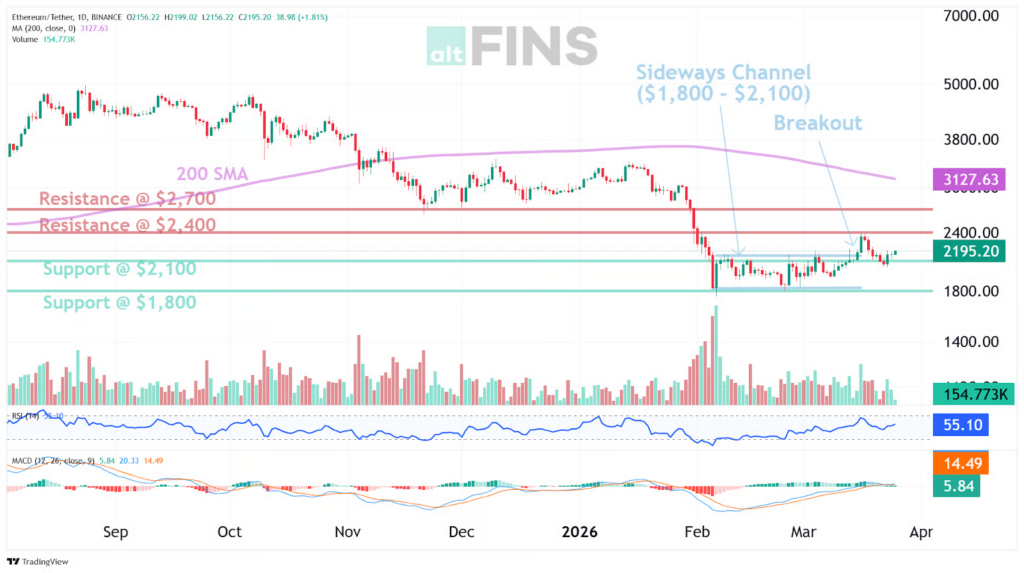
Ethereum was steadied over the week after a pullback into the low $2,000s, and a rebound was then sustained above $2,100. A push toward the upper end of the recent range was attempted, but clear acceptance closer to $2,400 was not secured. The week was therefore defined by repair rather than escape velocity. A base was preserved, higher lows were gradually formed, and short term control was improved without a full reversal of the broader structure being proved.\
Source: https://altfins.com/technical-analysis
That recovery was developed within a still uneven technical backdrop. The earlier breakout above the old $1,800 to $2,100 range was not fully rejected, and the retest of $2,100 was absorbed well enough for that level to remain the central pivot. Momentum, however, was not fully aligned with price. RSI was kept in neutral territory, which suggested that the market was neither stretched nor washed out, while MACD remained soft enough to leave upside conviction less than complete. Price was also kept well below the 200 day moving average, so the long term trend could not yet be described as repaired.
The technical map remains straightforward. Support has been reinforced at $2,100, with deeper structural support still sitting near $1,800. Resistance remains concentrated at $2,400, with a higher cap near $2,700. So long as $2,100 is defended, a renewed test of $2,400 can still be supported by the current structure. If that support is lost on a decisive basis, the breakout thesis would be weakened and the prior range would be reopened. Invalidation, therefore, is not abstract here, it is closely tied to whether price can continue to be held above the reclaimed breakout area.
Source: https://sosovalue.com/assets/etf/us-eth-spot
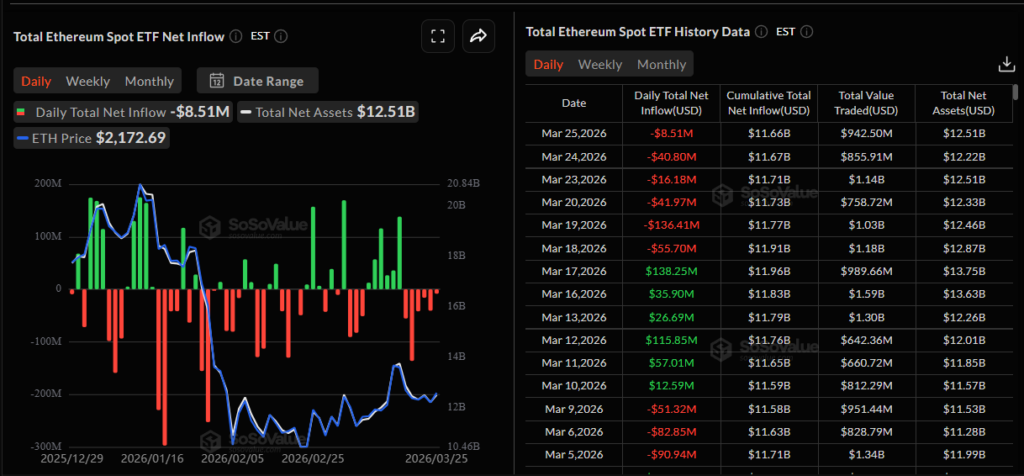
Flow data has added restraint to the otherwise improving chart. Spot Ethereum ETF activity was net negative over the latest stretch, and the most recent run was marked more by outflows than by sustained accumulation. That does not negate the rebound, but it does mean the move has not yet been fully confirmed by broad institutional demand. A constructive price pattern has therefore been visible, but it has been accompanied by weaker flow sponsorship than would normally be preferred for a cleaner continuation case.
The fundamental backdrop has remained more supportive than the ETF tape. Treasury style accumulation was reinforced by Bitmine buying, tokenization adoption was advanced through the Amundi launch, long duration protocol credibility was strengthened by the quantum roadmap, and ecosystem depth was supported by progress toward Aave V4. Not every headline has carried the same near term market weight, and some headline figures remain harder to verify than the underlying development itself, but the combined direction of travel has been constructive for Ethereum’s medium term narrative.
Taken together, Ethereum is still best understood as being in a short term recovery inside a larger bearish frame. The market has been stabilized, support has been respected, and upside toward $2,400 remains live while $2,100 continues to hold. At the same time, softer momentum, negative ETF flow, and the distance below the 200 day average have kept the setup in countertrend territory. A cautiously constructive stance is therefore justified on present evidence, but only while the reclaimed support remains intact and further strength is converted into acceptance rather than another brief test and fade.
Mark Your Calendars
Economic Data Releases:
- April 3, 2026 (Friday): U.S. employment report
Token Unlock
- March 31, 2026 (Tuesday): SUI (SUI) unlocks $41.59 M (1.10 % of market cap)
- April 5, 2026 (Sunday): ENA (ENA) unlocks $17.93 M (2.18 % of market cap)
- April 5, 2026 (Sunday): HYPE (HYPE) unlocks $399.05 M (2.66 % of market cap)