Treasury Liquidity Breaks the Range
Key Numbers:
Bitcoin $78,554.14 (+25.38%) Ethereum $2,466.93 (+32.56%)
1-month return
Total Crypto Market Cap $2.681T (+16.67%)
2026 returns
Bitcoin -10.59% Ethereum -17.29% Gold 3.83%
Nasdaq 13.46% S&P 500 12.28%
Treasury Liquidity Breaks the Range
This Month’s Highlights
- Bitcoin gained 25.38% and closed near $78,554 after trading below $65,000 for most of the first half.
- Ethereum rose 32.56% to roughly $2,467. Its ETF inflows reached $1.76 billion through August 28, large against a month-end fund base of $15.23 billion.
- The Treasury doubled long-end liquidity-support buybacks from $2 billion to at least $4 billion per operation. The announcement broke the range and forced roughly $1.4 billion of Bitcoin shorts to cover.
- US spot Bitcoin ETFs added $3.31 billion through August 28. Fifteen of 20 sessions were positive.
- Stablecoin supply grew from $306.4 billion to $310.4 billion. DeFi TVL rose from $75.3 billion to $87.8 billion, helped by higher token prices.
- Goldman agreed to buy NEOS for up to $2.25 billion, while Fidelity proposed staking Ether inside FETH. Wall Street spent August packaging crypto volatility and protocol yield into familiar income products.
- The SEC proposed Regulation Crypto Assets, a tailored offering framework with two exemptions and a conditional safe harbour. The proposal still faces a public-comment process.
- July PCE inflation held at 3.7% year on year and core PCE at 3.3%. August ended with price momentum ahead of macro relief.
How August Unfolded
August changed direction in one afternoon. Bitcoin spent the first half of the month pinned below $65,000, even as inflation eased and ETF money returned. The U.S. Treasury then doubled the planned size of its long-end liquidity-support buybacks on August 19. Yields fell, shorts covered, and Bitcoin cleared three resistance levels in less than a week.
The rally survived the squeeze. US spot Bitcoin ETFs absorbed $3.31 billion through August 28, while Ether funds took in $1.76 billion. BTC closed the month near $78,554, up 25.38%. ETH did better, gaining 32.56% to roughly $2,467. Gold also rose 10.92%, but equities stayed well behind crypto.
September inherits a stronger market and a harder test. July PCE inflation stayed at 3.7%, core PCE held at 3.3%, and leverage rebuilt quickly as price ran. August proved that buyers would follow a breakout. It did not prove they will keep buying after forced covering and easy momentum are gone.
Performance Table
| Asset | Month-end observation | August 2026 return | 2026 YTD return |
|---|---|---|---|
| Bitcoin | $78,554.14 | +25.38% | -10.59% |
| Ethereum | $2,466.93 | +32.56% | -17.29% |
| COMEX gold futures (GC=F) | $4,491.20 | +10.92% | +3.83% |
| Nasdaq Composite (^IXIC) | 26,370.89 | +3.93% | +13.46% |
| S&P 500 (^GSPC) | 7,686.14 | +2.62% | +12.28% |
Source: CoinGecko snapshots, Yahoo Finance exchange closes for COMEX gold futures, the Nasdaq Composite and the S&P 500. Crypto and US-market observations occur at different times.
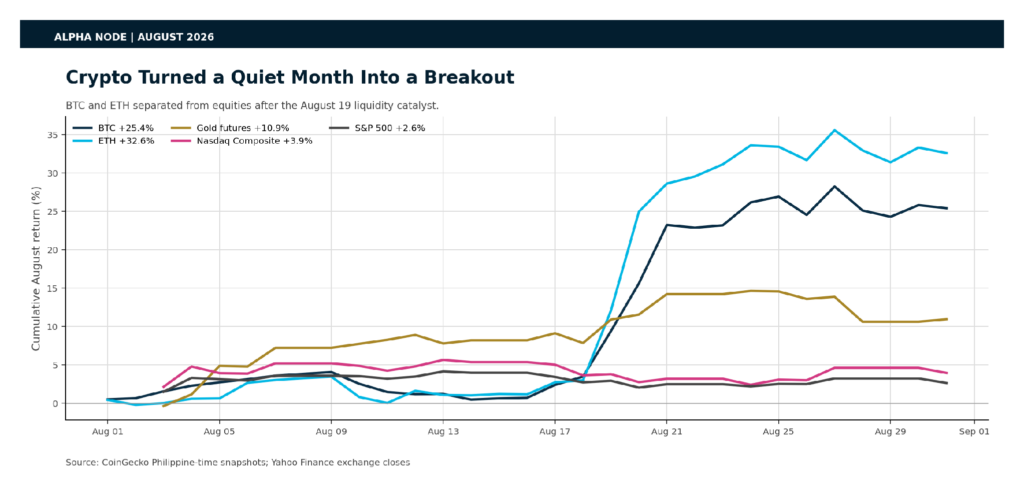
Source: CoinGecko snapshots and Yahoo Finance exchange closes.
August opened with another support test. Bitcoin fell to an hourly low near $62,470 on August 1, while Ethereum reached roughly $1,835. The market recovered, but repeated BTC failures around $65,000 kept July’s rebound looking provisional. Coinbase Research entered the month with Bitcoin order-book depth modestly tilted toward asks, a sign that sellers still had more visible liquidity near price.
CPI eased to 3.4% on August 12 and Treasury yields fell. Bitcoin barely moved. The hesitation was useful evidence: softer inflation alone could not unlock a market still carrying overhead supply and miner selling. Public miners were estimated to have sent $1.78 billion of Bitcoin into the market while financing AI and data-centre expansion.
The August 19 Treasury announcement did what CPI could not. Larger buybacks in the 10-to-20-year and 20-to-30-year sectors promised more support for long-bond liquidity beginning September 9. Long yields dropped and roughly $1.4 billion of shorts were liquidated as Bitcoin burst through $65,000. That was the month’s inflection.
ETF buyers arrived behind the squeeze. Five consecutive sessions from August 19 through August 25 brought $2.08 billion into Bitcoin funds and $890.3 million into Ether funds. BTC traded above $80,000 on August 25. ETH reached $2,535 two days later. Both assets consolidated into month end without surrendering the new range.
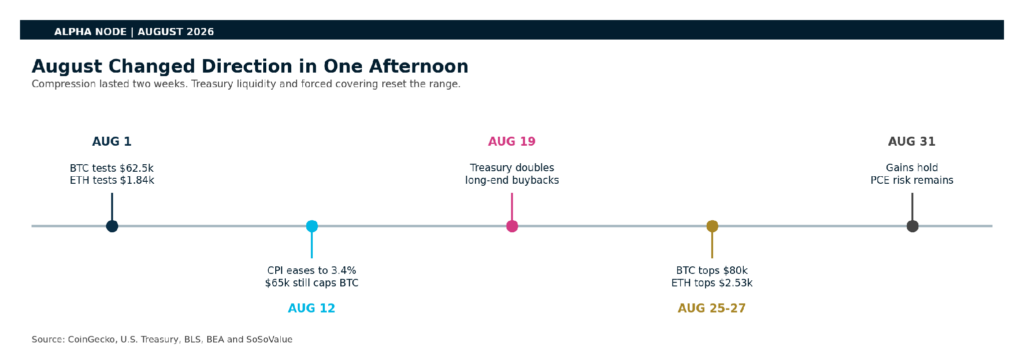
Source: CoinGecko, U.S. Treasury, BLS, BEA and SoSoValue. Compiled by Alpha Node through August 31, 2026.
Bitcoin Market Analysis
Bitcoin opened the measurement window near $62,652 and closed at $78,554. The 25.38% gain hides two different markets. For 18 days, BTC traded like July had solved the liquidation problem without finding a fresh trend. Then it moved almost $18,000 from the August 1 hourly low to the August 25 high near $80,698.
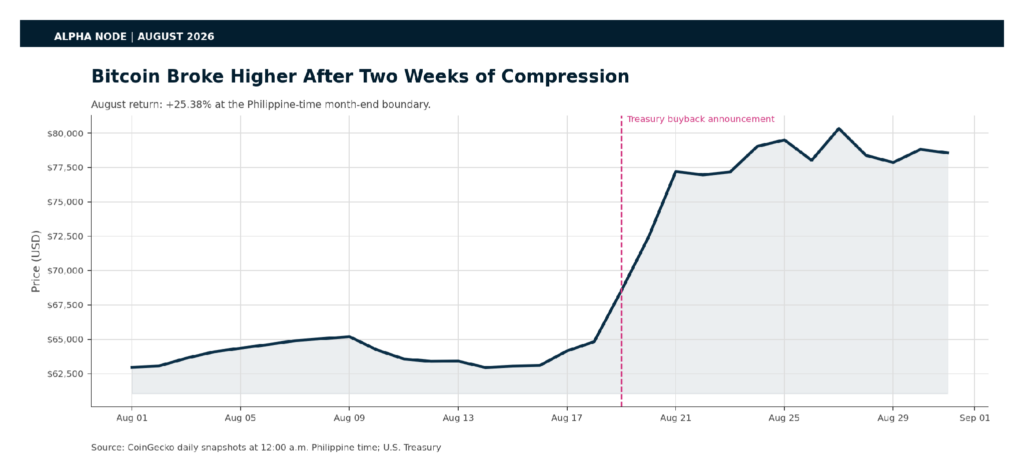
Source: CoinGecko daily snapshots
$65,000 was the hinge. It had rejected several rallies during July and early August, then became the lower edge of the breakout structure after August 19. The next band at $70,000 gave way quickly. BTC entered the final week above its 200-day average and held near $78,000 even after momentum indicators moved into overbought territory.
The first burst came from forced demand. Short liquidations buy back borrowed exposure as price rises, which turns a normal advance into a squeeze. Roughly $1.4 billion of shorts were liquidated within hours of the Treasury news. That flow can disappear as soon as the losing positions are gone.
ETF cash made the move more credible. Bitcoin funds added $3.31 billion from August 3 through August 28, including 15 positive sessions and five negative ones. Buyers subscribed at rising prices through the strongest part of the move. That pattern matters more than the month-end AUM increase, because fund assets also rose when Bitcoin itself appreciated.
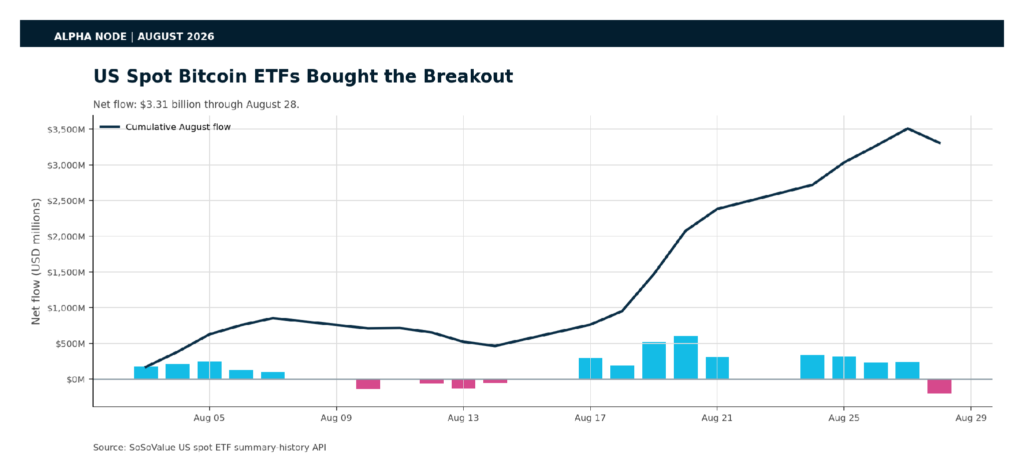
Source: SoSoValue US spot ETF summary-history API through August 28, 2026. Chart calculated by Alpha Node.
The composition of institutional demand also widened. Goldman Sachs agreed to acquire NEOS for up to $2.25 billion. NEOS manages a Bitcoin income ETF that sells call options against Bitcoin-linked exposure. The product turns volatility into distributions, giving advisers a reason to own the wrapper even when spot price stalls.
That income structure caps part of the upside in exchange for cash flow. It also says something useful about the marginal buyer. Wall Street no longer needs a single bullish view to sell Bitcoin exposure. It can package direction, yield, volatility and downside management separately.
September starts with $75,500 as the first short-term balance area, then $70,000 and the old $65,000 ceiling. A clean hold above $70,000 would show the market can digest the squeeze. A break back through that zone while ETF flows fade would expose how much of August was mechanical.
Ethereum Market Analysis
Fund demand gave Ethereum its cleanest August evidence. US spot Ether ETFs added $1.76 billion through August 28, with 16 positive sessions, three negative sessions and one flat day. The total equalled more than 11% of the $15.23 billion month-end net asset base. Bitcoin funds drew more dollars, but Ether’s subscriptions carried more weight relative to product size.
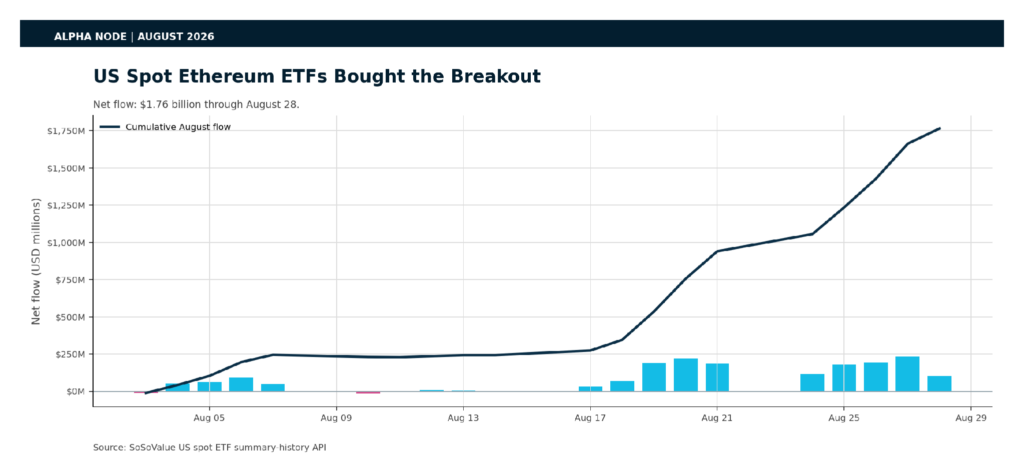
Source: SoSoValue US spot ETF summary-history API through August 28, 2026. Chart calculated by Alpha Node.
The wrapper is changing, too. Fidelity proposed staking the Ether held by FETH, retaining 15% of gross rewards for service fees and distributing cash quarterly after expenses. Brokerage investors would receive protocol yield without managing validators, withdrawal queues or signing keys.
Yield introduces new fund risks. Slashing, validator exits and liquidity management sit between protocol rewards and shareholder cash. Draft EIP-8363 added another variable by proposing lower consensus issuance as more ETH is staked. The investable product is becoming easier to own while its base return is still being debated.
Price followed the product story after August 19. ETH moved from an hourly low near $1,835 to $2,535, then closed at $2,467. The 32.56% monthly gain beat Bitcoin by more than seven percentage points. Unlike July, the outperformance arrived with a broad liquidity impulse and a steady ETF sequence rather than a small cluster of fund days.
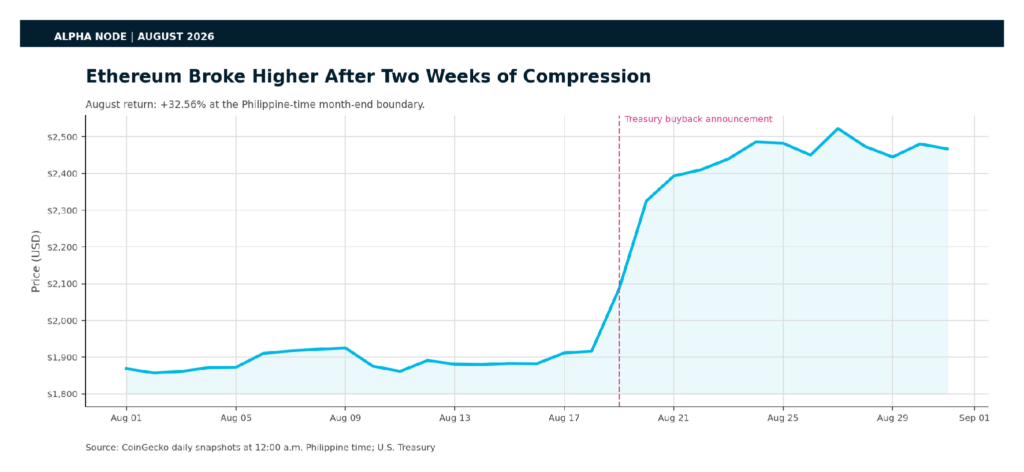
Source: CoinGecko daily snapshots
$2,500 became the immediate supply line. ETH crossed it intraday several times but closed the month below it. The first useful support sits around $2,380, near the late-August balance area, followed by $2,100 and the 200-day trend zone around $2,000. Ethereum repaired more of its chart than Bitcoin did. It also finished farther above its medium-term averages.
BNY Mellon’s institutional staking service and Fidelity’s proposal move ETH toward a familiar servicing model: custody, reporting, yield and cash distribution in one channel. The value case still depends on how much activity and fee demand remain connected to Ethereum as faster settlement systems compete above the base layer.
ETH enters September with a sharper question than BTC. Bitcoin needs proof that ordinary buyers can hold the new range. Ethereum needs proof that access to staking creates durable net demand after the launch excitement, especially if protocol changes compress the underlying reward.
Sector Breadth Broke Out
Sector gains confirmed that the move extended beyond the largest tokens. Artemis’s one-month ranking put Crypto Infrastructure first at 38.1%, followed by Gold Miners at 32.8%, DeFi Lending & Yield at 32.6%, and Crypto Exchanges & Brokers at 32.4%. Twenty-two of the 25 displayed themes beat the S&P 500’s 2.6% return. Bitcoin Miners fell 7.8%, China Internet & Growth lost 8.5%, and China AI declined 10.6%.
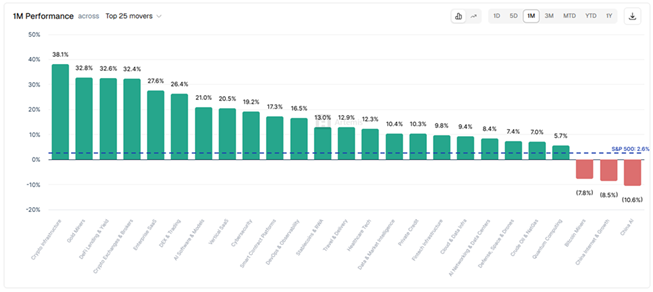
Source: Artemis, 1M Performance across Top 25 movers, captured September 1, 2026. Original provider chart reproduced without alteration.
Leverage arrived with it. Rising open interest pushed Binance leverage ratios to their highest level since January, and the Crypto Fear and Greed Index reached 74 before the August 28 options expiry. Open interest measures outstanding derivative exposure. When it grows faster than spot demand, a normal pullback can trigger forced selling through weaker collateral and liquidations.
August therefore ended with a broader market and a smaller margin for error. ETF flows, stablecoin growth and higher TVL gave the rally a cash base. Overbought momentum and rising leverage made the next decline easier to accelerate.
Wall Street Productised the Return Stream
August’s institutional story moved beyond spot access. Goldman bought an options-income platform. Fidelity proposed passing staking rewards through an ETF. BNY Mellon added staking to institutional custody. Each development separates a component of crypto return and fits it into an existing investment process.
Bitcoin provides volatility but no native cash flow. Covered-call products sell part of that volatility and distribute the premium. Ether produces protocol rewards, but earning them requires operational work and carries penalties. A staking ETF turns that work into a service fee and a quarterly payment.
Productisation can widen ownership. It can also hide trade-offs behind a familiar label. A high distribution rate from an option fund may include return of capital and surrendered upside. A staking payout arrives after fees, validator performance and liquidity constraints. The wrapper simplifies the client experience. The economics still need reading.
The deeper change is distribution. Crypto entered the ETF market as a price exposure. It is now being split into income, collateral, custody and settlement products that advisers can compare with ordinary funds. That makes demand less dependent on one heroic price forecast.
Tokenised Money Reached the Operating Layer
HSBC and Standard Chartered completed the first live transaction on Swift’s blockchain-based ledger. Seventeen banks across six continents are testing a system that matches and nets obligations before settling through existing payment rails. The pilot links tokenised deposits without asking banks to replace their regulatory controls.
Source: Swift, “Interoperability without disruption,” official blockchain-ledger explainer, 2026. Published visual reproduced without alteration.
The Bank of England placed stablecoins and a digital pound in the same cross-border trade-finance test. Shinhan Financial and Visa started work on stablecoin issuance and business settlement in South Korea. POSCO moved trade receivables onto Avalanche for working-capital finance.
These projects target handoffs: the delay between an invoice, ownership record, payment instruction and final settlement. The token matters only if legal records, identity and cash move with it. August produced more work on those connections than on standalone issuance.
Thirty-nine state banking associations formed BankChain Alliance, with a 2027 launch target for tokenised deposits, stablecoins and automated settlement. The group still has to select a technology partner. Its ownership model deserves attention because banks are trying to control the network through which deposit money becomes programmable.
The competitive layer is shifting toward distribution and authoritative records. August’s projects used blockchains as infrastructure inside finance, not as a substitute for the institutions already responsible for ownership, credit and compliance.
Macro Watch: Liquidity Beat Inflation for One Month
CPI eased to 3.4% in July, yet Bitcoin stayed below $65,000. The data lowered Treasury yields and reduced the immediate pressure on risk assets, but it did not create enough demand to clear the range. Investors needed a stronger liquidity cue.
Treasury supplied it on August 19. The department will raise the maximum size of long-end liquidity-support buybacks from $2 billion to at least $4 billion per operation beginning September 9. Buybacks can improve trading conditions by retiring less-liquid securities and supporting market depth. They do not reduce Treasury’s overall financing need, and they are not Federal Reserve asset purchases.
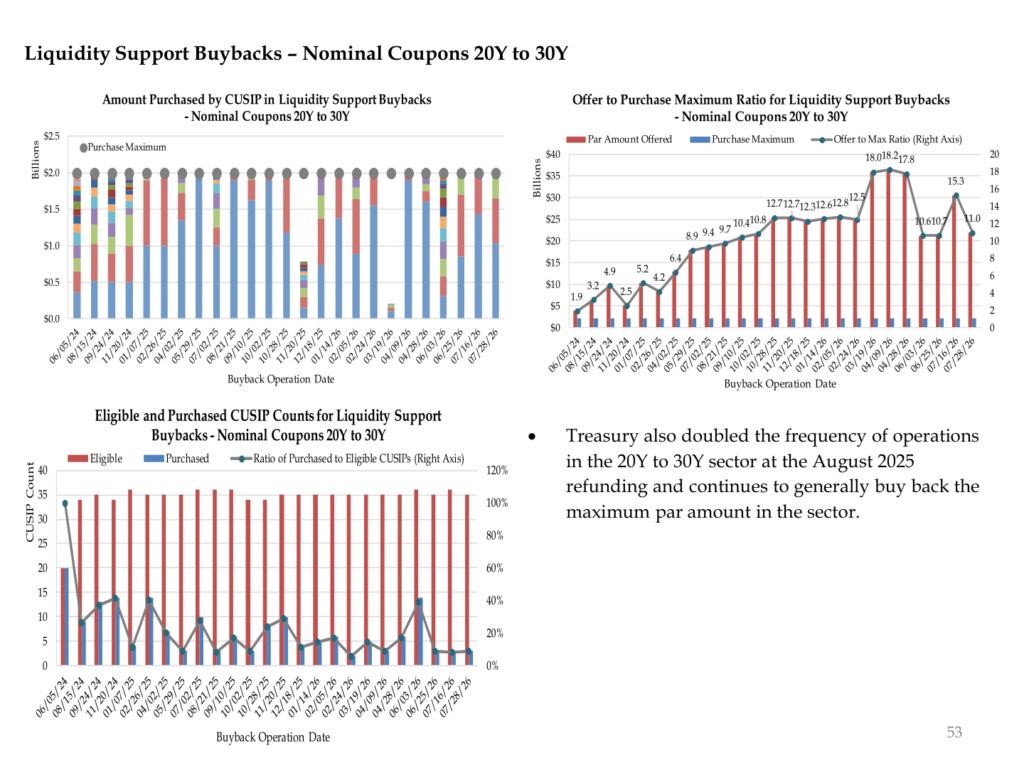
Source: U.S. Treasury, *Treasury Presentation to TBAC*, Q3 2026, slides 52–53. Original government charts reproduced without alteration.
The transmission into crypto ran through yields and positioning. Lower long yields reduced the return hurdle for assets without contractual income. Short sellers then had to buy back exposure as Bitcoin broke resistance. ETF subscriptions extended the move after the first mechanical burst.
The July PCE report closed the month with a warning. Headline inflation rose 3.7% from a year earlier, core inflation increased 3.3%, and real consumer spending was flat. The Fed still faces high inflation without a strong growth cushion.
September 15-16 brings a new Summary of Economic Projections. August gave markets a Treasury-liquidity catalyst before it gave them a lower policy rate. Payrolls, PPI and CPI now have to decide whether that order can continue.
Market Structure: Cash Returned, Leverage Followed
Stablecoin supply rose from $306.4 billion to $310.4 billion during August. The 1.3% increase kept more cash-like value on crypto networks. Supply is capacity. It does not show whether holders are taking risk, paying invoices or waiting.
DeFi TVL climbed from $75.3 billion to $87.8 billion, a 16.6% rise. ETH gained almost twice that percentage, and many DeFi positions are denominated in volatile collateral. Part of the TVL increase came from marking existing assets at higher dollar prices.
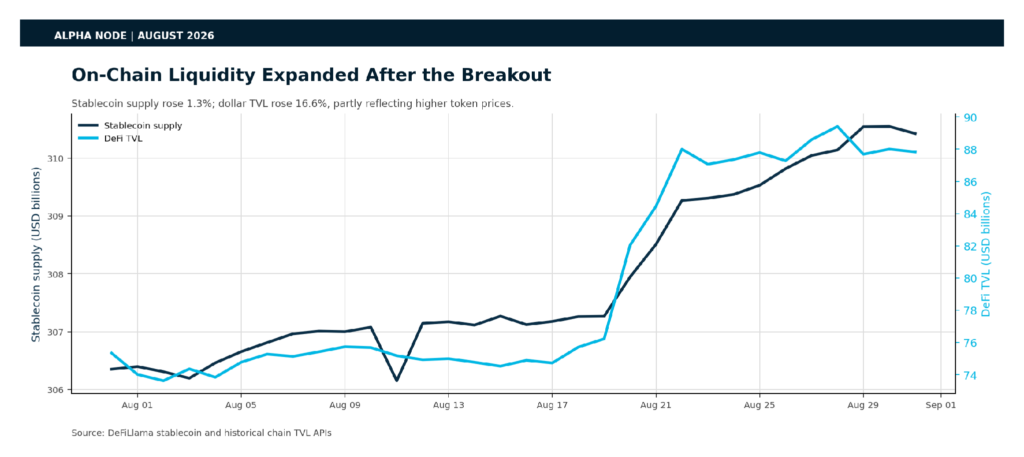
Source: DeFiLlama stablecoin and historical chain TVL APIs through August 31, 2026. Calculated by Alpha Node.
Breadth improved. CoinGecko’s month-end top-30 snapshot showed Solana up about 43%, XRP 31%, Chainlink 41%, Hyperliquid 61% and Zcash 85% over 30 days. The list was no longer only BTC and ETH. Spot breadth arrived after the liquidity break, not before it.
Regulatory Developments: The SEC Moved While Congress Stalled
The SEC proposed Regulation Crypto Assets on August 18. The proposal creates a startup exemption for offerings up to $5 million over four years, a fundraising exemption up to $75 million in a 12-month period, and a conditional safe harbour once promised managerial work has ended.
Those numbers define a fundraising path. They do not settle custody, commodities jurisdiction or the broader market structure that Congress is still debating. The public-comment period remains open for 60 days after Federal Register publication, followed by review and any final rule.
The CLARITY Act remained stuck over ethics language and investor protections. August widened the gap between agency action and legislation: the SEC published a detailed proposal while the Senate’s floor window narrowed.
FASB also proposed clarifying when fully reserved, redeemable dollar stablecoins can qualify as cash equivalents. Accounting treatment decides whether companies can use stablecoins for treasury operations without presenting them as a separate investment category. Comments run through November 19.
Policy advanced on separate clocks. SEC capital-formation rules entered comment. Stablecoin accounting entered comment. Custody rules moved toward proposal. Congressional market structure remained political. None is final yet.
Wrap-up
August was the month buyers stopped waiting. Treasury’s liquidity announcement broke the range, short covering accelerated the move, and ETF subscriptions kept arriving as prices rose. Bitcoin finished more than 25% higher. Ethereum gained almost 33% and drew fund demand large enough to change the scale of its institutional market.
The operating story also matured. Banks tested tokenised deposits inside existing settlement systems. Asset managers split crypto exposure into spot, option income and staking yield. The SEC wrote a tailored offering proposal while Congress remained stuck.
Price moved faster than policy and inflation. That leaves September with one job: show that the new range can survive normal conditions. August’s breakout was real. Its durability is still on trial.