
Bitcoin Defends $60K as Liquidity Leaves Through Three Doors
11th June 2026 • 11 mins read
This Week’s Recap
- Bitcoin defends support after CPI: BTC moved back above $62,000 after May CPI came in at 4.2% headline and 2.9% core. The print was still too hot to revive a clean rate-cut trade, but it was cool enough to avoid the deeper selloff traders feared around $60,000. That makes $60,000 the live test, not a solved problem.
- SpaceX IPO liquidity drain: the expected SpaceX deal is being framed as a $75 billion raise, with reports of demand running far above available shares. That is a direct liquidity competitor for crypto because institutions and retail buyers have to fund the allocation from somewhere. In a week of ETF redemptions and forced selling, the IPO became another reason to keep cash away from Bitcoin.
- Strategy buys 1,550 Bitcoin: the company bought at an average price of $65,332, spent about $101 million, and lifted total holdings to 845,256 BTC. It also raised $181 million through common stock sales and increased cash reserves to $1 billion. The buy repaired some narrative damage after the 32 BTC sale, but the bigger question is now how Strategy balances accumulation with preferred-stock and cash obligations.
- Bitcoin ETFs keep bleeding: U.S. spot Bitcoin ETFs recorded 13 straight outflow days from May 15 to June 3, with SoSoValue data cited at more than $4.37 billion in redemptions. A small $3.05 million inflow ended the streak, then a $325.7 million outflow hit the next session. That flow picture makes the $60,000 defense more fragile, because technical support needs cash buyers behind it.
- BlackRock and Fidelity dominate the ETF market: institutional money is concentrating around IBIT and FBTC while smaller products fight for relevance. During the outflow streak, IBIT was reported as roughly $3.3 billion of the $4.37 billion drawdown, with Fidelity next at about $456 million. The market is deeper at the top but thinner everywhere else, which can make flow reversals feel more concentrated.
- May jobs report runs hot: U.S. payrolls rose by 172,000 in May against an 85,000 consensus, while unemployment held at 4.3%. The first market reaction was higher yields, a stronger dollar, and less urgency for Fed cuts. Wage growth cooling to 3.4% kept the debate alive, but Bitcoin traded the headline as a tighter-liquidity shock.
- Bitcoin futures liquidations hit $10 billion: Bitcoin fell nearly 14% last week and forced almost $10 billion of long-futures liquidations. CryptoSlate tied the move to crowded leverage, ETF outflows, hedge-fund selling, and a capital rotation toward AI. The selloff may have cleared some leverage, but open interest and funding still need to stabilize before the market can call it a bottom.
- Mt. Gox-linked wallets move 10,422 BTC: estate-linked wallets moved roughly $739 million of Bitcoin on June 2, with 10,306 BTC going to a fresh address and 116 BTC moving to a known hot wallet. The transfer happened in block 952,072, ahead of the Oct. 31, 2026 repayment deadline. The key watch is onward movement to exchanges, custodians, liquidity providers, or creditor distribution venues.
- Strategy discloses 32 BTC sale: Strategy sold 32 BTC for $2.5 million at an average net price of $77,135 to fund preferred-stock distributions. The sale was only 0.0038% of its holdings and about 0.014% of reported daily BTC volume, so it did not explain the correction by itself. It mattered because it proved the sell button exists.
- Strive adds 2,500 BTC: Strive bought about $185.2 million of Bitcoin at an average price of $74,092, lifting holdings to 19,000 BTC. The firm also cited a 23.0% quarter-to-date BTC yield, 36.7% year-to-date BTC yield, and an 18-month dividend reserve. That matters because it gives the treasury theme another buyer while Strategy is being scrutinized.
- Morgan Stanley and Galaxy target crypto lending collateral: the arrangement moves client crypto into bankable portfolio workflows where it can become marginable, reportable, and usable inside wealth-management infrastructure. Galaxy Research put crypto-collateralized lending at $73.59 billion in Q3 2025. That is the next institutional test: Bitcoin as collateral can deepen demand, but it also imports deleveraging cycles into the price.
- Circle launches cirBTC: cirBTC is live on Ethereum and backed 1:1 by native BTC, with Circle saying reserves are segregated from corporate assets and designed for on-chain visibility. The product plugs into Circle Mint, USDC workflows, Ethereum DeFi, and planned Arc support. The test is whether liquidity, reserve feeds, oracle support, and protocol listings make it usable collateral at scale.
- A16z and Paradigm lead $175 million Morpho round: Morpho raised $175 million from Paradigm, a16z crypto, Ribbit, Apollo Funds, Circle Ventures, VanEck, and Ledger Cathay. The protocol has more than $11 billion in deposits and is used by firms including Galaxy, Anchorage Digital, and Bitwise. The round says institutional DeFi credit is still investable, but only for rails buyers trust.
- Wall Street increases DeFi exposure: DeFi TVL fell from $172 billion to $148 billion while the sector logged $635 million in April exploit losses, yet institutional buyers still moved into selected tokens. Apollo secured rights to acquire up to 90 million MORPHO over 48 months, and Coinbase Ventures and Janus Henderson bought into ENA. The buying is selective: cash-flow, custody integration, and real distribution are winning over broad beta.
- Janus Henderson invests in Ethena: Janus Henderson’s ENA position landed while Ethena is trying to push USDe into more traditional distribution channels. Coinbase is also now supporting security and operations across more than $5 billion in Ethena assets. That gives Ethena a stronger channel story, but it raises the bar for transparency around reserves, basis-trade risk, and stress behavior.
- Humanity Protocol suffers $36 million exploit: Humanity said a June 8 attack hit H on Ethereum and BNB Chain after a compromised employee laptop exposed Gnosis Safe owner keys for a Hyperlane bridge ProxyAdmin. The update cited roughly $36 million stolen and sold, about 141.2 million H moved on Ethereum, and 200 million H minted on BSC. The lesson is blunt: ZK branding does not fix weak key custody.
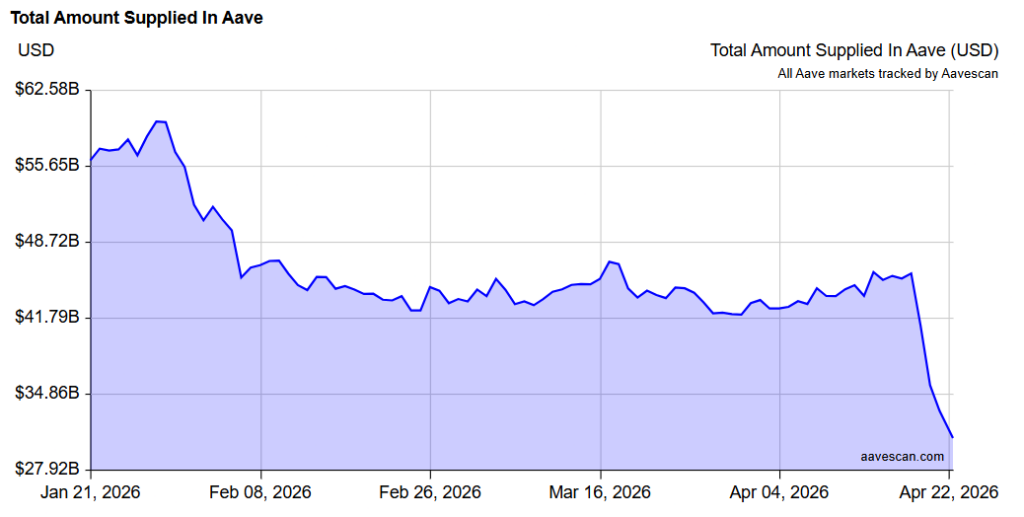
- Aave founder defends protocol after $8.45 billion run: a $292 million KelpDAO LayerZero bridge exploit triggered an $8.45 billion, 48-hour deposit run on Aave. The platform survived after a human-led $300 million emergency bailout, including 25,000 ETH from the Aave DAO and 5,000 ETH from Stani Kulechov. The V4 plan now matters because it aims to localize collateral risk before contagion reaches core reserves.
- Zcash proposes Ironwood upgrade: ZEC rebounded about 45% from Friday’s low near $300 after developers proposed Ironwood, but it remained down roughly 22% on the week. The upgrade would move users to a repaired privacy pool and let anyone running Zcash software verify that supply is clean. The rebound showed relief that a path exists, but privacy coins now have to win back confidence in their accounting layer.
- Ethereum privacy standards return to focus: Ethereum developers are exploring new token standards as privacy shifts from a niche crypto-coin feature into mainstream infrastructure. The important change is context: privacy now touches tokenized assets, institutional workflows, payments, and compliance design. Ethereum needs that conversation if it wants serious financial activity without forcing every transaction into public view.
- BitMine buys 126,971 ETH: BitMine spent about $214 million during the drawdown, adding to an already large ETH treasury while critics pushed for slower accumulation. The buy supports the ETH treasury theme, but it also concentrates the market’s attention on funding cost, staking income, and whether ETH can hold the $1,600 area.
- BitMine seeks $300 million through preferred stock: BitMine plans to sell 3 million perpetual preferred shares with a 9.5% payout, potentially raising $300 million. A full sale would add about $28.5 million in annual dividends, paid weekly when declared, while unrealized ETH losses sit above $8 billion. The coupon tells the story: ETH treasury firms can keep buying, but capital is getting more expensive.
- Tom Lee sets a $250,000 ETH target: the BitMine chairman argued that AI, tokenization, and corporate validators could push Ethereum toward a much larger valuation range. BitMine had nearly 5.4 million ETH, about 4.47% of circulating supply, after recent purchases. The target is less useful as a forecast than as a signal of how aggressively ETH treasury advocates are framing validator economics.
- Mastercard opens stablecoin settlement: the initial rollout supports USDC, PYUSD, USDG, USDP, RLUSD, and SoFiUSD across Ethereum, Solana, Polygon, Base, Arbitrum, XRP Ledger, Canton, and Tempo. Payment networks are moving toward crypto settlement because customers want speed and programmability. Issuer quality, chain support, and compliance will decide which coins actually win distribution.
- Coinbase and Ethena pursue a yield workaround: Coinbase may route idle USDC into activity-based Ethena yield rather than passive stablecoin interest. Coinbase now supports security and operations across more than $5 billion in Ethena assets, while USDe sits near $4.5 billion and the broader stablecoin market near $320 billion. The structure shows how quickly firms will test the edges of stablecoin-yield rules if direct interest payments are restricted.
- Major U.S. banks plan a shared tokenized network: JPMorgan, Bank of America, Citi, and other large banks are targeting a shared tokenized deposit network by the first half of 2027, operated by The Clearing House. The goal is to give deposits blockchain-like speed and programmability while keeping funds inside the banking system. It is a defensive move against stablecoins becoming the default digital settlement rail.
- Tokenized stocks hit $1.48 billion: tokenized equities held $1.48 billion in distributed value as of June 1, up 39% over 30 days, with $4.2 billion in monthly transfer volume. Robinhood EU lists more than 2,000 stock tokens, while Coinbase is adding stock and ETF trading alongside crypto. The appeal is simple: familiar assets, fractional access, and crypto-style settlement.
- OpenAI files for a U.S. IPO: OpenAI said it confidentially filed for a U.S. IPO but has not decided on timing. The filing follows Anthropic’s IPO move and lands beside the expected SpaceX debut, making AI listings the dominant capital-markets story. For crypto, the issue is attention and allocation: every mega-deal raises the hurdle for speculative capital to return to tokens.
- rcement. Prediction markets are becoming more financialized, and the surveillance layer is catching up.
Bitcoin Market Analysis
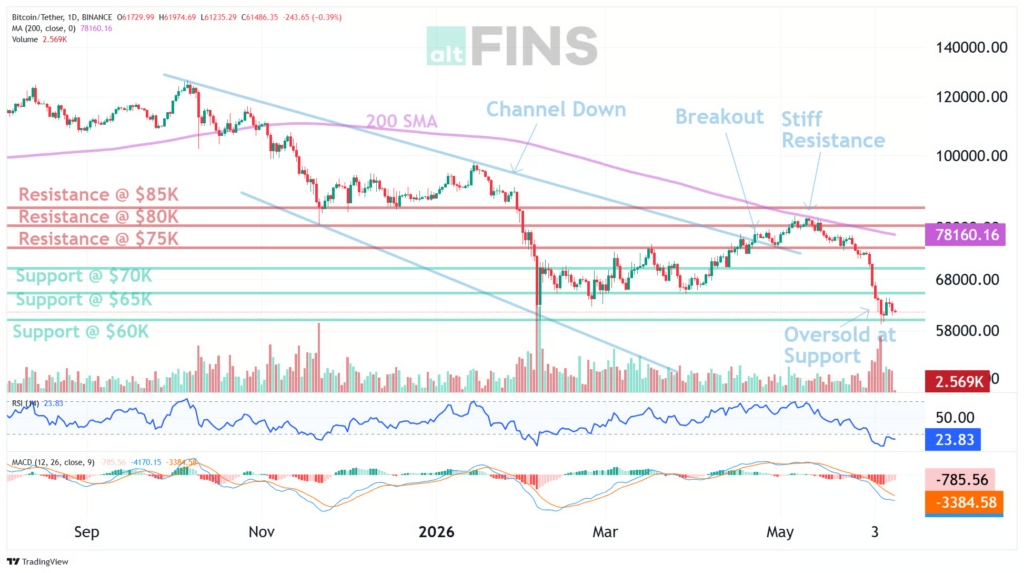
Bitcoin traded like a market trying to find the floor after a forced reset. Price was last marked near $61,559, with the weekly move down about 4.0% and the daily range sitting between $60,742 and $62,847. The failed recovery into the $80,000 to $83,000 area earlier in the move still hangs over the chart, because that zone rejected price twice near the 200-day average before BTC lost $75,000 and $70,000. The market is now back near $60,000 support, where the setup is more about whether sellers are exhausted than whether buyers are in control.
Source: https://altfins.com/technical-analysis
The indicator stack is still weak. Short-term, medium-term, and long-term trend scores are all marked Strong Down, and the 200-day average is still falling far above spot. Momentum is bearish but starting to bend, with MACD below the signal line while the histogram improves, and RSI-14 is deep in oversold territory near 24. That combination can produce a fast bounce, especially when price is close to mapped support, but a trend change still needs higher closes. The first real upside tests are $65,000, then $70,000, with heavier resistance still waiting at $75,000 and $80,000.
Support is clean because few levels sit between current price and the line the market has already chosen. The nearest support zone is $60,000, and the trade setup uses $57,000 as the stop level for any pullback-buy thesis. A daily close below $60,000 would put the 52-week low near $59,122 into play quickly. A break below $57,000 would change the conversation from an oversold bounce to a deeper trend failure. Until then, the chart is stretched enough for a relief move, but the relief has to reclaim levels before it earns trust.
Source: https://sosovalue.com/assets/etf/us-btc-spot
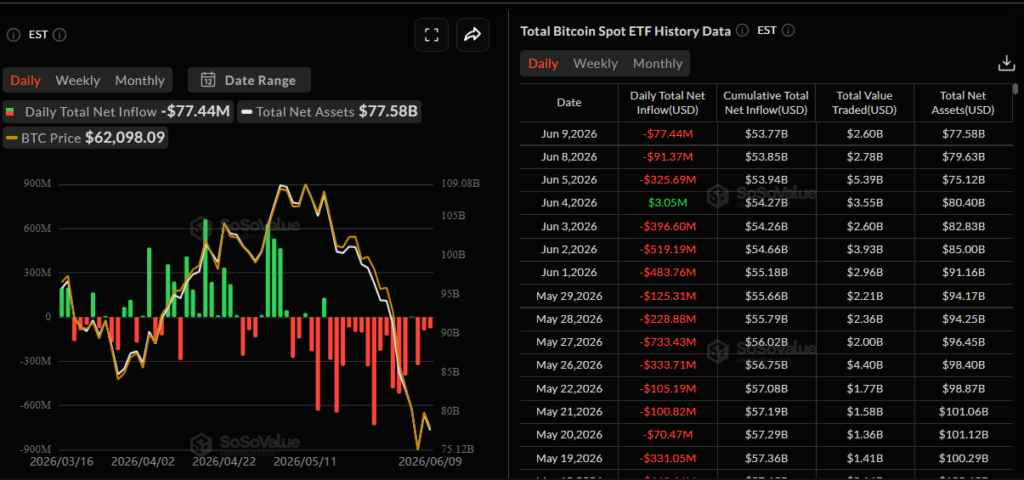
ETF demand is still a drag. The latest table showed spot Bitcoin ETFs with a $77.4 million daily net outflow, $2.6 billion in value traded, and $77.6 billion in net assets, while cumulative net inflow sat near $53.8 billion. Earlier in the week, the flow tape was worse, with reports of a $325.7 million daily redemption and a longer run of redemptions near $1.7 billion. That is the pressure point for BTC now: support is technical, but the bid still needs fresh spot demand to turn a bounce into something more durable.
The treasury story is messier than usual. Strategy’s 1,550 BTC purchase put corporate accumulation back on the board, but it came only after the same firm sold 32 BTC to meet preferred stock obligations. That small sale mattered because it cracked a clean narrative. Strive’s 2,500 BTC purchase and the Morgan Stanley-Galaxy lending push show that institutional Bitcoin usage is still expanding, but the market is no longer treating every treasury headline as automatic support.
Macro is the part Bitcoin cannot trade around. CPI gave buyers enough room to defend $60,000, yet 4.2% headline inflation keeps the Fed boxed in before the June 16-17 meeting. The same week brought a hot jobs report, oil-risk headlines, and warnings that the SpaceX and OpenAI capital cycles are competing for the same speculative dollars. Bitcoin can bounce from oversold support. To lead again, it needs the ETF tape to stop draining and the macro calendar to stop punishing every risk rally.
Ethereum Market Analysis
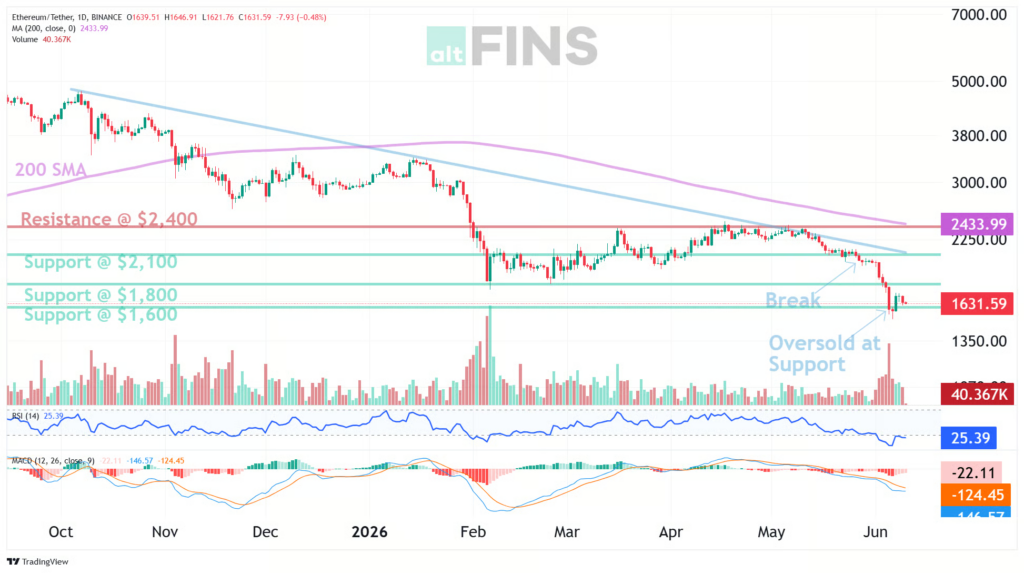
Ethereum’s week started with structure, then ended with a test of patience. Price was last shown near $1,622, down 10.49% over one week and more than 31% over one month. The break back below $2,100 and $1,800 put ETH back into a downtrend and left the market approaching the $1,600 support zone. That is a sharper setup than Bitcoin’s, because ETH is already sitting close to its next mapped support rather than defending a wider range above it.
Source: https://altfins.com/technical-analysis
Trend readings are poor across the board. Short-term, medium-term, and long-term trend scores are all Strong Down, with the 200-day average down more than 30% from spot and most shorter averages pointing lower. RSI-14 is oversold near 25, and MACD remains bearish at about -147, though the histogram is starting to improve. ADX is marked very strong, which means the current direction still has force behind it. Oversold readings can spark a bounce, but ETH needs more than a bounce to repair the chart.
The level map is straightforward. Support sits at $1,600, with the latest daily low near $1,603, and the 52-week low close by at $1,505. A clean loss of $1,600 would put that lower zone into view and damage the near-term rebound case. Resistance is much higher at $2,400 and then $2,700, which shows how much work ETH has to do before the market can talk about a broader recovery. The first step is simply holding $1,600 and reclaiming $1,800.
Source: https://sosovalue.com/assets/etf/us-eth-spot
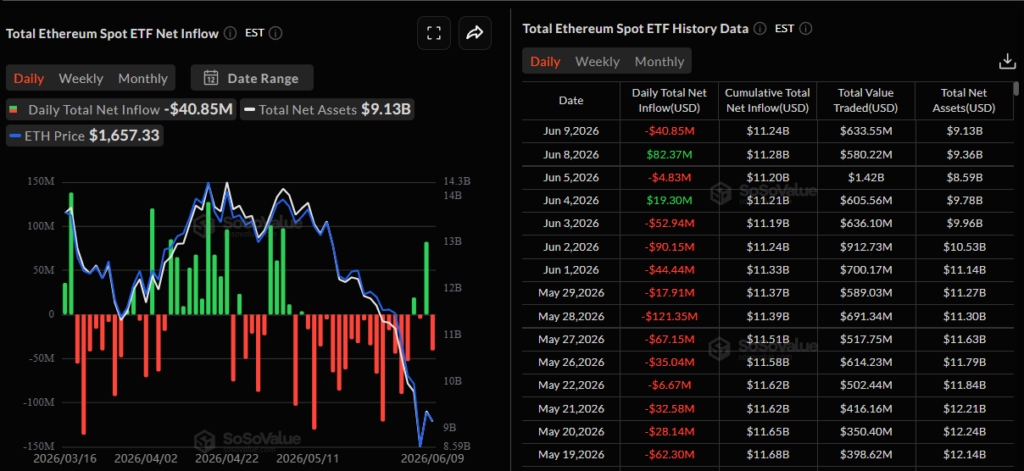
ETF flows gave ETH little cushion. The latest table showed a $40.9 million daily outflow, $633.6 million in value traded, $9.1 billion in net assets, and cumulative net inflow near $11.2 billion. That came after an earlier positive print of $82.4 million, so the flow picture is choppy rather than one-way. Choppy inflows cannot offset a 10% weekly drawdown when the trend stack is this weak. ETH needs persistent buying instead of isolated green days.
Ethereum still has a stronger institutional story than the chart suggests. BitMine bought 126,971 ETH during the selloff, and Wall Street firms are still backing DeFi assets tied to credit and synthetic dollars. The A16z and Paradigm Morpho round adds weight to the idea that professional investors see value in on-chain lending. That story is real. It is also fighting a price chart that keeps falling.
The weak spot is operational trust. Humanity Protocol’s $36 million exploit and Aave’s $8.45 billion liquidity-run debate landed in the same week that institutions were buying DeFi exposure. That split matters for ETH because Ethereum is still the venue where much of this financial experimentation happens. If ETH holds $1,600, the market can frame the decline as an oversold washout. If it loses that level, the institutional DeFi bid will have to prove it can absorb security-driven selling rather than just fund the next growth story.
The DeFi Credit Bid Meets The Security Test
Stablecoins and tokenization stayed active, but both have been regular guests in recent reports. The fresher tension was sharper: professional money is moving deeper into DeFi credit at the same time that operational failures are giving the market new reasons to demand a discount.
Source: https://cointelegraph.com/news/aave-deposits-drop-15b-kelp-dao-exploit
Morpho’s $175 million raise, led by A16z and Paradigm, shows that the credit thesis still has serious backers. Janus Henderson’s ENA investment points in the same direction. Apollo and other Wall Street names are also showing interest in tokens tied to lending, synthetic dollars, and on-chain collateral. That is a different quality of demand than the retail yield chase of prior cycles.
The failure mode is also different. Humanity Protocol lost tens of millions of dollars without a complicated smart-contract collapse. A compromised laptop and private-key exposure were enough. Aave’s public defense after an $8.45 billion liquidity run added another reminder that DeFi risk often sits in collateral design, integrations, oracle choices, and off-chain controls. The code can work as written while the system still breaks in practice.
The institutional credit bid is important, but it is still fighting the trust discount. The money is arriving because the products are useful: lending, collateral movement, stable-dollar distribution, and 24/7 settlement all have obvious demand. The discount remains because the market has learned to price the gap between a protocol’s pitch and its real-world controls. This week widened that gap.
Mark Your Calendars
- June 16-17, 2026 (Tuesday-Wednesday): FOMC meeting
Token Unlock
- June 12, 2026 (Friday): Aptos (APT) unlocks 0.54% of supply
- June 15, 2026 (Monday): Arbitrum (ARB) unlocks 0.93% of circulating supply
- June 17, 2026 (Wednesday): Spark (SPK) unlocks 2.52 billion tokens, valued near $61.18 million
- June 20, 2026 (Saturday): LayerZero (ZRO) unlocks 2.36% of supply
- June 25, 2026 (Thursday): Humanity Protocol (H) unlocks 269.73 million tokens, valued near $72.40 million