
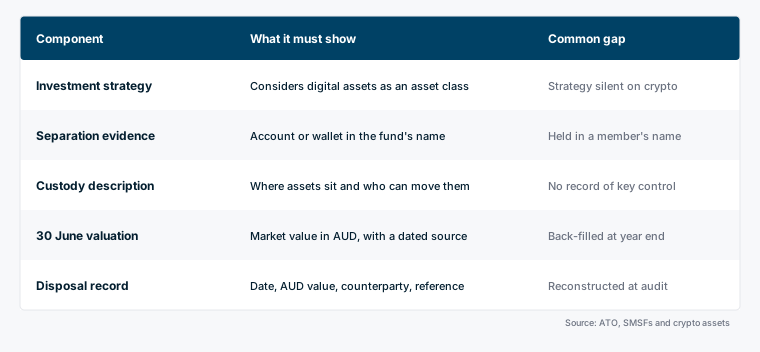
A compliant SMSF crypto file is built from five documents the ATO and the fund’s auditor expect to see: a documented investment strategy that addresses digital assets, evidence that the assets are held separately from the members’ personal holdings, a description of the custody arrangement, a valuation at 30 June, and a complete record of every acquisition and disposal. Each of these exists whether or not the trustee ever buys more. For accountants and SMSF administrators, the work is making sure they exist in writing, in the right form, before the annual audit asks for them.
Key takeaways on SMSF crypto and the ATO
- The ATO’s expectations for SMSF crypto are not new and pre-date the Digital Assets Framework. They sit inside the existing Superannuation Industry (Supervision) Act 1993 (SIS Act) and the ATO’s published “SMSFs and crypto assets” guidance.[1]
- A complete file has five components: investment strategy addressing digital assets, separation evidence, a custody-arrangement description, a 30 June valuation, and a full acquisition and disposal record.
- Separation of fund assets from members’ personal assets is a covenant under the SIS Act, not a best practice. A wallet or exchange account in a member’s personal name is the most common point of failure.[2]
- Every disposal is a CGT event for the fund. The record needs date, AUD value at the time, counterparty or platform, and the transaction reference, kept contemporaneously rather than reconstructed at year end.
- Pension-phase funds carry the same documentation load, with the added question of how illiquid or volatile digital assets interact with minimum pension payment obligations.
The ATO has had a settled position on SMSF crypto for several years. It rests on the sole purpose test, the requirement to keep fund assets separate from personal assets, and the duty to document investment decisions.[1] None of that shifts when the Framework commences on 9 April 2027.[5] What changes from the trustee’s side is the volume of questions, not the rules. SMSFs collectively held approximately AUD 3.02 billion in digital assets at 30 June 2025, and 45% of self-identified SMSF investors report exposure to Bitcoin and crypto.[3][4] The accountants and administrators who service those funds are the ones who assemble the file the ATO eventually reads.
This article walks through what that file contains, section by section. It is written for the people who prepare the accounts and the annual return, with trustees as the secondary reader. It does not cover the auditor’s independent perspective or platform selection mechanics, which sit in separate pieces. For the regulatory backdrop, see the Digital Assets Framework pillar overview.
What does the ATO expect an SMSF crypto file to contain?
The ATO expects the same things it expects for any SMSF asset, applied to an asset class that makes each of them harder to evidence. Five documents carry the weight.
The first is the investment strategy. The SIS Act requires trustees to formulate, review, and give effect to an investment strategy that has regard to risk, return, diversification, liquidity, and the ability to discharge liabilities.[1] A strategy that is silent on digital assets while the fund holds them is the gap an administrator sees most often. The strategy does not need to name a specific token. It needs to show that the trustee considered digital assets as an asset class, set a range or a ceiling for the allocation, and recorded why that exposure is consistent with the fund’s objectives.
The second is evidence of separation. The third is a description of the custody arrangement, meaning where the assets sit and who can move them. The fourth is a valuation at 30 June in Australian dollars. The fifth is a complete acquisition and disposal record. The sections below take each of the last four in turn, since the strategy is the one most administrators already produce in some form.
How should the investment strategy address digital assets?
The strategy should name digital assets as a considered asset class and set out the parameters the trustee has chosen for them. Volatility is the reason this matters more here than elsewhere. A fund that allocates to digital assets without a documented view on how that allocation fits its liquidity needs and risk tolerance has a strategy that does not match its balance sheet.
The practical test the ATO applies is whether the trustee gave effect to the strategy, not merely whether one exists on file.[1] If the strategy contemplates a 5% ceiling and the holding has drifted to 20% on price appreciation, the trustee needs a record of having noticed and either rebalanced or formally revised the strategy. SMSFs with balances under AUD 200,000 allocate around 7% to digital assets, against roughly 2% across all SMSFs, so the smaller funds are the ones most likely to carry a concentration that the strategy needs to address directly.[3]
For administrators, the cleanest approach is a strategy that references digital assets explicitly, a dated trustee minute recording the decision, and an annual review minute confirming the allocation was checked against the documented range. Three short documents close the most common query before it is raised.
What does evidence of separation look like?
Separation means the fund’s digital assets are held in the name of the fund or its corporate trustee, distinct from any member’s personal holdings. This is a covenant under the SIS Act and a separation-of-assets operating standard under the SIS Regulations, not an administrative nicety.[2] The failure pattern is consistent: a member opens an exchange account in their own name, buys through it, and treats the holding as the fund’s. The account name does not match the fund, and the audit trail breaks at the first transaction.
The evidence an administrator wants on file is an account or wallet held in the fund’s or corporate trustee’s name, statements that show that name, and a clear line between fund transactions and any personal activity by the member. Where the platform cannot open an account in the fund’s name, that is a structural problem to resolve before the holding is treated as a fund asset, not a documentation gap to paper over afterward.
Custody and separation are linked but distinct. Separation is about whose name the asset sits under. Custody is about where it physically sits and who controls the keys or the platform credentials. The file needs both: who owns it, and who can move it.
How should digital assets be valued at 30 June?
Digital assets must be valued at market value in Australian dollars as at 30 June for the fund’s financial statements and annual return.[1] The value comes from a fair and reasonable source, typically the price on a recognised exchange or platform at the relevant date, converted to AUD. The point most often missed is contemporaneity: the valuation should be captured at or near 30 June and supported by a record of the source, not estimated months later when the accounts are prepared.
For an asset that can move sharply overnight, the valuation date and the source both matter. An administrator who records the platform, the AUD price, and the timestamp at 30 June gives the auditor a clean basis. One who back-fills a figure from memory creates a query. Where the fund holds across multiple platforms or tokens, each line needs its own valuation source.
What records does the ATO expect for acquisitions and disposals?
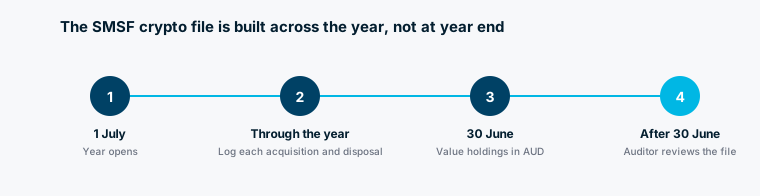
Every acquisition and disposal needs a contemporaneous record, because each disposal is a capital gains tax event for the fund. The record for each transaction should show the date, the type of transaction, the AUD value at the time, the counterparty or platform, and the transaction reference or wallet address. Crypto-to-crypto trades are disposals too, which is the point trustees most often miss. Swapping one token for another triggers a CGT event on the token given up, even though no Australian dollars changed hands.
The reason contemporaneous records matter is reconstruction risk. A fund that trades actively across a year and tries to rebuild the record at audit time will struggle to match on-chain movements to AUD values at the moment of each transaction. The administrator’s role is to set up the feed or the process that captures each event as it happens, so the year-end task is reconciliation rather than archaeology.
The same record set answers the ATO’s other recurring questions. It shows the holding existed, that it belonged to the fund, how it was valued, and how each gain or loss was calculated. One well-kept transaction ledger does most of the compliance work for the rest of the file. Detailed CGT calculation methods and tax outcomes sit with the tax-cluster material rather than here.
What changes for funds in pension phase?
Pension-phase funds carry the same five-part file, plus the question of how a volatile, sometimes illiquid asset interacts with minimum pension payment obligations. A fund that must make minimum payments each year needs liquidity to meet them. Digital assets can supply that liquidity, but only if the trustee has planned for the disposals and recorded them, and only if a price fall has not left the fund unable to fund the payment without selling at a loss.
The documentation question is whether the investment strategy still holds in pension phase. A strategy written for accumulation, with a higher tolerance for volatility and a longer horizon, may no longer match a fund that is drawing down. The administrator’s flag is to check that the strategy was reviewed at the transition to pension phase and that the digital asset allocation was reconsidered against the new liquidity requirement. Each disposal made to fund a pension payment is still a CGT event and still needs the full transaction record.
Common questions
What documents does the ATO want to see for SMSF crypto?
An investment strategy that addresses digital assets, evidence that the assets are held in the fund’s name separately from members’ personal assets, a description of the custody arrangement, a market valuation in AUD at 30 June, and a complete record of every acquisition and disposal. These are the same expectations the ATO applies to any SMSF asset, applied to digital assets.[1]
Does the SMSF investment strategy need to mention crypto specifically?
The strategy should address digital assets as an asset class if the fund holds them, including a view on how the allocation fits the fund’s risk, return, liquidity, and diversification position.[1] It does not need to name a specific token, but a strategy that is silent on digital assets while the fund holds them is a common gap. A dated trustee minute recording the decision strengthens the file.
Can an SMSF hold crypto in an exchange account in a member’s name?
No. Fund assets must be held separately from members’ personal assets, which is a covenant under the SIS Act.[2] An exchange account or wallet in a member’s personal name does not satisfy separation, even if the member treats the holding as the fund’s. The account should be in the name of the fund or its corporate trustee.
How do you value SMSF crypto at 30 June?
At market value in Australian dollars as at 30 June, using a fair and reasonable source such as the price on a recognised exchange or platform at that date.[1] The valuation should be captured at or near 30 June with a record of the source, rather than estimated later. Each token and each platform needs its own valuation line.
Is swapping one crypto for another a CGT event for an SMSF?
Yes. A crypto-to-crypto trade is a disposal of the token given up and triggers a capital gains tax event for the fund, even though no Australian dollars are involved. The transaction record needs the date, the AUD value at the time, and the transaction reference, the same as any other disposal.
Does the ATO position on SMSF crypto change when the Framework starts in 2027?
The ATO’s SMSF requirements sit in the SIS Act and the ATO’s existing guidance, and they do not change when the Digital Assets Framework commences on 9 April 2027.[1][5] The Framework regulates the platforms and custody providers, not the trustee’s superannuation obligations. The file an SMSF must keep is the same before and after commencement.
What are the most common ATO query patterns for SMSF crypto?
The recurring gaps are an investment strategy that does not mention digital assets, assets held in a member’s personal name rather than the fund’s, a missing or back-dated 30 June valuation, and incomplete transaction records that cannot be reconciled at audit. Most queries trace back to records that were reconstructed at year end rather than kept contemporaneously.
- ATO, “SMSFs and crypto assets”: ATO guidance on sole purpose test, separation of assets, valuation, and record-keeping for SMSF crypto holdings.
- Superannuation Industry (Supervision) Act 1993 (Cth), s 52B and related covenants: the trustee duty to keep fund assets separate from members’ personal assets.
- ATO SMSF Quarterly Statistical Report, June 2025: SMSF digital asset holdings and allocation data.
- Independent Reserve Cryptocurrency Index 2026: SMSF investor exposure to digital assets.
- ASIC, “ASIC’s roadmap for digital assets law reform implementation”, 20 April 2026: Digital Assets Framework commencement timing.
Where to start
Alpha Node is the regulated digital asset infrastructure layer Australian advice practices and SMSF professionals partner with: execution, custody, wholesale funds management, wholesale advice, and commercial lending.[6] Practices engage the digital asset market without building the stack themselves.
If you administer SMSFs with digital asset holdings and want a custody and reporting arrangement that produces an audit-ready file, the appropriate next step is a conversation.
Explore the SMSF Partnership pathway →
Sources
- ATO, “SMSFs and crypto assets”. Guidance on the sole purpose test, separation of assets, market valuation at 30 June, and record-keeping for SMSF digital asset holdings. The ATO’s position pre-dates the Digital Assets Framework and operates under the Superannuation Industry (Supervision) Act 1993 (Cth). https://www.ato.gov.au/individuals-and-families/investments-and-assets/crypto-asset-investments/smsfs-and-crypto-assets ↩
- Superannuation Industry (Supervision) Act 1993 (Cth), s 52B(2)(d) (covenant to keep the money and other assets of the fund separate from personal assets); separation-of-assets operating standard in the Superannuation Industry (Supervision) Regulations 1994 (Cth), reg 4.09A. https://www.legislation.gov.au/C2004A04633/latest/text ↩
- ATO, SMSF Quarterly Statistical Report, June 2025. SMSFs held approximately AUD 3.02 billion in digital assets at 30 June 2025; SMSFs with balances under AUD 200,000 allocate around 7% to digital assets, against roughly 2% across all SMSFs. https://www.ato.gov.au/about-ato/research-and-statistics/in-detail/super-statistics/smsf/self-managed-super-fund-quarterly-statistical-report-june-2025 ↩
- Independent Reserve Cryptocurrency Index 2026, p. 29. 45% of self-identified SMSF investors have exposure to Bitcoin and crypto. https://www.independentreserve.com/blog/news/australian-independent-reserve-cryptocurrency-index-irci-2026 ↩
- ASIC, “ASIC’s roadmap for digital assets law reform implementation”, 20 April 2026. The Digital Assets Framework commences on 9 April 2027, when the digital asset platform and tokenised custody platform categories take effect. https://www.asic.gov.au/about-asic/news-centre/news-items/asic-s-roadmap-for-digital-assets-law-reform-implementation/ ↩
- Alpha Node Global, regulatory authorisations. Alpha Node X Pty Ltd (ACN 689 717 422; AUSTRAC VASP 100903039); Alpha Node Capital Pty Ltd (ACN 603 150 634; AFSL 479974, wholesale clients only; AUSTRAC VASP 100612840-001); Alpha Node Capital Management Pty Ltd (ACN 675 404 047; CAR 1308193 of Alpha Node Capital; AUSTRAC VASP 100895147-001); Alpha Node Advisors Pty Ltd (ACN 154 320 000; AFSL 416956, wholesale clients only; AUSTRAC VASP 100282425-001); Alpha Node Finance Pty Ltd (ACN 675 410 116; Credit Representative 556504 of Fair Loans Foundation Pty Ltd, ACL 378968). https://alphanode.global/regulatory/ ↩