
For individuals, trusts, and partnerships, the 50% capital gains tax discount is being replaced from 1 July 2027 with a discount based on inflation, plus a minimum 30% tax on the gain. The change applies to most assets, including crypto held as an investment. It was introduced to Parliament on 28 May 2026 and is not yet law, and superannuation funds and companies are excluded.[1][2][3]
Anyone holding a long-term crypto position has been planning around one number. The 50% discount has halved the taxable gain on a CGT asset held for more than 12 months since 1999. The 2026-27 Federal Budget ends it, and the replacement is a different calculation rather than a tweak to the old one.
Key takeaways on the CGT discount changes
- From 1 July 2027 the 50% CGT discount is replaced, for individuals, trusts, and partnerships, by cost-base indexation plus a minimum 30% tax on the real gain.[1]
- The new regime applies to most asset classes, including crypto (Bitcoin, Ethereum, other tokens and NFTs) held as an investment.[1]
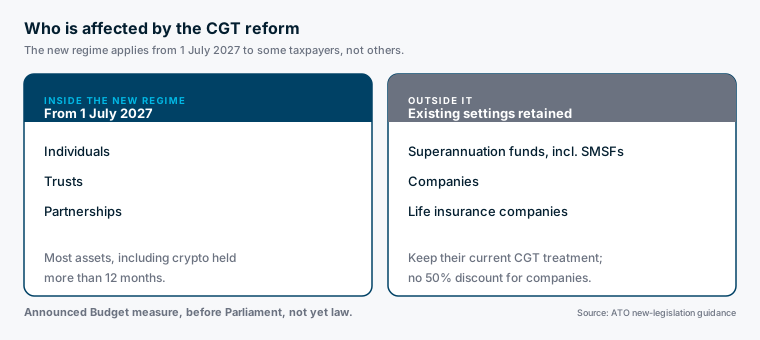
- Superannuation funds, including SMSFs, and companies are excluded and keep their existing CGT settings.[3]
- The measure was introduced to Parliament on 28 May 2026 and is not yet law. Until it passes, the current 50% discount continues to apply.[2]
- This is income tax law. It is separate from the Digital Assets Framework, the Corporations Act regime that regulates crypto platforms from 9 April 2027.[6]
What is changing, and from when?
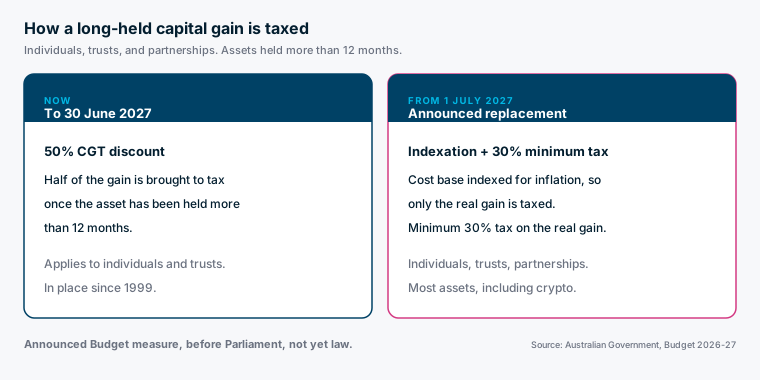
The 50% CGT discount is being replaced from 1 July 2027. In its place, a long-held capital gain for individuals, trusts, and partnerships will be worked out under two new rules: the cost base is indexed for inflation, and a minimum tax rate of 30% applies to the real gain.[1] The discount that has applied since 1999 halved the gain that was brought to tax once an asset had been held for more than 12 months. The new approach changes both how the gain is measured and the floor on the rate that applies to it.
The reform sits inside the 2026-27 Federal Budget’s broader capital gains and housing tax package. It is not crypto-specific. It reaches most CGT assets held by individuals, trusts, and partnerships, and crypto is named alongside property and shares as being inside the new regime.[1] For a digital asset investor, the significance is that the asset class is treated the same way as any other long-held investment, rather than carved out or singled out.
How will cost-base indexation and the 30% minimum tax work?
Cost-base indexation lifts the cost base by inflation over the holding period, so only the real gain above inflation is taxed.[1] In broad terms, the longer an asset is held and the higher inflation has been, the more of the headline gain is treated as inflation rather than as a taxable gain. Indexation is not new to the Australian system. It applied to CGT before the 50% discount was introduced in 1999, and the reform reaches back to that style of calculation.
The 30% minimum tax sets a floor. The reform is drafted so that the effective tax rate on the real capital gain cannot fall below 30%.[1] For an investor whose marginal rate is already above 30%, the floor may not bind, and the indexation of the cost base is the main lever. For an investor on a lower marginal rate, the floor is the part that changes the result. The interaction between indexation and the floor is where the detail will matter, and it is the kind of calculation that belongs with an accountant rather than a rule of thumb.
This article describes the announced model in general terms. It does not work through figures for any particular holding, because the outcome depends on the cost base, the holding period, inflation over that period, and the investor’s circumstances. The companion pieces on how the ATO taxes digital assets and on CGT events for crypto set out the underlying rules the reform builds on. How the ATO taxes digital assets CGT events for crypto
Does it apply to crypto?
Yes. Crypto held as an investment is a CGT asset, and the reform applies to it the same way it applies to property and shares.[1] A disposal of crypto, which includes selling it for Australian dollars, swapping one token for another, and using crypto to pay for something, is a CGT event under the existing rules, and that does not change.[5] What changes from 1 July 2027 is how the gain on a disposal of a long-held crypto asset is calculated and the minimum rate that applies to it.
The reform does not alter the threshold question of whether a disposal has happened, or the investor-versus-business distinction that decides whether a gain is on capital or revenue account. Those rules continue to run as they do now. The reform operates at the next step, on the gain itself, once a CGT event on capital account has occurred. A crypto investor who already tracks disposals and cost base will use the same records; the calculation applied to them is what shifts.
Who is excluded?
Superannuation funds, including self-managed super funds, and companies are excluded from the new regime and keep their existing CGT settings.[3] Complying super funds retain their current treatment for directly held assets, and companies, which never had access to the 50% discount, continue under existing rules. The new cost-base indexation and 30% minimum tax regime is aimed at individuals, trusts, and partnerships.
For a digital asset investor, the exclusion makes the holding structure more consequential than it was. The same crypto position can sit on a different forward footing depending on whether it is held personally, through a trust, or inside an SMSF. That is a structural question rather than a timing one, and it is worth raising with an accountant well before any disposal is contemplated. The SMSF-specific compliance and record-keeping requirements are a separate topic and are not affected by this reform.
Is it law yet?
No. The measure was introduced to Parliament on 28 May 2026, through the Treasury Laws Amendment (Tax Reform No. 1) Bill 2026 and the Income Tax Rates Amendment (Tax Reform No. 1) Bill 2026, and it is not yet law as at June 2026.[2] Until the legislation passes, the current 50% CGT discount continues to apply in full. As drafted, the reform applies to gains arising after 1 July 2027.[2]
The status matters for how the change should be read. An announced measure before Parliament can be amended in passage, and the detail that determines outcomes, particularly the transitional rules, is the part most likely to be refined. The direction is set, but the precise mechanics are not final, and anything written about the reform, including this article, describes the announced position rather than enacted law.
What about assets I already hold?
The reform is drafted to apply to gains arising after 1 July 2027, with proposed transitional rules for assets owned before that date and sold afterwards.[2][4] The announced transitional approach allows the gain to be split between the old and new systems, either by a time-apportionment method or by taking a market valuation of the asset at 1 July 2027.[4] The effect is that the appreciation up to 1 July 2027 and the appreciation after it can be treated under their respective regimes rather than the new rules applying to the whole gain.
For a crypto investor with a long-held position, the transitional rules are the part to watch as the legislation moves through Parliament, because they decide how a gain that straddles the start date is handled. The mechanics are not yet settled, and the sensible posture is to keep clean records of cost base and acquisition dates so that whichever method applies can be supported. This is general information, not advice to acquire, hold, or dispose of anything before or after the start date.
Does this have anything to do with the Digital Assets Framework?
No. The CGT reform is income tax law. The Digital Assets Framework is a Corporations Act regime, administered by ASIC, that regulates crypto platforms and conduct and commences on 9 April 2027.[6] The two are separate reforms that happen to land within a few months of each other, and they do different things. The Framework decides how platforms must be licensed and how digital assets are held and dealt with. The CGT reform decides how a capital gain is taxed.
The proximity of the dates is a coincidence of timetable, not a connection of substance. A digital asset investor will feel both, but through different channels: the Framework through the platforms they use, and the CGT reform through their tax return. Conflating the two leads to the wrong conclusion that the Framework changes the tax, which it does not.
Common questions
Is the 50% CGT discount being abolished?
For individuals, trusts, and partnerships it is being replaced from 1 July 2027 with cost-base indexation plus a minimum 30% tax on the real gain.[1] The measure was introduced to Parliament on 28 May 2026 and is not yet law, so the current 50% discount continues until the legislation passes.[2]
Does the change apply to cryptocurrency?
Yes. Crypto held as an investment is within the new regime, alongside property and shares, from 1 July 2027.[1] Whether a crypto disposal is a CGT event does not change; what changes is how the gain on a long-held crypto asset is calculated and the minimum rate that applies.[5]
Are SMSFs affected?
No. Superannuation funds, including SMSFs, are excluded and keep their existing CGT settings.[3] The same applies to companies. The new regime applies to individuals, trusts, and partnerships.
When does it start?
The reform applies to gains arising after 1 July 2027.[2] Proposed transitional rules would split a gain on an asset held across that date between the old and new systems, using time apportionment or a 1 July 2027 market valuation.[4]
Is it law now?
No. It was introduced to Parliament on 28 May 2026 and is not yet law as at June 2026.[2] It can change as it moves through Parliament, particularly the transitional detail.
Does the Digital Assets Framework change crypto tax?
No. The Framework is a separate Corporations Act and ASIC regime that regulates platforms and conduct from 9 April 2027.[6] The CGT reform is income tax law. The two are unrelated changes.
- Australian Government, Budget 2026-27 tax reform: the replacement of the 50% CGT discount with an inflation-based discount and a 30% minimum tax from 1 July 2027.
- ATO, "Reforming negative gearing and capital gains tax": the new-legislation status and scope of the measure.
- Baker McKenzie, "Budget Bites: CGT Discount and Negative Gearing": analysis of the CGT discount replacement.
- PwC, "2026-27 Federal Budget: CGT and housing tax reform": the measure, its start date, and exclusions.
- Westcourt, "How capital gains tax changes from 1 July 2027": the new rules and proposed transitional approach.
- ATO, "Crypto asset investments": crypto as a CGT asset and what counts as a disposal.
Where to start
Alpha Node is the regulated digital asset infrastructure layer Australian advice and accounting practices partner with: execution, custody, wholesale funds management, wholesale advice, and commercial lending.[7] Practices engage the digital asset market without building the stack themselves.
If you or your clients hold digital assets and want a custody and reporting arrangement that produces clean cost-base and disposal records ahead of the change, the appropriate next step is a conversation.
Sources
- 2026-27 Federal Budget capital gains tax reform. From 1 July 2027 the 50% CGT discount is replaced, for individuals, trusts, and partnerships, with cost-base indexation (the cost base is uplifted by CPI so only the real gain above inflation is taxed) plus a minimum 30% tax on the real gain. The new regime applies to most asset classes, including crypto held as an investment. Australian Government, Budget 2026-27 (https://budget.gov.au/content/04-tax-reform.htm); Baker McKenzie, "Budget Bites: CGT Discount and Negative Gearing" (https://www.bakermckenzie.com/en/insight/publications/2026/05/australia-budget-bites-cgt-discount-and-negative-gearing); PwC, "2026-27 Federal Budget: CGT and housing tax reform" (https://www.pwc.com.au/tax/tax-alerts/cgt-and-housing-tax-reform.html). ↩
- The measure was introduced to Parliament on 28 May 2026 (Treasury Laws Amendment (Tax Reform No. 1) Bill 2026; Income Tax Rates Amendment (Tax Reform No. 1) Bill 2026) and is not yet law as at June 2026. The CGT reforms apply only to gains arising after 1 July 2027. Australian Government, Budget 2026-27 (https://budget.gov.au/content/04-tax-reform.htm); ATO, "Reforming negative gearing and capital gains tax" (https://www.ato.gov.au/about-ato/new-legislation/in-detail/individuals/tax-reform-boosting-home-ownership-reforming-negative-gearing-and-capital-gains-tax). ↩
- Superannuation funds (including self-managed super funds), companies, and life insurance companies are excluded from the new regime and retain their existing CGT settings; the new rules apply to individuals, trusts, and partnerships. Australian Government, Budget 2026-27 (https://budget.gov.au/content/04-tax-reform.htm); ATO, "Reforming negative gearing and capital gains tax" (https://www.ato.gov.au/about-ato/new-legislation/in-detail/individuals/tax-reform-boosting-home-ownership-reforming-negative-gearing-and-capital-gains-tax). ↩
- Proposed transitional rules for assets owned before 1 July 2027 and sold afterwards would allow the gain to be split between the old and new systems, using a time-apportionment method or a market valuation of the asset at 1 July 2027. The transitional detail is part of the announced measure before Parliament and is subject to change. Westcourt, "How capital gains tax changes from 1 July 2027" (https://westcourt.com.au/news-article/how-capital-gains-tax-changes-from-1-july-2027-part-1-the-new-rules/). ↩
- ATO, "Crypto asset investments". Crypto held as an investment is a CGT asset; a disposal triggers a CGT event, and disposal includes selling crypto for Australian dollars, exchanging one crypto for another, and using crypto to pay for goods or services. https://www.ato.gov.au/individuals-and-families/investments-and-assets/crypto-asset-investments ↩
- The Digital Assets Framework (Corporations Amendment (Digital Assets Framework) Act 2026) is a Corporations Act regime administered by ASIC. It regulates digital asset platforms and conduct, commences on 9 April 2027, and does not change the income tax or CGT treatment of digital assets. ASIC, "ASIC’s roadmap for digital assets law reform implementation", 20 April 2026. https://www.asic.gov.au/about-asic/news-centre/news-items/asic-s-roadmap-for-digital-assets-law-reform-implementation/ ↩
- Alpha Node Global, regulatory authorisations. Alpha Node X Pty Ltd (ACN 689 717 422; AUSTRAC VASP 100903039); Alpha Node Capital Pty Ltd (ACN 603 150 634; AFSL 479974, wholesale clients only; AUSTRAC VASP 100612840-001); Alpha Node Capital Management Pty Ltd (ACN 675 404 047; CAR 1308193 of Alpha Node Capital; AUSTRAC VASP 100895147-001); Alpha Node Advisors Pty Ltd (ACN 154 320 000; AFSL 416956, wholesale clients only; AUSTRAC VASP 100282425-001); Alpha Node Finance Pty Ltd (ACN 675 410 116; Credit Representative 556504 of Fair Loans Foundation Pty Ltd, ACL 378968). https://alphanode.global/regulatory/ ↩