
Bitcoin Falls Below $60K as ETF Redemptions and the AI Trade Drain the Bid
25th June 2026 • 7 mins read
This Week’s Recap
- Bitcoin breaks below $60,000: BTC lost the level that had contained every June selloff and briefly traded near $59,100, leaving it roughly 20% lower for the month and more than 50% below its October peak. AI and semiconductor equities continued to attract capital during the decline, so the break reflected weak crypto demand as much as forced selling.
- US Bitcoin ETF withdrawals reach $6.4 billion: US spot funds lost roughly $6.4 billion over 30 days, reversing the institutional flow that had supported earlier corrections. The withdrawals leave the $57,300 liquidation zone exposed because technical buyers now have to absorb ETF supply without a reliable new-money bid.
- The Fed removes its easing cushion: the Fed held rates at 3.50% to 3.75%, raised its inflation concern, and signalled that another increase remained possible under Chair Kevin Warsh. Crypto fell even as the US-Iran agreement lifted stocks and lowered oil, showing that interest-rate expectations had become the stronger market force.
- The dollar threatens a 13-month breakout: DXY climbed above 100.60 and approached the top of a range that had capped it since May 2025. Bitcoin’s 90-day correlation with the dollar was reported near minus 0.82, so a confirmed currency breakout would keep pressure on BTC even if crypto-specific news improves.
- South Korea’s KOSPI crashes 10%: the index plunged after regulators acknowledged that leveraged chip ETFs had been approved too quickly, extending a violent reversal in one of the world’s strongest AI trades. Bitcoin fell below $63,000 during the shock because the same leveraged capital was being reduced across technology shares and crypto.
- Crypto liquidations reach $714 million: roughly $714 million of positions were liquidated over 24 hours, with long traders taking most of the loss as BTC moved through the low-$60,000s. Open leverage was cleared, but spot demand did not replace it, which explains why the usual post-liquidation bounce faded quickly.
- A $10 billion Bitcoin options settlement approaches: quarterly options worth about $10 billion are due to settle near the PCE inflation release, placing two volatility catalysts in the same window. Dealer hedging can hold price near large strikes before expiry, then accelerate the move once those positions roll off, especially if $60,000 remains broken.
- Bitcoin traders buy protection down to $52,000: options demand shifted toward puts at $60,000, $55,000, and $52,000 after the weekly rebound failed. The positioning does not guarantee those prices, but it shows that professional traders are paying to protect against a deeper decline rather than treating the current range as a firm bottom.
- Bitcoin may find its next floor near $55,000: 10x Research placed the next potential base near $55,000 as tighter monetary policy and ETF outflows weakened the $60,000 zone. That target sits beneath the report’s $57,000 tactical invalidation level, making the mid-$50,000s the first area where a failed rebound could meet a new valuation argument.
- Bitcoin network traffic hits a two-year high: daily transactions moved above 820,000 as Runes activity returned, producing the busiest network period since 2024. The divergence is useful: demand for block space improved while investment demand weakened, so higher usage alone was not enough to support BTC’s price.
- Older Bitcoin holders slow their selling: distribution from long-held wallets fell to its lowest pace in nearly two years, reducing one source of supply that had weighed on the market above $100,000. ETF redemptions and miner sales have replaced those holders as the more immediate pressure points, leaving the supply picture mixed rather than uniformly bearish.
- Strategy buys 520 BTC and raises its cash reserve: Strategy spent $34.9 million at an average price near $67,000 and lifted its dollar reserve by $300 million to roughly $1.4 billion. The reserve increase is as relevant as the purchase because preferred dividends and debt obligations now compete directly with the company’s Bitcoin accumulation plan.
- CryptoQuant tells Strategy to pause: the research firm argued that Strategy should protect liquidity after its Bitcoin position moved to a reported paper loss near $10.6 billion. A pause would remove a familiar source of demand, but continuing to buy through expensive financing could deepen pressure on its preferred shares and common equity.
- Strategy’s STRC preferred stock loses par: STRC fell below $83 only five weeks after trading around its $100 target, as Bitcoin losses and leveraged liquidations overwhelmed its income appeal. The discount shows investors demanding a higher return for funding a company whose underlying asset produces no cash flow.
- Bitcoin miners sell into weak economics: Bitcoin traded below JPMorgan’s estimated $78,000 production cost for five consecutive months, and about 20% of miners were estimated to be unprofitable. Public miners sold more than 32,000 BTC in the first quarter, exceeding their combined 2025 sales and turning operating stress into spot-market supply.
- JPMorgan sees mining difficulty becoming more price-sensitive: the six-month beta of mining difficulty to Bitcoin price rose to 0.62 as more operators moved close to breakeven. The network can adjust through lower difficulty, but sharper shutdown cycles and treasury sales make miners a stronger amplifier of price weakness until BTC recovers toward production cost.
- Ethereum Foundation cuts its budget by 40%: the Foundation also cut headcount by 20% after nine senior departures since January and plans to reduce annual spending from roughly 15% of treasury assets toward 5% by 2030. The endowment model can extend its runway, but winding down teams such as Privacy and Scaling Explorations raises execution risk for an already ambitious roadmap.
- Ethlabs launches with former Ethereum researchers: five former senior researchers created a separate nonprofit to address a reported $30 million annual shortfall in core protocol funding. The new organisation broadens Ethereum’s research base, while also making coordination and accountability harder to judge as work moves beyond the Foundation.
- BitMine adds $92 million of ETH: BitMine bought into the decline and reinforced its position as one of the largest corporate ETH holders. The purchase gives Ethereum a visible treasury buyer, but price still lost $1,800, showing that corporate accumulation remains too small to offset ETF redemptions and broad risk reduction.
- Morgan Stanley prices ETH and SOL ETFs at 0.14%: amended filings set proposed sponsor fees below competing crypto products as the bank moves toward Ethereum and Solana exposure. The low price targets adviser platforms and long-term allocations, where a few basis points matter more than they do for short-term crypto traders.
- Ethereum validators may fund development directly: a proposal would let validators redirect up to 10% of staking rewards toward approved ecosystem projects. It offers a recurring funding source after the Foundation’s cuts, but validators may resist giving up yield unless project selection and reporting are transparent.
- Taiko halts after a bridge exploit: the Ethereum Layer 2 stopped block production after an attacker forged withdrawal proofs and drained roughly $1.7 million through its bridge. TAIKO fell more than 20% from midnight UTC, and the shutdown showed how one bridge failure can interrupt an entire network rather than one application.
- Ethereum’s largest sandwich bot loses $7.5 million: the Jaredfromsubway bot, known for extracting value from user trades, was itself drained through a flaw in its automated system. The incident exposes a wider risk in complex trading infrastructure: profitable code can run for years while carrying a hidden failure point large enough to erase the gains.
- SecondFi confirms a $2.4 million loss: three attacks drained 16 million ADA from 374 wallets before the team secured another 129 million ADA with a third-party custodian. SlowMist estimated that total losses could exceed $20 million, but that higher figure remains unconfirmed pending an independent audit.
- Binance withdraws its Greek MiCA application: Binance abandoned Greece as its route to an EU-wide licence while maintaining that it intends to keep serving Europe. MiCA’s passporting model rewards firms that secure one credible home regulator, so the withdrawal increases uncertainty around Binance’s access and product range after the July 1 transition.
- The CLARITY Act gets a July 17 hearing: lawmakers set a field hearing that gives the market-structure bill a concrete next step after months of negotiation. Support from roughly seven Senate Democrats remains the practical hurdle, leaving regulatory clarity as a possible summer catalyst rather than an assured outcome.
- Cboe revives binary S&P 500 options: Cboe is returning to all-or-nothing index contracts as prediction markets pull retail demand toward simpler event outcomes. A regulated exchange can bring deeper liquidity and familiar surveillance, but it also places direct competitive pressure on Kalshi, Polymarket, Coinbase, and Robinhood.
- Meta develops a prediction market app: the proposed Arena product would let users forecast events with points instead of cash, placing prediction mechanics inside a mass-market social platform. Even without direct wagering, Meta could train a much larger audience on event markets and become a distribution channel or competitor for existing platforms.
- Chainlink links 47 banks for cross-border settlement: Project Pangea brings European and South Korean institutions together to test stablecoin settlement for large foreign-exchange transfers. The project targets the slow reconciliation and limited operating hours of correspondent banking, giving Chainlink a role in connecting bank systems rather than replacing them.
- Securitize and tZERO enter a patent fight: tZERO filed suit in Delaware over patents covering parts of tokenised securities issuance and trading infrastructure. The dispute could affect licensing costs and product design across a fast-growing market, making intellectual property another constraint alongside regulation, custody, and liquidity.
Bitcoin Market Analysis
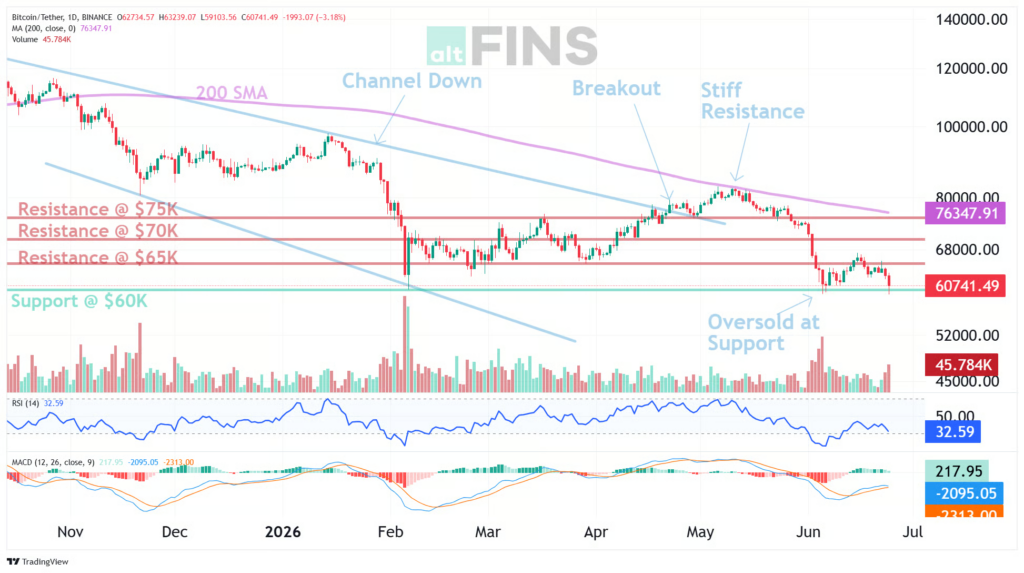
Bitcoin’s $60,000 defense broke after weeks of repeated testing. Price was last marked near $61,000 after touching $59,095, only 3.2% above the 52-week low and more than 51% below the October 2025 peak. The weekly move was down roughly 2.8%, the monthly loss reached 20.9%, and the year-to-date decline stood near 30%. The earlier rejection around $80,000 to $83,000 set the direction. Every rebound since then has made less progress.
Source: https://altfins.com/technical-analysis
The trend remains down across every measured horizon. Short, medium, and long-term readings all score Strong Down, with price below the major simple and exponential averages. RSI-14 sits near 34 after reaching oversold territory earlier in June. MACD is still bullish on the crossover reading, but the histogram has started to fade. That combination can produce a sharp relief rally. It cannot carry the reversal argument by itself.
$60,000 remains the immediate pivot even after the intraday break. Buyers need to recover that level quickly and hold it on daily closes. The tactical stop zone is $57,000, close to a reported liquidation pocket at $57,300, while a deeper failure opens the $52,000 to $55,000 range now visible in research calls and options positioning. Resistance starts at $65,000, then $70,000. The 200-day average near $76,350 sits above both and keeps the larger repair job unfinished.
Source: https://sosovalue.com/assets/etf/us-btc-spot
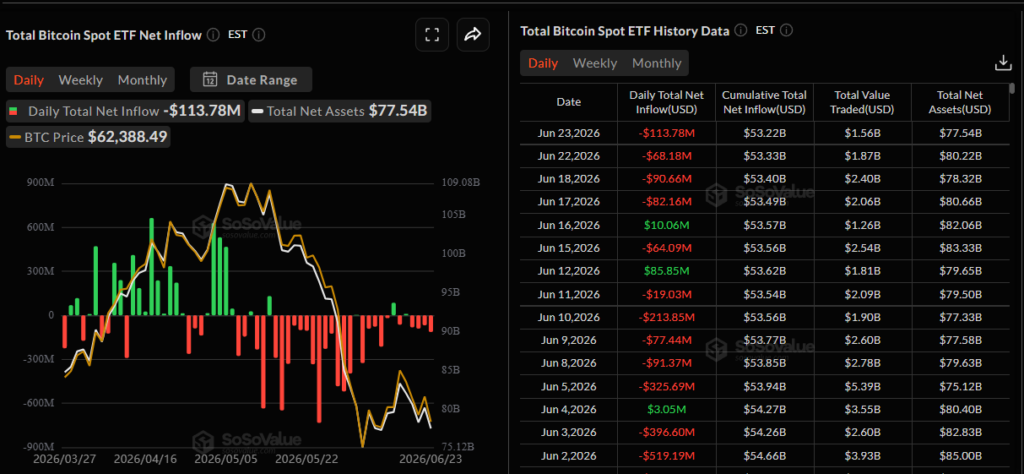
ETF flows are where the support case weakened most. The latest session showed a $113.8 million outflow, $1.56 billion in value traded, and net assets near $77.5 billion. The prior two sessions also closed red, taking the three-day withdrawal total above $264 million. The longer window looks worse: US Bitcoin ETFs lost roughly $6.4 billion over 30 days. Technical support has been asked to absorb a persistent institutional exit.
Strategy added 520 BTC and raised its cash reserve, but the treasury bid no longer lands with the same force. STRC traded below par, miners sold more than 32,000 BTC in the first quarter, and CryptoQuant urged Strategy to stop buying until its cash position improves. Bitcoin still has corporate buyers. Their cost of capital is rising as the asset falls.
Daily Bitcoin transactions climbed above 820,000, and older holders slowed distribution to the lowest pace in nearly two years. Supply told a firmer story than flows. The next move hinges on whether that on-chain resilience can outlast ETF selling and the $10 billion options expiry. A quick recovery through $65,000 would give the oversold bounce room. A daily close below $57,000 would clear the path toward the low-$50,000s.
Ethereum Market Analysis
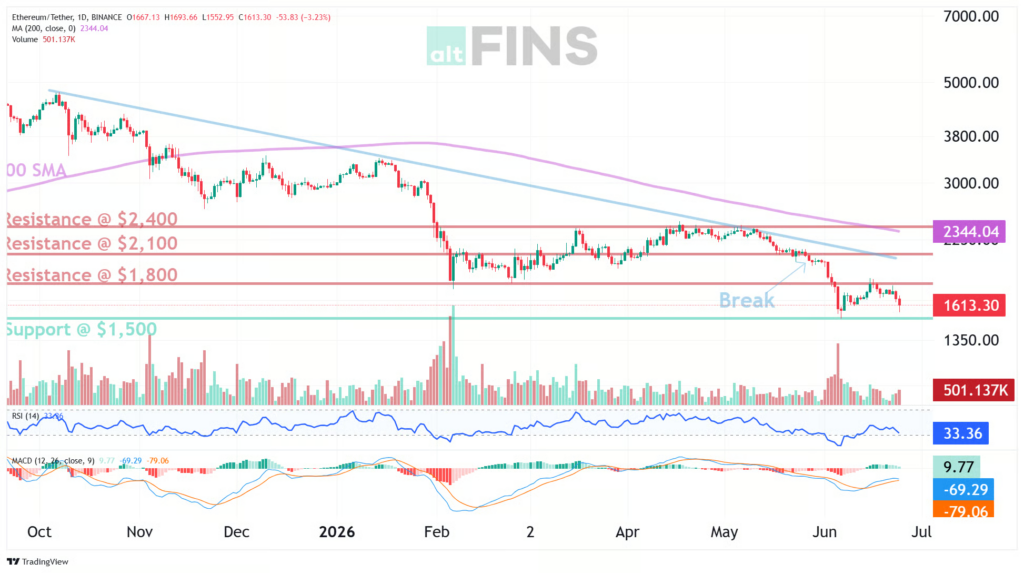
Ethereum’s problem starts with distance. ETH traded near $1,620 after reaching $1,552, leaving the asset only 7.7% above its 52-week low and 67% below the August 2025 peak. The weekly loss reached 2.7%, the monthly decline was 22.8%, and the year-to-date fall stood above 45%. Bitcoin is wrestling with a round-number floor. Ethereum is already living between broken support and the cycle low.
Source: https://altfins.com/technical-analysis
The chart remains firmly bearish across short, medium, and long-term measures. Most moving averages point down, including a 200-day average near $2,344 that sits far above spot. RSI-14 is near 34, while fast stochastic RSI remains oversold. MACD retains a bullish crossover reading, though momentum is fading. ETH can rebound from this position. The prevailing trend still has control.
$1,500 is the level that carries the immediate risk. The latest low at $1,552 left little room before that support is tested again, and a sustained break would put ETH into fresh 52-week lows. Resistance begins at $1,800, the level that rejected the latest rebound. The next checkpoints are $2,100 and $2,400. Price needs to recover $1,800 before the market can treat any bounce as more than short covering.
Source: https://sosovalue.com/assets/etf/us-eth-spot
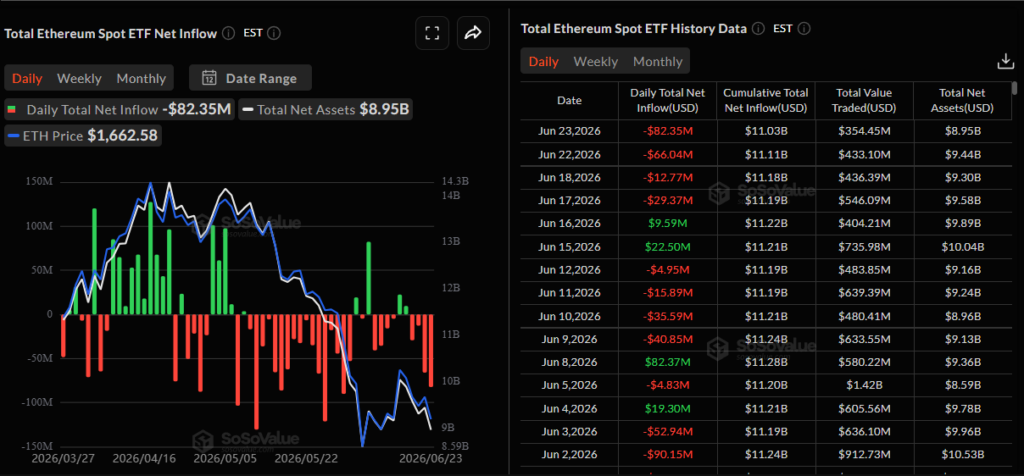
ETF flows offered no protection. Spot ETH funds recorded an $82.4 million outflow in the latest session, following losses of $66.0 million and $12.8 million in the two prior sessions. Net assets fell below $9 billion while cumulative inflow held near $11.0 billion. Three consecutive red sessions left the product channel aligned with the price trend. ETH needs recurring inflows before the ETF story becomes a counterweight again.
The Ethereum Foundation cut its budget by 40% and staff by 20% after senior leaders left. BitMine’s $92 million ETH purchase and Morgan Stanley’s proposed 0.14% ETF fee show that institutional interest survives. The Foundation reset changes the internal question: Ethereum now has to maintain its research pace with fewer central resources while price pressure makes every funding decision harder.
Security kept the discount wide. Taiko halted after a bridge exploit, the Jaredfromsubway bot lost $7.5 million, and the Foundation’s former researchers launched Ethlabs to close a protocol funding gap. Ethereum’s activity and institutional product pipeline remain broad. The market is charging more for execution risk. Holding $1,500 and reclaiming $1,800 would buy time for that development story to regain weight.
Ethereum’s Research Reset Starts in a Bear Market
The Ethereum Foundation chose the hardest point in the cycle to get smaller. A 40% budget reduction and 20% staff cut arrived while ETH was down more than 45% for the year, ETF assets were shrinking, and senior researchers had already left. Leaner spending may preserve the treasury. It also concentrates the burden on fewer teams when the protocol roadmap still demands years of work.
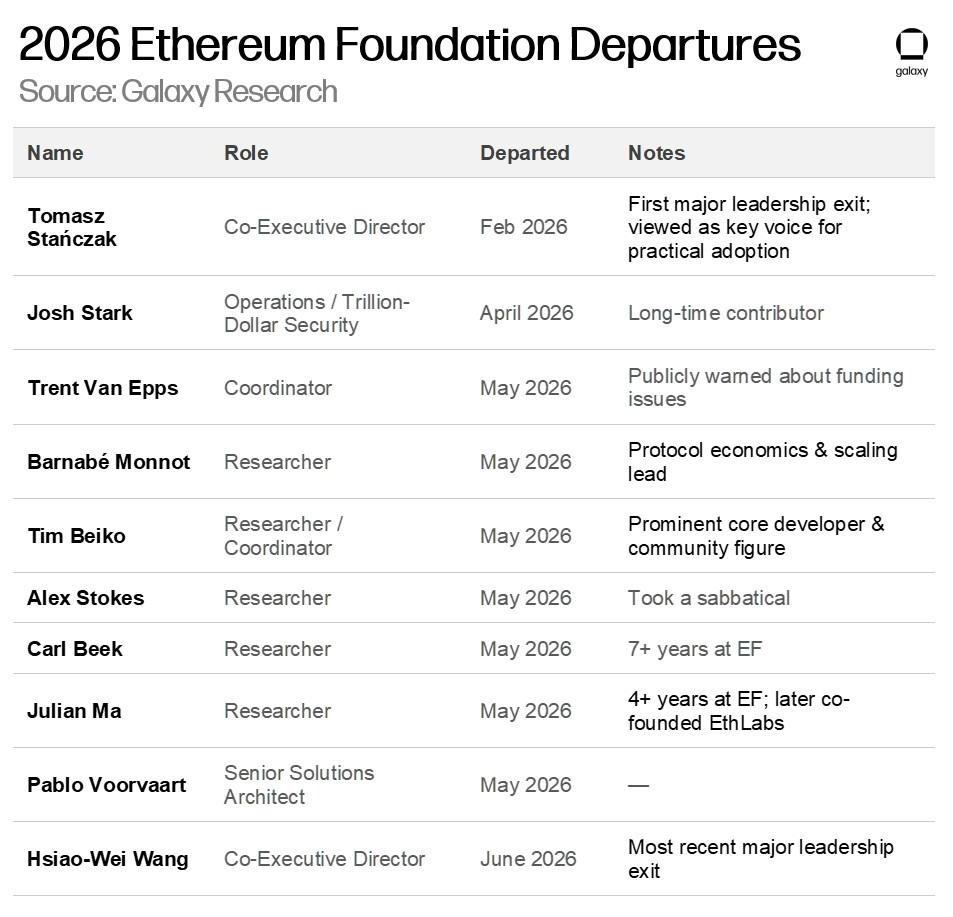
Source: https://www.galaxy.com/insights/research/ethereum-foundation-layoffs-20-percent-workforce-third-iteration-2026
Ethlabs formed around five former senior researchers and a reported $30 million annual funding gap. That gives Ethereum a new research centre outside the Foundation and may reduce dependence on one institution. Fragmentation carries a cost. Priorities, funding, and accountability become harder to follow when core work is split across more organisations.
The market will judge the reset through delivery. Ethereum still has major upgrades in development, a growing institutional staking business, and fresh ETF competition from Morgan Stanley. Those strengths survive an organisational change. Missed milestones or another round of departures would land differently with ETH near $1,500. The Foundation has bought itself a lower cost base. Ethlabs now has to prove that a broader research model can move faster under pressure.
Mark Your Calendars
Economic Data Releases:
- June 25, 2026 (Thursday): Personal Income and Outlays for May, including PCE and Core PCE; third estimate of first-quarter GDP; durable goods
- June 26, 2026 (Friday): Advance US goods trade balance, wholesale inventories, and retail inventories for May
- July 2, 2026 (Thursday): US Employment Situation for June
Token Unlock
- June 26, 2026 (Friday): Sahara AI (SAHARA) unlocks approximately 1.03 billion tokens
- July 1, 2026 (Wednesday): Sui (SUI) unlock from the Community Reserve