
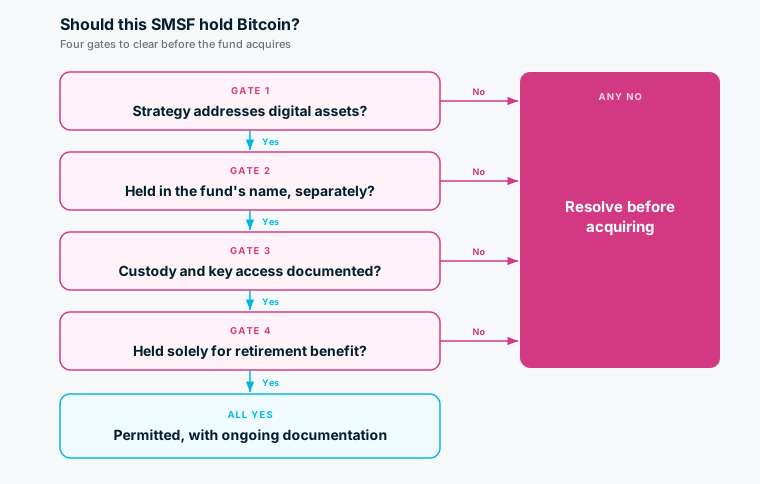
Yes. An SMSF can hold Bitcoin, provided the holding satisfies the sole-purpose test, the fund’s assets stay separate from the members’ personal assets, the investment strategy contemplates digital assets, and the trustee can demonstrate control over custody and access. The asset is permitted. The discipline around it is where most of the work sits.
Key takeaways on holding Bitcoin in an SMSF
- Bitcoin is not a prohibited asset for an SMSF. The constraint is the same one that governs every other holding: it must be maintained for the sole purpose of providing retirement benefits to members.[1]
- The fund’s Bitcoin must be held in the name of the SMSF, separate from any member’s personal wallets or exchange accounts, and that separation must be evidenced.[2]
- The fund’s investment strategy must address digital assets before the holding is acquired, not after the audit asks for it.[3]
- Custody and access controls (who holds the keys, how the seed is secured, what happens if a trustee is unavailable) are part of the trustee’s compliance position, not an operational afterthought.
- SMSF appetite is real and rising: 45% of self-identified SMSF investors already report exposure to Bitcoin and crypto, and 46% say they are likely to invest, up from 36% a year earlier.[4]
A trustee who buys Bitcoin on a personal exchange account, then transfers it to the fund later, has usually created a problem before the fund owns anything. The order matters. The fund decides, the fund acquires, and the fund holds, in its own name, from the start. Everything below follows from that sequence.
Does the sole-purpose test allow Bitcoin?
The sole-purpose test allows Bitcoin in the same way it allows any asset: the holding must exist to provide retirement benefits to members, and nothing else. Section 62 of the Superannuation Industry (Supervision) Act 1993 requires an SMSF to be maintained solely for that purpose.[1] Bitcoin is not named in the Act, and the ATO’s published position is that crypto assets are not inherently incompatible with the test.[3]
The test is failed by use, not by asset selection. A trustee who lets a member draw a present-day benefit from fund-held Bitcoin (spending it, borrowing against it personally, using it as collateral for a member’s own purposes, or treating a fund wallet as a personal one) breaches the sole-purpose test regardless of how the asset performs. The asset can be volatile, illiquid, or unconventional. What it cannot be is a source of current-day benefit to a member or a related party.
For most trustees the practical question is simpler than the statute makes it sound. Is this Bitcoin being held to grow the members’ retirement balance, and is it being held in a way that keeps it entirely inside the fund until a benefit is properly paid? If the answer to both is yes, the asset itself does not offend the test.
How do you keep an SMSF’s Bitcoin separate from your own?
Separation means the Bitcoin is held in the name of the SMSF, recorded as a fund asset, and never commingled with a member’s personal holdings. The covenants in section 52B of the SIS Act require trustees to keep the fund’s money and assets separate from those held personally, and the ATO applies that standard to crypto the same way it applies it to a bank account or a parcel of shares.[2][3]
In practice, separation has two layers for a digital asset. The first is title: the account, wallet, or custody arrangement must be clearly in the fund’s name, not a member’s. The second is evidence: the trustee needs to be able to show, at audit, that the wallet or platform account belongs to the fund and that no personal funds passed through it. A personal exchange account that a trustee “also uses for the SMSF” does not satisfy this, even if the trustee intends to keep the holdings notionally distinct.
Custody and access controls sit inside this question rather than beside it. With Bitcoin, control of the private key is control of the asset. A trustee needs a documented answer to who holds the keys, how the seed phrase is secured, whether access depends on a single person, and what happens to the holding if a trustee dies or loses capacity. None of that is unique to super, but in an SMSF the trustee carries the obligation to evidence it. A holding that only one person can access, with no recorded recovery process, is a separation and governance gap an auditor will reasonably raise.
Does the fund’s investment strategy need to mention digital assets?
Yes. The fund’s investment strategy should address digital assets before the trustee acquires Bitcoin, and it should do so in a way that reflects an actual decision rather than a retrofitted clause. The ATO expects an SMSF’s investment strategy to consider risk, return, diversification, liquidity, and the ability to meet liabilities, and to be reviewed regularly.[3] A holding in a single, volatile asset class engages every one of those considerations directly.
This does not require a separate crypto strategy. It requires the existing strategy to show that the trustee considered digital assets and made a deliberate choice about their role and weighting in the fund. A strategy that is silent on Bitcoin while the fund holds a meaningful Bitcoin position is the kind of gap that turns a routine audit into a query. The point is not the existence of a paragraph. It is evidence that the trustee thought about concentration, volatility, and liquidity before committing fund money.
The weighting question is worth taking seriously. Across all SMSFs, digital assets sit at roughly 2% of fund assets, but smaller funds, those under AUD 200,000, allocate closer to 7%.[5] A higher allocation is not prohibited, but it raises the diversification and liquidity questions the strategy is supposed to answer, and it raises them more sharply in a fund with a smaller base to absorb a drawdown.
How is Bitcoin valued in an SMSF at 30 June?
Bitcoin held by an SMSF must be valued at market value for the fund’s financial statements each 30 June, using a fair and reasonable basis the trustee can support. The ATO requires SMSF assets to be reported at market value, and for a liquid, continuously traded asset like Bitcoin that generally means the price on a reputable exchange or platform at the relevant date.[3] The methodology matters less than its consistency and its evidence.
The practical discipline is to record the source and the timestamp. A screenshot or platform statement showing the holding and its value as at 30 June, retained with the fund’s records, is the kind of evidence that lets an auditor sign off without a back-and-forth. Bitcoin trades around the clock, so the trustee should be able to say which price, from which source, at what point on 30 June, was used. The detailed tax and record-keeping treatment of acquisitions and disposals sits in the ATO compliance file, which is covered in a separate SMSF crypto ATO compliance checklist.
What should a trustee document when buying or selling Bitcoin?
A trustee should keep a complete record of every acquisition and disposal: the date, the amount of Bitcoin, the price, the counterparty or platform, and the fund account the money moved through. The fund’s transaction history is the spine of its compliance position, and with a digital asset the trustee cannot rely on a registry or a third-party custodian’s records the way they might with listed shares.
The records that matter most are the ones that prove the fund, not a member, made and held the investment. Bank statements showing fund money leaving a fund account, platform records showing the asset arriving in a fund-named wallet or account, and a contemporaneous note of the trustee decision together form the chain. Where the trustee transfers Bitcoin between wallets the fund controls, the movement and the addresses should be recorded so the holding remains traceable end to end.
This documentation also does the auditor’s job before the auditor arrives. An SMSF’s accounts are subject to an independent annual audit covering both compliance and the financial statements.[6] A clean, contemporaneous record of how the Bitcoin was acquired, held, separated, and valued is what lets that audit proceed without contraventions. The auditor’s own checklist, and the failures that trigger a contravention report, are covered in a separate piece for SMSF auditors.
Does Framework licensing change any of this?
Not for the trustee’s core obligations. The sole-purpose test, asset separation, investment-strategy, and valuation requirements come from the SIS Act and ATO guidance, and they apply today, independent of the Digital Assets Framework.[1][2][3] A trustee holding Bitcoin in an SMSF in 2026 is governed by superannuation law, not by the new platform-licensing regime.
What the Framework changes is the platform layer beneath the trustee. The Framework commences on 9 April 2027 and creates two regulated categories: digital asset platforms (DAPs) and tokenised custody platforms (TCPs).[7] Ahead of that, ASIC has set 30 June 2026 as the deadline for digital asset operators to apply for the relevant financial services licence, with the INFO 225 class no-action position expiring on the same date.[8] The effect over time is that the platforms and custodians an SMSF uses to hold Bitcoin will sit inside a clearer licensing perimeter. The trustee’s duties do not move. The infrastructure they rely on becomes more formally regulated. What Framework-compliant custody looks like for an SMSF, and what to ask a platform during the transition, is covered in a separate piece on SMSF crypto custody.
For the wider regulatory picture, including how the Framework reshapes platform due diligence for the professionals around the fund, see the Digital Assets Framework pillar overview.
Common questions
Is Bitcoin a prohibited investment for an SMSF?
No. Bitcoin is not on any prohibited-asset list for SMSFs. It is permitted provided the holding meets the sole-purpose test, is held separately in the fund’s name, is contemplated by the investment strategy, and is properly valued and documented.[1][3]
Can I transfer Bitcoin I already own personally into my SMSF?
This is where many trustees create problems. The SIS Act restricts acquiring assets from related parties, and transferring personal Bitcoin into the fund raises that issue along with valuation and separation questions. The cleaner path is for the fund itself to acquire the asset directly, in its own name, with fund money. Trustees should take specific advice before attempting an in-specie transfer.[2][3]
How much of an SMSF can be held in Bitcoin?
There is no fixed cap on Bitcoin specifically. The limit is set by the diversification, liquidity, and risk considerations the fund’s investment strategy must address. Across all SMSFs digital assets average around 2% of assets, while funds under AUD 200,000 average closer to 7%.[5] A larger allocation is permitted but raises the strategy questions more sharply.
Who is allowed to hold the private keys for an SMSF’s Bitcoin?
The keys must give the fund, not an individual member, control of the asset, and the arrangement must be documented and recoverable. A single person holding the only key with no recorded recovery process is a governance gap. The trustee needs a clear answer to who holds the keys, how the seed is secured, and what happens if a trustee is unavailable.
Do I need to update my SMSF’s investment strategy before buying Bitcoin?
Yes. The investment strategy should address digital assets before the holding is acquired, showing that the trustee considered risk, return, diversification, and liquidity. A strategy that is silent while the fund holds a meaningful Bitcoin position is a common audit query.[3]
How do I value the SMSF’s Bitcoin at year end?
Use the market value at 30 June on a fair and reasonable basis, typically the price on a reputable exchange or platform at that date, and keep evidence of the source and timestamp.[3] Because Bitcoin trades continuously, record exactly which price and source were used.
Does the SMSF auditor need to see anything specific for Bitcoin?
The auditor will look for evidence of separation, custody and key control, investment-strategy alignment, the 30 June valuation, and a complete transaction record.[6] Preparing those records as you go is what allows the annual audit to proceed without contraventions. The auditor’s full checklist is covered in a separate piece for SMSF auditors.
Do the new digital asset laws stop an SMSF holding Bitcoin?
No. The Digital Assets Framework regulates the platforms and custodians, not the trustee’s right to hold Bitcoin. It commences on 9 April 2027, with a 30 June 2026 licensing-application deadline for operators.[7][8] The trustee’s obligations under the SIS Act and ATO guidance are unchanged.
- Superannuation Industry (Supervision) Act 1993 (Cth), s 62 (sole-purpose test), s 52B (covenants requiring separation of fund assets), s 35C (annual audit): the statutory basis for what an SMSF can hold and how it must be administered.
- ATO, “SMSFs and crypto assets” guidance: the regulator’s published position on the sole-purpose test, asset separation, investment-strategy, valuation, and record-keeping as applied to crypto held in an SMSF.
- ATO SMSF Quarterly Statistical Report, June 2025: SMSF scale and digital asset allocation data, including the ~2% average and ~7% for funds under AUD 200,000.
- Independent Reserve Cryptocurrency Index (IRCI) 2026: SMSF investor exposure and intention data (45% exposed; 46% likely to invest).
- ASIC, “ASIC’s roadmap for digital assets law reform implementation”, 20 April 2026, and “Deadline looms for digital asset businesses to apply for a licence”, 4 May 2026: Framework commencement (9 April 2027), the DAP and TCP categories, and the 30 June 2026 licensing-application deadline.
Where to start
Alpha Node is the regulated digital asset infrastructure layer Australian SMSF advisers and practices partner with: execution, custody, wholesale funds management, wholesale advice, and commercial lending, so a fund can hold digital assets without the trustee or the practice building the stack themselves.[9]
If you are an SMSF trustee or adviser weighing how to hold Bitcoin inside the fund’s rules, the appropriate next step is a conversation.
Explore the SMSF Partnership pathway →
Sources
- Superannuation Industry (Supervision) Act 1993 (Cth), s 62 (sole-purpose test): an SMSF must be maintained solely for the purpose of providing retirement benefits to members or their dependants. https://www.legislation.gov.au/C2004A04633/latest/text ↩
- Superannuation Industry (Supervision) Act 1993 (Cth), s 52B(2)(d) (trustee covenant to keep the money and other assets of the fund separate from any money and assets held by the trustee personally or by a standard employer-sponsor); applied to crypto assets by ATO guidance and consistent with the separation-of-assets operating standard in the Superannuation Industry (Supervision) Regulations 1994 (Cth), reg 4.09A. https://www.legislation.gov.au/C2004A04633/latest/text ↩
- Australian Taxation Office, “SMSFs and crypto assets” guidance (ATO position as published; subject to change). Addresses the sole-purpose test, separation of fund assets from personal assets, the requirement for the investment strategy to consider crypto holdings, valuation at market value for 30 June reporting, and record-keeping for acquisitions and disposals. Trustees should consult their SMSF accountant, auditor, and licensed adviser before acting. ↩
- Independent Reserve Cryptocurrency Index (IRCI) 2026, p. 29: 45% of self-identified SMSF investors report exposure to Bitcoin and crypto; 46% report being likely to invest in Bitcoin, up from 36% in 2025. ↩
- Australian Taxation Office, SMSF Quarterly Statistical Report, June 2025: digital assets represent approximately 2% of assets across all SMSFs, and approximately 7% for SMSFs with balances under AUD 200,000. SMSFs collectively held approximately AUD 3.02 billion in digital assets at 30 June 2025. ↩
- Superannuation Industry (Supervision) Act 1993 (Cth), s 35C: an SMSF must have its accounts and statements audited each year by an approved SMSF auditor, covering both the financial statements and compliance with the Act. https://www.legislation.gov.au/C2004A04633/latest/text ↩
- ASIC, “ASIC’s roadmap for digital assets law reform implementation”, 20 April 2026: the Digital Assets Framework commences on 9 April 2027, creating two regulated categories, digital asset platforms (DAPs) and tokenised custody platforms (TCPs). https://www.asic.gov.au/about-asic/news-centre/news-items/asic-s-roadmap-for-digital-assets-law-reform-implementation/ ↩
- ASIC, “Deadline looms for digital asset businesses to apply for a licence”, 4 May 2026: 30 June 2026 is the deadline for digital asset operators to apply for the relevant AFS licence (or notify ASIC of an intention to apply); the ASIC Information Sheet 225 class no-action position expires on the same date. https://www.asic.gov.au/about-asic/news-centre/news-items/deadline-looms-for-digital-asset-businesses-to-apply-for-a-licence/ ↩
- Alpha Node Global, regulatory authorisations. Alpha Node X Pty Ltd (ACN 689 717 422; AUSTRAC VASP 100903039); Alpha Node Capital Pty Ltd (ACN 603 150 634; AFSL 479974; AUSTRAC VASP 100612840-001), wholesale clients only; Alpha Node Capital Management Pty Ltd (ACN 675 404 047; CAR 1308193 of Alpha Node Capital; AUSTRAC VASP 100895147-001); Alpha Node Advisors Pty Ltd (ACN 154 320 000; AFSL 416956; AUSTRAC VASP 100282425-001), wholesale clients only; Alpha Node Finance Pty Ltd (ACN 675 410 116; Credit Representative 556504 of Fair Loans Foundation Pty Ltd, ACL 378968). https://alphanode.global/regulatory/ ↩