
Ethereum Holds Firm While Bitcoin Loses Momentum
30th July 2026 • 8 mins read
This Week’s Recap
- The Fed held rates steady and exposed a sharper split inside the committee: The benchmark range stayed at 3.50% to 3.75% for a sixth consecutive meeting. Three policymakers wanted a quarter-point increase, while nine backed the hold. Bitcoin briefly traded above $64,400 after the announcement, then failed to turn the decision into a breakout.
- Morgan Stanley added Ether and Solana products to its crypto shelf: The exchange-traded products generated about $38 million in combined volume on their first day and carry fees of 0.14%. That price puts pressure on specialist issuers that built the category before large banks arrived. Distribution through a firm with trillions in client assets is the harder advantage to match.
- Core Scientific made more from AI hosting than it did from mining Bitcoin: Colocation produced $136.7 million in revenue and $80 million in gross profit during the quarter. Self-mining produced $21.5 million in revenue against $33.7 million in costs, leaving a $12.2 million gross loss. Power access has become the asset, and mining now competes with AI for the same megawatts.
- Ionic Digital rose 26% in its Nasdaq debut: The listing put the miner near a $2.8 billion valuation and gave former Celsius creditors a public route out of shares received through bankruptcy distributions. The first-day gain offered relief after years of illiquidity. It also tested whether a new mining listing can hold investor attention while established operators race into AI hosting.
- BNY put the $8.6 trillion transfer-agency market in its blockchain plan: The bank plans to add digital ownership records for tokenised funds and connect them with existing servicing systems. Transfer agents sit inside subscriptions, redemptions, and shareholder records, so the project targets operational plumbing rather than a retail token. That is where blockchain adoption becomes harder to reverse.
- The CLARITY Act stalled on ethics language: The fight now centres on restrictions covering public officials and family crypto interests. Galaxy cut its estimated chance of passage to roughly 50% as the Senate calendar tightened. A market-structure bill that looked close a week ago is back to trading on political risk.
- Zcash moved about $80 million into its new Ironwood pool on day one: Roughly 5% of funds in the retired Orchard pool migrated after the Ironwood activation. The turnstile design forces value through a controlled path after a soundness bug raised the risk of undetected counterfeit coins. Zcash now has to prove that privacy and supply integrity can coexist without asking users to trust an invisible balance.
- Uniswap developers proposed an optional private execution path: The request for comment combines Uniswap v4 hooks, UniswapX, and zero-knowledge proofs for pre-trade compliance checks. Private routing could reduce front-running, sandwich attacks, and information leakage for larger orders. The design remains an RFC, so the market is pricing an idea rather than a live feature.
- Crypto suffered 207 hacks in the first half of 2026: TRM Labs counted the highest six-month incident total in its records, while aggregate losses fell to $972 million from $2.3 billion a year earlier. Smart-contract flaws produced many incidents. Compromised keys, signers, vendors, and governance controls still produced the losses that can break a protocol.
- South Korean lawmakers paired stablecoin rules with a push to repeal the crypto tax: The proposed consolidated law would set issuer and reserve rules as opposition lawmakers seek to remove the planned 22% tax on crypto gains. Korea is trying to define both the product and the investor burden in one political cycle. Exchanges and banks will care as much about the tax outcome as the stablecoin licence.
- NEAR governance voted to end the 30% developer gas rebate: Fees that once went back to smart-contract developers will be burned under the approved change. The vote strengthens the token’s scarcity mechanism but removes a direct incentive for applications that generated network activity. NEAR chose token economics over a subsidy that had been part of its developer pitch.
- Strive reached 20,000 BTC while Bitcoin per effective share fell: The treasury grew, but rapid share issuance pushed the per-share measure down 0.12%. Headline holdings can rise while each investor’s claim on those coins shrinks. Treasury companies now need to show accretive financing, not just a larger wallet.
- Arbitrum moved to correct a 51 million ARB voting-power discrepancy: The security council used a non-emergency process to fix an overstatement in recorded governance power. No funds were reported lost, but the error affected the system that determines who can change the protocol. Governance accounting deserves the same reconciliation discipline as token balances.
- Ethereum’s role changed as perpetual futures and tokenised assets expanded on exchanges: Tokenised traditional assets on centralised exchanges reached about $6.6 billion, giving ETH a broader settlement and collateral story than simple fee demand. Perpetual markets still dominate trading attention. Ethereum gains when those markets eventually need trusted onchain collateral and settlement.
- Schwab rebranded a $232.1 million ETF around natural-language processing: The fund holds companies tied to Bitcoin mining and Trump Media while presenting the strategy through an AI-screening label. The portfolio did not suddenly become a pure technology bet. Asset managers are learning that AI language can refresh a product whose holdings still carry crypto-cycle risk.
Bitcoin Market Analysis
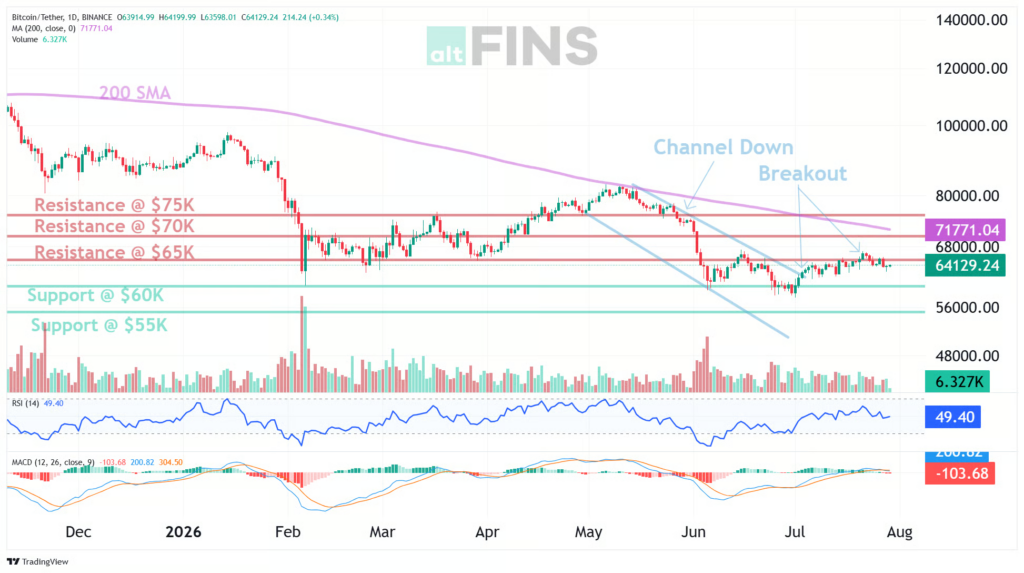
Bitcoin opened the seven-day window near $65,099 and fell 1.96% to about $63,822 on the still-open July 30 candle. The week’s high came at $65,809 and the low at $62,742. Sunday brought a push to $65,400, but Monday erased it with a 2.51% drop. The Fed hold did not repair the break. Sellers kept BTC below the level altFINS had identified as the resistance breakout.
Source: https://altfins.com/technical-analysis
The front of the chart has weakened. Bitcoin sits below its 5-day, 10-day, and 20-day simple moving averages, while remaining only 0.61% above the 50-day average. RSI-14 is neutral at 50.0, but RSI-9 has fallen to 26.1 and the MACD histogram is negative. That combination fits a market losing short-term momentum inside a broader range. It does not confirm a fresh long-term trend.
$62,742 is the first level buyers have to defend because it marks the week’s low and sits close to the lower Bollinger Band near $62,614. The next chart support is $60,000, followed by $55,000. Resistance starts at $65,000, then $70,000. A daily close back above $65,000 would repair the failed breakout. A break below $62,700 would expose the $60,000 area quickly.
Source: https://sosovalue.com/assets/etf/us-btc-spot
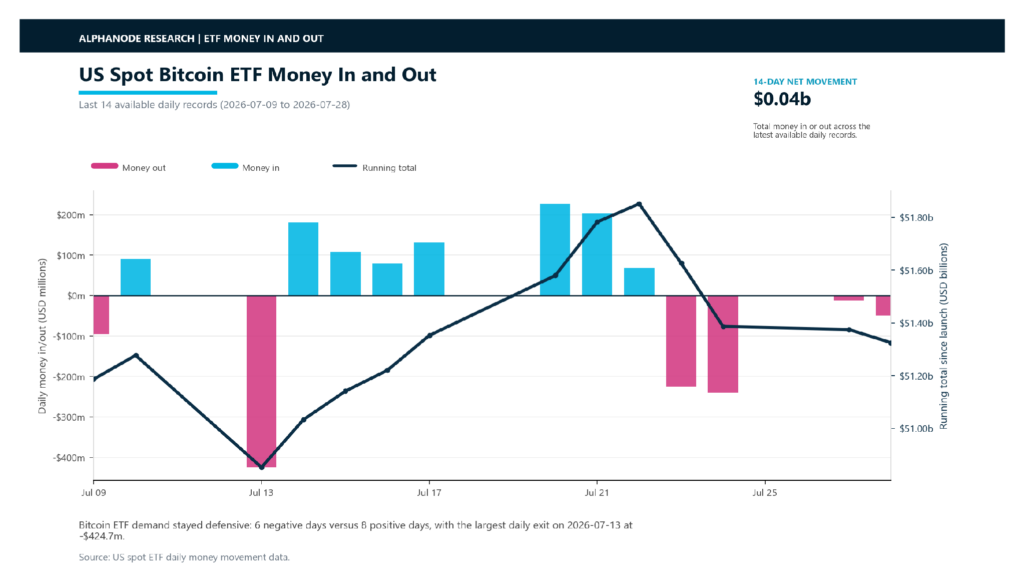
US spot Bitcoin ETFs added only $43.2 million across the latest 14 available sessions, with eight positive days and six negative days. The sequence changed late in the window. Investors removed $225.2 million on July 23 and $240.1 million on July 24, then removed another $49.8 million on July 28. Net assets ended at $77.23 billion, and cumulative money entering the funds stood at $51.32 billion. The ETF channel is still deep, but it stopped absorbing every bout of spot-market weakness.
Corporate Bitcoin stories carried the same warning. Strive grew its treasury to 20,000 BTC while Bitcoin per effective share fell 0.12%, showing how dilution can blunt a larger headline position. Ionic Digital’s 26% Nasdaq debut gave mining equities a better day, but the sector’s strongest operating result came from AI hosting. Bitcoin-linked companies are being judged on capital allocation now.
The next clean trade sits at the edge of the range. Holding $62,700 and reclaiming $65,000 would put $70,000 back in view. Losing the weekly low would make $60,000 the market’s next argument. The Fed removed one event risk without giving buyers a catalyst, and recent ETF redemptions left the spot market with less cover. Bitcoin needs price confirmation before the breakout thesis can return.
Ethereum Market Analysis
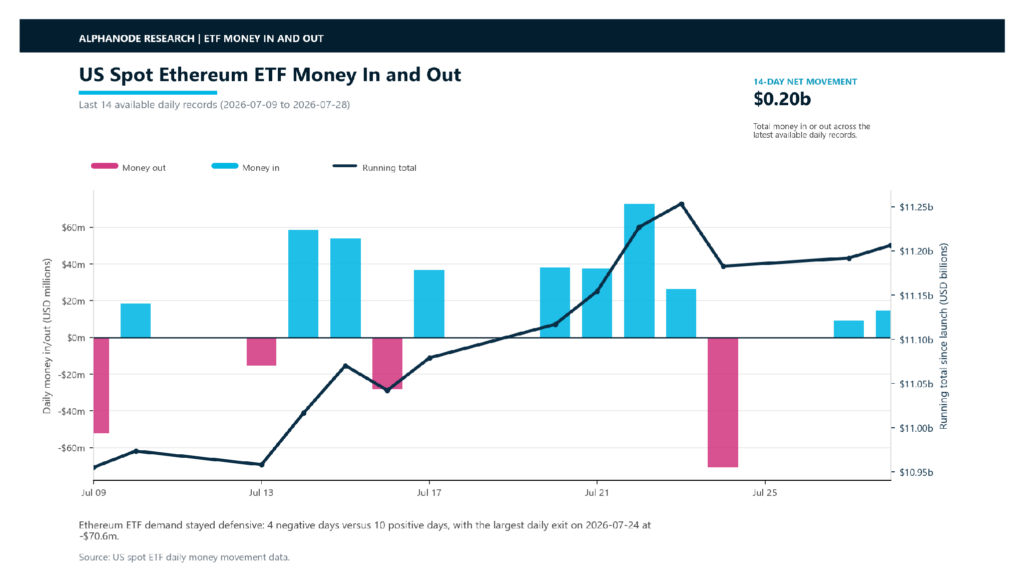
Ethereum had the stronger demand record before its price performance entered the discussion. Investors put $199.5 million into US spot Ether ETFs across the latest 14 available sessions, with ten positive days and four negative days. Bitcoin funds added $43.2 million over the same record count. ETH finished the seven-day price window up 1.51%, creating the week’s cleanest split between the two largest assets.
Source: https://altfins.com/technical-analysis
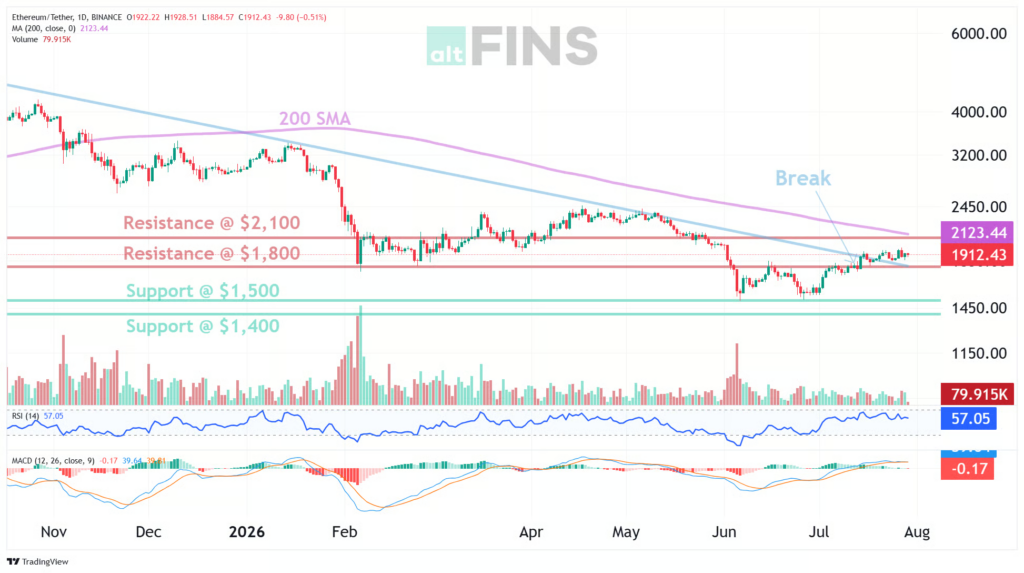
ETH opened near $1,878, traded as high as $1,981, and held around $1,907 on the open July 30 candle. Its best session came on Sunday with a 4.26% gain, followed by a 3.18% reversal on Monday. Price still held above the $1,800 breakout area identified by altFINS. The market gave back momentum without giving back the level that changed the setup.
The medium-term chart has improved more than the long-term chart. ETH sits above its 10-day, 20-day, 30-day, and 50-day simple moving averages, while staying below the 100-day and 200-day averages. RSI-14 is 55.4, and the MACD histogram is only slightly negative. Support begins at the week’s $1,848 low, then the broader chart points to $1,800 and $1,500. Resistance sits at $1,981, then $2,100.
Source: https://sosovalue.com/assets/etf/us-eth-spot
The latest ETF sessions kept adding money even as Bitcoin funds turned negative. Ether products took in $26.3 million on July 23, lost $70.6 million on July 24, then recovered with $9.2 million and $14.5 million on July 27 and July 28. Net assets ended at $10.50 billion, and cumulative money entering the funds reached $11.21 billion. The dollar totals remain smaller than Bitcoin’s. The direction has been steadier.
Morgan Stanley’s Ether and Solana ETP launch adds a distribution story to that demand. The new products generated about $38 million in combined first-day volume and charge 0.14%. Uniswap’s private-execution proposal works from the other end of the market by trying to make large onchain trades less exposed to front-running and sandwich attacks. One widens access. The other tries to improve execution.
ETH can press toward $2,100 if buyers keep $1,848 intact and clear the week’s $1,981 high. A loss of $1,800 would undo the chart improvement and put the ETF record under a harder test. Ethereum has the better weekly structure because price, product distribution, and fund demand are leaning in the same direction. It still trades below the long-term averages that would confirm a larger reversal.
Power Became More Valuable Than Mining
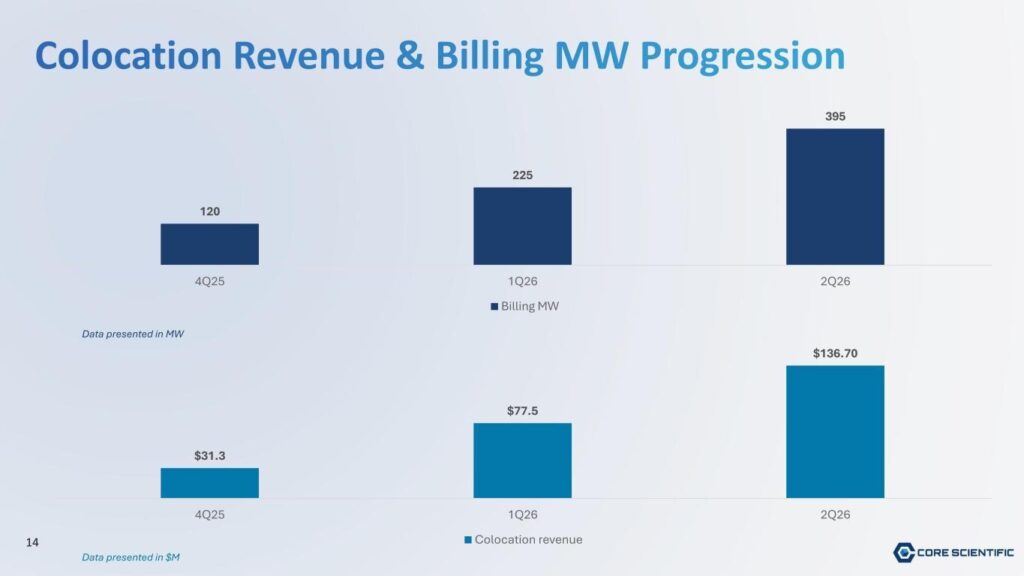
Core Scientific’s second-quarter segment results put a hard number on the miner-to-AI shift. Self-mining generated $21.5 million in revenue and cost $33.7 million, leaving a $12.2 million gross loss and a negative 56% margin. Colocation generated $136.7 million in revenue and $80 million in gross profit at a 59% margin. The same company produced two completely different businesses from access to power and data-centre infrastructure.
Source: https://investors.corescientific.com/news-events/presentations
Core Scientific had 395 megawatts under billing at quarter-end and 437 megawatts by mid-July. Management put annualised GAAP revenue near $635 million and said roughly 1.1 gigawatts of customer power was under lease, supporting more than $24 billion in potential contracted revenue. Those figures explain why miners keep renegotiating their identity. A long-dated hosting contract can offer better visibility than Bitcoin production exposed to price, difficulty, and energy costs.
The pivot also changes what can go wrong. Data-centre conversions require capital, construction, customer concentration, and delivery against multi-year contracts. Core Scientific reported a $1.16 billion net loss, driven largely by a $1.05 billion fair-value expense, even while the hosting segment performed well. Investors are paying for contracted power and execution now. Hash rate alone no longer carries the story.
Crypto’s Security Bill Is Still Human
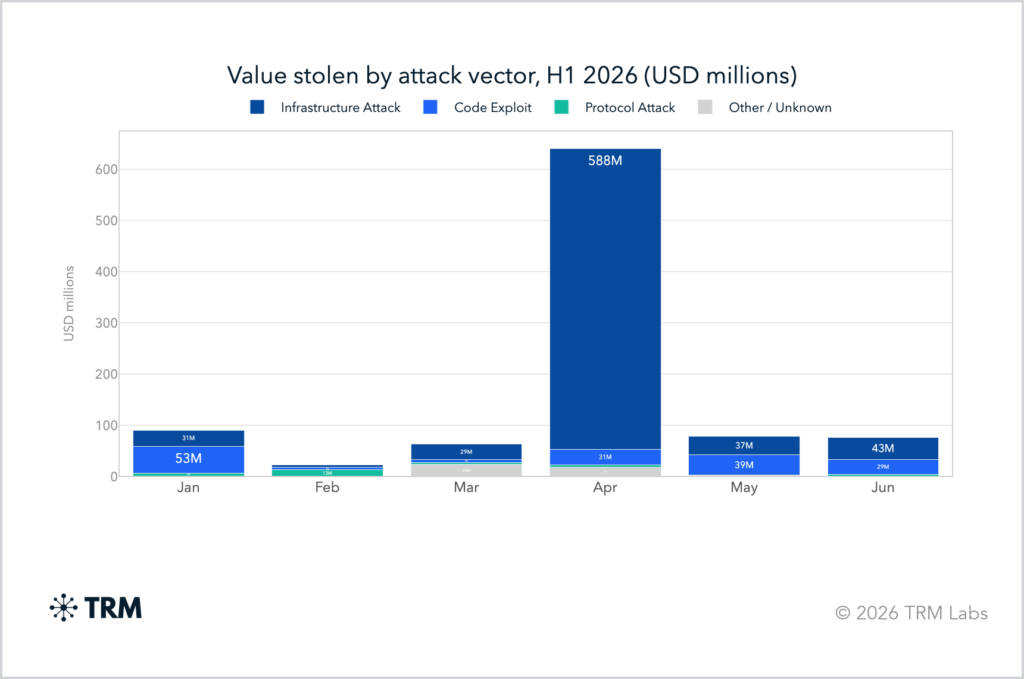
TRM Labs counted 207 crypto hacks in the first half of 2026, the highest six-month total in its data. Losses fell to $972 million from $2.3 billion during the same period in 2025. The lower dollar figure came from the absence of another outsized theft, not from attackers becoming less capable.
Source: https://www.trmlabs.com/resources/blog/h1-2026-crypto-hacks-reach-record-high-as-losses-fall-below-usd-1-billion
Smart-contract exploits still produced many incidents, but the largest losses kept tracing back to compromised private keys, signing infrastructure, custody, vendor access, and weak approval processes. Those failures sit around the code. A protocol can pass an audit and still lose control of the people or systems authorised to move funds.
Security budgets need to follow the loss path. Teams need separated signing roles, transaction limits, tested incident playbooks, vendor controls, and rehearsed key rotation alongside contract audits. The first-half count says attackers have more targets. The $972 million bill says one broken operational control can still dominate the year.
Mark Your Calendars
Economic Data Releases:
- August 7, 2026 (Friday): Employment Situation for July 2026
Token Unlocks:
- August 5, 2026 (Wednesday): Ethena (ENA) unlocks US$13.42 M (1.97% of released supply)
- August 5, 2026 (Wednesday): Succinct (PROVE) unlocks US$34.47 M (104.17% of released supply)
- August 6, 2026 (Thursday): Hyperliquid (HYPE) unlocks US$536.99 M (2.42% of released supply