
Bitcoin Recovers as Coldcard Breach Tests Custody
6th August 2026 • 9 mins read
This Week’s Recap
- Coldcard told affected users to migrate funds while the exploit remained active: The flaw drained at least 1,816 BTC, worth about $114 million, from more than 5,200 addresses. The breach turned firmware provenance, seed entropy, and recovery procedures into market risks rather than private operational details.
- Analysts expect the Coldcard breach to increase demand for regulated Bitcoin exposure: ETFs and qualified custodians remove device-level key management from the investor. The trade-off is clearer after a compromise reaches four figures of Bitcoin.
- The CLARITY Act remained stalled over ethics language and investor protections: The Senate’s voting window narrowed as lawmakers argued over restrictions involving public officials and family crypto interests. A bill meant to settle market structure is carrying its own political risk premium.
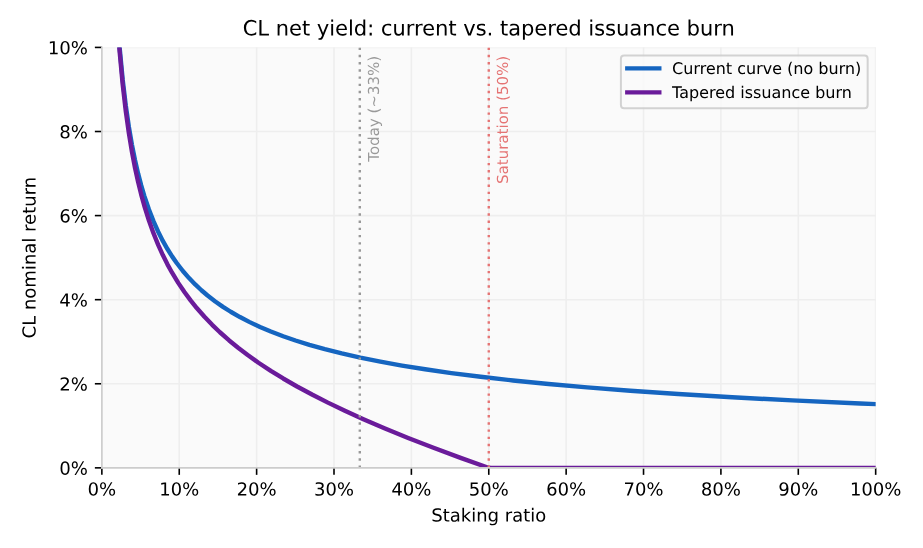
- Draft EIP-8363 would taper Ethereum issuance as the staking ratio rises: The burn fraction reaches 100% at roughly 50% staked and phases in over 18 months. The permanent curve would pull the consensus yield near today’s staking ratio from about 2.6% to 1.2%.
- Circle reported $701 million in quarterly revenue and advanced its Arc blockchain: Revenue missed the $713 million Wall Street estimate, while earnings and institutional backing for Arc supported the shares. Circle is trying to own more of the infrastructure around USDC rather than relying only on reserve income.
- SpaceX reported a $540 million decline in the value of its Bitcoin holdings: Revenue beat expectations in the company’s first public earnings report, but the crypto position cut through the operating result. Public-market investors can now price the Bitcoin exposure directly.
- Yellow Card raised $40 million for bank-to-stablecoin processing: The round pushed total funding above $120 million. The African payments company is building settlement connections between banks, businesses, and stablecoins where cross-border dollar access remains expensive.
- BNY Mellon added institutional staking through Galaxy: Custody clients can earn proof-of-stake rewards without moving assets outside an institutional control framework. Staking is moving into the same servicing stack that already handles safekeeping and reporting.
- Binance sued RedotPay over alleged losses tied to 470,000 users: The claim seeks $473 million and centres on customers diverted under an earlier commercial agreement. Distribution partnerships can become liabilities when ownership of the client relationship is unclear.
- US and UK officials deepened cooperation on stablecoins and tokenisation: The talks focused on aligning market rules and cross-border supervision. Stablecoin issuers need compatible treatment before institutional payment rails can operate across both markets.
- Galaxy Digital recorded an $85 million second-quarter loss: Lower digital-asset prices and weaker revenue weighed on the quarter. The result shows how quickly trading, investment, and principal exposure can move through an integrated crypto balance sheet.
- Cloudflare introduced programmable wallets for AI agents: The wallets let software agents initiate stablecoin payments under defined controls. Machine commerce needs spending limits, identity, and revocation before autonomous payment volume can scale.
- Taiwan will apply the Travel Rule to domestic virtual-asset transfers in October: Providers will have to transmit originator and beneficiary information with covered transfers. Compliance data is becoming part of the transaction path rather than a later reconciliation step.
- Nomura’s Laser Digital backed ZIGChain’s onchain private-credit push: The investment runs into the single-digit millions and targets credit infrastructure in the UAE. Tokenised lending is moving from pilot language toward financed distribution.
Bitcoin Market Analysis
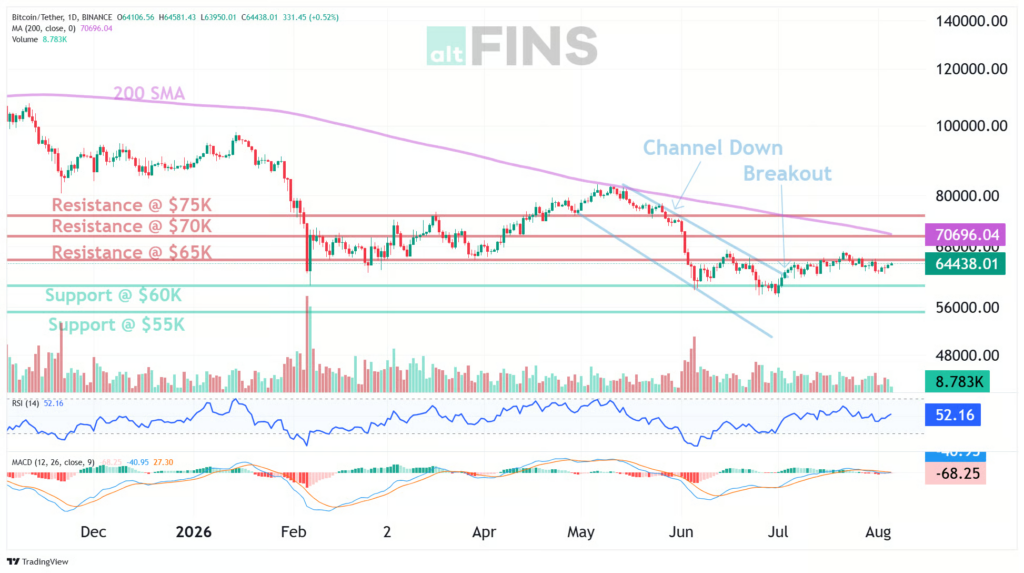
Bitcoin opened the seven-day window near $64,780, fell to $62,275, and recovered to roughly $64,628 on the still-open August 6 candle. The weekly change was close to flat at negative 0.23%. July 31 delivered the damage with a 2.92% drop. Three later sessions rebuilt most of it, including gains of 0.92% and 0.87% on August 4 and August 5.
Source: https://altfins.com/technical-analysis
AltFins reads the move as a bullish break from a descending channel, with price now pressing into resistance. Its short-term trend is neutral, the medium-term trend is down, and the long-term trend remains strongly down. Momentum is bearish but improving as the MACD histogram rises, while RSI-14 sits in neutral territory. Binance data adds the short-term repair: BTC is above its 5-day, 10-day, and 20-day simple moving averages.
$62,275 is the week’s first support, sitting just below the $62,400 invalidation level in the AltFins setup. AltFins places the broader support zones at $60,000 and $55,000. Resistance begins at $65,000, where BTC has been rejected several times, followed by $70,000. A daily close above $65,000 would confirm the channel breakout and reopen the path toward $70,000. Losing $62,275 would turn the move back into a range failure.
Source: https://sosovalue.com/assets/etf/us-btc-spot
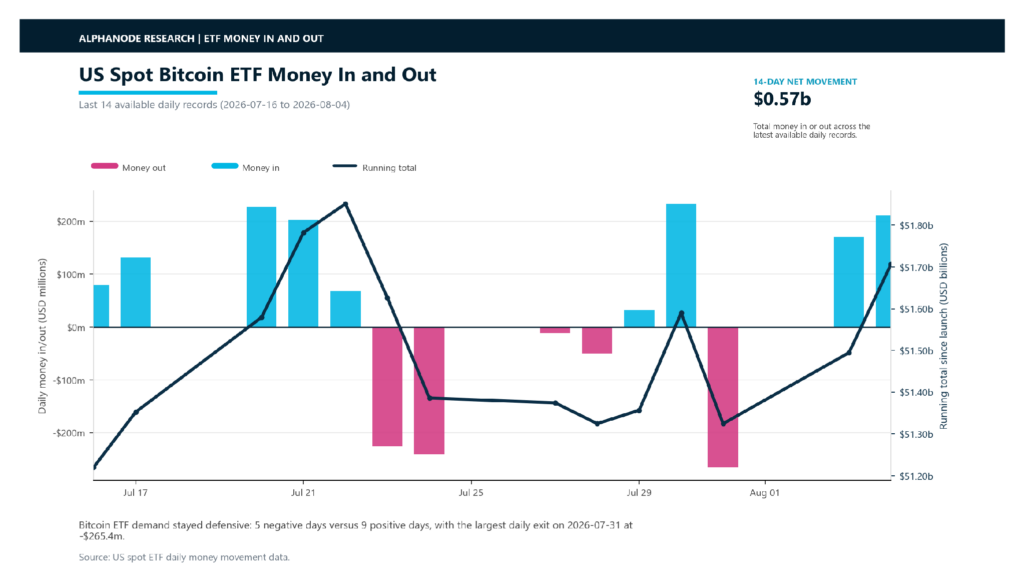
US spot Bitcoin ETFs added $565.3 million across the latest 14 available sessions, with nine positive days and five negative days. The sequence remained volatile. Funds lost $265.4 million on July 31, then took in $170.1 million on August 3 and $211.5 million on August 4. Net assets finished at $78.26 billion and cumulative inflows reached $51.71 billion.
The Coldcard breach gave that ETF demand a harder edge. Investors deciding between direct ownership and a regulated wrapper are now pricing a concrete device and firmware failure. Bitcoin held $64,000, but the week’s strongest argument was about custody.
SpaceX’s first public earnings report put a $540 million decline against the value of its Bitcoin holdings. The company beat revenue expectations, but the crypto position became part of the equity story. Corporate holders still have to explain how Bitcoin fits the operating balance sheet.
Ethereum Market Analysis
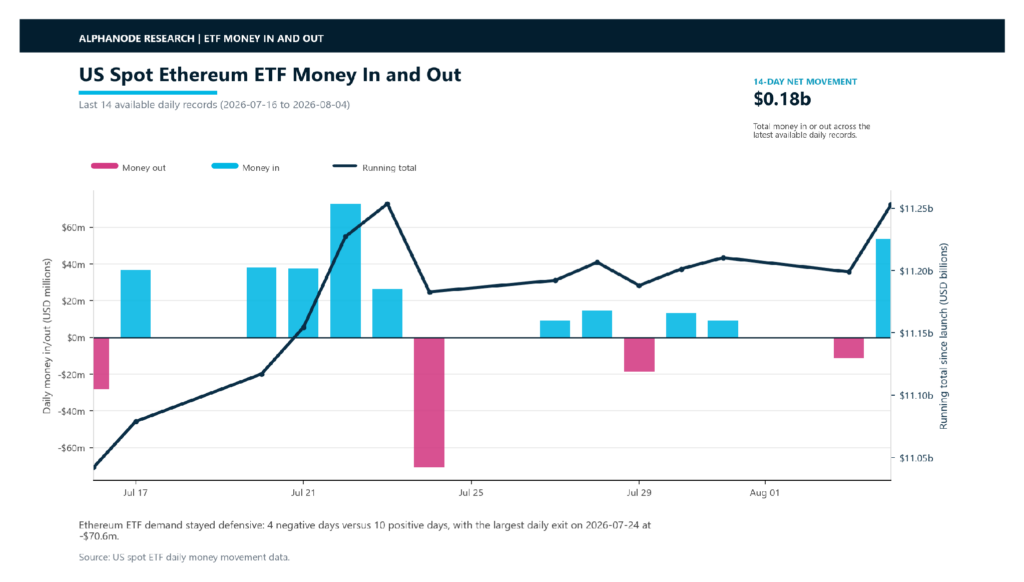
Fund demand set Ethereum’s better record. US spot Ether ETFs took in $182.3 million across the latest 14 available sessions, with ten positive days and four negative days. The funds added $53.7 million on August 4 after losing $11.4 million the day before. Net assets ended at $10.32 billion and cumulative inflows reached $11.25 billion.
Source: https://altfins.com/technical-analysis
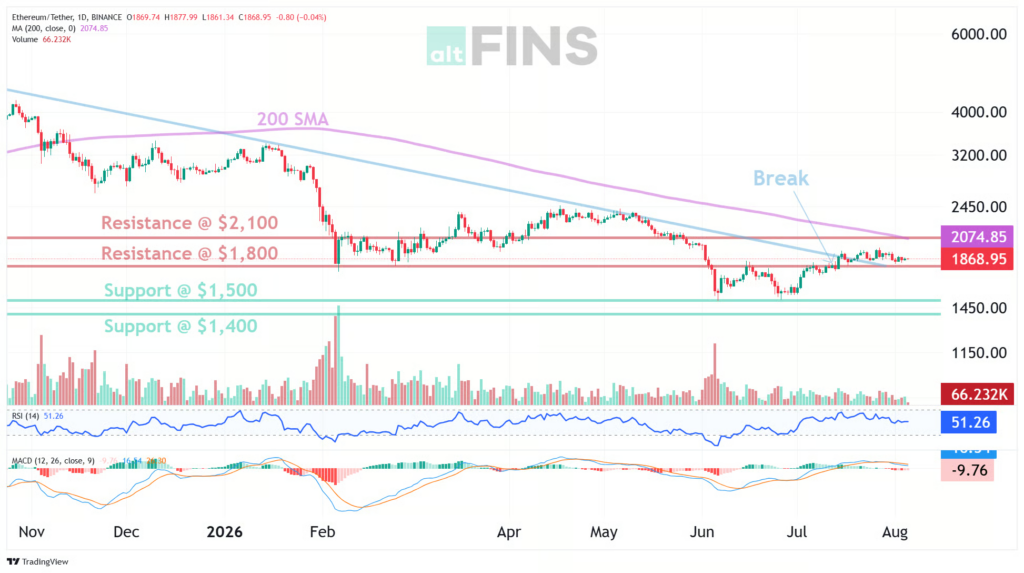
ETH opened near $1,918, traded down to $1,822, and returned to about $1,909 on the open August 6 candle. The seven-day move was negative 0.51%. A 2.90% fall on July 31 and another loss on August 3 were followed by a 2.09% rebound on August 5. Price recovered. The week’s $1,936 high remained untouched.
AltFins classifies ETH as a resistance breakout after price reclaimed $1,800 and crossed its descending trendline. Its short- and medium-term trends are neutral, while the long-term trend remains strongly down. Momentum is bearish but inflecting, RSI readings are neutral, and the Ultimate Oscillator is bullish. Binance data confirms that price has recovered above its 20-day, 30-day, and 50-day simple moving averages.
Source: https://sosovalue.com/assets/etf/us-eth-spot
Support begins at $1,822 and the reclaimed $1,800 breakout level. The 30-day low sits near $1,713, while AltFins places the deeper structural zones at $1,500 and $1,400. Resistance starts at $1,936 and $1,981 before the AltFins target zone at $2,100 to $2,200. Holding $1,800 keeps that breakout intact. A close below it would put the month-long recovery under pressure.
EIP-8363 shifts the debate from price to cash flow. A lower consensus reward would compress returns for liquid-staking tokens and leveraged loops, even if it reduces issuance. Ethereum is attracting more professional access while the protocol argues over how much that access should earn.
BNY Mellon’s institutional staking service widens distribution from the custody side. More investors can earn protocol rewards inside a controlled servicing framework. That channel becomes harder to price if Ethereum changes the base yield underneath it.
The Wallet Became the Market Risk
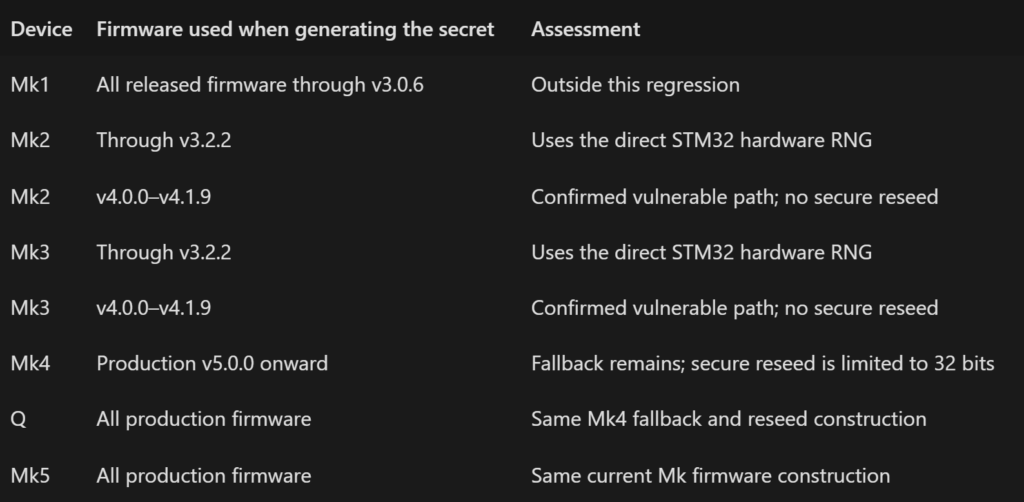
Coldcard’s compromise drained at least 1,816 BTC from more than 5,200 addresses. A hardware wallet is meant to isolate signing from an exposed computer. Firmware becomes the trust boundary when weak seed entropy lets an attacker regenerate the key.
Source: https://engineering.block.xyz/
The damage reaches beyond affected owners. Recovery instructions, firmware provenance, supply-chain controls, and multisignature policies now belong in the investment decision. One device should not carry unilateral authority over a treasury whose loss would end the business.
Regulated products absorb part of that burden. ETF investors accept custodian and counterparty exposure in exchange for operational controls, insurance arrangements, and audited processes. The $211.5 million Bitcoin ETF inflow on August 4 arrived as the cost of self-custody became visible.
Ethereum Is Repricing Its Base Yield
Draft EIP-8363 would burn a rising fraction of validator rewards as more ETH is staked. The permanent curve reaches zero consensus yield at the 50% saturation point, with an 18-month transition designed to avoid an abrupt cut at activation.
Source: https://github.com/pintail-xyz/
Leveraged loops depend on a positive spread between staking rewards and borrowing costs. The draft estimates that the permanent curve would reduce yield near today’s staking ratio from roughly 2.6% to 1.2%. Borrowing costs would have to fall with it or looped positions would unwind.
Lower issuance can strengthen ETH’s monetary profile, but the adjustment would land unevenly. Solo validators, staking providers, lending markets, and institutional custodians carry different costs. The proposal asks Ethereum to choose how much security budget it needs as staking participation grows.
Mark Your Calendars
Economic Calendar:
- August 7, 2026 at 8:30 AM ET: US Employment Situation for July. Payrolls, unemployment, and wage growth set the immediate macro tone for risk assets.
- August 12, 2026 at 8:30 AM ET: US CPI and core CPI for July. Inflation data will reset rate expectations ahead of the next Federal Reserve meeting.
- August 13, 2026 at 8:30 AM ET: US PPI for July. Producer-price data will test whether inflation pressure is easing beyond the consumer level.
- August 14, 2026 at 8:30 AM ET: US advance retail sales for July. Consumer spending will show whether demand held after the jobs and inflation releases.
Token Unlock
- August 10, 2026 at 12:00 AM UTC: Avalanche unlocks $11.12 million of AVAX through a cliff release, equal to 0.31% of released supply.