ETF Repair, ETH Leadership, Narrow Participation
Key Numbers:
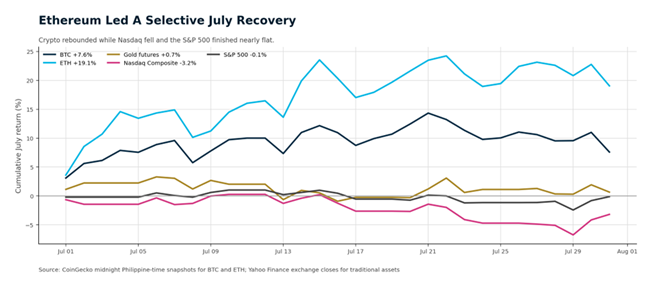
Bitcoin $62,721.33 (7.59%) Ethereum $1,860.78 (19.06%)
July ETF net flows
Bitcoin +$172.8M Ethereum +$347.4M
2026 returns
Bitcoin -28.61% Ethereum -37.61% Gold -6.39%
Nasdaq 9.17% S&P 500 9.41%
This Month’s Highlights
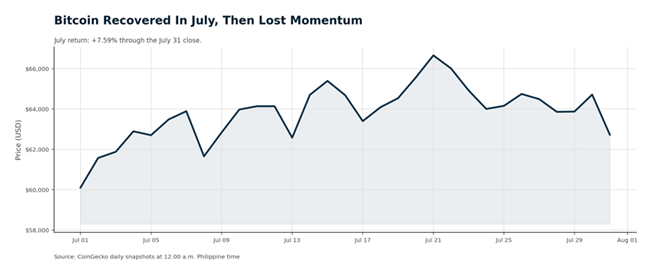
- Bitcoin rose 7.59% in July, ending two consecutive monthly declines, but closed below the $65,000 level it briefly reclaimed.
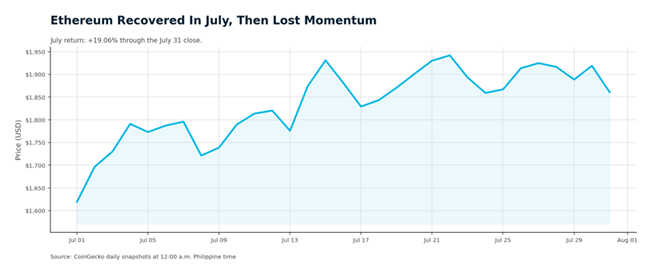
- Ethereum gained 19.06%. ETF demand, treasury accumulation and Ethereum-linked application activity gave ETH the month’s stronger relative bid.
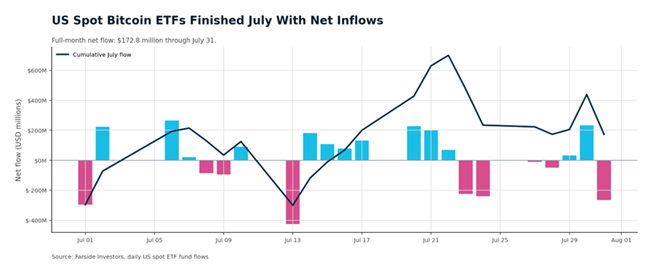
- US spot Bitcoin ETFs reversed June’s record outflow with $172.8 million of July net inflows. The gain was modest and arrived through alternating bursts of buying and redemption.
- Artemis measured stablecoin supply at $308.1 billion by July 26, while DeFi TVL moved off its late-June low. Capital was available inside crypto, but those balances did not produce a broad recovery in smaller tokens.
- More than 30 firms participated in DTCC’s July limited-production trades. By July 15, the broader working group had grown to more than 100 members and partners.
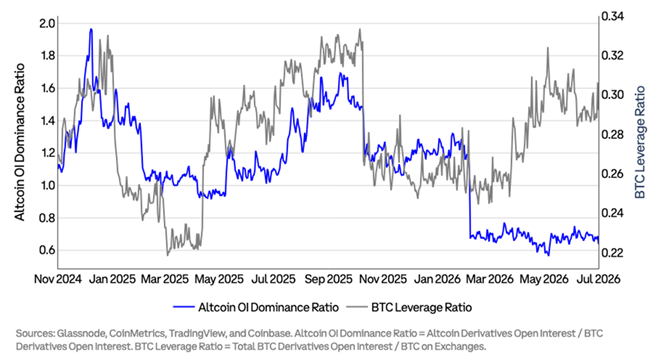
- Coinbase Research found that altcoin open-interest dominance remained near historic lows. July’s gains were concentrated rather than the start of a broad altcoin cycle.
- The Federal Reserve held rates at 3.50% to 3.75% by a 9-3 vote. Beth Hammack, Neel Kashkari and Lorie Logan preferred a quarter-point increase. That was not the backdrop for easy high-beta valuations.
- June PCE rose 3.7% year on year, while core PCE rose 3.3%. Q2 GDP grew at a 1.5% annual pace, with consumption holding up better than the headline suggested.
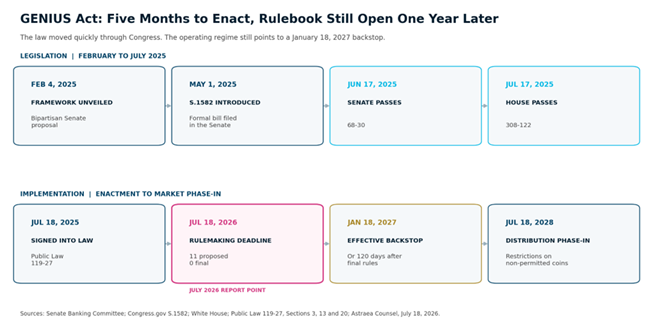
- Senators released updated CLARITY Act text on July 22, but ethics, consumer protection, illicit finance, conflicts of interest and market integrity still required work. The GENIUS Act’s July 18 rulemaking deadline passed without the required final regulations.
July ended two consecutive monthly declines for Bitcoin and gave Ethereum its strongest monthly performance of 2026. At the Philippine-time month-end cutoff, BTC rose 7.59% to $62,721 and ETH gained 19.06% to $1,861. The rebound began from a damaged base: crypto had just completed its longest quarterly decline since 2022, US spot Bitcoin ETFs had suffered their worst month of redemptions, and sentiment entered July under severe pressure.
The month repaired price faster than participation. ETF money returned in fits and starts, with Bitcoin products ending July modestly positive after June’s $4.5 billion exodus. Ethereum funds drew steadier demand relative to their size. Altcoin leverage remained depressed, DeFi activity recovered unevenly, and the total market struggled to turn a majors-led bounce into a broad cycle.
The operating layer moved on a different clock. Stablecoin supply reached about $308.1 billion by July 26, DTCC began real production trades in tokenised securities, and traditional firms widened access to digital assets. Washington moved more slowly. Senators released updated CLARITY Act text on July 22, but ethics, consumer-protection, illicit-finance, conflict-of-interest and market-integrity provisions still lacked agreement. The July 18 statutory deadline for GENIUS Act implementing regulations also passed without the required final rulemakings. July was a recovery, but it was selective, flow-dependent and still constrained by policy and the cost of capital.
Performance Table
Source: CoinGecko midnight Philippine-time snapshots for BTC and ETH; Yahoo Finance exchange closes for COMEX gold futures (GC=F), Nasdaq Composite (^IXIC) and S&P 500 (^GSPC)
How July Unfolded
The first week was about exhaustion. June had forced leveraged traders out, pulled $4.5 billion from Bitcoin ETFs and pushed sentiment into Extreme Fear. Then a weak payroll print lowered the chance of an immediate rate increase. ETF buyers returned on July 2, shorts lost control of the $60,000 area, and the market found enough breathing room to rebound. The move started because selling pressure eased before new conviction arrived.
The middle of July supplied that conviction. Seven positive Bitcoin ETF sessions brought $999.3 million into the funds, ETH creations persisted for longer, and both assets cleared their June ranges. Ethereum became the higher-beta expression of the recovery. Stablecoin supply reached $308.1 billion by July 26, but smaller-token leverage stayed depressed. Available liquidity had not become broad risk appetite.
The last week changed the tone again. Bitcoin could not hold above $65,000, ETF redemptions returned, oil kept inflation risk alive, and the Fed produced three votes for a hike. July still closed green. It simply ended with a harder question than it began: was this the first month of a durable recovery, or the relief rally that follows a forced liquidation? The answer now depends on the quality of new demand, not the absence of old sellers.
Bitcoin Market Analysis
Bitcoin’s July began as a repair trade. June had ended with about $4.5 billion of spot-ETF redemptions and BTC below $60,000. Recent buyers were realising losses and leverage had already been cut. Traders read the weak payroll report as reducing the risk of an immediate rate increase, and $223.5 million entered US spot funds on July 2. The pressure stopped accelerating.
Source: CoinGecko daily snapshots at 12:00 a.m. Philippine time
CoinGecko’s hourly aggregate tracked BTC from a Philippine-time July opening near $58,297 to a high near $66,803. The break through $65,000 changed the short-term chart, but it did not repair the longer trend. Bitcoin closed July at $62,721, below the reclaimed level and 28.61% lower for 2026.
The ETF tape explains both the rebound and the stall. Seven consecutive positive sessions brought $999.3 million into the funds from July 14 through July 22. Redemptions returned after July 22, and the full-month balance finished at $172.8 million. ETF assets also rose because Bitcoin’s price rose. Net flow measures new money; assets under management combine flows with the changing value of the Bitcoin already held. Confusing the two makes the institutional recovery look stronger than it was.
Source: Farside Investors, daily US spot Bitcoin ETF flows through July 31, 2026
Coinbase Research provides the useful wider frame. June had already unwound leverage across perps, futures and options, and recent holders were selling at losses. Bitcoin’s order-book depth did improve on the bid side, but the broader market remained majors-led rather than speculative. July’s bounce came from a cleaner market structure. It did not create new breadth.
Corporate treasury buyers also became less automatic. Strategy sold 3,588 BTC between June 29 and July 5, including 2,225 BTC during July, to help fund preferred distributions and rebuild its dollar reserve. That sequence deserves more attention than a simple tally of holdings. The public-company treasury model remains a buyer when financing is available. In July it was also a reminder that funding costs and liability management set the limits of that support.
Bitcoin finished July with a better floor and a less convincing ceiling. The recovery ended a damaging monthly streak. It did not answer whether traditional investors will keep buying after the easy rebound from June’s forced selling.
Ethereum Market Analysis
Ethereum delivered the month’s stronger price result. ETH began July near $1,563, reclaimed $1,800, reached a CoinGecko hourly high near $1,967 and closed at $1,861. Its 19.06% gain more than doubled Bitcoin’s return, although ETH remained 37.61% lower for the year.
Source: CoinGecko daily snapshots at 12:00 a.m. Philippine time
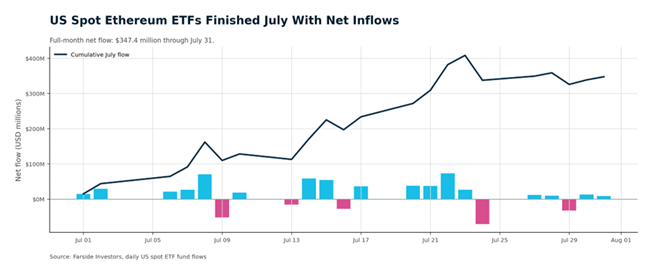
ETF demand helped. Farside recorded $347.4 million of ETH net inflows in July, with 17 positive sessions and five negative sessions. BTC took in more dollars during its strongest streak, but ETH’s full-month flow pattern was steadier relative to its smaller product base.
Source: Farside Investors, daily US spot Ethereum ETF flows through July 31, 2026
That support was not evenly distributed. CoinDesk reported that a large share of returning ETH ETF demand sat in BlackRock’s fund. It also linked new Ethereum demand to Robinhood Chain, whose reported DEX activity was heavily memecoin-driven. Those facts temper the easy conclusion. Ethereum had a better bid, but it was still concentrated and partly speculative.
The operating story was broader. Justin Drake’s Lean Ethereum vision, published in July 2025, kept base-layer scale and post-quantum security on the agenda. July 2026 also showed why Ethereum stays central to the financial-rails theme: stablecoins, tokenised assets, trading applications and new settlement systems continue to seek the chain’s liquidity and execution environment.
Treasury-company behaviour supplied a useful check. BitMine slowed ETH purchases and repurchased about $86 million of its own shares. The new ETH treasury bid has the same dependence on equity-market conditions and financing discipline that Bitcoin’s treasury buyers face.
ETH’s July outperformance was a real change from June. It was not a clean resolution of Ethereum’s governance, funding or value-capture questions. The market gave it a better month because flows and usage became more supportive at the same time. It will need both to continue.
Implementation Outran Legislation
July’s most durable story happened away from the price chart. DTCC’s tokenisation programme moved into limited production trades for tokenised securities, drawing banks, exchanges, asset managers and crypto firms into one operating test. That is a different category of progress from a pilot deck or a conference announcement. It is still limited production, not a completed market transformation. The distinction matters.
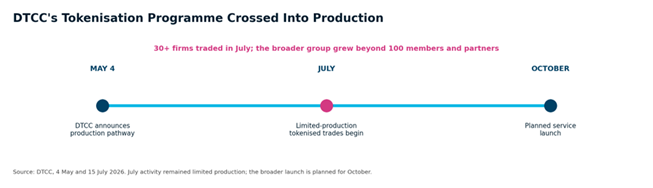
Source: DTCC, May 4 and July 15, 2026
Morgan Stanley added Ether and Solana ETPs. Baillie Gifford and BNY launched a UK fund using Ethereum and Solana as part of its legal ownership record. The common thread was distribution. Crypto’s practical growth is increasingly arriving through products investors already recognise: funds, securities and settlement records.
Kent Egan’s July research for Liquid Mercury described the divide well: implementation outpaced legislation. DTCC and other firms did not need a Senate floor vote to advance. The regulatory framework did. The GENIUS Act’s rulemaking path slipped behind its July deadline, while the CLARITY Act became entangled in an ethics dispute over the scope and enforcement of restrictions on senior officials’ crypto dealings.
The report should not turn that into a generic anti-regulation point. Industry wants rules it can build around. July showed that infrastructure can keep moving without them, but the most sensitive questions of market structure, supervision and long-term capital allocation remain less certain until the political work is done.
Liquidity Returned, Breadth Did Not
Bitcoin and Ethereum rose while altcoin leverage remained pinned near the bottom of its historical range. Coinbase’s July 6 positioning report described a market still concentrating futures risk in BTC and ETH. The rebound had strong pockets, but it had not become a market-wide expansion.
Stablecoins provide the second half of the picture. Artemis measured supply at $308.1 billion on July 26, up 18.6% over the period covered in its research. Stablecoins are both a settlement tool and a holding place for capital that has not committed to volatile tokens. A large supply base alongside subdued altcoin leverage shows that liquidity can remain inside the system without moving into broad speculative positions.
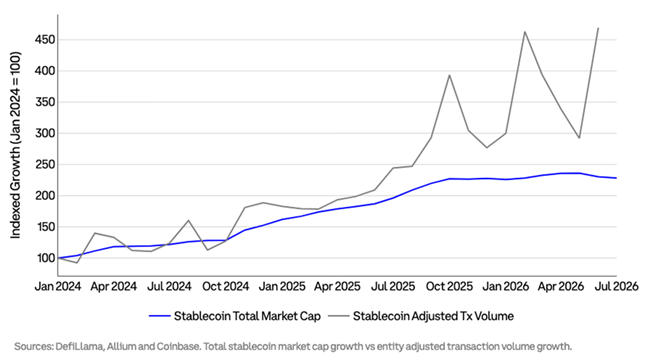
Source: Coinbase Research, DeFiLlama and Allium. Published July 10, 2026
DeFi TVL moved off the late-June area near $70 billion. Dollar TVL rises when deposited assets appreciate, when users add capital, or both. The headline alone cannot separate those effects. Protocol revenue, borrowing and stablecoin transfer activity provide better evidence of genuine usage than TVL by itself.
Sector dispersion stayed wide. Perpetual exchanges and revenue-producing protocols retained interest, while social, gaming and other narrative-heavy groups remained deeply damaged after June. The lesson is useful for readers who do not follow daily prices: a green Bitcoin month does not mean the average token recovered.
Infrastructure, Security and the Cost of Operating
The miner-to-AI shift belongs here as a case study rather than the month’s organising theme. CryptoSlate reported that Core Scientific generated $80 million of gross profit from AI colocation while self-mining ran at a negative gross margin. Hut 8 signed a second 15-year lease for 352 megawatts of AI infrastructure at Beacon Point. The comparison highlighted the relative economics of selling grid access, cooling and developed sites instead of using all of that capacity for mining.
Security supplied the less comfortable operating lesson. CertiK recorded $444 million lost through wallet compromises across 33 incidents in the first half. Ethereum accounted for 153 incidents and $522.8 million of total losses across attack types. The report’s incident ranking also shows how concentrated the damage became: Kelp DAO and Drift Protocol lost about $291 million and $285 million in Q2. Smart-contract audits cannot stop an attacker who steals an administrator’s credentials or persuades a signer to approve the wrong transaction. For users, hardware-backed authentication, withdrawal allowlists and limited token approvals matter as much as the protocol selected.
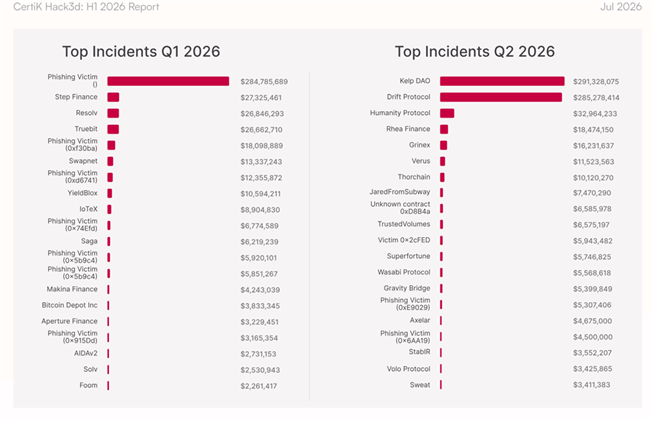
Source: CertiK Hack3D H1 2026 Report, page 12. Published July 6, 2026
Both stories point to the same stage of market development. Crypto is being judged as infrastructure. Investors care about contracted revenue, operational controls and recoverability, not only token supply and price charts.
Macro Watch: The Cost of the Rebound
The jobs number flipped the mood in early July. June nonfarm payroll employment rose by 57,000. Traders treated the weak print as reducing the risk of an immediate rate increase, and Bitcoin recovered from the $58,000-$60,000 stress area. Crypto did not need a rate cut that week. It needed the market to stop repricing the next move as a hike.
Oil then complicated the relief. Prices were volatile and rose as fighting and disrupted traffic through the Strait of Hormuz renewed supply-risk concerns. Energy feeds into transport, goods and inflation expectations. Around the July 29 Fed decision, the two-year Treasury yield traded near 4.32% and the ten-year near 4.65%. Kiplinger’s meeting coverage tracked the shift from cut hopes toward renewed hike risk.
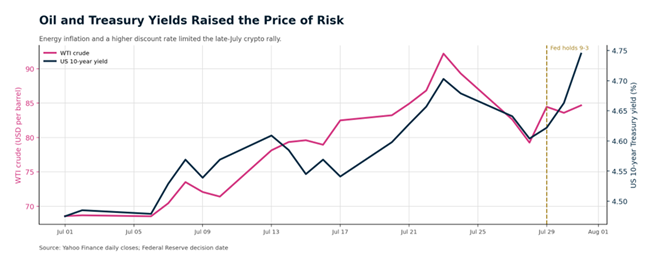
Source: Yahoo Finance adjusted daily closes
Those yields reach crypto through three channels. Cash and short-dated government debt become harder competitors for capital. Higher discount rates reduce what investors will pay for assets whose value depends on future adoption. A stronger dollar also tightens global financial conditions, particularly for leveraged traders and offshore liquidity. Bitcoin can rise while yields rise, as it did for part of July. Sustaining that combination requires persistent spot demand because the macro tide is no longer doing the lifting.
The Fed held its target range at 3.50% to 3.75% on July 29, but the vote mattered more than the decision. Beth Hammack, Neel Kashkari and Lorie Logan preferred a quarter-point increase, producing a 9-3 split. The market heard a central bank debating how much restraint was still required, not one preparing to rescue risk assets.
The following day’s growth and inflation data explained the disagreement. BEA reported that Q2 GDP grew at a 1.5% annual rate, consumer spending advanced 3.2% and underlying domestic demand rose 3.9%. June PCE inflation was 3.7% year on year and core PCE was 3.3%. The headline economy looked slow while the parts that drive demand remained firm. Growth was too resilient to force cuts and inflation remained above target.
August therefore starts with a simple hierarchy. Oil determines whether the inflation shock keeps spreading. Payrolls and services activity show whether households can continue carrying growth. Core PCE tells the Fed whether that demand is still feeding prices. The ten-year yield is the market’s running verdict. A crypto rally accompanied by stable or falling yields and recurring ETF creations would have a stronger foundation than one driven by a single soft data point.
Market Structure: A Cleaner Market, Still a Narrow One
July’s rebound was possible because June had already done the violent work. CoinGlass counted $16.14 billion of liquidations in June, the highest monthly total of the first half, and 69.5% came from long positions. By July, fewer crowded longs remained to be forced out. That changed the path of least resistance even before buyers became enthusiastic.
Source: Coinbase Research, Glassnode, CoinMetrics and TradingView. Published July 6, 2026
Open interest, volume and funding describe different parts of that process. Open interest is the stock of derivatives positions still outstanding. Volume measures how actively those positions trade. Funding is the recurring payment between perpetual-futures longs and shorts. Coinbase Research found that open interest fell across perpetuals, dated futures and options while trading volume rose. BTC funding softened, ETH funding turned negative and options skew moved toward downside protection. Traders were active, but they were taking risk off balance sheets.
That distinction helps explain July’s first rally. A market can climb because fresh buyers arrive, because sellers exhaust themselves, or because shorts cover. July began with the second and third forces. The midmonth ETF streak added the first. When redemptions resumed after July 22, Bitcoin lost the marginal buyer that had carried it through $65,000 and slipped back below the level.
ETF assets under management are easy to misread here. AUM rises when investors create new shares and when the Bitcoin or Ether already inside a fund appreciates. Net flow isolates subscriptions and redemptions. Bitcoin ETFs ended July with only about $200 million of net new money after June’s $4.51 billion withdrawal. The price rebound made the products look healthier than their creation data alone. Ethereum’s steadier inflows were more persuasive relative to its smaller base, which is one reason ETH held its June breakout better.
Liquidity also has an address. CoinGlass found that the top two venues, Binance and OKX, accounted for 64.8% of BTC derivatives depth within 1% of the mid-price during the first half. The ten largest exchanges handled 81.2% of derivatives volume. Concentration makes price discovery efficient when the leading venues function normally, but it turns venue outages, forced deleveraging and jurisdiction-specific shocks into market-wide events. Thin books outside the leaders also allow a modest ETF order or liquidation wave to move the quoted price farther than its dollar size suggests.
Stablecoins show where the uncommitted capital sat. Artemis measured supply at $308.1 billion on July 26, while Coinbase found stablecoin transaction activity had grown much faster than supply since 2024. The same token can be trading collateral, a cash substitute, a cross-border payment or the first step into DeFi. Supply tells us money is available inside the system. It does not tell us that investors have chosen volatile assets. Borrowing, DEX volume, protocol revenue and sustained spot turnover reveal when that cash starts working.
Breadth remained the missing confirmation. Coinbase’s July 6 positioning report placed altcoin open-interest dominance in a historically depressed 0.6-0.7 range while describing June’s leverage reset. A durable expansion would look different: BTC and ETH hold their gains, altcoin spot volume rises without a jump in funding, stablecoins move into lending and trading applications, and more sectors participate. July delivered the first condition and pieces of the third. It never completed the sequence.
Regulatory Developments: Two Clocks, One Bottleneck
July ran on two regulatory clocks. The CLARITY Act determines who supervises much of the spot crypto market and how a token can move between securities and commodities regimes. The GENIUS Act establishes the federal framework for payment stablecoins. Both matter because a product can exist under today’s permissions while its cheapest route to national scale still depends on final rules.
Source: Senate Banking Committee, Congress.gov, the White House, Public Law 119-27 and Astraea Counsel’s July 18, 2026 rulemaking status.
After the Senate Banking Committee advanced the CLARITY Act 15-9 in May, senators released updated merged text on July 22. Democratic senators said ethics, consumer-protection, illicit-finance, conflict-of-interest and market-integrity provisions still required work. The bill ended July without a confirmed floor vote.
That delay keeps costs in the system. An exchange deciding where to list a token still has to price the risk that one agency treats it as a security while another treats the venue as a commodities market. Token issuers cannot know with confidence when decentralisation changes their obligations. Banks and asset managers can offer exposure through carefully structured products, but they remain selective because compliance design can change after legislation. The Senate calendar therefore affects product breadth, legal budgets and the willingness of long-duration capital to enter the sector.
The GENIUS timetable slipped in a different way. The July 18 statutory deadline for implementing regulations passed without the required final rulemakings being completed. Astraea Counsel counted 11 proposed rules and no final rules as of July 17. That is the firm’s rule-tracking count, rather than an official consolidated tally. The Act takes effect on the earlier of January 18, 2027 or 120 days after the primary federal payment-stablecoin regulators issue any final implementing regulations. Reserve composition, redemption rights, capital treatment and the route available to state and federally supervised issuers still need operational detail.
Companies did not wait for every answer. Visa introduced its Stablecoin Platform on July 16 with OpenUSD as the first supported stablecoin. More than 30 firms also participated in DTCC’s real production tokenised-securities trades, and the broader working group had grown past 100 members and partners by July 15. These projects can proceed under existing charters and permissions. Their eventual scale will depend on whether final rules allow different institutions to connect without rebuilding compliance for every state, counterparty and asset.
The useful signals for August are procedural. A Senate floor slot for CLARITY would show that the ethics dispute has a workable settlement. A standalone Federal Reserve proposal would begin closing the largest gap in the stablecoin rulebook. Final OCC and FDIC rules would let issuers compare federal routes on actual economics. DTCC’s planned October launch will test whether limited-production activity can become routine settlement. Policy progress should be judged by those handoffs, not the number of speeches supporting crypto.
Wrap-up
July was the month crypto stopped selling as one trade. Bitcoin recovered from the ETF shock, but its sponsorship remained fickle. Ethereum had the better month because its flows improved more consistently and its operating narrative found traction again. Neither result erased the larger constraint: markets still had to pay for exposure with capital that remained expensive.
The more durable progress happened in the rails. Tokenised securities reached limited production at DTCC. Banks expanded distribution. Power-rich miners found a better buyer for their infrastructure in AI. Those developments do not settle the investment case for BTC or ETH, but they do show where crypto’s commercial momentum kept moving while token prices were still repairing.
August begins with a clear test. If Bitcoin ETF flows stabilise after July’s late fade and inflation continues to cool, the July floor can become a base. If macro remains restrictive and fund flows turn back out, the split can widen: financial infrastructure advances while native-token demand stays selective.