
This article provides general information only and does not constitute personal financial advice. It does not take into account your individual objectives, financial situation, or needs. Before making any financial decision, consider whether it is appropriate for your circumstances and seek independent professional advice.
Key takeaways on digital asset investing in Australia
- The Digital Assets Framework gives financial professionals a defined timeline for platform and custody due diligence.
- Client demand is already visible through Australian ownership data, SMSF questions, and institutional allocation signals.
- The practical decision for most practices is whether to build digital asset capability internally or partner with specialist infrastructure.
- Advisers, accountants, and SMSF professionals need a repeatable process for custody, reporting, suitability, and client communication.
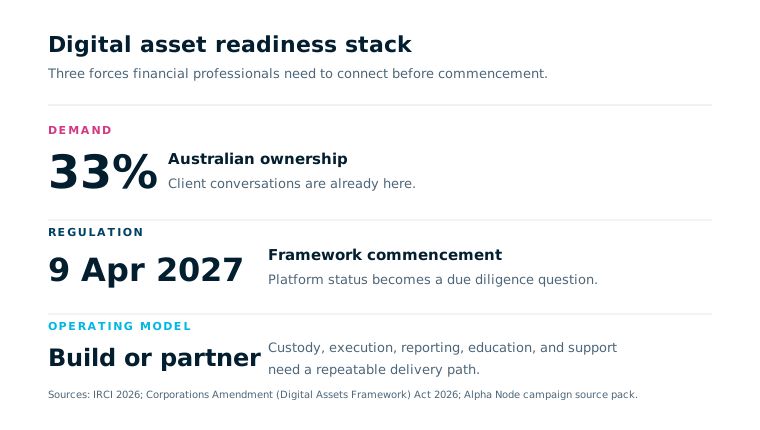
Digital asset investing in Australia now sits inside a clearer regulatory timetable. On 1 April 2026, the Australian Government passed the Digital Assets Framework. It commences on 9 April 2027, giving every platform, custodian, and financial professional in the country twelve months to understand what has changed and decide how to respond.
That window is the context for everything that follows.
The Framework does not make digital assets new. Australians have been buying, holding, and asking questions about them for years. What the Framework does is formalise the infrastructure layer — the platforms and custody arrangements that sit between the investor and the asset. For financial professionals, that changes the operating environment more than the investment thesis.
This page is designed to be a working reference. It covers the demand picture, the regulatory structure, the transition mechanics, and the practical questions that advisers, SMSF practitioners, and accountants will need to work through before April 2027.
The demand picture
The Independent Reserve Cryptocurrency Index (IRCI) 2026, surveying approximately 2,000 Australian respondents, puts cryptocurrency ownership at 33% of the adult population — a record high. That figure was 31% in 2025 and 27.5% in 2024 (IRCI 2025; IRCI 2024). The direction has been consistent for three years.
Ownership alone is a limited indicator. What the IRCI 2026 also shows is portfolio deepening: 26% of holders report allocating between 11% and 20% of their portfolio to digital assets. That is no longer a speculative toe-in-the-water. It is a weighting that affects portfolio construction, risk exposure, and reporting obligations.
The composition is broadly what you would expect. Bitcoin is held by 71% of Australian crypto investors. Ethereum sits at 33%. Solana has moved into the third position (IRCI 2026). The long tail is wide, but the concentration at the top has not shifted dramatically.
Institutional flows
Retail demand has institutional echoes. By January 2026, Australian pension funds had committed approximately $12 billion AUD to spot crypto ETFs (Proactive Investors, January 2026). Corporate cryptocurrency holdings grew 15% year-on-year over the same period (Proactive Investors, January 2026).
These are not speculative positions from fringe allocators. Pension funds operate under strict investment mandates and fiduciary obligations. The commitments reflect a calculation that regulated crypto exposure can sit inside an institutional portfolio, not a conviction that prices will keep rising.
The trust gap — and its partial closure
The IRCI 2026 includes a question that matters more than the headline ownership number: 46% of non-investors cited “not regulated enough” as their primary barrier to entering the market. Regulation was the single most common reason Australians gave for staying out.
On the other side, 51% of respondents said the new Digital Assets Framework increases their confidence in cryptocurrency exchanges (IRCI 2026).
Those two data points sit in tension. The Framework has passed, but it has not commenced. Trust has shifted on paper, but the operational changes — licensing, compliance, ASIC oversight — are still twelve months away. The gap between sentiment and implementation is where financial professionals will do most of their work over the next year.
What does the Digital Assets Framework actually do?
The Digital Assets Framework creates two regulated categories:
1. Digital asset platforms — exchanges and trading platforms that facilitate buying, selling, and transferring digital assets.
2. Tokenised custody platforms — platforms that hold digital assets or tokenised products on behalf of clients.
Both categories must obtain an Australian Financial Services Licence (AFSL) from ASIC (Gilbert + Tobin, April 2026). ASIC’s current digital asset guidance remains available in INFO 225: Digital assets, financial products and services.
Platform regulation, not token regulation
The Framework regulates platforms, not tokens. It does not classify individual cryptocurrencies as financial products. It does not create a taxonomy of which tokens are securities and which are commodities. The regulatory obligation sits with the entity operating the platform — its governance, its custody arrangements, its capital adequacy, its dispute resolution framework, and its conduct obligations.
This is a deliberate design choice. It avoids the token-by-token classification debate that has consumed regulatory energy in other jurisdictions. For financial professionals, the practical implication is that the compliance question centres on which platform a client uses and how that platform is licensed, not on whether a specific token meets a particular legal test.
What the AFSL requirement means in practice
Platforms that fall into either category will need to meet AFSL conditions that cover:
- Minimum capital and liquidity requirements
- Custody and segregation of client assets
- Internal dispute resolution and external dispute resolution (including AFCA jurisdiction)
- Ongoing reporting to ASIC
- Professional indemnity insurance or equivalent arrangements
For advisers who recommend or facilitate client access to digital assets, the licensing status of the underlying platform becomes a due diligence checkpoint. An unlicensed platform after 9 April 2027 is an unregulated platform. The distinction will matter in advice documentation, file notes, and any best-interests analysis.
What happens during the transition period?
The Framework commences on 9 April 2027. Between now and then, ASIC Information Sheet 225 remains the primary public guidance for how digital asset businesses interact with the existing financial services regime (ASIC, current as at April 2026).
INFO 225 sets out ASIC’s view on when digital assets are financial products under existing law, how the Corporations Act applies to certain crypto-asset activities, and what businesses should consider before operating in this space. It has been the de facto regulatory reference since its publication, and it does not expire when the Framework commences — it will be updated to reflect the new regime.
What changes and when
During the transition period:
- Existing platforms that intend to continue operating will need to prepare AFSL applications that address the new digital asset platform or tokenised custody platform categories.
- Advisers who reference digital asset platforms in their advice process should begin reviewing which platforms they work with and whether those platforms have indicated an intention to apply for licensing under the Framework.
- SMSF practitioners who administer funds with existing digital asset holdings should consider whether their current custody and reporting arrangements will meet the post-Framework requirements their platform providers will be subject to.
There is no automatic grandfathering. Platforms that do not obtain an AFSL under the relevant category will not be authorised to operate after commencement. For practices that currently direct clients toward a particular exchange or custody provider, the transition period is the window to confirm that provider’s licensing trajectory.
85% of local exchanges already hold full licences under the existing regime (Australian Treasury, per CryptoNews AU, 2026). That suggests the licensing infrastructure is not starting from zero. But the new AFSL conditions are more demanding than the existing AUSTRAC registration requirements, and the gap between holding an AUSTRAC registration and meeting full AFSL obligations is not trivial.
What does this mean for financial professionals?
The Framework does not directly regulate financial advisers. Advisers are already regulated under the Corporations Act and their existing AFSL conditions. What the Framework changes is the landscape around the adviser — specifically, the platforms and custody providers that advisers interact with when clients seek digital asset exposure.
The advice conversation
33% of Australians hold cryptocurrency (IRCI 2026). Some of those Australians are clients of financial advice practices. Some are SMSF members. Some are business owners whose accountant handles their tax and structuring.
The practical question is not whether these conversations are happening. They are. The question is whether the practice has a repeatable way to handle them.
A structured response involves several layers:
- Suitability assessment — does digital asset exposure fit the client’s risk profile, investment objectives, and time horizon?
- Platform due diligence — is the proposed platform licensed (or on a credible path to licensing under the Framework)?
- Custody and control — where do the assets sit, who holds the keys, and what happens if the platform fails?
- Reporting and documentation — can the practice integrate digital asset holdings into existing reporting, file notes, and review processes?
- Tax treatment — how are digital asset transactions treated for CGT, income, and GST purposes?
Each of those layers exists whether or not the adviser recommends digital assets. A client who holds crypto outside the advice relationship still creates a documentation question when they disclose it in a review meeting.
The cost of avoidance
Practices that choose not to engage with digital assets do not eliminate the issue. They relocate it. The client goes to a platform independently, makes decisions without advice, and brings the complexity back to the practice later — usually with less documentation, less structure, and less control.
That is not an argument for recommending digital assets to every client. It is an observation that having no process is itself a position, and it tends to create more operational risk than having a considered one.
The SMSF dimension
Self-managed superannuation funds hold approximately $1.1 trillion in assets across 653,062 funds (APRA, 2024-25 annual statistics). The SMSF sector is large enough that any shift in asset class interest creates meaningful demand for professional services.
Digital assets in SMSFs are not new. Trustees have been holding cryptocurrency for several years, within the constraints of the Superannuation Industry (Supervision) Act 1993 (SIS Act). The sole purpose test, the in-house asset rules, the investment strategy requirements, and the arm’s length provisions all apply. None of that changes under the Framework.
What does change is the infrastructure environment. When the platforms that custody SMSF-held digital assets become AFSL-regulated entities, the obligations on those platforms — around segregation, reporting, dispute resolution, and capital adequacy — formalise. For SMSF practitioners, that creates both clarity and a new set of questions.
Unmet demand
Based on observed practitioner signals and the scale of the SMSF sector, SMSF-related digital asset guidance appears to be among the highest areas of unmet demand for financial professionals (inference based on practitioner commentary and APRA scale data, not a formal adviser survey).
The questions practitioners encounter tend to cluster around:
- Custody — which platforms can hold digital assets on behalf of an SMSF trustee in a way that satisfies SIS Act requirements?
- Reporting — how are digital asset holdings valued, reported, and reconciled for annual auditing purposes?
- Governance — does the fund’s investment strategy explicitly contemplate digital asset exposure, and has the trustee documented their decision-making process?
- Appropriateness — under what circumstances is digital asset exposure consistent with the fund’s objectives and the trustee’s risk tolerance?
These are operational questions, not philosophical ones. They have answers, but those answers require infrastructure — custody arrangements, reporting feeds, valuation methodologies, and audit-ready documentation. Most SMSF practitioners are not set up to build that infrastructure internally for one asset class.
The institutional shift
The demand data and the regulatory structure sit inside a broader pattern of institutional engagement with digital assets in Australia.
Pension funds
The $12 billion AUD in pension fund spot crypto ETF commitments by January 2026 (Proactive Investors) is the most visible marker. These commitments are made through regulated fund structures, approved by investment committees, and subject to ongoing performance and risk review. They represent a considered allocation, not a directional bet.
For financial professionals, the pension fund signal is relevant because it normalises digital asset exposure within institutional portfolio construction. When a super fund commits to a crypto ETF, it has already worked through the governance, custody, and compliance questions that an advice practice will face at a smaller scale.
The Big 4 banks
All four major Australian banks now have transparent digital asset transfer policies under the Scam-Safe Accord (CryptoNews AU, 2026). The Accord requires banks to verify transfer destinations before approving transactions to digital asset platforms.
This is a significant operational shift. For several years, banks restricting or blocking transfers to crypto exchanges was a friction point for investors and a compliance grey area for advisers. The Scam-Safe Accord does not endorse digital asset investing, but it establishes a visible, documented process for how bank transfers to regulated platforms are handled. That clarity is useful for advisers who need to explain the mechanics to clients.
Tokenised real estate
Tokenised real estate in Australia has reached approximately $2.4 billion AUD in market value (Proactive Investors, January 2026). Tokenisation — representing ownership of real-world assets as digital tokens on a blockchain — is one of the areas the Framework’s tokenised custody platform category is designed to address.
For advisers and accountants, tokenised assets introduce questions that sit between traditional property investment and digital asset investment. Custody, valuation, liquidity, and regulatory treatment all need to be assessed on their own terms.
The Digital Finance CRC estimates the annual opportunity from tokenised markets in Australia at $24 billion AUD. That figure is an estimate and should be treated as an indicator of potential market scale rather than a forecast.
The operating model question
For most financial professionals, the practical decision is not whether digital assets are legitimate. The Framework has settled that at the platform level. The decision is how to incorporate digital asset capability into an existing practice without building infrastructure from scratch.
Partnership versus build
There are two broad approaches:
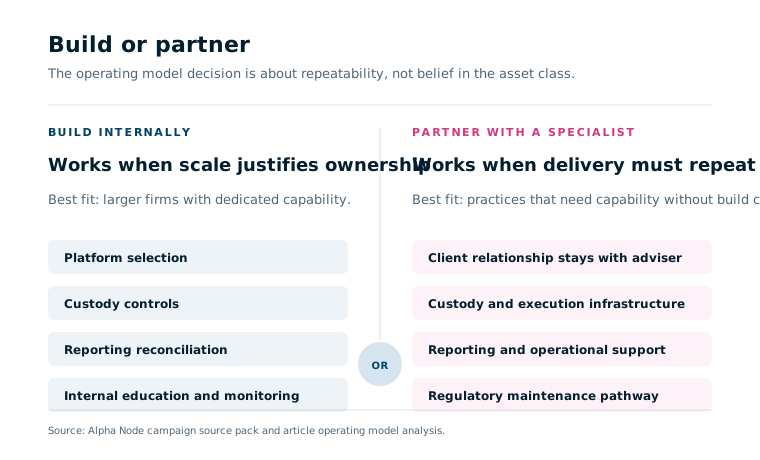
Build internally. The practice develops its own digital asset knowledge, selects platforms, establishes custody and reporting arrangements, and manages the compliance layer in-house. This works for firms with scale, technical resource, and a long-term commitment to the asset class.
Partner with a specialist. The practice works with an infrastructure provider that handles custody, execution, reporting, and compliance support, while the adviser retains the client relationship and the advice layer. This works for firms that want digital asset capability without the operational overhead of building it.
Most advice practices, particularly those in the small-to-mid market, will gravitate toward the partnership model. The operational complexity of custody, key management, platform integration, reporting reconciliation, and regulatory monitoring is substantial enough that in-house solutions only make sense at significant scale.
What the right partner provides
A credible digital asset infrastructure partner should be able to demonstrate:
- Licensing status or a clear path to AFSL under the Framework
- Institutional-grade custody with segregated client assets
- Reporting that integrates with the adviser’s existing systems
- Education and support for the advice team
- A compliance framework that aligns with the adviser’s own obligations
- Transparent pricing and a clear service boundary
The test is straightforward: can the partnership reduce operational risk for the practice while giving clients access to digital assets through a documented, repeatable process?
Working with Alpha Node
Alpha Node provides digital asset infrastructure for Australian financial professionals. The model is built around partnership — advisers maintain the client relationship while Alpha Node handles custody, execution, reporting, and ongoing support.
If your practice is working through how to respond to the Framework, how to handle client conversations about digital assets, or how to build a repeatable process for SMSF-related digital asset questions, a conversation is a reasonable starting point.
Review the partnership pathway or book an introductory call.
Common questions
Has the Digital Assets Framework commenced?
No. The Framework has passed, but the main commencement date is 9 April 2027. Until then, financial professionals should treat the period as preparation time for platform due diligence, custody assessment, reporting workflows, and client communication.
Does the Framework regulate individual tokens?
The Framework is focused on platforms and custody arrangements, not on classifying every token individually. For advisers and related professionals, the practical question is which platform or custody category applies and whether the provider can demonstrate a credible compliance path.
What should advice practices do first?
Start with the operating model. Before selecting a platform or building a client offer, practices need to define who owns custody, execution, reporting, compliance support, education, and client communication.
Sources
- Independent Reserve Cryptocurrency Index 2026: Australian ownership, portfolio composition, and confidence data.
- ASIC INFO 225: current ASIC guidance on digital assets, financial products, and financial services.
- ASIC roadmap for digital assets law reform implementation: commencement date and implementation context for the Digital Assets Framework.
- Gilbert + Tobin regulatory update: legal summary of the Digital Assets Framework and AFSL implications.
- APRA Annual Superannuation Bulletin 2024-25 highlights: SMSF scale and superannuation sector context.
- Digital Finance CRC summary: Australian digital finance and tokenisation economic gain estimates.