
A digital asset platform that provides financial services in Australia must hold an Australian Financial Services (AFS) licence, or hold a variation that adds the relevant authorisations, before it can lawfully operate. The 30 June 2026 application deadline is the gate that decides whether a platform is inside the licensing regime at all, and from 9 April 2027 a compliant platform adds the digital asset platform (DAP) or tokenised custody platform (TCP) authorisation on top of the AFS licence it already holds.[5][7]
Key takeaways on AFSL requirements for digital asset platforms
- A digital asset platform providing financial services in Australia must hold an AFS licence, or a variation adding the relevant authorisations, unless an exemption applies.[1]
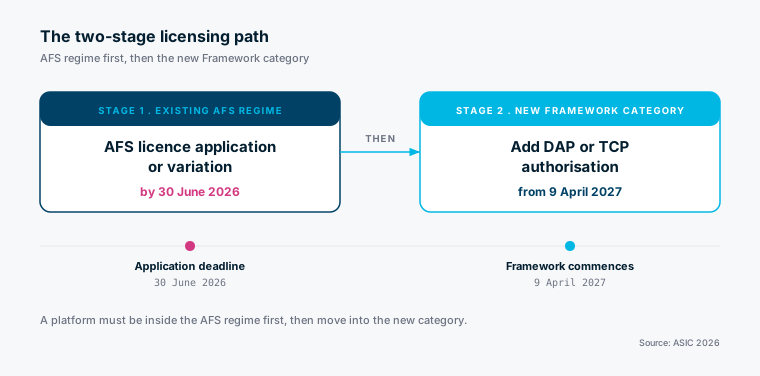
- The licensing path is two-stage: lodge an AFS application or variation by 30 June 2026, then add the DAP or TCP authorisation from 9 April 2027 when the Framework commences.[5][7]
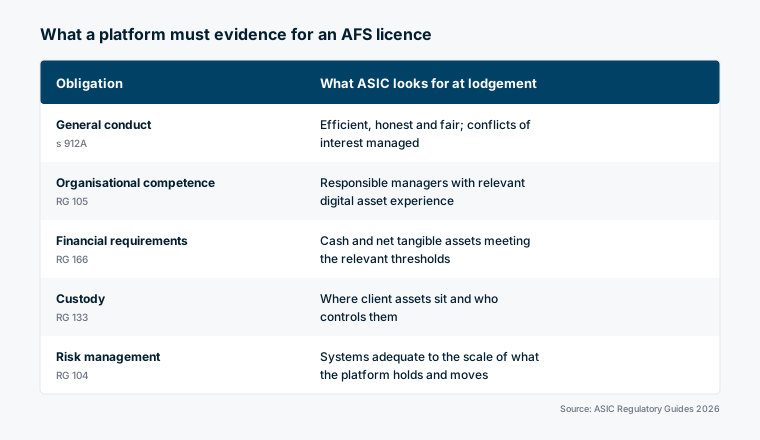
- An AFS licence carries the general obligations under the Corporations Act: provide services efficiently, honestly and fairly, manage conflicts, maintain competence, and hold adequate resources and risk management systems.[2]
- ASIC assesses a platform against published standards for organisational competence, financial requirements, and custody. The mapping of services to authorisations has to be complete at lodgement.[4]
- For a dealer group vetting a platform, the question is concrete: does this provider hold a current AFS authorisation covering the digital asset financial products it offers, or has it lodged by the deadline.[5]
The licensing requirement is not new law dressed up for digital assets. It is the existing AFS regime applied to platforms that have, in many cases, been operating under the comfort of ASIC Information Sheet 225 while the Digital Assets Framework was drafted.[6] The Framework, which received Royal Assent on 8 April 2026 and commences on 9 April 2027, adds two new regulated categories, the digital asset platform and the tokenised custody platform, both of which require an AFS licence.[7] What sits underneath both categories is the same licence a dealer group already understands. For the wider rollout and how these pieces connect, see the Digital Assets Framework pillar overview.
This article is written for dealer groups and practice principals who recommend, or are considering recommending, platforms that touch digital assets. It covers what triggers the licensing requirement, the obligations that attach once a licence is held, and what a principal should check when vetting a platform. It does not cover SMSF-specific custody, tax treatment, or the DAP-versus-TCP distinction in depth, each of which sits in its own piece. See our guides to SMSF crypto custody, the ATO’s treatment of digital assets, and how a platform authorisation differs from a custody authorisation.
What triggers the AFS licensing requirement for a digital asset platform?
A platform needs an AFS licence when it carries on a financial services business in Australia, unless an exemption applies. A person who carries on a financial services business must hold an AFS licence covering the services provided, or act as an authorised representative of a licensee that does.[1] The classification of the underlying digital asset is the gating question. Where the asset itself is a financial product under the Corporations Act, or where the services around it (managed investments, derivatives, lending) are financial services, the platform is inside the licensing requirement.[6]
The Framework does not move this trigger. The 30 June 2026 deadline is governed by the existing financial services regime, not by the new DAP and TCP categories, which take effect from 9 April 2027.[5][7] A platform that lists, executes, or holds digital asset financial products will typically need either a new AFS licence or a variation that adds the relevant authorisations. The new Framework categories sit on top of that licence; they do not replace the underlying requirement to be inside the AFS regime.
For a dealer group, the practical reading is straightforward. A platform that holds digital assets meeting the definition of a financial product, or that provides financial services in relation to them, must be licensed. A platform that cannot point to a current authorisation or a lodged application is operating outside the perimeter a principal should reasonably be recommending.
What obligations does an AFS licence place on a platform?
An AFS licence carries a standing set of general obligations that apply to the platform for as long as it holds the licence. The Corporations Act requires a licensee to do all things necessary to ensure the financial services covered by the licence are provided efficiently, honestly and fairly. The same provision requires the licensee to manage conflicts of interest, maintain the competence to provide the services, ensure its representatives are adequately trained, and hold adequate financial, technological and human resources together with adequate risk management systems.[2]
These obligations are continuous, not a one-time hurdle at application. A platform that clears the licensing bar in 2026 still has to evidence, year after year, that it is meeting the efficiently-honestly-and-fairly standard, that its conflicts are managed, and that its resources and risk systems remain adequate to the scale of what it holds and moves. For a custodial-style platform, the risk-management and resource obligations carry particular weight, because the platform is holding client assets rather than simply arranging access to them.
A licensee can also authorise representatives, including corporate authorised representatives, to provide services on its behalf.[3] For a dealer group, that mechanism is familiar territory, and it is worth confirming whether a platform is operating under its own licence or as a representative of another licensee, because the obligations and the responsible entity differ in each case.
What standards does ASIC apply when assessing a platform’s licence?
ASIC assesses an applicant against its published licensing guidance, and the standards that matter most for a digital asset platform are organisational competence, financial requirements, and custody. ASIC’s AFS licensing kit sets out the application process; its guidance on organisational competence governs the experience and competence ASIC expects of responsible managers; its financial-requirements guidance sets the cash and net-tangible-asset thresholds; and its custody guidance governs how client assets are held.[4]
Each authorisation sought has to be matched to the services the platform actually provides. AFS licence conditions are granular. A spot-only execution venue requires a different authorisation set than a custodial-style platform offering both execution and holding, and the mapping has to be complete at the point of lodgement rather than filled in later. ASIC will look for responsible managers with relevant experience and competence in the specific digital asset products and services proposed, not generic financial-services experience.
The financial-resources position is its own line of inquiry. Until the Framework’s new financial-requirements regime for DAPs and TCPs is produced, the existing requirements under ASIC’s financial-requirements guidance apply, and a platform should be at least within those thresholds before lodging.[4][7] For a principal vetting a platform, the depth of a platform’s responsible-manager bench and the clarity of its custody arrangement are the two signals that most reliably separate a serious applicant from a speculative one.
How does the AFS licence connect to the new DAP and TCP authorisations?
The AFS licence comes first, and the DAP or TCP authorisation is added on top of it from 9 April 2027. The Framework creates two defined categories, the digital asset platform and the tokenised custody platform, and both require an AFS licence as their foundation.[7] A DAP provides services in relation to digital assets that are not themselves financial products. A TCP holds tokens that represent underlying financial products. The category determines the specific obligations, but neither category exists without the underlying licence.
The path for most platforms is therefore two-stage. Lodge an AFS application or variation by 30 June 2026, which is the date the INFO 225 class no-action position expires, then add the DAP or TCP authorisation from 9 April 2027 onward under the Phase 3 licensing window.[5][6][7] The new authorisations are not part of the 30 June lodgement. They become available at commencement, and DAP and TCP operators run under regulatory relief while ASIC processes their applications.
The DAP and TCP obligations include asset-holding standards and transactional and settlement standards, with ASIC drawing on its existing custody, financial-requirements, and compensation guidance to administer them.[7] Skipping the first stage means there is no underlying licence for the second to attach to. A platform that has not lodged an AFS application by 30 June 2026 has no foundation on which to build a DAP or TCP authorisation in 2027.
What should a dealer group check when vetting a platform’s licence position?
The first check is whether the platform holds a current AFS authorisation that covers the digital asset financial products it offers, or has lodged an application or variation by the 30 June 2026 deadline. Until 30 June 2026, due diligence on a digital asset platform could reasonably rest on the INFO 225 class no-action position. After that date, it cannot, and a platform without a lodged application sits outside the AFS perimeter.[5][6]
The second check is the match between the platform’s authorisations and the services it actually provides. An AFS licence is not a single permission. A platform authorised for execution is not, by that fact, authorised to hold client assets. A principal should confirm that the authorisations on the platform’s licence map to the services the practice’s clients would actually use, and that custody, where it applies, is covered.
The third check is the platform’s standing obligations: who its responsible managers are, how it manages conflicts, and how it holds and reconciles client assets. These are the same general obligations any AFS licensee carries, and a platform that cannot articulate them clearly is a platform a dealer group should pause on.[2] The Framework’s two-stage path adds a fourth question for the medium term, which is whether the platform has a credible plan to add the DAP or TCP authorisation from 9 April 2027.
Common questions
Does a digital asset platform need an AFS licence?
A digital asset platform that carries on a financial services business in Australia must hold an AFS licence covering the services it provides, or be an authorised representative of a licensee that does, unless an exemption applies.[1] Whether the requirement bites depends on whether the platform deals in digital assets that are financial products, or provides financial services in relation to them.[6]
What is the deadline for a digital asset platform to apply for an AFSL?
30 June 2026 is the date by which providers of financial services involving digital asset financial products must apply for the relevant AFS licence, or notify ASIC of an intention to apply. The ASIC Information Sheet 225 class no-action position expires on the same date.[5][6]
Does an existing AFS licence cover digital asset financial products automatically?
No. An existing AFS licence only covers digital asset financial products if its authorisations extend to them. A platform that already holds an AFSL whose authorisations do not capture the digital asset products it offers sits in the AFS variation path and must lodge the variation by 30 June 2026.[5]
What is the difference between the AFS licence and the DAP or TCP authorisation?
The AFS licence is the underlying licence required to provide financial services. The DAP and TCP authorisations are the new Framework categories that activate at commencement on 9 April 2027 and sit on top of an AFS licence. A platform lodges its AFS application or variation by 30 June 2026, then adds the DAP or TCP authorisation from 9 April 2027.[5][7]
What obligations does an AFS licensee have to meet on an ongoing basis?
An AFS licensee must provide its services efficiently, honestly and fairly, manage conflicts of interest, maintain organisational competence, ensure representatives are adequately trained, and hold adequate financial, technological and human resources together with adequate risk management systems.[2] These obligations apply continuously for as long as the licence is held.
Does the AFSL requirement apply to wholesale-only platforms?
The licensing requirement applies to providers of financial services involving digital asset financial products. The wholesale-versus-retail distinction affects the licence conditions and the consumer-protection obligations that follow, not whether the platform must be inside the licensing regime. A wholesale-only platform is not exempt from holding an AFS licence.[5]
What should a dealer group check before recommending a digital asset platform?
Confirm that the platform holds a current AFS authorisation covering the digital asset financial products it offers, or has lodged an application or variation by 30 June 2026; that its authorisations match the services clients would use, including custody where relevant; and that its responsible managers, conflicts management, and asset-holding arrangements are clear.[5][2]
- ASIC, “Deadline looms for digital asset businesses to apply for a licence”, 4 May 2026: the 30 June 2026 application deadline and the licensing actions it covers.
- ASIC, “ASIC’s roadmap for digital assets law reform implementation”, 20 April 2026: Framework commencement, the phased rollout, and the DAP/TCP categories.
- ASIC Information Sheet 225, “Digital assets: Financial products and services”: the analytical framework for whether a digital asset or service is a financial product, and the class no-action position expiring 30 June 2026.
- Corporations Act 2001 (Cth), s 911A (licensing requirement), s 912A (general obligations), Part 7.6 (authorisation of representatives): the AFS licensing regime applied to platforms.
- ASIC Regulatory Guides on AFS licensing, organisational competence, financial requirements, risk management, and custody: the standards ASIC applies when assessing an application.
Where to start
Alpha Node is the regulated digital asset infrastructure layer Australian advice practices and dealer groups partner with: execution, custody, wholesale funds management, wholesale advice, and commercial lending.[8] Practices engage the digital asset market without building the licensing and custody stack themselves.
If you are a dealer group or principal weighing how to vet and recommend digital asset platforms ahead of the Framework, the appropriate next step is a conversation.
Explore the Dealer Group pathway →
Sources
- Corporations Act 2001 (Cth) s 911A. A person who carries on a financial services business in Australia must hold an Australian Financial Services licence covering the services provided, or be authorised as a representative of a licensee, unless an exemption applies. (Compliance to verify exact section reference.) https://www.legislation.gov.au/C2004A00818/latest/text ↩
- Corporations Act 2001 (Cth) s 912A. General obligations of an AFS licensee, including to do all things necessary to ensure the financial services covered by the licence are provided efficiently, honestly and fairly; to manage conflicts of interest; to maintain the competence to provide the services and ensure representatives are adequately trained; and to have adequate financial, technological and human resources and adequate risk management systems. (Compliance to verify exact section reference and enumerated obligations.) https://www.legislation.gov.au/C2004A00818/latest/text ↩
- Corporations Act 2001 (Cth) Part 7.6. An AFS licensee may authorise representatives, including corporate authorised representatives, to provide financial services on its behalf. (Compliance to verify exact Part reference.) https://www.legislation.gov.au/C2004A00818/latest/text ↩
- ASIC Regulatory Guides on AFS licensing and ongoing obligations. AFS licensing kit (application process); organisational competence (responsible-manager experience and competence); financial requirements (cash and net-tangible-asset thresholds); risk management; and custody (how client assets are held). (Compliance to verify exact RG numbers: AFS licensing kit RG 1, noting RG 2 and RG 3 were withdrawn in 2025 and consolidated into RG 1; organisational competence RG 105; financial requirements RG 166; risk management RG 104; custody RG 133.) https://www.asic.gov.au/regulatory-resources/ ↩
- ASIC, “Deadline looms for digital asset businesses to apply for a licence”, 4 May 2026. Providers of financial services involving digital asset financial products must apply for the relevant ASIC licence, or notify ASIC of an intention to apply, by 30 June 2026; missing the deadline exposes providers to civil and criminal penalties under financial services law, including fines of up to ten percent of annual turnover. https://www.asic.gov.au/about-asic/news-centre/news-items/deadline-looms-for-digital-asset-businesses-to-apply-for-a-licence/ ↩
- ASIC Information Sheet 225, “Digital assets: Financial products and services” (no-action letter dated 29 October 2025; expiry 30 June 2026). https://www.asic.gov.au/regulatory-resources/digital-transformation/digital-assets-financial-products-and-services/ ↩
- ASIC, “ASIC’s roadmap for digital assets law reform implementation”, 20 April 2026. The Digital Assets Framework received Royal Assent on 8 April 2026 and commences on 9 April 2027, when the digital asset platform (DAP) and tokenised custody platform (TCP) categories take effect. DAP and TCP obligations include asset-holding standards (s 912BE) and transactional and settlement standards (s 912BF), with ASIC drawing on Regulatory Guides on custody (RG 133), financial requirements (RG 166), and compensation (RG 126). https://www.asic.gov.au/about-asic/news-centre/news-items/asic-s-roadmap-for-digital-assets-law-reform-implementation/ ↩
- Alpha Node Global, regulatory authorisations. Alpha Node X Pty Ltd (ACN 689 717 422; AUSTRAC VASP 100903039); Alpha Node Capital Pty Ltd (ACN 603 150 634; AFSL 479974, wholesale clients only; AUSTRAC VASP 100612840-001); Alpha Node Capital Management Pty Ltd (ACN 675 404 047; CAR 1308193 of Alpha Node Capital; AUSTRAC VASP 100895147-001); Alpha Node Advisors Pty Ltd (ACN 154 320 000; AFSL 416956, wholesale clients only; AUSTRAC VASP 100282425-001); Alpha Node Finance Pty Ltd (ACN 675 410 116; Credit Representative 556504 of Fair Loans Foundation Pty Ltd, ACL 378968). https://alphanode.global/regulatory/ ↩