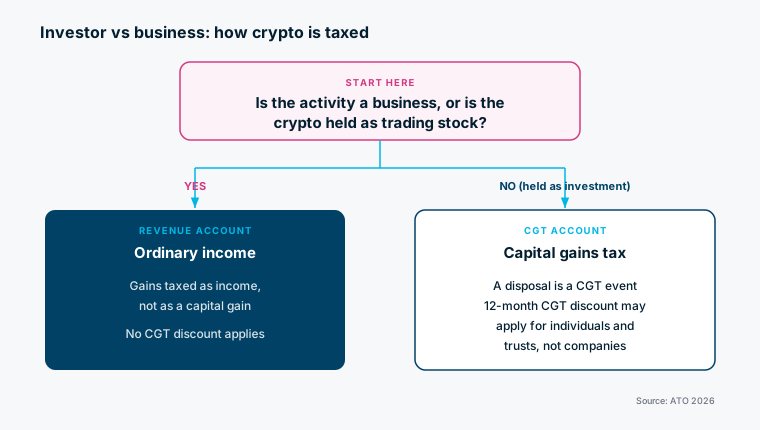
The ATO treats a crypto asset as a CGT asset. For someone holding crypto as an investment, a disposal triggers a capital gains tax event, and the gain or loss is worked out the same way it would be for any other CGT asset.[1] Where the activity is a business or the crypto is trading stock, the same coins are taxed on revenue account as ordinary income instead.[2] The Digital Assets Framework, which received Royal Assent on 8 April 2026 and commences on 9 April 2027, regulates platforms and conduct under the Corporations Act. It does not change any of this. Tax treatment stays governed by the income tax law and ATO guidance.[9][10]
For accountants and tax advisers, the ATO crypto tax position has been settled for several years. The work is matching each client’s activity to the right account, capital or revenue, and holding the records that let the calculation stand up.
Key takeaways on ATO crypto tax
- The ATO treats crypto as a CGT asset. For an investor, a disposal is a CGT event, and the same crypto tax rules apply as for any other CGT asset.[1]
- Disposal is broader than selling for cash. Exchanging one crypto for another and using crypto to pay for goods or services are both disposals.[1]
- Business or trading activity sits on revenue account. Where crypto is trading stock or the activity is a business, gains are ordinary income, not capital.[2]
- Staking rewards and airdrops are generally ordinary income at their AUD market value when received, separate from any later CGT on disposal.[5]
- The 50% CGT discount is being replaced. From 1 July 2027 a 2026-27 Budget measure (before Parliament, not yet law) replaces it for individuals, trusts, and partnerships with cost-base indexation plus a 30% minimum tax, and it applies to crypto; SMSFs and companies are excluded.[4]
- The Digital Assets Framework does not change crypto tax. The Framework is a separate Corporations Act regime; the CGT discount change above comes from the income tax law, not the Framework.[9][4]
Is crypto a CGT asset or income?
A crypto asset is a CGT asset, and for most individual holders the answer is CGT.[1] The ATO treats crypto held as an investment the same way it treats other CGT assets: a disposal is a CGT event, and the capital gain or loss is the difference between the proceeds and the cost base. The account changes only where the activity is a business or the crypto is held as trading stock, in which case the gains are ordinary income on revenue account.[2]
The line between investor and business turns on the nature of the activity, not on volume alone. An investor acquires crypto to hold for capital growth or to dispose of from time to time. A business buys and sells with the repetition, system, and commercial intent of trading, or holds crypto as stock in a crypto-related enterprise. Where the activity is on revenue account, the discount described below does not apply and the gains are assessed as ordinary income.
The distinction carries through to losses. A capital loss can offset capital gains but not other income, while a revenue loss from a genuine business is treated differently again. Characterising the activity correctly at the start of the engagement decides which set of crypto tax rules runs for the whole file.
What counts as a disposal for CGT?
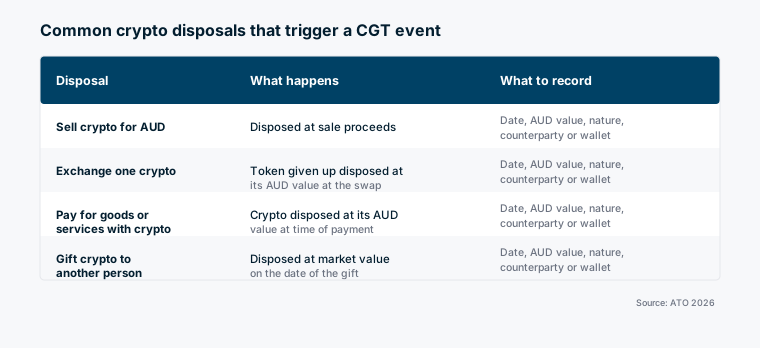
A disposal is any event where the holder stops being the owner of the crypto, and it covers more than selling for Australian dollars.[1] Selling crypto for AUD is a disposal. Exchanging one crypto for another is a disposal of the crypto given up. Using crypto to pay for goods or services is also a disposal. Each of these triggers a CGT event, and each needs the gain or loss calculated at the AUD value at the time.
The crypto-to-crypto point is the one clients miss most often. Swapping one token for another feels like moving a position around rather than realising it, but for CGT it is a disposal of the first token at its market value in AUD at the moment of the swap, even though no Australian dollars changed hands. A client who trades actively across pairs can generate a long list of CGT events without ever withdrawing cash.
Paying for goods or services with crypto sits in the same category. The crypto used to make the payment is disposed of at its AUD value at the time, and any gain on it from the original cost base is a capital gain. The personal use asset rules described below can affect this in narrow cases, but the default treatment for crypto held as an investment is that spending it is a disposal.
For the detailed mechanics of each CGT event and how the cost base is built, the companion piece goes deeper. CGT events framework
How does the CGT discount apply to crypto?
A capital gain on a crypto asset held for more than 12 months may qualify for the CGT discount, in the same way as for other CGT assets.[3] The discount is available to individuals and trusts and is not available to companies.[3] The holding period runs from the day after acquisition to the date of the CGT event, and the asset must have been held for more than 12 months for the gain to be discounted.
The discount applies to the gain, not to the activity, so it follows the capital characterisation. Where the crypto is held on revenue account because the activity is a business or the crypto is trading stock, the gains are ordinary income and the discount does not apply at all.[2] The same client can hold some crypto as a long-term investment and trade other crypto as a business, and the two parcels are treated separately.
For a client with frequent crypto-to-crypto activity, the 12-month test is worth tracking parcel by parcel. Each swap resets the holding period for the new token acquired, so a position that looks long-held in aggregate can be a series of short-held parcels once the swaps are unpacked. The transaction record is what makes that visible.
Is the CGT discount changing?
Yes, for individuals, trusts, and partnerships. The 2026-27 Federal Budget announced that the 50% CGT discount will be replaced from 1 July 2027 with a discount based on inflation, together with a minimum 30% tax on the gain.[4] Under the announced model the cost base is uplifted by CPI over the holding period, so only the real gain above inflation is taxed, and the effective rate on that real gain cannot fall below 30%. The change applies to most asset classes, including crypto held as an investment.[4]
The measure was introduced to Parliament on 28 May 2026 and is not yet law as at June 2026. As drafted it applies to gains arising after 1 July 2027, with proposed transitional rules for assets held across that date: a time-apportionment method, or a market valuation at 1 July 2027, to split the gain between the old and new systems.[4] Until it passes, the current 50% discount continues to apply.
Two groups sit outside the new regime. Superannuation funds, including SMSFs, and companies retain their existing CGT settings.[4] For an accountant, that means a client holding crypto personally faces a different forward position from the same client holding crypto through an SMSF, which is one more reason the holding structure is worth getting right. The detailed CGT mechanics are covered in the companion piece. CGT events framework
How are staking rewards and airdrops taxed?
Staking rewards and airdrops are generally ordinary income, assessable at their AUD market value at the time they are received.[5] This sits separately from the CGT treatment of the underlying crypto. The income is recognised when the reward or airdrop is received, and then the crypto received takes a cost base equal to that AUD value for any later disposal.
The two-step pattern is where errors appear. A client who receives staking rewards records income at the market value on receipt, and that same value becomes the cost base. When the client later disposes of those coins, the CGT calculation runs off that cost base, so the income already recognised is not taxed a second time on disposal. Missing the first step understates income; missing the cost base on the second step overstates the later capital gain.
For airdrops the same logic applies in most cases: market value at receipt is ordinary income, and that value sets the cost base.[5] The AUD value at the moment of receipt is the figure that has to be captured, which is one more reason contemporaneous records matter for crypto tax.
Does the personal use asset exemption apply to crypto?
The personal use asset exemption is narrow and generally does not apply to crypto held for investment.[6] It can apply where crypto is acquired and used to buy personal items, subject to a cost-base threshold, but the ATO reads the exemption tightly. Crypto acquired and held to make a capital gain, or held as part of a profit-making plan, is not a personal use asset, and the way the crypto is kept and used over time bears on the question more than the holder’s stated intention.
The threshold and the scope are the two points to check before relying on the exemption. A capital gain on a personal use asset is disregarded only where the asset was acquired for $10,000 or less, and the exemption falls away once the crypto is held for investment rather than for personal consumption.[6] The gain-disregard rule and the $10,000 threshold sit in section 118-10(3) of the Income Tax Assessment Act 1997; section 108-20, which defines a personal use asset, disregards capital losses on such assets rather than gains.[6] For most clients holding crypto as part of a portfolio, the exemption is not in play, and treating a disposal as exempt on a personal-use basis is a position that needs to be supported carefully.
This is general information, not advice on any client’s circumstances. Whether the exemption is available in a specific case depends on the facts and on the current ATO guidance, which is the kind of question that warrants checking before a return is lodged.
How is GST treated on digital currency?
Since 1 July 2017, digital currency is treated like money for GST, so buying or selling digital currency is not subject to GST.[7] The amendment to the GST law removed the earlier double-GST problem, where digital currency was treated as property and a transaction could be taxed both on the purchase of goods and on the currency used to pay for them. From that date, supplying or acquiring digital currency in exchange for goods, services, or money is not a taxable supply for GST.[7]
The GST position is separate from the income tax and CGT treatment. A transaction that is outside GST on the digital-currency leg can still be a CGT event for income tax, and a business dealing in crypto still accounts for GST on its taxable supplies in the ordinary way. The 2017 change addresses the GST treatment of the digital currency itself, not the broader tax characterisation of what the client is doing with it.
For clients running crypto-related enterprises, the GST analysis turns on what is being supplied, and it sits inside the general GST rules rather than a crypto-specific regime.
What records does the ATO expect for crypto tax?
The ATO expects a record of every transaction, capturing the date, the AUD value, the nature of the transaction, and the counterparty or wallet.[8] That record set is what supports both the CGT calculations and any income recognised on staking or airdrops. It needs to be kept contemporaneously, because reconstructing AUD values at the moment of each historical transaction is difficult once the year has closed.
The recurring problem is active crypto-to-crypto trading. A client who moves across many pairs generates a CGT event on each swap, and matching each on-chain movement to its AUD value at the time is a substantial task if it is left to year end. A feed or process that captures each event as it happens turns the year-end job into reconciliation rather than reconstruction.
The same record set answers most of the ATO’s questions at once. It shows what was held, when it was disposed of, the AUD value at the time, and how each gain, loss, or item of income was worked out. One complete transaction ledger does most of the crypto tax compliance work for the file. SMSF holdings carry their own document requirements on top of this. SMSF crypto ATO checklist
Does the Framework change how crypto is taxed?
No. The Digital Assets Framework is a Corporations Act and ASIC regime, and it does not change the income tax or CGT treatment of digital assets, which stay governed by the ITAA and ATO guidance.[9] The Framework received Royal Assent on 8 April 2026 and commences on 9 April 2027, when it regulates how platforms operate and how digital assets are held and dealt with.[10] What it regulates is the platform and the conduct, not the tax.
For an accountant, the practical effect on the day the Framework commences is continuity. A disposal is still a CGT event, business activity is still on revenue account, staking is still income, and the records the ATO expects are unchanged. The Framework adds a licensing and conduct layer over the platforms clients use, without touching the tax calculations the accountant runs.
The separate point worth holding alongside this is that tax law is not frozen just because the Framework leaves it alone. The 2026-27 Budget’s CGT discount reform, covered above, changes how a long-held capital gain is taxed for individuals, trusts, and partnerships from 1 July 2027.[4] That change comes from the income tax law, not the Framework, and the two should not be conflated: the Framework does not touch tax, while tax itself is set to change on a separate timetable.
The fuller treatment of the Framework and what it does and does not affect sits in the pillar. Digital Assets Framework field guide
Common questions
Does the ATO treat crypto as money or as an asset for income tax?
For income tax, the ATO treats crypto as a CGT asset, not as money.[1] A disposal of crypto held as an investment is a CGT event. The separate treatment of digital currency as money applies to GST, not to income tax, and dates from 1 July 2017.[7]
Is swapping one crypto for another a taxable event?
Yes. Exchanging one crypto for another is a disposal of the crypto given up and triggers a CGT event, even though no Australian dollars are involved.[1] The gain or loss is worked out on the AUD value of the crypto disposed of at the time of the swap.
When is crypto taxed as income rather than capital gains?
Where the activity is a business or the crypto is held as trading stock, gains are assessed on revenue account as ordinary income rather than under CGT.[2] The distinction turns on the nature and intent of the activity, not on transaction volume alone. An investor holding for capital growth is generally on capital account.
Can crypto qualify for the CGT discount?
A capital gain on crypto held for more than 12 months may qualify for the CGT discount, which is available to individuals and trusts and not to companies.[3] The discount applies only where the gain is on capital account. Where the crypto is on revenue account because the activity is a business, the discount does not apply.[2]
How are staking rewards and airdrops taxed?
Staking rewards and airdrops are generally ordinary income, assessable at their AUD market value when received.[5] That same value becomes the cost base of the crypto received, which is then used for any later CGT calculation on disposal.
Is there GST on buying or selling crypto?
No. Since 1 July 2017, digital currency is treated like money for GST, so buying or selling digital currency is not subject to GST.[7] This removed the earlier double-GST problem. The GST treatment is separate from the income tax and CGT position.
What records does the ATO expect for crypto transactions?
A record of every transaction showing the date, the AUD value, the nature of the transaction, and the counterparty or wallet.[8] The records should be kept contemporaneously, because AUD values at the time of each transaction are hard to reconstruct after the year has closed.
Does the Digital Assets Framework change crypto tax?
No. The Framework is a Corporations Act and ASIC regime regulating platforms and conduct, and it does not change the income tax or CGT treatment of digital assets.[9] Tax stays governed by the ITAA and ATO guidance before and after the Framework commences on 9 April 2027.[10]
- ATO, “Crypto asset investments”: ATO guidance on crypto as a CGT asset, disposals, the investor-versus-business distinction, staking and airdrops, the personal use asset rules, and record-keeping.
- Income Tax Assessment Act 1997 (Cth), Division 115: the CGT discount for assets held more than 12 months by individuals and trusts.
- Income Tax Assessment Act 1997 (Cth), s 118-10(3) and s 108-20: the personal use asset gain disregard ($10,000 threshold) and the definition of a personal use asset.
- A New Tax System (Goods and Services Tax) Act 1999 (Cth), digital-currency amendment effective 1 July 2017: digital currency treated like money for GST.
- Australian Government, Budget 2026-27 tax reform and ATO, “Reforming negative gearing and capital gains tax”: the announced replacement of the 50% CGT discount from 1 July 2027 (before Parliament, not yet law).
- ASIC, “ASIC’s roadmap for digital assets law reform implementation”, 20 April 2026: Digital Assets Framework Royal Assent and commencement timing.
Where to start
Alpha Node is the regulated digital asset infrastructure layer Australian advice and accounting practices partner with: execution, custody, wholesale funds management, wholesale advice, and commercial lending.[11] Practices engage the digital asset market without building the stack themselves.
If you advise clients with digital asset holdings and want custody and reporting that produces a clean transaction record at year end, the appropriate next step is a conversation.
Sources
- ATO, “Crypto asset investments”. Guidance that crypto assets are CGT assets, that a disposal triggers a CGT event, and that disposal includes selling crypto for AUD, exchanging one crypto for another, and using crypto to pay for goods or services. https://www.ato.gov.au/individuals-and-families/investments-and-assets/crypto-asset-investments ↩
- ATO, “Crypto asset investments” / business-versus-investor guidance. Where crypto is held as trading stock or the activity is a business, gains are assessed on revenue account as ordinary income rather than as capital. https://www.ato.gov.au/individuals-and-families/investments-and-assets/crypto-asset-investments ↩
- Income Tax Assessment Act 1997 (Cth), Division 115. A capital gain on a CGT asset held for more than 12 months may qualify for the CGT discount; the discount is available to individuals and trusts and is not available to companies. https://www.ato.gov.au/individuals-and-families/investments-and-assets/capital-gains-tax/cgt-discount ↩
- 2026-27 Federal Budget capital gains tax reform, introduced to Parliament on 28 May 2026 (Treasury Laws Amendment (Tax Reform No. 1) Bill 2026; Income Tax Rates Amendment (Tax Reform No. 1) Bill 2026); not yet law as at June 2026. From 1 July 2027 the 50% CGT discount is replaced for individuals, trusts, and partnerships with cost-base indexation (CPI uplift of the cost base) plus a minimum 30% tax on the real gain, applying to most asset classes including crypto; superannuation funds (including SMSFs), companies, and life insurance companies are excluded and retain existing CGT settings. Applies to gains arising after 1 July 2027, with proposed transitional rules. Australian Government, Budget 2026-27 (https://budget.gov.au/content/04-tax-reform.htm); ATO, “Reforming negative gearing and capital gains tax” (https://www.ato.gov.au/about-ato/new-legislation/in-detail/individuals/tax-reform-boosting-home-ownership-reforming-negative-gearing-and-capital-gains-tax); Baker McKenzie, “Budget Bites: CGT Discount and Negative Gearing” (https://www.bakermckenzie.com/en/insight/publications/2026/05/australia-budget-bites-cgt-discount-and-negative-gearing). ↩
- ATO guidance on staking rewards and airdrops. Staking rewards and airdrops are generally ordinary income, assessable at their AUD market value when received; that value becomes the cost base of the crypto received for any later CGT event. https://www.ato.gov.au/individuals-and-families/investments-and-assets/crypto-asset-investments ↩
- ATO “personal use asset” guidance; Income Tax Assessment Act 1997 (Cth), s 118-10(3) (a capital gain on a personal use asset is disregarded where the asset was acquired for $10,000 or less) and s 108-20 (defines a personal use asset and disregards capital losses on such assets). The exemption is narrow and generally does not apply to crypto held for investment. https://www.ato.gov.au/individuals-and-families/investments-and-assets/crypto-asset-investments ↩
- A New Tax System (Goods and Services Tax) Act 1999 (Cth), digital-currency amendment; ATO GST and digital currency guidance. Since 1 July 2017, digital currency is treated like money for GST, so buying or selling digital currency is not subject to GST, removing the earlier double-GST problem. https://www.ato.gov.au/businesses-and-organisations/gst-excise-and-indirect-taxes/gst/in-detail/your-industry/financial-services-and-insurance/gst-and-digital-currency ↩
- ATO crypto record-keeping guidance. The ATO expects a record of every transaction, including the date, the AUD value, the nature of the transaction, and the counterparty or wallet. https://www.ato.gov.au/individuals-and-families/investments-and-assets/crypto-asset-investments ↩
- The Digital Assets Framework operates under the Corporations Act 2001 (Cth) as administered by ASIC; it regulates digital asset platforms and conduct, not taxation. The income tax and CGT treatment of digital assets remains governed by the Income Tax Assessment Acts and ATO guidance and is not changed by the Framework. ↩
- ASIC, “ASIC’s roadmap for digital assets law reform implementation”, 20 April 2026. The Digital Assets Framework received Royal Assent on 8 April 2026 and commences on 9 April 2027. https://www.asic.gov.au/about-asic/news-centre/news-items/asic-s-roadmap-for-digital-assets-law-reform-implementation/ ↩
- Alpha Node Global, regulatory authorisations. Alpha Node X Pty Ltd (ACN 689 717 422; AUSTRAC VASP 100903039); Alpha Node Capital Pty Ltd (ACN 603 150 634; AFSL 479974, wholesale clients only; AUSTRAC VASP 100612840-001); Alpha Node Capital Management Pty Ltd (ACN 675 404 047; CAR 1308193 of Alpha Node Capital; AUSTRAC VASP 100895147-001); Alpha Node Advisors Pty Ltd (ACN 154 320 000; AFSL 416956, wholesale clients only; AUSTRAC VASP 100282425-001); Alpha Node Finance Pty Ltd (ACN 675 410 116; Credit Representative 556504 of Fair Loans Foundation Pty Ltd, ACL 378968). https://alphanode.global/regulatory/ ↩