For an SMSF, Framework-compliant custody is an authorised platform (a digital asset platform or tokenised custody platform once those categories commence) that produces auditor-friendly reporting, can demonstrate the fund’s assets are held separately, and supports a defensible valuation at 30 June. Until those categories exist, the same test runs against the existing financial services regime: the platform sits inside an Australian Financial Services Licence, and the fund’s file can prove it.
Key takeaways on Framework-licensed custody for SMSF clients
- The new platform categories, digital asset platforms (DAPs) and tokenised custody platforms (TCPs), commence on 9 April 2027. Until then, the relevant test is whether a platform holds, or has applied for, an Australian Financial Services Licence covering its services.[3][1]
- 30 June 2026 is the date by which digital asset providers must have applied for the relevant licence. The class no-action position attached to ASIC Information Sheet 225 expires the same day.[1][2]
- Platform selection for an SMSF turns on four practical things: separation of fund assets from anyone else’s, reporting an auditor can reconcile, a workable 30 June valuation process, and a custody arrangement that survives the platform failing.
- Tokenised real estate held through an SMSF is governed by the same SIS Act provisions as any other asset: the sole purpose test, the in-house asset cap, the arm’s-length rules, and asset separation. The token wrapper does not change them.[5][6]
- 45% of self-identified SMSF investors already have exposure to Bitcoin and crypto, and audit-friendly reporting (43%) and security (55%) rank among the criteria SMSF investors use to choose a platform.[10]
Most adviser conversations about SMSF crypto custody start in the wrong place. They start with which platform, when the question that decides everything downstream is what the fund’s auditor will be able to see. An SMSF holds assets, values them at 30 June, and submits to an independent annual audit. A platform that cannot support those three things is not a custody solution for an SMSF, regardless of how it markets itself.
This piece is for advisers fielding those conversations, and for dealer groups deciding which platforms to put on an approved list. It covers the path from the existing licence regime into the new DAP and TCP categories, what to ask a platform, how tokenised real estate sits inside the same SIS Act constraints, how reporting and audit fit together, and what to do in the window before the new authorisations exist.
What does Framework-compliant custody actually look like for an SMSF?
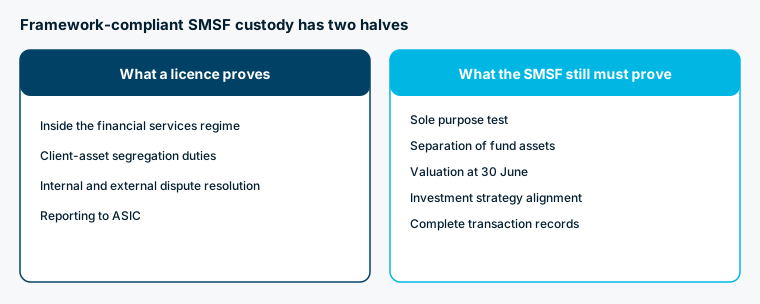
Framework-compliant custody for an SMSF is an authorised platform that can demonstrate three things: the fund’s assets are held separately from the platform’s own and from other clients’, the holdings can be reported in a form the fund’s auditor can reconcile, and there is a process to value the holdings at 30 June. From 9 April 2027, “authorised” means the platform operates as a digital asset platform or a tokenised custody platform under the new categories. A DAP provides services in relation to digital assets that are not themselves financial products. A TCP holds tokens that represent underlying financial products.[4]
Before commencement, the same test runs against the existing regime. The platform either holds an Australian Financial Services Licence covering its services, or has lodged an application for one. That is the gate. The 30 June 2026 deadline is the date by which providers of financial services involving digital asset financial products must apply.[1]
The SIS Act is the other half of the test, and it does not wait for the Framework. A self-managed super fund must be maintained for the sole purpose of providing retirement benefits to members.[5] The fund’s assets must be kept separate from the personal assets of members and trustees.[7] The fund is audited every year by an approved SMSF auditor.[8] A platform can be perfectly licensed and still leave the trustee unable to satisfy any of those obligations. Custody for an SMSF is the intersection of the two: a licensed platform and a fund file that proves separation, valuation, and documentation.
How does a platform get from an AFSL to a DAP or TCP authorisation?
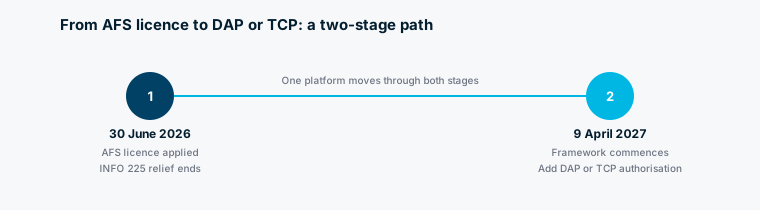
The path is two stages, and the order matters. First, the platform must be inside the existing Australian Financial Services regime. Providers of financial services involving digital asset financial products must have applied for the relevant AFS licence, or a variation to an existing one, by 30 June 2026. On that date the class no-action position attached to ASIC Information Sheet 225 expires, and the existing financial services regime applies in full.[1][2]
Second, from commencement on 9 April 2027, the platform adds the new authorisation. The Corporations Amendment (Digital Assets Framework) Act 2026 creates the DAP and TCP categories, and they take effect from that date under ASIC’s implementation roadmap published on 20 April 2026.[3][4] A platform that lodged an AFS application by the 30 June deadline then lodges a further variation to add the DAP or TCP authorisation once the category is live.
For an adviser or a dealer group, this means a platform’s answer to “are you Framework-ready” should be specific, not aspirational. The right answer in 2026 is some version of “we have lodged, or hold, an AFS licence covering our services, and we intend to apply for the DAP or TCP authorisation from commencement.” A platform that cannot describe where it sits in that sequence has not done the work.
What should an adviser ask a platform before recommending it for an SMSF?
Ask what the auditor will be able to see, before anything about returns or token coverage. The questions that decide whether a platform works for an SMSF are operational, and most of them are about separation and reporting rather than the asset itself.
A workable due-diligence set:
- Licence position. Do you hold an AFS licence covering these services, or have you lodged an application? Do you intend to apply for a DAP or TCP authorisation from 9 April 2027?[1][4]
- Separation. How are an SMSF client’s assets held separately from the platform’s own assets and from other clients’ assets? Can you evidence that separation in a form an auditor can test?[7]
- Reporting. Do you produce holding and transaction reports per fund, including 30 June balances, in a format that reconciles to the fund’s accounting and audit file?
- Valuation. What is your method and source for valuing holdings at 30 June, and is it documented?
- Custody and keys. Who controls the keys or the access credentials, and what happens to the fund’s assets if the platform fails or is wound up?
- Transaction records. Can you provide a complete, exportable record of every acquisition and disposal, with dates and values, for the life of the holding?
Audit-friendly reporting is not a nice-to-have for this audience. When SMSF investors are asked what they look for in a platform, security (55%), tax-and-accounting integrations (45%), and audit-friendly reporting (43%) sit near the top of the list.[10] A platform that cannot answer the reporting and separation questions has failed the test that matters to the fund’s auditor, whatever else it offers.
The auditor’s view of the same records is covered separately in the SMSF auditor’s checklist for digital asset holdings.
Can an SMSF hold tokenised real estate, and what does the SIS Act require?
An SMSF can hold tokenised real estate, but the token wrapper changes nothing about the rules that apply. Tokenisation represents ownership of an asset as a digital token. The asset underneath is still real property, and the fund still has to satisfy the same SIS Act provisions it would for any property holding.
Four provisions do most of the work.
The sole purpose test. The fund must be maintained for the sole purpose of providing retirement benefits to members.[5] A tokenised property the members or a related party use, occupy, or benefit from outside the fund is a sole-purpose problem, exactly as a directly held property would be.
The in-house asset rules. Investments in, or assets leased to, related parties are capped at 5% of the fund’s total assets.[6] If the tokenised structure routes the fund’s investment through a related entity, or the property is leased to a related party, the in-house asset cap applies to that exposure. The token does not exempt it.
The arm’s-length and related-party rules. Acquisitions from related parties are restricted, and dealings must be on arm’s-length terms. A tokenised interest acquired from, or transacted with, a related party is tested the same way a direct interest would be.
Valuation at 30 June. The fund must value the holding for its annual accounts and audit. A tokenised property still needs a defensible valuation method and source at 30 June, and the absence of a liquid market price does not remove the obligation; it makes the valuation method more important.
The practical point for advisers is that “tokenised” is a custody and access characteristic, not a regulatory exemption. The questions a trustee has to answer about a tokenised property are the questions they would answer about any property in the fund, with an added layer about how the token is held and who controls it.
The trustee-level rules for holding crypto directly are covered separately in the guide to holding Bitcoin in an SMSF.
How do reporting and audit fit together for SMSF digital assets?
Reporting is the input; audit is the test the reporting has to survive. Every SMSF is audited each year by an approved SMSF auditor, who covers both the financial statements and the fund’s compliance with the SIS Act.[8] For a digital asset holding, the auditor is looking for the same things they look for in any asset: that it exists, that it belongs to the fund and is held separately, that it is valued correctly at 30 June, and that the transactions are documented.
A platform that produces per-fund reporting makes this straightforward. The auditor can reconcile the platform’s 30 June holding report to the fund’s accounts, trace each transaction to a record, and confirm separation from the platform’s own balance sheet. A platform that produces only a pooled or account-level view, with no clean per-fund export, pushes that reconciliation work onto the accountant and the trustee, and increases the chance the auditor cannot get comfortable.
This is where platform selection and audit outcome connect. The reporting questions in the due-diligence set above are not administrative preferences. They determine whether the fund’s annual audit runs cleanly or generates queries. For SMSFs holding digital assets, the ATO’s existing guidance already addresses the sole purpose test, asset separation, and documentation, and it pre-dates the Framework.[9] The Framework formalises the platform side; the trustee’s obligations were already there.
The full ATO file requirements are covered separately in the SMSF crypto ATO compliance checklist.
What should advisers do in the window before DAP and TCP authorisations exist?
Treat the period before 9 April 2027 as due-diligence time, not a pause. The new categories do not exist yet, so the question for any platform a fund uses, or might use, is where it sits in the existing regime and whether it is on the path to the new one.
Concrete steps for the transition window:
- Map the platforms in use. For any SMSF client already holding digital assets, identify the platform and confirm whether it holds an AFS licence covering its services or has lodged an application by the 30 June 2026 deadline.[1]
- Confirm intent on the new categories. Ask each platform whether it intends to apply for a DAP or TCP authorisation from commencement. A platform with no stated intent is a platform to watch.[4]
- Check the reporting and separation position now. The audit obligations do not wait for the Framework. A fund’s 30 June 2026 audit will test separation, valuation, and records under the existing rules.[7][8]
- Document the basis for using the platform. File a note on why the platform was considered suitable, including its licence position. After 30 June 2026, deferring to the INFO 225 no-action comfort is no longer available, so the file needs to stand on the platform’s actual licence status.[2]
- Plan for the two-stage move. Expect platforms to lodge an AFS application first, then add the DAP or TCP authorisation from 9 April 2027. A platform that has only done the second part, with no underlying licence, has nothing for the new authorisation to attach to.[3]
For dealer groups building an approved list, the same logic applies at scale. A platform’s place on the list should rest on its licence position and its reporting and separation capability, reviewed against the 30 June deadline and the commencement date, rather than on its product range.
Common questions
Is there a Framework-licensed platform for SMSFs available now?
The DAP and TCP categories created by the Corporations Amendment (Digital Assets Framework) Act 2026 commence on 9 April 2027, so no platform holds a DAP or TCP authorisation before that date.[3][4] In the meantime, the relevant question is whether a platform holds, or has applied for, an Australian Financial Services Licence covering its services, which providers must do by 30 June 2026.[1]
Does an SMSF crypto holding still need to be audited the usual way?
Yes. Every SMSF is audited annually by an approved SMSF auditor, covering both the financial statements and SIS Act compliance, and a digital asset holding is part of that audit.[8] The auditor tests existence, ownership, separation, 30 June valuation, and documentation, the same as for any asset.
Can an SMSF hold tokenised real estate?
An SMSF can hold tokenised real estate, subject to the same SIS Act provisions that apply to any property: the sole purpose test, the in-house asset cap on related-party exposure, the arm’s-length rules, and valuation at 30 June.[5][6] Tokenisation changes how the asset is held and accessed, not the rules the fund must satisfy.
What is the difference between a DAP and a TCP?
A digital asset platform (DAP) provides services in relation to digital assets that are not themselves financial products. A tokenised custody platform (TCP) holds tokens that represent underlying financial products.[4] Which one applies depends on what the platform holds for the fund.
How should a platform be valued for the 30 June return?
The fund needs a documented method and source for valuing the holding at 30 June for its accounts and audit. A platform’s per-fund 30 June holding report supports this where the valuation method is clear; for assets without a liquid market price, the valuation method matters more, not less.[8]
What happens to an SMSF’s assets if the platform fails?
This is one of the questions to ask before recommending a platform. The trustee needs to know who controls the keys or access credentials and how the fund’s assets are recovered if the platform is wound up, because the SIS Act requires the fund’s assets to be held separately from anyone else’s.[7]
Does the 30 June 2026 deadline affect SMSF trustees directly?
The 30 June 2026 deadline applies to digital asset providers applying for a licence, not to SMSF trustees.[1] It affects trustees indirectly: after that date, a platform’s licence position is the basis for treating it as suitable, since the INFO 225 no-action comfort that previously covered the gap expires.[2]
Can a dealer group put a digital asset platform on its approved list now?
A dealer group can assess a platform now on its current licence position, its asset-separation arrangements, and its per-fund reporting capability, reviewed against the 30 June 2026 deadline and the 9 April 2027 commencement.[1][3] The platform’s intent to seek a DAP or TCP authorisation from commencement is part of that assessment.
- ASIC, “Deadline looms for digital asset businesses to apply for a licence”, 4 May 2026: the 30 June 2026 AFS licence application deadline.
- ASIC Information Sheet 225, “Digital assets: Financial products and services”: current ASIC guidance and the class no-action position expiring 30 June 2026.
- ASIC, “ASIC’s roadmap for digital assets law reform implementation”, 20 April 2026: commencement on 9 April 2027 and the DAP/TCP timeline.
- Corporations Amendment (Digital Assets Framework) Act 2026: the DAP and TCP categories.
- Superannuation Industry (Supervision) Act 1993: sole purpose test (s 62), in-house asset rules (s 71, s 82), separation of assets (s 52B covenants), annual audit (s 35C).
- ATO, “SMSFs and crypto assets”: the regulator’s existing position on sole purpose, separation, and documentation.
- Independent Reserve Cryptocurrency Index (IRCI) 2026: SMSF exposure and platform-selection criteria.
For the full regulatory picture, see the Digital Assets Framework pillar overview. The provider-side 30 June 2026 licensing deadline is covered separately in the deadline guide.
Alpha Node is the regulated digital asset infrastructure layer Australian advice practices partner with: execution, custody, wholesale funds management, wholesale advice, and commercial lending. The practice keeps the client relationship and the advice; Alpha Node is the infrastructure behind it, not a platform recommended to the trustee.[11]
If you advise SMSF clients and are working out which platforms can stand up to a 30 June audit and the new Framework categories, the appropriate next step is a conversation.
Explore the SMSF Partnership pathway →
Sources
- ASIC, “Deadline looms for digital asset businesses to apply for a licence”, 4 May 2026. https://www.asic.gov.au/about-asic/news-centre/news-items/deadline-looms-for-digital-asset-businesses-to-apply-for-a-licence/ ↩
- ASIC Information Sheet 225, “Digital assets: Financial products and services” (no-action letter dated 29 October 2025; expiry 30 June 2026). https://www.asic.gov.au/regulatory-resources/digital-transformation/digital-assets-financial-products-and-services/ ↩
- ASIC, “ASIC’s roadmap for digital assets law reform implementation”, 20 April 2026. https://www.asic.gov.au/about-asic/news-centre/news-items/asic-s-roadmap-for-digital-assets-law-reform-implementation/ ↩
- Corporations Amendment (Digital Assets Framework) Act 2026; ASIC roadmap, 20 April 2026. Digital asset platforms (DAPs) cover services in relation to digital assets that are not themselves financial products; tokenised custody platforms (TCPs) hold tokens that represent underlying financial products. Categories commence 9 April 2027. https://www.asic.gov.au/about-asic/news-centre/news-items/asic-s-roadmap-for-digital-assets-law-reform-implementation/ ↩
- Superannuation Industry (Supervision) Act 1993 (Cth) s 62 (sole purpose test). https://www.legislation.gov.au/C2004A04633/latest/text ↩
- Superannuation Industry (Supervision) Act 1993 (Cth) s 71, s 82 (in-house asset rules; 5% cap on related-party investments). https://www.legislation.gov.au/C2004A04633/latest/text ↩
- Superannuation Industry (Supervision) Act 1993 (Cth) s 52B(2)(d) (covenant to keep fund assets separate from personal assets); separation-of-assets operating standard in the Superannuation Industry (Supervision) Regulations 1994 (Cth), reg 4.09A. https://www.legislation.gov.au/C2004A04633/latest/text ↩
- Superannuation Industry (Supervision) Act 1993 (Cth) s 35C (annual audit by an approved SMSF auditor covering compliance and financial statements). https://www.legislation.gov.au/C2004A04633/latest/text ↩
- ATO, “SMSFs and crypto assets”. The ATO’s existing position on SMSF crypto, addressing the sole purpose test, asset separation, and documentation; pre-dates the Framework. https://www.ato.gov.au/ ↩
- Independent Reserve Cryptocurrency Index (IRCI) 2026. 45% of self-identified SMSF investors have exposure to Bitcoin and crypto; SMSF platform-selection criteria include security (55%), tax-and-accounting integrations (45%), and audit-friendly reporting (43%). https://www.independentreserve.com/blog/news/australian-independent-reserve-cryptocurrency-index-irci-2026 ↩
- Alpha Node Global, regulatory authorisations. Alpha Node X Pty Ltd (ACN 689 717 422; AUSTRAC VASP 100903039); Alpha Node Capital Pty Ltd (ACN 603 150 634; AFSL 479974; AUSTRAC VASP 100612840-001), wholesale clients only; Alpha Node Capital Management Pty Ltd (ACN 675 404 047; CAR 1308193 of Alpha Node Capital; AUSTRAC VASP 100895147-001); Alpha Node Advisors Pty Ltd (ACN 154 320 000; AFSL 416956; AUSTRAC VASP 100282425-001), wholesale clients only; Alpha Node Finance Pty Ltd (ACN 675 410 116; Credit Representative 556504 of Fair Loans Foundation Pty Ltd, ACL 378968). https://alphanode.global/regulatory/ ↩