
The best interests duty does not change when a client raises digital assets. What changes is the set of facts an adviser must reasonably consider: the platform’s licensing trajectory under the Digital Assets Framework, where the assets sit and who controls them, whether exposure is appropriate for this client, and what the file note records about the conversation.
Key takeaways on best interests duty and digital assets
- The best interests duty under section 961B of the Corporations Act applies the same way to a digital asset enquiry as to any other product enquiry. The Framework does not rewrite it.[1][6]
- The safe-harbour steps in section 961B(2) still set the path: identify the subject matter, inquire into the client’s circumstances, assess your own expertise, investigate the product, and base the advice on that work.[2]
- Platform due diligence is now a best-interests input. After 30 June 2026, an adviser should reasonably check whether a platform has lodged an AFS licence application or sits inside an existing AFSL with the relevant authorisations.[9][6]
- “No recommendation” is a legitimate position. Declining to recommend, and documenting why, can be the appropriate advice under section 961G.[3]
- Declining to engage at all does not remove the issue. The client acts unadvised, and the complexity returns to the practice later with less documentation and less control.
What does the best interests duty require when a client asks about digital assets?
The same thing it requires for any other enquiry. When an adviser gives personal advice, section 961B of the Corporations Act 2001 (Cth) requires the adviser to act in the best interests of the client in relation to that advice, and ASIC’s guidance on how that duty and the related obligations operate is set out in Regulatory Guide 175.[1][7] A client raising digital assets in a review meeting does not create a separate, lighter duty. It brings a new asset class inside the duty the adviser already owes.
What the Digital Assets Framework changes is the factual landscape the adviser reasonably works through, not the obligation itself. The Framework regulates platforms, not individual tokens, and it does not rewrite the best interests duty, the safe harbour, or the Statement of Advice regime.[8][6] So the analysis an adviser runs for a managed fund or a listed security carries over. The facts that fill it in are different: a platform’s licensing position under the Framework, the custody and control arrangement, the client’s suitability for a volatile asset class, and the documentation that records the decision.
This holds whether or not the adviser ends up recommending anything. A client who already holds crypto outside the advice relationship still creates a best-interests question the moment they disclose it and ask what to do.
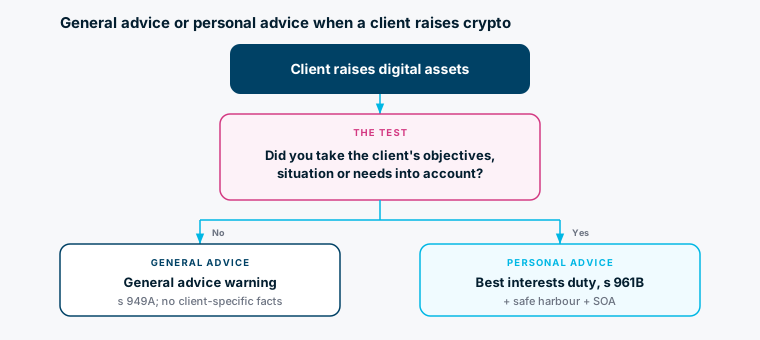
Is it general advice or personal advice when a client raises crypto?
It depends on whether the adviser takes the client’s personal circumstances into account. General advice does not consider the client’s objectives, financial situation, or needs, and it triggers a general advice warning. Personal advice does take those into account, and it triggers a Statement of Advice.[5] The boundary is the same one advisers already manage every day. Digital assets do not move it.
The practical risk is drift. A client asks a general question about Bitcoin. The adviser, knowing the client’s portfolio, risk profile, and retirement timeline, answers in a way that is shaped by those facts. At that point the conversation has likely crossed into personal advice, and the obligations that follow, including the best interests duty and the Statement of Advice, attach.
Two clean positions exist. The adviser can give genuinely general information and flag it as such with the general advice warning, keeping the response free of the client’s specific circumstances. Or the adviser can move deliberately into personal advice and run the full process. The position to avoid is the accidental middle, where the adviser gives what is effectively personal advice while treating it as a casual aside, and the file note does not reflect the duty that was actually engaged.
How do the safe-harbour steps apply to a digital asset enquiry?
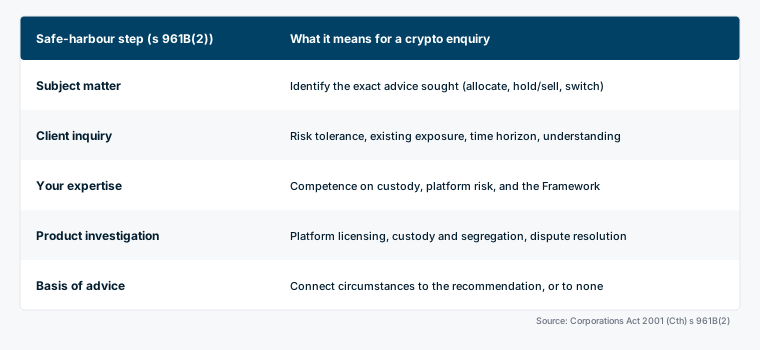
They apply step by step, the same as for any product. Section 961B(2) sets out the steps an adviser can take to show they have met the best interests duty.[2] Applied to a client asking about digital assets, each step has a concrete digital-asset content.
The subject matter step asks the adviser to identify what advice the client is actually seeking. A client wanting a small speculative allocation, a client who has inherited crypto and wants to know whether to hold or sell, and a client asking whether to move existing holdings to a different platform are three different advice questions. Naming the subject matter precisely sets the scope of everything that follows.
The inquiry step asks the adviser to gather the client’s relevant circumstances: risk tolerance for a volatile and still-maturing asset class, existing exposure if any, time horizon, and understanding of what they are holding. Where the holding sits inside an SMSF, additional questions apply that sit outside this article and are covered in separate pieces on holding Bitcoin in an SMSF and on SMSF crypto custody.
The expertise step asks the adviser to assess whether they are competent to advise on the subject matter. Digital assets are a genuine test here. An adviser who does not understand custody, platform risk, and the licensing position under the Framework should either build that competence or decline the subject matter rather than advise outside their knowledge.
The investigation step asks the adviser to investigate the product. For a digital asset enquiry this is where platform due diligence lives: licensing status, custody and segregation arrangements, and dispute resolution. The next section covers this in detail.
The final step asks the adviser to base the advice on the work done in the earlier steps. The reasoning that connects the client’s circumstances to the recommendation, or to the decision not to recommend, is what the file note needs to capture.
Why is platform due diligence a best-interests input?
Because the platform is where the client’s assets sit and who controls them, and the best interests duty requires the adviser to investigate the product before advising on it.[2] With digital assets, the platform is not a neutral conduit. Its licensing status, custody arrangement, and dispute resolution all bear directly on whether exposure through it is in the client’s interest.
Licensing status under the Framework is now part of this. The Digital Assets Framework passed with Royal Assent on 8 April 2026 and commences on 9 April 2027.[8] Before that, ASIC set 30 June 2026 as the date by which providers of financial services involving digital asset financial products must apply for the relevant AFS licence, and the date the INFO 225 class no-action position expires.[9] After 30 June 2026, adviser due diligence reasonably extends to confirming that any platform considered has either lodged an AFS licence application by the deadline or sits inside an existing AFSL with the relevant authorisations. A platform that missed the cliff sits outside the perimeter an adviser should reasonably be recommending. The deadline mechanics sit in a separate piece, and the full regulatory picture sits in the Digital Assets Framework pillar overview.
Custody and control is the second input. Where the assets are held, who holds the keys, and what happens if the platform fails are questions the client usually cannot answer alone. An adviser investigating the product should understand whether client assets are segregated, how they are held, and what recovery looks like in a failure. This is the same enquiry an adviser makes for any custodial arrangement, applied to an asset class where custody failure has a particular history.
Dispute resolution is the third. A platform that holds an AFS licence carries internal and external dispute resolution obligations, including AFCA membership as a condition of its licence. A platform outside the licensing perimeter does not, and that gap is a fact the adviser should weigh and record.
When is “no recommendation” the appropriate position?
When the work points there. Section 961G requires that an adviser only provide advice that is appropriate to the client.[3] Appropriate advice sometimes means advising the client not to proceed, or declining to recommend digital asset exposure at all. Recommending against, with reasons, is advice. It is not a failure to advise.
Several situations point this way. The client’s risk profile may not support exposure to a volatile asset class. The only platform the client wants to use may sit outside the licensing perimeter. The adviser may lack the competence to advise on the subject matter and may reasonably decline it. In each case the appropriate position is a clear “no,” documented with the reasoning that produced it.
There is also the conflict case. Where an adviser’s interests and the client’s interests diverge, section 961J requires the adviser to give priority to the client’s interests.[4] If anything about a digital asset recommendation would benefit the adviser at the client’s expense, priority sits with the client, which may again point to no recommendation.
“No recommendation” is a position, not an absence of one. The distinction matters most in the file note, where a documented decision not to recommend protects the client and the adviser in a way that silence does not.
What documentation does a digital asset conversation need?
A file note that records what was asked, what was considered, and why the adviser landed where they did. The best interests duty and the safe harbour are demonstrated through evidence of the process, and the file is where that evidence lives.[2] A digital asset conversation does not need a heavier standard than other advice. It needs the same discipline applied to facts that are easier to get wrong.
For a personal advice interaction, the Statement of Advice carries the formal record, and that drafting sits in a separate piece on Statements of Advice for digital asset recommendations. For the broader file, the note should capture the subject matter the client raised, the circumstances the adviser inquired into, the platform due diligence undertaken including licensing and custody, the suitability assessment, and the basis for the recommendation or the decision not to recommend. Risk profiling for a volatile asset class deserves its own attention and is covered in a separate piece on digital asset risk profiling.
Where the advice is general, the file should record that the general advice warning was given and that the response was kept free of the client’s specific circumstances.[5] The point of the record is the same in both cases. It shows which duty was engaged and that the adviser met it.
Advisers also operate under the Financial Planners and Advisers Code of Ethics, which sits alongside the statutory duties and reinforces the standard of competence and client-first conduct that a digital asset conversation draws on.[6]
What does it cost to decline to engage?
The issue relocates rather than disappears. A practice that treats digital assets as out of bounds does not stop the client from holding them. The client goes to a platform independently, makes the decision without advice, and brings the holding back to the practice later, usually with less documentation, less structure, and less control over custody and platform choice. 33% of Australians hold cryptocurrency, a record high, so the conversations are already inside most client bases.[10]
This is not an argument for recommending digital assets to any client, let alone every client. Appropriateness governs that, and for many clients the appropriate answer is no.[3] It is an observation that having no process is itself a position, and it tends to produce more operational risk than a considered one. The client who self-directs unadvised carries custody risk, platform risk, and tax complexity that surface in the practice eventually, at a point where the adviser has less to work with.
There were 15,469 financial advisers on the ASIC Financial Advisers Register as at 20 November 2025.[11] Each of them faces the same enquiry the first time a client raises crypto in a review. The choice is not whether to have the conversation. It is whether to have it with a process behind it.
Common questions
Does the best interests duty change because the product is a digital asset?
No. Section 961B of the Corporations Act applies to personal advice regardless of the asset class.[1] The Digital Assets Framework regulates platforms and does not rewrite the best interests duty, the safe harbour, or the Statement of Advice regime.[8][6] What changes is the set of facts the adviser reasonably considers, including platform licensing, custody, and suitability.
When does a crypto conversation become personal advice?
When the adviser takes the client’s objectives, financial situation, or needs into account. At that point personal advice obligations attach, including the best interests duty and the requirement to provide a Statement of Advice.[5] General information that does not consider the client’s circumstances remains general advice and requires a general advice warning.
Do I have to recommend a digital asset platform if a client asks?
No. Section 961G requires only that advice be appropriate to the client.[3] Recommending against exposure, or declining to recommend a particular platform, is a legitimate advice position when the work supports it. The reasoning belongs in the file note.
What platform due diligence does the best interests duty expect?
Investigation of the product is a safe-harbour step, and for a digital asset enquiry the platform is the product context.[2] After 30 June 2026, reasonable due diligence includes confirming the platform has lodged an AFS licence application or holds an existing AFSL with the relevant authorisations, understanding the custody and segregation arrangement, and checking dispute resolution.[9]
Is general advice safer than personal advice for crypto questions?
Neither is inherently safer. Each carries its own obligations: general advice requires a general advice warning, personal advice triggers the best interests duty and a Statement of Advice.[5] The risk comes from giving personal advice while treating it as general, so the duty that was actually engaged is not reflected in the process or the file.
What should the file note record for a digital asset conversation?
The subject matter the client raised, the circumstances inquired into, the platform due diligence undertaken, the suitability assessment, and the basis for the recommendation or the decision not to recommend.[2] Where the advice was general, the note should record that the general advice warning was given.
What happens if I decline to engage with the topic entirely?
The client typically acts unadvised. They self-direct on a platform of their own choosing and return later with the holding, usually with weaker documentation and custody arrangements.[10] Declining to engage does not remove the best-interests question; it removes the adviser’s ability to shape the outcome.
- Corporations Act 2001 (Cth): best interests duty (s 961B), safe harbour (s 961B(2)), appropriate advice (s 961G), priority of client’s interests (s 961J), Statement of Advice and general advice warning (ss 946A, 949A).
- ASIC Regulatory Guide 175: ASIC guidance on the best interests duty and related obligations.
- Financial Planners and Advisers Code of Ethics: professional conduct standard binding advisers, alongside the statutory duties.
- ASIC, “Deadline looms for digital asset businesses to apply for a licence” (4 May 2026): the 30 June 2026 AFS licence application deadline and INFO 225 no-action expiry.
- ASIC’s roadmap for digital assets law reform implementation (20 April 2026): Framework commencement and implementation timeline.
- ASIC INFO 225: current ASIC guidance on digital assets, financial products, and services.
- ASIC Financial Advisers Register: adviser count as at 20 November 2025.
Where to start
Alpha Node is the regulated digital asset infrastructure layer Australian advice practices partner with: execution, custody, wholesale funds management, wholesale advice, and commercial lending. The practice keeps the client relationship and the advice; Alpha Node never advises the client and never assumes the adviser’s best interests duty.[12]
If you are an adviser or principal working out how to handle the first client who raises digital assets, the appropriate next step is a conversation.
Book a partnership conversation →
Sources
- Corporations Act 2001 (Cth) s 961B (best interests duty when giving personal advice). https://www.legislation.gov.au/C2004A00818/latest/text ↩
- Corporations Act 2001 (Cth) s 961B(2) (safe-harbour steps for satisfying the best interests duty). https://www.legislation.gov.au/C2004A00818/latest/text ↩
- Corporations Act 2001 (Cth) s 961G (appropriate advice). https://www.legislation.gov.au/C2004A00818/latest/text ↩
- Corporations Act 2001 (Cth) s 961J (priority of the client’s interests where a conflict arises). https://www.legislation.gov.au/C2004A00818/latest/text ↩
- Corporations Act 2001 (Cth) ss 946A (requirement to give a Statement of Advice for personal advice) and 949A (general advice warning). https://www.legislation.gov.au/C2004A00818/latest/text ↩
- Corporations Act 2001 (Cth) s 961B; Financial Planners and Advisers Code of Ethics. The Digital Assets Framework does not rewrite the best interests duty, the safe harbour, or the Statement of Advice regime; it changes the facts an adviser must reasonably consider. https://www.legislation.gov.au/C2004A00818/latest/text ↩
- ASIC Regulatory Guide 175, “Licensing: Financial product advisers, conduct and disclosure” (ASIC guidance on the best interests duty and related obligations). https://asic.gov.au/regulatory-resources/find-a-document/regulatory-guides/rg-175-licensing-financial-product-advisers-conduct-and-disclosure/ ↩
- Digital Assets Framework: Royal Assent 8 April 2026; commences 9 April 2027. The Framework regulates platforms (digital asset platform and tokenised custody platform categories), not individual tokens. ASIC, “ASIC’s roadmap for digital assets law reform implementation”, 20 April 2026. https://www.asic.gov.au/about-asic/news-centre/news-items/asic-s-roadmap-for-digital-assets-law-reform-implementation/ ↩
- ASIC, “Deadline looms for digital asset businesses to apply for a licence”, 4 May 2026 (30 June 2026 AFS licence application deadline; INFO 225 class no-action position expires 30 June 2026). https://www.asic.gov.au/about-asic/news-centre/news-items/deadline-looms-for-digital-asset-businesses-to-apply-for-a-licence/ ↩
- Independent Reserve Cryptocurrency Index (IRCI) 2026: 33% of Australians hold cryptocurrency, a record high. https://www.independentreserve.com/blog/news/australian-independent-reserve-cryptocurrency-index-irci-2026 ↩
- ASIC Financial Advisers Register snapshot, 20 November 2025 (15,469 relevant providers authorised). https://www.asic.gov.au/regulatory-resources/financial-services/financial-advice/financial-advisers-register/ ↩
- Alpha Node Global, regulatory authorisations. Alpha Node X Pty Ltd (ACN 689 717 422; AUSTRAC VASP 100903039); Alpha Node Capital Pty Ltd (ACN 603 150 634; AFSL 479974; AUSTRAC VASP 100612840-001); Alpha Node Capital Management Pty Ltd (ACN 675 404 047; CAR 1308193 of Alpha Node Capital; AUSTRAC VASP 100895147-001); Alpha Node Advisors Pty Ltd (ACN 154 320 000; AFSL 416956; AUSTRAC VASP 100282425-001); Alpha Node Finance Pty Ltd (ACN 675 410 116; Credit Representative 556504 of Fair Loans Foundation Pty Ltd, ACL 378968). Alpha Node Capital and Alpha Node Advisors authorisations are wholesale-only. https://alphanode.global/regulatory/ ↩