
Adding a digital asset product to a practice’s approved product list is a licensee-governance decision before it is an adviser question. It engages the licensee’s general obligations under section 912A of the Corporations Act, the product-governance and design and distribution obligations where a target market determination applies, and platform due diligence on licensing and custody. None of that work changes the rule underneath it: the best interests duty governs every recommendation regardless of what sits on the approved product list. This article sits within the Digital Assets Framework pillar overview.
Key takeaways on adding digital assets to your approved product list
- An approved product list (APL) is the set of products a licensee permits its advisers to recommend. It is a common licensee governance and supervision tool, not a statutory list, so it is the principal or licensee who owns the decision to add a digital asset product.[1]
- Adding a digital asset product engages the licensee’s section 912A general obligations: adequate resources, organisational competence, and risk management applied to the new product and the platform behind it.[2]
- Where a target market determination applies to the product, the licensee’s design and distribution obligations under Part 7.8A are engaged as part of the inclusion decision.[3]
- Platform due diligence sits inside the inclusion file: licensing position under the Digital Assets Framework, custody and segregation, reporting, and dispute resolution.[8]
- APL inclusion never makes a product appropriate for any particular client. The best interests duty and the requirement to give appropriate advice continue to constrain each adviser’s recommendation.[4][5]
What is an approved product list, and who decides what goes on it?
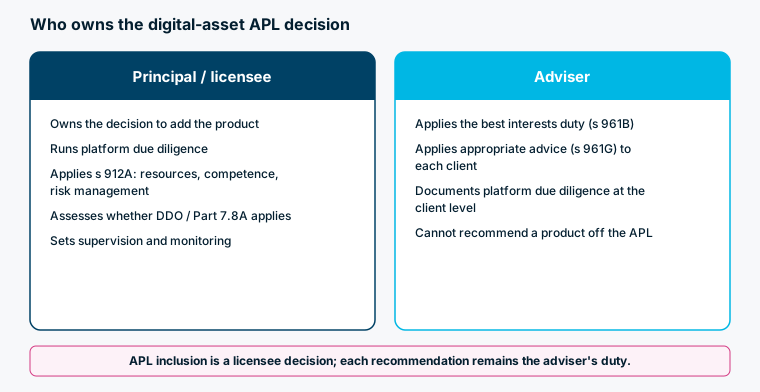
An approved product list is the set of products a licensee permits its advisers to recommend, and the decision to add a product to it sits with the licensee or principal, not the individual adviser. The APL is a common licensee governance and supervision tool rather than a statutory list. The Corporations Act does not require a licensee to keep an APL in those terms, and being absent from an APL is not the same as a product being prohibited by law.[1]
What the APL does is set the boundary inside which advisers operate. A product on the list has been through the licensee’s vetting and ongoing monitoring; a product off the list has not. For digital assets, this is where the governance question lands first. Before any adviser considers whether a digital asset product suits a client, the licensee decides whether the product belongs inside the practice’s supervised set at all.
That separation matters for how a practice approaches digital assets. The adviser-facing question, whether a specific recommendation meets the best interests duty, comes later and sits with the adviser. The adviser-side best interests analysis is covered separately. The inclusion question, whether the product and the platform behind it meet the licensee’s governance standard, comes first and sits with the principal.
What obligations does adding a digital asset product engage?
Adding a digital asset product to the APL engages the licensee’s general obligations under section 912A of the Corporations Act. Those obligations include providing financial services efficiently, honestly and fairly, managing conflicts of interest, maintaining the organisational competence to provide the services, and having adequate resources and risk management arrangements.[2] A new product class brings each of those obligations into the inclusion decision.
Organisational competence is the one digital assets test hardest. A licensee adding a digital asset product needs people who understand custody, platform risk, and the licensing position under the Framework well enough to supervise advice on it. Adequate resources and risk management extend the same way: the systems that monitor advice, record-keeping, and platform exposure have to cover an asset class that behaves differently from listed securities and managed funds.
Where a target market determination applies to the product, the licensee’s design and distribution obligations under Part 7.8A are engaged as part of the inclusion decision.[3] The DDO question is conditional on whether a TMD is required for the particular product. Where it is, the licensee distributing the product takes on the distribution-side obligations that come with it, and the APL inclusion decision has to account for them. Where no TMD applies, the section 912A obligations still govern the inclusion.
A licensee can authorise representatives, including corporate authorised representatives, to provide services on its behalf, and the supervision of those representatives runs through the same obligation set.[6] Adding a digital asset product widens the scope of what the licensee is supervising across its authorised representatives, not only its directly employed advisers.
What goes in the due-diligence file for adding a digital asset platform?
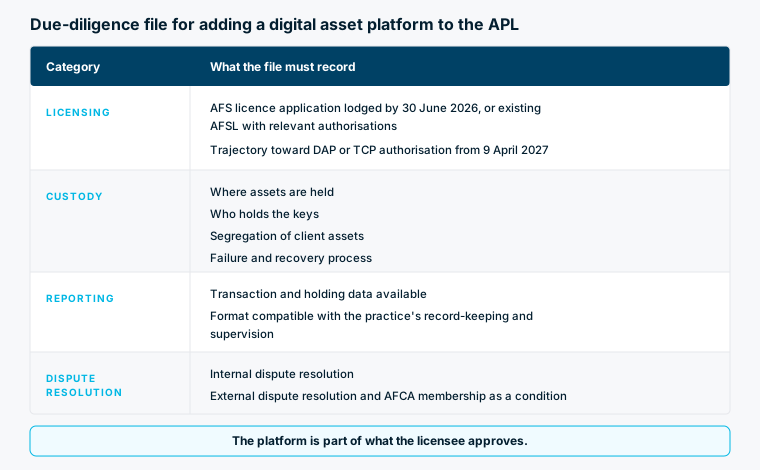
The due-diligence file for adding a digital asset platform to the APL covers the platform’s licensing position, its custody arrangement, its reporting, and its dispute resolution. With digital assets, the platform is where the client’s assets sit and who controls them, so the platform itself is a substantial part of what the licensee is approving.
Licensing position comes first. The Digital Assets Framework received Royal Assent on 8 April 2026 and commences on 9 April 2027, creating two regulated categories: digital asset platforms (DAPs) and tokenised custody platforms (TCPs), both requiring an AFSL from ASIC.[7] Ahead of commencement, ASIC set 30 June 2026 as the date by which providers of financial services involving digital asset financial products must apply for the relevant AFS licence, and the date the INFO 225 class no-action position expires.[8] A licensee vetting a platform for the APL after 30 June 2026 can reasonably check whether the platform has lodged an AFS licence application by the deadline or sits inside an existing AFSL with the relevant authorisations. The deadline mechanics sit in a separate piece. The AFSL requirements for digital asset platforms are covered separately.
Custody and segregation is the second input. Where the assets are held, who holds the keys, and what happens if the platform fails are questions that bear directly on whether the licensee should approve the platform. This is the same custody enquiry a licensee runs for any custodial arrangement, applied to an asset class where custody has a particular failure history. SMSF-held digital assets raise additional custody questions that sit outside this article. SMSF crypto custody is covered separately.
Reporting and dispute resolution round out the file. The licensee needs to know what transaction and holding data the platform produces, since that data feeds the practice’s own record-keeping and supervision. A platform holding an AFS licence carries internal and external dispute resolution obligations, including AFCA membership as a licence condition. A platform outside the licensing perimeter does not, and that gap is a fact the licensee weighs and records.
How does APL inclusion sit alongside the best interests duty?
APL inclusion and the best interests duty operate at different levels and neither replaces the other. The APL is the licensee’s governance boundary; the best interests duty is the adviser’s obligation on each individual recommendation. A product appearing on the APL does not make it appropriate for any particular client.[1][4]
The best interests duty under section 961B requires an adviser giving personal advice to act in the best interests of the client in relation to that advice, and section 961G requires that the advice be appropriate to the client.[4][5] Those obligations run on every recommendation, whether or not the product sits on the APL. A digital asset product can be fully approved at the licensee level and still be the wrong recommendation for a client whose risk profile does not support exposure to a volatile asset class. In that case the appropriate advice is to recommend against, with reasons, and the APL has no bearing on that conclusion.
The relationship runs one way. APL inclusion is a gate the adviser must pass before recommending a product, since an adviser cannot recommend a product the licensee has not approved. It is not a substitute for the best interests analysis that follows. The adviser-side mechanics of that conversation, including platform due diligence at the client level and the file note, sit in a separate piece. The adviser-side best interests analysis is covered separately.
What supervision does a digital asset product on the APL require?
A digital asset product on the APL requires ongoing supervision and monitoring under the same section 912A obligations that governed its inclusion. Adding the product is not a one-time decision. The licensee’s adequate-resources, competence, and risk-management obligations continue for as long as the product stays on the list.[2]
Monitoring covers two moving parts. The first is the platform. Its licensing position can change as it moves through the Framework’s phased licensing path toward a DAP or TCP authorisation from 9 April 2027, and the licensee supervising the product needs to track that trajectory rather than approve it once and stop looking.[7] The second is the advice itself. The licensee monitors how its advisers are recommending the product, whether the recommendations are meeting the best interests duty, and whether the file notes record the reasoning. Where the licensee authorises representatives to provide the service, that monitoring extends across them.[6]
Organisational competence is the obligation that ages fastest with digital assets. The custody arrangements, the platform landscape, and the licensing position under the Framework all keep moving through 2026 and 2027. A licensee that built the competence to add the product needs to keep it current as the regime develops, which is itself part of the section 912A standard.[2]
Common questions
Is an approved product list a legal requirement?
No, not in those terms. An APL is a common licensee governance and supervision tool, the set of products a licensee permits its advisers to recommend. The Corporations Act does not mandate an APL as a statutory list, and a product being absent from an APL is not the same as the product being prohibited by law.[1] The licensee’s governance obligations that an APL helps satisfy, including the section 912A general obligations, are the statutory layer.[2]
Who decides whether a digital asset product goes on the APL?
The licensee or principal. APL inclusion is a licensee-governance decision, not an individual adviser’s call. The principal runs the due diligence, applies the section 912A obligations, assesses whether design and distribution obligations apply, and decides whether the product belongs inside the practice’s supervised set.[2][3] The adviser then works within that boundary on each client recommendation.
Does adding a digital asset product to the APL trigger the design and distribution obligations?
It can. Where a target market determination applies to the product, the design and distribution obligations under Part 7.8A are engaged as part of the inclusion decision.[3] Whether a TMD is required depends on the particular product. Where one applies, the licensee distributing the product takes on the associated distribution obligations. Where no TMD applies, the section 912A obligations still govern the inclusion.[2]
Does putting a digital asset product on the APL mean an adviser can recommend it to any client?
No. APL inclusion is a gate, not a green light for every client. The best interests duty under section 961B and the appropriate-advice requirement under section 961G apply to each recommendation regardless of APL inclusion.[4][5] A product can be fully approved at the licensee level and still be the wrong recommendation for a particular client, in which case recommending against is the appropriate advice.
What platform due diligence should a licensee run before adding a digital asset platform?
The licensee should check the platform’s licensing position, custody and segregation arrangements, reporting, and dispute resolution.[8] After 30 June 2026, the licensing check reasonably includes confirming the platform has lodged an AFS licence application by the deadline or sits inside an existing AFSL with the relevant authorisations.[7] The platform is where client assets sit and who controls them, so it is a substantial part of what the licensee is approving.
What is the difference between the licensee’s responsibility and the adviser’s when adding digital assets?
The licensee owns the inclusion decision and the supervision that follows: due diligence, the section 912A obligations, design and distribution obligations where they apply, and ongoing monitoring.[2][3] The adviser owns the recommendation: applying the best interests duty and appropriate-advice requirement to each client, and documenting the reasoning.[4][5] The licensee decides what can be recommended; the adviser decides whether it should be, for this client.
Does the Digital Assets Framework require a digital asset product to be on an APL?
No. The Framework regulates platforms, not the internal governance tools a licensee uses to supervise its advisers.[7] The APL remains a common licensee practice. What the Framework changes is the factual landscape the licensee works through when vetting a platform: the platform’s licensing position under the new regime becomes part of the due-diligence file.[8]
How often should a licensee review a digital asset product already on the APL?
The section 912A obligations are ongoing, so monitoring continues for as long as the product stays on the list.[2] The platform’s licensing position can change as it moves through the Framework’s phased path toward a DAP or TCP authorisation from 9 April 2027, and organisational competence needs to stay current as the regime develops.[7] A licensee reviews both the platform and the advice being given against it, rather than approving once and stopping.
- Corporations Act 2001 (Cth): licensing requirement (s 911A); general obligations of AFS licensees (s 912A); authorised representatives (Part 7.6); best interests duty (s 961B) and appropriate advice (s 961G); design and distribution obligations (Part 7.8A).
- ASIC Regulatory Guide 175: ASIC guidance on the best interests duty and related obligations, the context in which approved product lists operate as a licensee supervision tool.
- ASIC, “Deadline looms for digital asset businesses to apply for a licence” (4 May 2026): the 30 June 2026 AFS licence application deadline and INFO 225 no-action expiry.
- ASIC’s roadmap for digital assets law reform implementation (20 April 2026): Framework commencement, the DAP and TCP categories, and the phased licensing path.
- ASIC INFO 225: current ASIC guidance on digital assets, financial products, and services.
Where to start
Alpha Node is the regulated digital asset infrastructure layer Australian advice practices partner with: execution, custody, wholesale funds management, wholesale advice, and commercial lending. The practice keeps the client relationship, the advice, and the licensee governance; Alpha Node is the infrastructure behind the product, never the advice-giver and never the licensee’s supervisor.[9]
If you are an adviser or principal working out whether and how to add digital assets to your practice’s approved product list, the appropriate next step is a conversation. Principals weighing the licensee-level decision can start with the Dealer Group pathway.
Book a partnership conversation →
Sources
- An approved product list (APL) is the set of products a licensee permits its advisers to recommend. It is a common licensee governance and supervision tool, not a statutory list; the Corporations Act does not mandate an APL in those terms, and absence from an APL is not a legal prohibition on the product. ASIC Regulatory Guide 175 provides the conduct-and-disclosure context in which APLs operate. https://asic.gov.au/regulatory-resources/find-a-document/regulatory-guides/rg-175-licensing-financial-product-advisers-conduct-and-disclosure/ ↩
- Corporations Act 2001 (Cth) s 912A (general obligations of AFS licensees, including to provide financial services efficiently, honestly and fairly; manage conflicts of interest; maintain organisational competence; and have adequate resources and risk management arrangements). https://www.legislation.gov.au/C2004A00818/latest/text ↩
- Corporations Act 2001 (Cth) Part 7.8A (design and distribution obligations). DDO is engaged where a target market determination is required for the product; whether a TMD applies depends on the particular product. https://www.legislation.gov.au/C2004A00818/latest/text ↩
- Corporations Act 2001 (Cth) s 961B (best interests duty when giving personal advice). APL inclusion does not displace the best interests duty, which applies to each recommendation. https://www.legislation.gov.au/C2004A00818/latest/text ↩
- Corporations Act 2001 (Cth) s 961G (requirement that advice be appropriate to the client). https://www.legislation.gov.au/C2004A00818/latest/text ↩
- Corporations Act 2001 (Cth) Part 7.6 (a licensee may authorise representatives, including corporate authorised representatives, to provide financial services on its behalf; the licensee remains responsible for supervising those representatives). https://www.legislation.gov.au/C2004A00818/latest/text ↩
- Digital Assets Framework: Royal Assent 8 April 2026; commences 9 April 2027. The Framework creates two regulated categories, digital asset platforms (DAPs) and tokenised custody platforms (TCPs), both requiring an AFSL from ASIC, and regulates platforms rather than individual tokens. ASIC, “ASIC’s roadmap for digital assets law reform implementation”, 20 April 2026. https://www.asic.gov.au/about-asic/news-centre/news-items/asic-s-roadmap-for-digital-assets-law-reform-implementation/ ↩
- ASIC, “Deadline looms for digital asset businesses to apply for a licence”, 4 May 2026 (30 June 2026 AFS licence application deadline; INFO 225 class no-action position expires 30 June 2026). https://www.asic.gov.au/about-asic/news-centre/news-items/deadline-looms-for-digital-asset-businesses-to-apply-for-a-licence/ ↩
- Alpha Node Global, regulatory authorisations. Alpha Node X Pty Ltd (ACN 689 717 422; AUSTRAC VASP 100903039); Alpha Node Capital Pty Ltd (ACN 603 150 634; AFSL 479974; AUSTRAC VASP 100612840-001); Alpha Node Capital Management Pty Ltd (ACN 675 404 047; CAR 1308193 of Alpha Node Capital; AUSTRAC VASP 100895147-001); Alpha Node Advisors Pty Ltd (ACN 154 320 000; AFSL 416956; AUSTRAC VASP 100282425-001); Alpha Node Finance Pty Ltd (ACN 675 410 116; Credit Representative 556504 of Fair Loans Foundation Pty Ltd, ACL 378968). Alpha Node Capital and Alpha Node Advisors authorisations are wholesale-only. https://alphanode.global/regulatory/ ↩