Bitcoin Holds 60K Through Record Outflows
26th November 2026 • 9 mins read
This Week’s Recap
- Bitcoin falls below $58,000 as CoinShares’ Butterfill sees ‘tail end of the bear market’: The head of research frames the decline as a 411-day cyclical retracement rather than a new regime. The test of that view is whether $55,000 holds on a weekly close, because the realised price sits near $53,200 and leverage cascades below it.
- Bitcoin drops as November spot ETF outflows increase to record $4.71 billion: The previous monthly record was $4.51 billion in June. Thirteen of the last fourteen sessions have been negative, and the one inflow was $8.0 million into the complex on 16 November.
- US inflation rises to 3.8% ahead of December Fed meeting, clouding crypto outlook: October core PCE reached 3.3% against 3.2% expected. With futures at 97% for a quarter point rise on 9 December, the argument in the market is about whether the committee moves 25 or 50 basis points, not whether it moves.
- Bitcoin’s drop to $55,000 left a record 11.6 million BTC underwater: More coins are now held below their purchase price than at any point in the cycle. That is supply that becomes resistance on every rally, because the first job of an underwater holder is to get out at cost.
- JPMorgan says bitcoin’s correction widens the gap to an $86,000 production cost: The bank puts the average cost of production near $86,000 against a spot price 30% below it. Miners either sell treasury coins or switch off, and CleanSpark’s $987 million annual loss shows which one they chose.
- BlackRock’s IBIT loses a record $541 million in a single day: The largest bitcoin fund carried the heaviest single session of the month on 20 November, the same day bitcoin made its $55,130 low. Concentration cuts both ways: the fund that took the most in 2024 is now the marginal seller on the way out.
- Ethereum’s next big upgrade is pushed into 2027 by apps it would break: Developers settled on mid-January 2027 as the earliest mainnet date if the specification stands, with a Hoodi rehearsal pencilled in for the week of 14 December. Four client teams backed proceeding without changes, Erigon wanted the rules rewritten, and Besu accepted them reluctantly.
- Ethereum wallets holding $72 billion of ETH are under threat of a future quantum attack: About 42 million ether sits in accounts that have already published their public keys through a transaction. No machine can run the attack today, but the proof of ownership problem starts the moment one can.
- Ethereum Foundation doubles its protocol security team: The foundation is hiring against both AI-assisted auditing and post-quantum migration, and it has budgeted for the second because the first keeps finding work. The Glamsterdam delay is the same signal from the other direction.
- French Senate blocks new crypto tax and wallet list critics called a kidnapping risk: Lawmakers rejected an amendment that would have required holders of self-custody wallets above EUR100,000 to declare them. The security argument won: a register of who holds what is a target list before it is a tax tool.
- Ukraine passes crypto market law, with a $332 million revenue target: Parliament set a 23% tax rate on digital asset gains and a target of 15 billion hryvnias for the budget. A war economy legitimising a market it needs to tax is the fastest route to formal custody and reporting.
- South Korea proposes ending its 2017 ICO ban: The proposal would let issuers raise from domestic investors under disclosure rules rather than forcing them offshore. Nine years of prohibition produced the opposite of its aim, with Korean projects listing in Singapore and Zug.
- BlackRock launches tokenised money market fund accepting stablecoins in Hong Kong: The fund opened with $100 million, Standard Chartered as custodian and Ant International as a distribution partner. A cash fund that accepts stablecoin subscriptions is a bank deposit with a different legal wrapper.
- Italy’s UniCredit launches a six-year bitcoin certificate with 100% capital protection and a 65% cap: The note reaches roughly 8 million retail clients and returns the first 65% of any bitcoin gain. Banks are now packaging the asset for depositors who would never open an exchange account, and taking the excess return as the fee.
- BTCS offloaded more than half its ether to settle $43.8 million in Aave debt: The company had already told the SEC that a $54 million Aave loan could be liquidated. Selling the collateral before the lender does is the difference between a loss and a forced sale at whatever the market offers.
- Bit Digital repays $50 million to Galaxy after selling 29,825 ether: The treasury company cleared a secured loan with the proceeds of a single block of coins. BitMine’s holdings of 6,085,564 ether lost $655 million of value in a week, which is nearly three years of projected staking revenue.
- Binance hackers push $247 million through transactions designed to cloud the source: North Korean operators moved the proceeds of crypto’s largest theft through bridges, mixers and coinjoins, with $149 million of bitcoin laundered through coinjoins alone. Binance holds a $6.5 billion freezing order and prosecutors are pursuing $1.1 billion of USDC.
Bitcoin Market Analysis
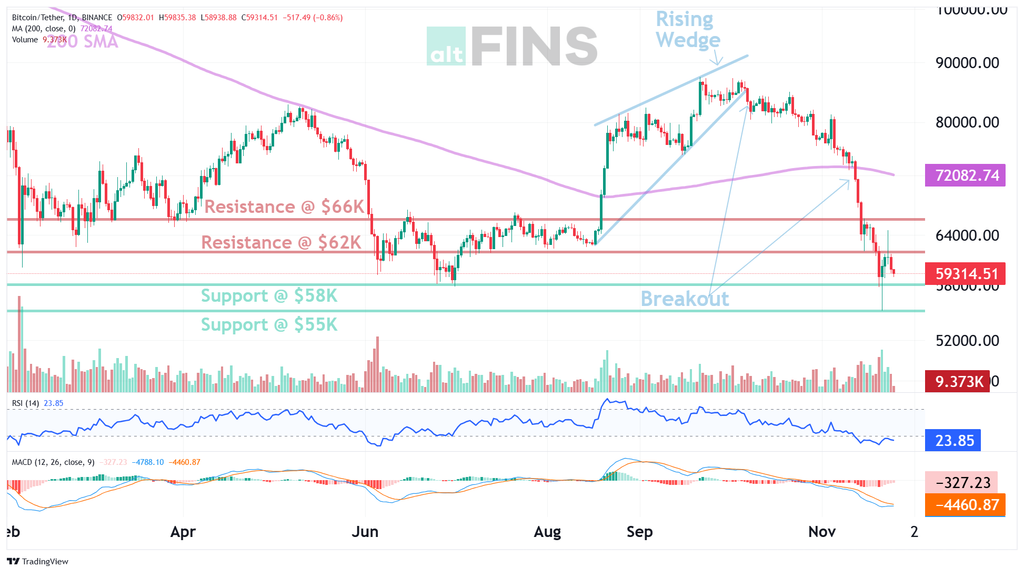
Bitcoin spent the week failing to hold a bid above $60,000. It opened at $61,987 on 20 November, fell 4.90% that session to $58,952, and made the low of $55,130 on 21 November before recovering to $60,216. Two positive sessions took it to a high of $64,603 on 23 November, but the close that day was unchanged at $61,271, which is what a rally looks like when it is being sold into. The 24 November session lost 2.35% to $59,832, and the week finished at $60,458. Volume ran $2.82 billion on the reversal day and $1.22 billion on the quietest session.
Source: https://altfins.com/technical-analysis
Momentum has stopped deteriorating without turning. RSI-14 reads 21.7 and RSI-9 28.4, both still in oversold territory, and the MACD line at minus 4,558.21 sits $92.35 below its signal, a gap narrow enough that a flat week would close it. ATR-14 of $3,310 puts an ordinary day at 5.5% of the price, the Bollinger range of $54,347 to $77,704 leaves the close 10% above the lower band, and a stochastic reading of 32.5 says the last fortnight has been sold in steps rather than in one flush. AltFins reads the pattern as an approach to resistance after a bearish break from a rising wedge.
Every average above the price is now resistance, and the order of them matters. Bitcoin trades 0.34% below its five-day average at $60,657 and 1.29% below the ten-day at $61,245, so the short averages are within reach. The twenty-day at $66,026 is 8.44% away, the fifty-day at $74,779 is 19.16%, and the 200-day at $71,979 is 16.01%, which is the level that would have to fall for the downtrend to end. AltFins puts resistance at $62,000, then $66,000, and support at $58,000, then $55,000.
Source: https://sosovalue.com/assets/etf/us-btc-spot
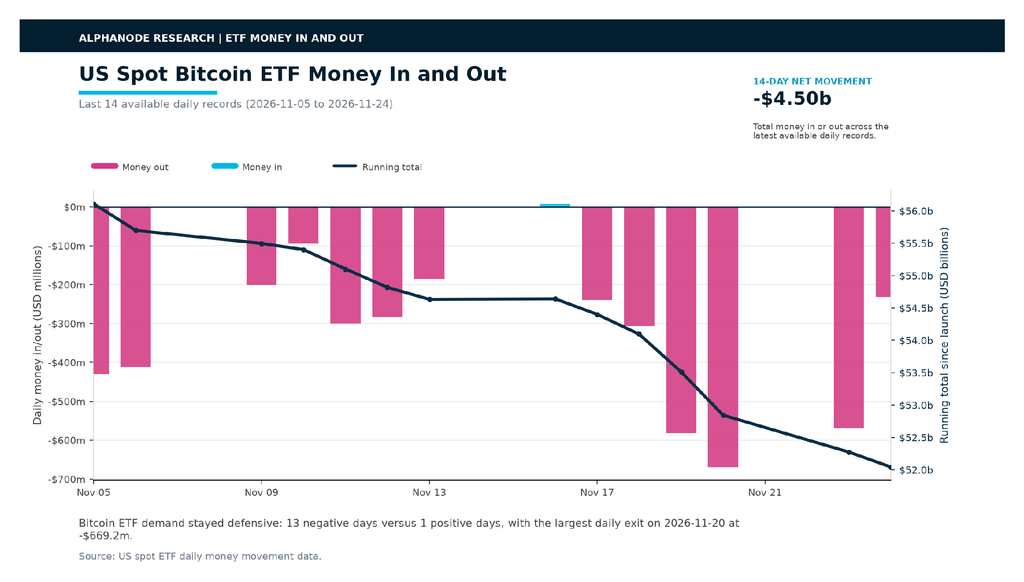
The funds have become the supply. Across the fourteen settled sessions to 24 November, United States spot bitcoin funds are net minus $4.50 billion, one positive day against thirteen negative, and net assets fell to $72.01 billion from $96.65 billion at the start of that window. The heaviest exits were $669.2 million on 20 November, $582.2 million on 19 November and $569.7 million on 23 November, and the only inflow was $8.0 million on 16 November. November’s total of $4.71 billion is the largest month on record, beating June’s $4.51 billion. Cumulative inflows since launch are still $52.04 billion, so the wrapper has given back a quarter of its assets without yet returning a dollar of principal.
The macro calendar did the rest. Core inflation rose to 3.8%, October core PCE printed 3.3% against 3.2% expected, and the White House proposed tariffs on 14 trading partners. Futures put a quarter point rise at 97% for the 8 and 9 December meeting, which is an odd shape for a risk asset: the market is not debating direction, only pace. The Summary of Economic Projections on 9 December will set the 2027 path bitcoin has been trading against all quarter.
The corporate bid is smaller than it was. Strategy bought another 457 bitcoin for about $30 million and widened its buyback authorisation, which is a fraction of the pace it set through 2025, and MSCI removes it from its global indexes after 30 November. BTCS sold more than half its ether to settle an Aave loan, and JPMorgan’s $86,000 production cost estimate means the mining complex is unprofitable at spot. The levels that matter are $58,000, which held twice this week, then $55,130 and the realised price near $53,200 behind it. A close above $66,026 would be the first evidence that the sellers have finished.
Ethereum Market Analysis
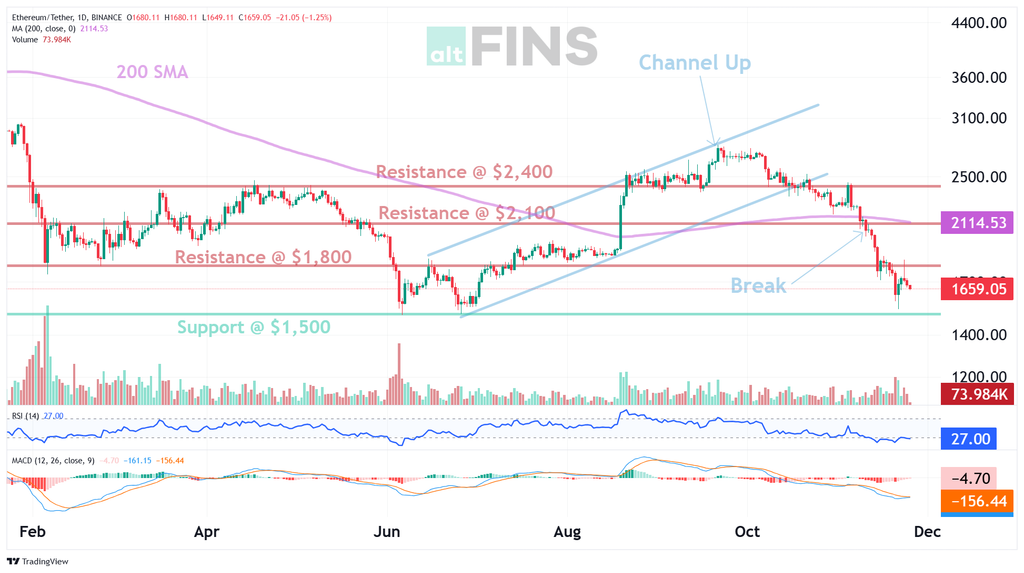
Ether’s problem is that its rallies keep arriving at the same wall. The token opened the week at $1,757, fell 7.64% on 20 November to $1,623, made the low of $1,538 on 21 November, and then recovered to $1,845 on 23 November. That bounce stopped exactly where the broken $1,800 shelf sits, and the following three sessions gave back 0.79%, 1.78% and then a 0.75% gain to finish at $1,693. The high of the week was $1,845 and the 200-day average is $2,111, so the recovery never came within 12% of the level that would end the downtrend.
Source: https://altfins.com/technical-analysis
The path was more violent than bitcoin’s at both ends. Ether lost 7.64% on the first session against bitcoin’s 4.90%, rallied 3.85% on 21 November against 2.14%, and closed the week 3.67% lower against 2.47%. Volume of $1.11 billion on 20 November was the heaviest of the window and $0.40 billion on 22 November the lightest, so the selling came with size and the recovery did not.
The indicators are less stretched than bitcoin’s and more conflicted. RSI-14 at 26.5 and RSI-9 at 31.7 sit above bitcoin’s readings, the MACD line at minus 153.13 has crossed above its signal at minus 155.35 for the first time since the October high, and ATR-14 of $111.73 puts a normal day at 6.6% of the price against bitcoin’s 5.5%. The Bollinger range of $1,499 to $2,216 leaves the close 5.3% above the lower band. Ether is 8.88% below its twenty-day average, 21.99% below the fifty-day at $2,170 and 19.82% below the 200-day, and the one-month loss of 27.98% is worse than the three-month loss of 30.70%, which means almost all of the quarter’s damage happened in November.
Source: https://sosovalue.com/assets/etf/us-eth-spot
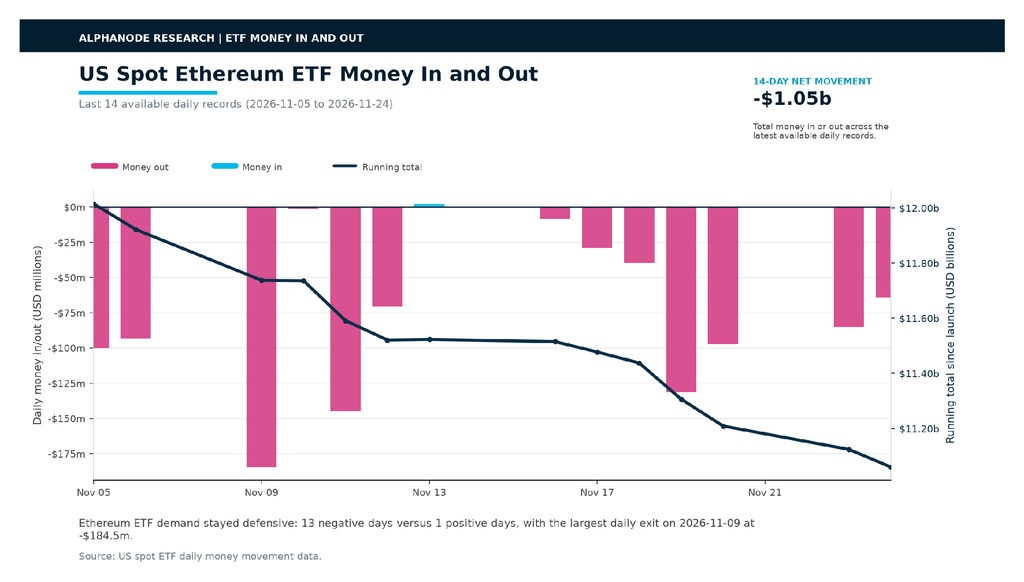
The funds are shrinking faster than the coin. Across the fourteen sessions to 24 November, United States spot ether funds lost $1.05 billion, negative on thirteen days, and net assets fell to $8.87 billion from $13.04 billion, a 32% decline against bitcoin’s 25%. The single inflow was $2.4 million on 13 November. The largest exits were $184.5 million on 9 November and $131.2 million on 19 November. Cumulative inflows of $11.06 billion mean the redemption is coming out of this cycle’s mark, and the wrapper now holds less than two thirds of the assets it held on 5 November.
The protocol news removed a support that had nothing to do with price. Glamsterdam is now expected in late January or early February 2027, with mid-January the earliest date if the specification stays as written, a Hoodi rehearsal in the week of 14 December and a go/no-go on 26 November. The upgrade was meant to raise the network’s throughput; instead it has spent six weeks repricing gas for contracts that cannot be patched quickly. The Ethereum Foundation doubled its protocol security team in the same week, which is the honest admission that review capacity, not developer output, is now the constraint on shipping.
The holders are the other half of the story. Bit Digital sold 29,825 ether to repay $50 million and BTCS sold more than half its holdings to settle Aave debt, so the treasury companies that absorbed supply through 2025 are now releasing it under duress. Against that, staking has held near a third of supply and the quantum work now underway treats the staked float as a migration problem in its own right. AltFins puts support at $1,500 with resistance at $1,800 and then $2,100. The 52-week low of $1,505.52 is 11% below the close, and a weekly close under $1,538 would put the February 2025 range in play.
Glamsterdam Slips To 2027 As Ethereum Counts Its Own Code
Ethereum’s next upgrade will not reach mainnet this year, and probably not before February. At the All Core Devs execution call on 19 November, the Ethereum Foundation reported that outreach to more than 50 affected companies put mid-January 2027 as the earliest viable date if the specification stayed as written. Ansgar Dietrichs pencilled in a Hoodi testnet fork for the week of 14 December, with a final go/no-go two weeks later, and the group reached a rough consensus to proceed with the current rules unless a viable alternative emerged. CoinDesk reported the same evening that a realistic launch is late January or early February. Glamsterdam had been targeted for December.
The visual records that decision, and the language is doing work. “Most affected projects could be ready by mid-January if the spec remained unchanged” is a conditional, not a plan. The Hoodi date is pencilled rather than scheduled. The consensus is rough, with Besu and Erigon still arguing that the gas repricing should change. What the call settled was a preference: keep the specification, give applications until mid-December for the most serious problems and 10 January for the rest, and decide on 26 November whether the rehearsal proceeds.
The reason the schedule broke is more interesting than the delay. Ethereum Foundation researcher Toni Wahrstätter’s post-mortem, published on 20 November, counts 320 days from scope to target for Glamsterdam against 433 to 475 days for the three previous forks, on the largest specification the project has written at 6,080 lines of execution-layer code against 2,318 for Prague. Twelve devnets shipped in 160 days against seven in 285 for Pectra, and 10 specification changes landed in the six weeks after the first public testnet, where Altair through Deneb recorded none. The team now writes faster than it can review, and a fork that repriced contract creation from 32,000 gas to 183,600 was always going to find the applications that hard-coded the old number.
Source: Ethereum Magicians, All Core Devs Execution (ACDE) #249 meeting summary, 19 November 2026, captured 26 November 2026.
Forty Two Million Ether Sits Behind One Exposed Key
A wallet that has sent a transaction has published its public key, permanently, and a quantum computer running Shor’s algorithm could work backwards from that key to the private one. A paper posted to arXiv on 19 November by researchers at the University of Pittsburgh and the Chicago security firm SeQure puts the exposure at about 42 million ether, worth roughly $72 billion at current prices, or 54.6% of the 76.7 million ether the team counted on the execution layer outside staking. Another 61% of staked ether is set to be withdrawn into addresses whose keys are already visible. No publicly known machine can run the attack, and the authors are explicit that the coins are not compromised, only the locks.
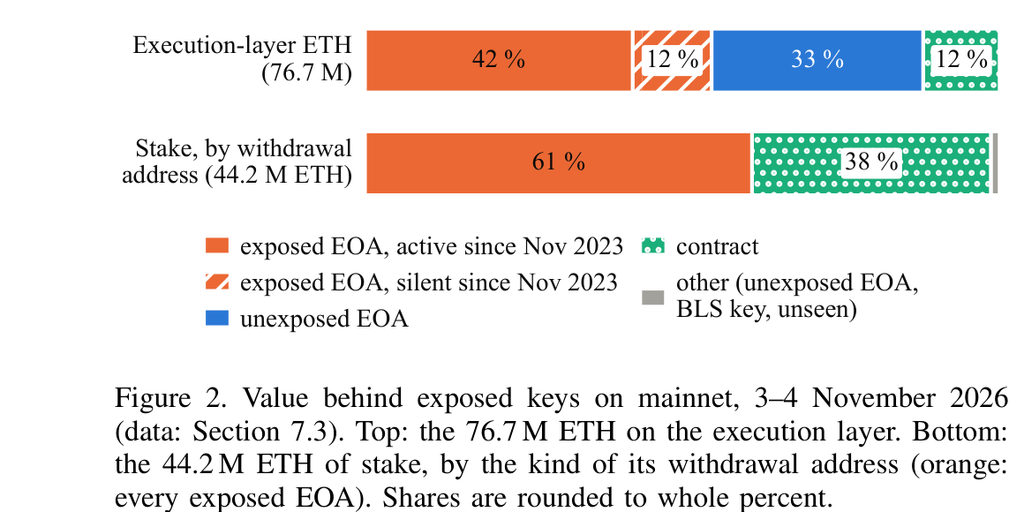
The chart splits the exposure by account type. On the execution layer, 42% of the ether sits in externally owned accounts active since November 2023, 12% in accounts silent since then, 33% in accounts whose keys are unexposed, and 12% in contracts. The staked side is worse: 61% of 44.2 million ether is already assigned to withdrawal addresses that have signed a transaction. An address that has never sent anything has not published its key. An address that has sent once cannot take that back.
The proposed fix is a two stage migration. Owners can enrol a post-quantum key with their existing signature at about $1 an account before ECDSA is retired at a scheduled block, after which unmigrated accounts freeze and are recoverable with a zero knowledge proof of the wallet’s seed phrase. The 4.45 million accounts holding at least 0.1 ether would migrate in 29.4 days if they all enrol early, and 235 days if they all wait and recover in batches of four. The paper found no publicly documented backup compatible with the recovery method at any of the 25 exchanges it reviewed.
Source: Jin, Liao, Chen, Li and Liu, “Correctable Enrollment and One-Transaction Seed Proofs for Ethereum’s Post-Quantum Transition”, arXiv:2611.25663, Figure 2, data 3 to 4 November 2026.
Mark Your Calendars
Economic Data Releases:
- December 1, 2026 (Tuesday): United States ISM manufacturing index for November.
- December 3, 2026 (Thursday): United States weekly initial jobless claims, week ending 28 November.
- December 4, 2026 (Friday): United States employment situation for November, including nonfarm payrolls.
- December 9, 2026 (Wednesday): Federal Reserve rate decision and quarterly Summary of Economic Projections.
Token Unlock
- November 28, 2026 (Saturday): Falcon Finance (FF) unlocks US$7.75 M (2.11% of released supply).
- November 30, 2026 (Monday): EigenCloud (EIGEN) unlocks US$3.95 M (3.92% of released supply).
- December 2, 2026 (Wednesday): MemeCore (M) unlocks US$36.12 M (2.13% of released supply).