
Yields Cap Crypto’s Best Quarter Since 2024
1st October 2026 • 7 mins read
This Week’s Recap
- Bitget raises its hack loss estimate to $387.5 million: The exchange added Zcash and Tron transfers missed in its first count, and roughly $3.9 million of the stolen ZEC has since entered Zcash’s shielded pool, pushing about 15% of those coins beyond routine tracing.
- Bitcoin closes out its best quarter since 2024: A 33.50% three-month gain and Ether’s 52.67% run landed against the highest long-term yields in more than two decades, which makes the quarter’s advance harder to explain with cheap money alone.
- Open Standard launches OUSD with $1 billion behind it: Coinbase, Mastercard, Shopify, Stripe and Visa committed the liquidity and took equal equity, and businesses can mint and redeem at par with no fees. Distribution, not yield, is the selling point. OUSD enters a market above $300 billion, where Tether’s USDT holds about $143 billion and Circle’s USDC close to $74 billion, so the consortium starts a long way behind the two incumbents even with its backers’ reach.
- US job openings fall to 7.08 million: August vacancies dropped by 256,000 from a revised 7.34 million in July, the lowest since March and below the 7.23 million economists expected. Quits held at a 1.9% rate, which keeps the labour market softer than the growth data suggests.
- Strive adds 1,107 Bitcoin for $94.5 million: The company paid an average of $85,396 a coin, taking its treasury to 27,462 BTC. The purchase landed near the top of the recent range, which says the treasury playbook keeps running regardless of the entry price.
- The FCA opens its crypto application window: Firms now have until February to seek authorisation before the regime takes effect in October 2027. A fourteen-month lead time gives incumbents room to prepare and smaller entrants a reason to consolidate. The deadline shapes the UK market’s structure more than any single applicant does, because firms that miss it face operating under existing rules or leaving the jurisdiction.
- Bitwise lists the first US spot NEAR ETF: The fund began trading on NYSE Arca with a staking component after NEAR rallied about 160% over thirty days. An altcoin ETF tied to network yield tests whether staking income can carry a product beyond the two majors.
- Robinhood adds perpetuals and weekend trading: The brokerage opened leveraged crypto products and automated trading agents to US users. Perpetual futures in a retail app deepen leverage access at the same moment the bond market is tightening financial conditions.
- XRP Ledger starts carrying fund records for a $4 trillion operator: A regulated Brazilian operator is moving fund ownership data onto the ledger. Putting authoritative records onchain is the part of tokenisation that outlasts the pilot phase.
- Standard Chartered sees more than 600% upside for ENA: The bank expects the USDe stablecoin to reach $40 billion by 2028. A sell-side target that large resets how a regulated desk frames stablecoin growth, even if the number is years from being testable.
- Petrobras uses Cardano to track fuel emissions: Brazil’s state oil company is recording sustainability data across production on a public chain. Corporate traceability, not price speculation, is where blockchain adoption keeps showing up.
- HANetf lists currency-hedged Bitcoin ETCs in Europe: New products in London and Paris offer pound sterling and euro exposure. Hedged wrappers let European allocators take Bitcoin risk without an explicit dollar bet, which is a niche but real source of new demand.
- Cosmos builds bank connectivity into Swift’s ledger: The infrastructure lets institutions run tokenised deposit ledgers through their existing core banking systems. Reusing bank rails is the practical route to settlement upgrades that regulators will actually approve.
- Apple patches a zero-day used against crypto wallets: The fix addresses a vulnerability exploited against iPhone users holding digital assets in the same week Bitget lost $387.5 million. Consumer custody keeps proving to be the softest part of the market.
- zk.money returns after three years: The privacy tool relaunched on the Aztec Network to let Ethereum users pay privately again. The demand for private transfers is the same force that makes stolen funds harder to trace after an exchange hack.
- Stablecoin card spending hits a record $1.17 billion: September’s total passed August even as transaction counts slipped, lifting the average purchase to about $107. Base handled $216.8 million of onchain volume, the largest share of any network.
- Tokenised equities pass $3 billion: The onchain market for public stocks crossed the threshold this month, up more than 260% since January. The growth predates any single venue’s announcement, which is what makes it durable. Holders of distributed tokenised assets also set a record over the same stretch, so the expansion is spread across users rather than concentrated in a few large positions.
Bitcoin Market Analysis
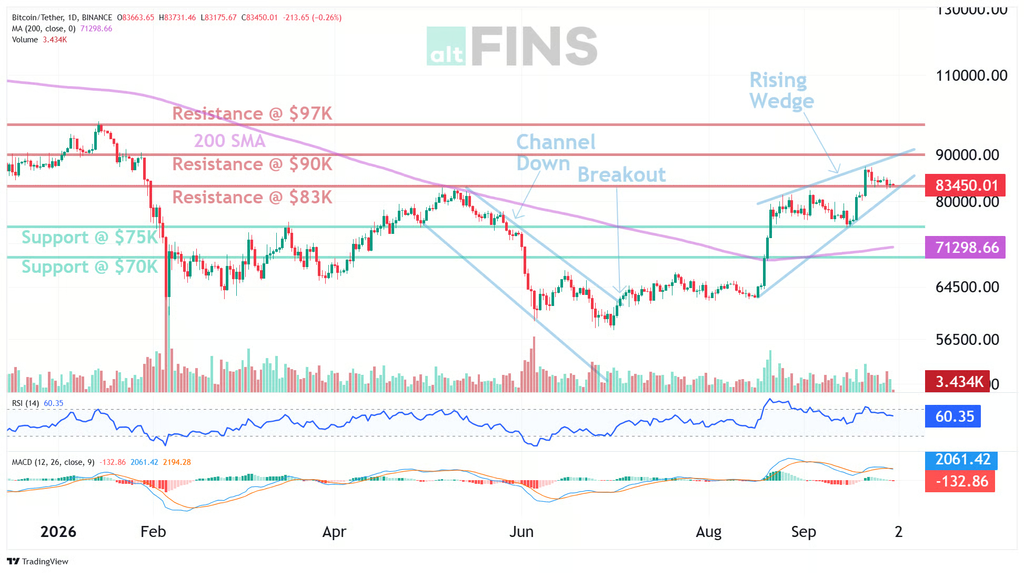
Bitcoin opened the window at $84,410 on September 25 and closed October 1 at $83,550, a 1.02% decline, with the seven-day range running from $82,563 to $85,650. The week was calm until Monday, when a 1.15% drop to $83,500 took price to the low, and the following three sessions barely moved: a 0.20% gain, a 0.05% loss and a 0.09% slip. The $85,650 high came on Tuesday and was never seriously revisited. After a quarter that added more than a third to Bitcoin’s value, the flat finish was less a reversal than a pause at the top of the range.
Source: https://altfins.com/technical-analysis
Momentum cooled at the edges. RSI-14 sits at 74.6 and MACD has flipped negative with a histogram of minus 195.21 after a positive run through September, the first bearish crossover since the August breakout. ATR-14 of $2,313 describes wider daily ranges than earlier in the quarter, and the Bollinger band spread of $74,635 to $88,652 leaves price in the upper half without pinning it to the ceiling. Price is 2.34% above the twenty-day average, 7.53% above the fifty-day and 17.09% above the 200-day. AltFins reads the structure as a resistance breakout above the $83,000 zone with the nearest support at $75,000 and the next resistance at $90,000, which is where the move stalled.
The quarter, not the week, is the better frame. Bitcoin’s three-month gain of 33.50% is its strongest since 2024, and the move happened while the long end of the Treasury curve repriced higher. A rising discount rate usually works against an asset with no cash flow, and this quarter it did not. The rally carried price from the low $60,000s to a $87,396 peak in September before this week’s drift, and the market is still 33.89% below its October 2025 record of $126,217.71, which means the advance is a recovery from a deep drawdown rather than an extension of a peak.
Source: https://sosovalue.com/assets/etf/us-btc-spot
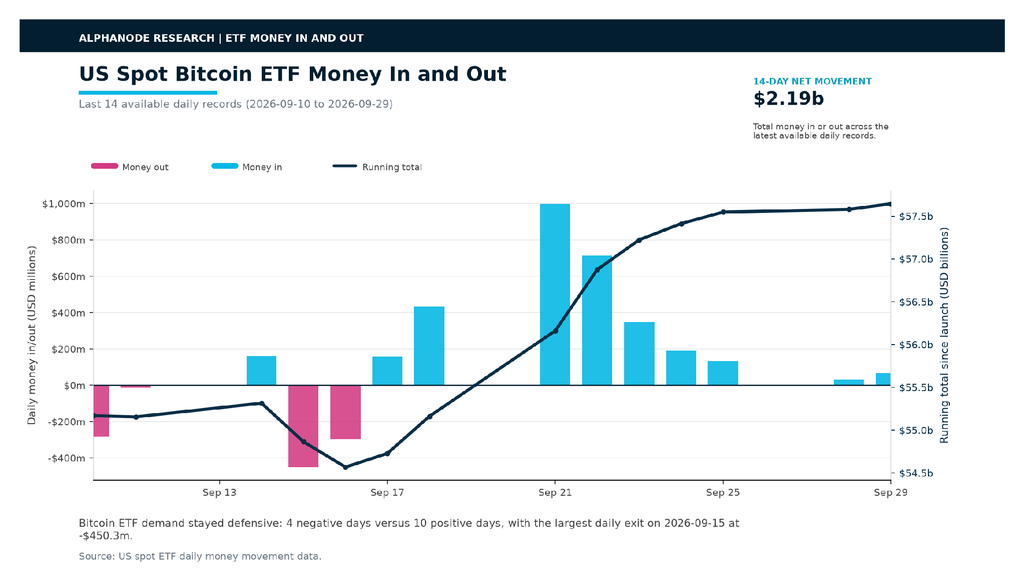
The ETF tape kept buying through the pause. Across the fourteen sessions from September 10 to September 29, US spot Bitcoin funds netted $2.19 billion over ten positive days and four negative ones, with net assets ending at $107.96 billion and cumulative inflows since launch at $57.64 billion. The concentration is striking: $999.0 million arrived on September 21, the largest single-day haul in the window, and $714.7 million followed on September 22. The one rough session was September 15, which pulled $450.3 million after trading volume spiked to $4.35 billion. The most recent settled day, September 29, added $66.2 million, a fraction of the peak but still positive. The shape of the window matters as much as the total: roughly half the net inflow arrived across September 21 and 22, and the four negative days cluster around the mid-month yield spike, which says the marginal ETF buyer watches the rates calendar as closely as the price.
The quarter’s gain arrived against a bond market that is getting harder to ignore. The 10-year Treasury yield touched 5.304% on September 30, the highest since May 2002, and the 30-year reached 5.65%. Core PCE inflation slowed to 3.0% from 3.3%, which cut the odds of an October Fed hike to 37% from 45%, yet the long end sold off anyway on upward revisions to second-quarter growth and heavier issuance. The inflation-adjusted 10-year yield rose to 2.83% from 2.68% in a week, and that real yield is the number that raises the cost of holding a volatile asset with no yield. Bitcoin’s resilience through it is the quarter’s most interesting signal.
The levels are narrow. Support sits at $82,563, this week’s low, and then $75,000, the AltFins floor. Resistance is $85,650 and then $90,000, where the breakout target and options interest converge, with $97,000 beyond it. A close below $82,563 would put the breakout structure above $83,000 in doubt and shift the debate from a pause to a correction. A push through $90,000 into a September jobs report on October 2 would confirm that ETF demand is doing more work than the macro backdrop is taking away.
Ethereum Market Analysis
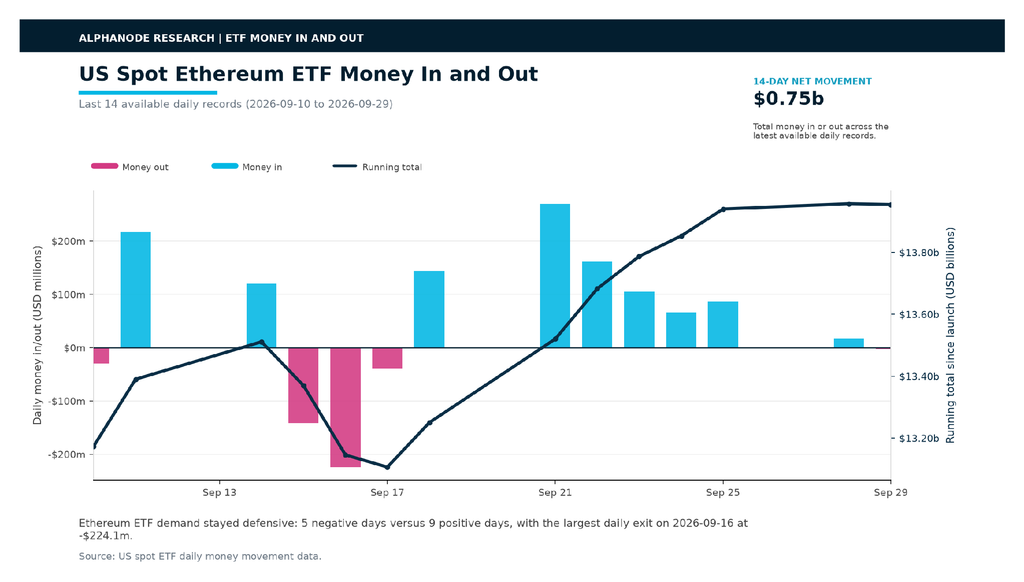
Ether’s ETF channel did more of the talking than its chart did. US spot Ether funds added $750.8 million across the fourteen sessions to September 29, with nine positive days against five negative ones, and net assets finished at $17.79 billion against cumulative inflows of $13.95 billion. That ratio says roughly four-fifths of all money ever committed to those products is still in place. September 21 was the standout session at $270.0 million, matched by September 22’s $162.3 million, while the two worst days, September 16 at minus $224.1 million and September 15 at minus $141.5 million, both landed in the same mid-month stretch. Ether’s five negative days are smaller in aggregate than the outflows that hit Bitcoin funds over the same stretch, which is why the two assets’ fourteen-day nets look closer than their individual daily prints suggest.
Source: https://altfins.com/technical-analysis
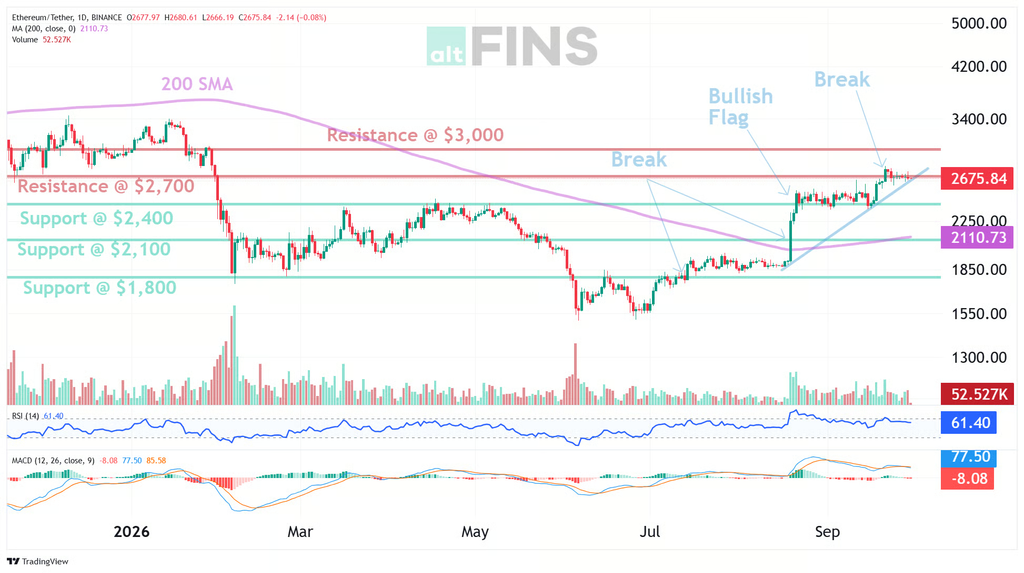
Price did less. Ether opened at $2,688 on September 25 and closed October 1 at $2,684, a 0.14% decline, inside a band from $2,636 to $2,749. The largest single move was a 0.40% slip on September 29, and the final three sessions each changed by less than a third of a percent. The flat week sits on top of a 52.67% quarterly gain and a 70.9% three-month advance, which is Ether’s best quarter since 2021. The quiet finish after that run reads as consolidation rather than distribution.
AltFins frames the setup as a bullish flag breakout. Price cleared the $2,700 resistance that had capped it, and the curated view targets $3,000 with a stop at $2,640, which is a stated 11% of upside. The nearest support is $2,400 and then $2,100, and the resistance stack is $2,700 and $3,000. RSI-14 at 75.7 is firmer than Bitcoin’s, and the MACD histogram of minus 9.20 is only just negative. ATR-14 of $90.99 and Bollinger bands at $2,399 and $2,840 describe a market that is still expanding. Price is 9.45% above the fifty-day average and 27.01% above the 200-day.
Source: https://sosovalue.com/assets/etf/us-eth-spot
Valuation is the other half of the story. Ether trades 45.91% below its August 2025 record of $4,956.67 and 78.10% above its 52-week low, and the gap between the two says the recovery has plenty of room before prior highs come back into range. The three-month performance of 52.67% is ahead of Bitcoin’s 33.50%, so the rotation into Ether that began earlier in the year kept its edge through the quarter. Longer-term holders who bought the 2021 and 2024 peaks are still carrying losses, and that supply is what caps how fast Ether can re-rate.
What happens next depends on two things at once. The bond market is repricing the cost of capital while stablecoin infrastructure keeps consolidating around Ethereum’s rails. The OUSD launch runs natively on Ethereum among its first four networks, which adds a settlement layer’s worth of activity to the chain even as Ether’s own price drifts. The September jobs report on October 2 and CPI on October 14 are the near-term tests; a yield shock would hit Ether harder than Bitcoin because more of its value sits in staking, DeFi collateral and tokenised assets that a rise in the risk-free rate reprices first.
Watch $2,700. Holding it keeps the flag breakout intact and leaves $3,000 in play, and losing it points back to the $2,636 low and then $2,400. The $2,684 close sits just under the $2,700 line, which makes the level a genuine decision point rather than a formality. Bollinger bands at $2,399 and $2,840 bracket the range on both sides.
Bond Yields Set A Ceiling Crypto Cannot Ignore
The US 10-year Treasury yield reached 5.304% on September 30, its highest level since May 2002 and above the 5.303% intraday peak set during the 2007 financial crisis. The 30-year yield climbed to 5.65%, also a multi-decade high, and the move came after core PCE inflation slowed to 3.0% in August from 3.3%. That combination is what matters: the inflation news was good, and the long end sold off anyway. The driver was a heavier issuance calendar and an economy that revised stronger, with second-quarter growth marked up and September private hiring ahead of expectations. Long-dated yields answer to supply and growth expectations, not only to the policy rate, and both pushed the same way.
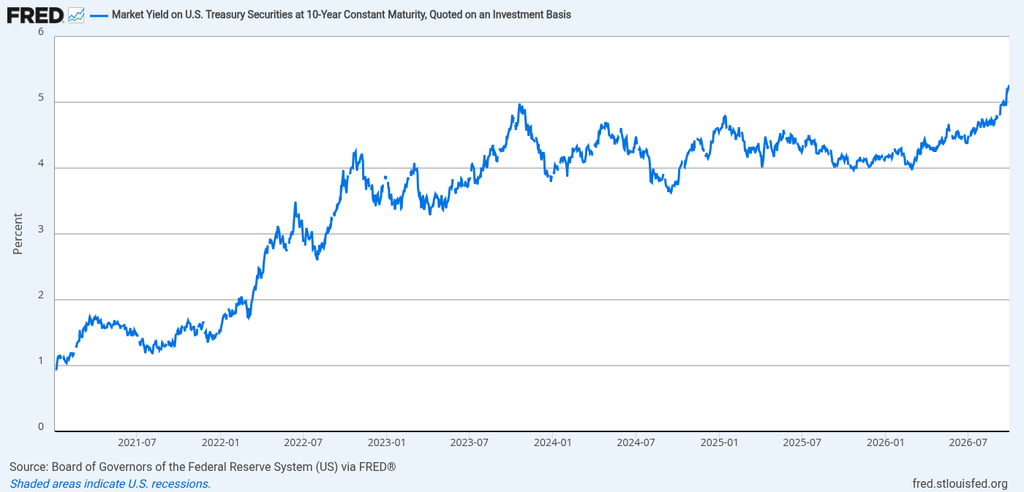
The chart shows how far the repricing has travelled. The 10-year yield started 2021 near 1%, crossed 2% in early 2022, ran to about 4% by late 2022, then spent 2023 through 2025 chopping between roughly 3.5% and 4.7%. The recent leg is a clean break above that range and into territory last visited when the market was pricing a very different inflation regime. The 2007 peak that this week’s print exceeded sat below today’s level, and the 2002 comparison points to a bond market that has unwound two decades of compression. Read against equities, the same move is a repricing of the risk-free rate rather than a flight to safety, because the rise is driven by supply and growth instead of a scramble for duration.
The consequence for crypto is a higher discount rate at the same time as a live ETF bid. The inflation-adjusted 10-year yield rose to 2.83% from 2.68% in a single week, which is the rate that actually competes with a non-yielding asset, and Bitcoin still closed its best quarter since 2024. The near-term risk is sequencing. October 2 brings the September employment report, October 14 the September CPI print, and October 28 the next Fed decision, and any of the three could push the long end higher and force the kind of risk reduction that a rising cost of capital implies. The quarter’s gains held through the first leg of that repricing; the next test is whether they hold through the second.
The Bitget Hack Put A Price On Privacy
Bitget confirmed a $387.5 million loss after revising its initial $351.6 million estimate upward to include Zcash and Tron transfers that its first tally missed. The breach is the largest at a crypto exchange this year, and the exchange recorded about $463 million in net outflows in its aftermath. The scale is what makes the accounting matter: the exchange’s protection fund faces a draw that could reach as much as 84% of its stated size if the full loss is absorbed from it, which turns a customer-safety buffer into a live solvency question.
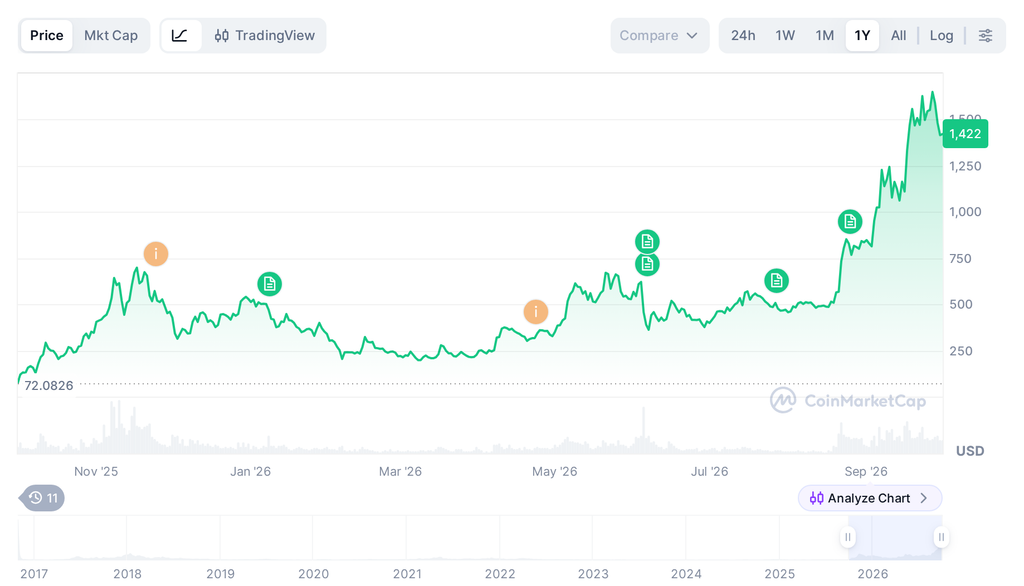
The Zcash element is the part with a wider reach. Wallets tied to the hack moved roughly $3.9 million of ZEC into Zcash’s shielded pool on September 30, about 15% of the stolen ZEC, and the transfer makes those coins materially harder to trace. Zcash’s own chart shows why the asset is useful for that purpose: it has re-rated from about $72 a year ago to $1,422, and its market value sits near $24 billion. The same shielded-pool mechanism that lets a lawful user transact privately lets a thief break the on-chain trail, and a market cap that size means the pool is deep enough to absorb eight-figure flows without obvious distortion. The shape of the chart also shows how quickly privacy demand can re-rate an asset the market had spent years ignoring: the move is a step change in the final months, not a gradual drift.
The wider week showed both sides of the same coin. zk.money relaunched on the Aztec Network to restore private payments on Ethereum, and Apple patched a zero-day that had been exploited against crypto wallets on iPhones. Demand for genuine privacy and demand for cover from theft are served by the same tools, and the regulatory response tends to blur them together. Exchanges and investigators now have a concrete case to argue from: a nine-figure hack that partly disappeared into a privacy pool is the strongest argument privacy advocates will have to answer in the next round of policy, and the strongest argument regulators will have for tighter tracing requirements.
Mark Your Calendars
Economic Data Releases:
- October 7, 2026 (Wednesday): minutes from the Federal Reserve’s September meeting.
Token Unlock
- October 2, 2026 (Friday): Ethena (ENA) unlocks US$10.88 M (0.45% of released supply).
- October 6, 2026 (Tuesday): Hyperliquid (HYPE) unlocks US$905.99 M (2.32% of released supply).