
Two Layers Close While Credit Gets Rated
8th October 2026 • 8 mins read
This Week’s Recap
- Blast winds down its network as costs exceed revenue: A Paradigm-backed chain that drew more than $2 billion in deposits now holds about $32 million in value locked, and annualised fees of roughly $755,500 support only about $22,700 of revenue. Users have until October 26 to exit through the normal interface before withdrawals drop back to raw bridge contracts.
- Abstract to shut down on December 15 after losing tens of millions: Igloo funded the consumer chain for eighteen months and decided against a token sale to extend it. Funds left behind after the deadline become inaccessible, and the native bridge carries a three-hour delay.
- S&P Global Ratings launches Vault Risk Assessment for digital asset markets: The framework scores vaults on portfolio credit quality, liquidity mismatch, curator, blockchain, protocol and governance risk, with AAA(v) as the strongest outcome. Deposits in these structures reached $10 billion in September against $1.5 billion two years earlier.
- GSR commits $100 million to an onchain credit vault business: The market maker is putting its own balance sheet into Hare, built with Turtle, with the first two products running on Aave. One takes dollar stablecoins, the other takes Paxos gold, and outside allocators are expected to follow GSR’s capital into the same vaults.
- Ether is about to lose a steady buyer as Bitmine sets a 5% cap: Tom Lee told Token2049 in Singapore that accumulation stops at 5% of supply. With more than 6 million tokens held at 4.9%, roughly 100,000 Ether remains to be bought and $643 million of cash is on hand to do it.
- Robinhood adds $25 million of bitcoin to its balance sheet: The brokerage allocated company capital to Bitcoin for treasury diversification, joining a list of listed firms whose disclosures now move sentiment. The purchase is small against its cash pile, so the signal is the intent rather than the size.
- Liquidations jump to $547 million as an oil rally drags Bitcoin below $84,000: Forced closures surged as crude prices moved and leveraged long positions unwound, taking Bitcoin down 2.60% in a session. The move came from the macro side rather than from anything onchain.
- Russia clears its first crypto exchanges and custodians: The Bank of Russia listed four exchange operators and five digital custodians under a law that took effect on September 1, with Sberbank and VTB licensed to hold digital assets. Sberbank plans its first products on December 1 across Bitcoin, Ether and USDT, while the ban on using crypto to pay for goods remains.
- South African bank opens crypto trading to nearly 9 million customers: FNB built the service with local exchange VALR and runs it inside its existing share-trading accounts, starting at a R10 minimum. Coins bought through the bank cannot be sent to an external wallet, which keeps the exposure inside the balance sheet that sold it.
- Brevan Howard picks Ripple Prime for multi-asset brokerage: The $35 billion alternative manager will use Ripple Prime for clearing and financing across asset classes. A macro fund of that size routing through crypto-native infrastructure is a stronger endorsement than another exchange listing.
- OKX and NYSE owner ICE move toward 24/7 tokenised US stocks: OKXICE notified the SEC of plans to trade more than 60 US-listed equities continuously, each token backed one for one by a real share. The filing also opens a 30-day window in which any issuer can refuse to have its stock included.
- Polygon taps TRON’s $94 billion stablecoin supply: The partnership connects TRON’s USDT liquidity across EVM networks without third-party bridges, aimed at cross-border transfers that touch US banking rails. Pooling the two largest USDT venues reduces the fragmentation that has kept large transfers on correspondent banking.
- Spiko raises $90 million to expand tokenised cash funds: The tokenised fund manager closed a round to broaden institutional distribution for its cash products. Money market exposure is the least exciting corner of tokenisation and the one that institutions can approve fastest.
- Moody’s assigns its first issuer rating to Sky Protocol: The B3 rating with a stable outlook is the first Moody’s has issued on a stablecoin protocol. A second agency entering the sector gives allocators a comparison point that did not exist a year ago.
- Tether tapped by Kazakhstan’s central bank: The central bank will explore a tenge stablecoin and a tokenisation framework with the largest issuer in the market. A sovereign mandate for the incumbent is a distribution outcome its competitors cannot match.
- Winklevoss group files for a spot Zcash ETF: The filing sets a 0.25% fee and a WINK ticker, with an initial $100 million commitment from Winklevoss Capital. A privacy coin in a spot wrapper will draw the same regulatory questions the asset has faced for years.
- Coinbase Pro returns as Deribit integration completes: The merged venue gives US institutions access to Deribit’s perpetual futures and options liquidity. Options depth is the piece US regulated venues have lacked, and it now sits behind one login.
- Conduit sues Tether over a frozen $2.8 million: The suit challenges a freeze of $2.76 million in USDT linked to Brazilian proceedings. Each freeze that reaches a courtroom tests how much discretion an issuer can exercise over tokens it controls.
Bitcoin Market Analysis
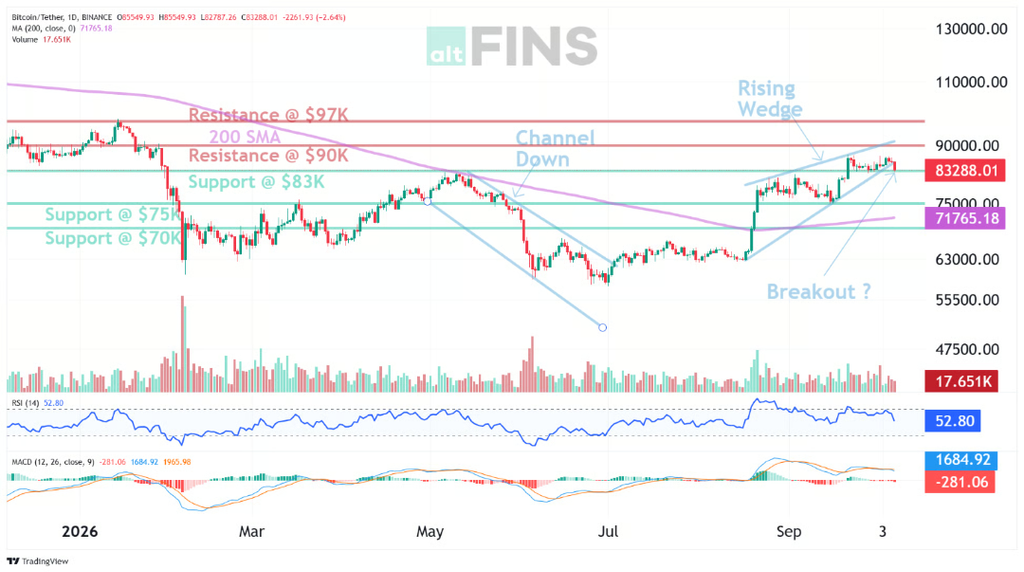
Bitcoin opened the window at $84,880 on October 2 and closed October 8 at $83,302, a 1.86% decline, with the seven-day range running from $82,787 to $87,220. The path was calm until it was not: a 0.28% gain on October 3, then a 2.10% advance to $86,530 on October 4, which stood as the week’s high-water mark for closes. Three sessions of drift followed, and on October 7 price fell 2.60% to $83,322, a drop that erased the earlier gain in one move. The final session barely traded at all, finishing two dollars lower.
Source: https://altfins.com/technical-analysis
Momentum cooled at the edges. RSI-14 sits at 43.6 and the MACD histogram has turned negative at minus 393.81 after a positive run through September. ATR-14 of $1,802 describes a wider daily range than the previous week, and the Bollinger band spread of $81,464 to $87,184 leaves price in the lower half without pinning it to the floor, with the stochastic reading at 15.9 of the latest fourteen-day range. Price is 1.21% below the twenty-day average, 3.38% above the fifty-day and 15.95% above the 200-day. The setup AltFins describes is a sideways range between $83,000 and $87,000, with the breakout above $83,000 intact while price holds that level, the nearest support at $75,000 and the next resistance at $90,000.
The quarter is still the better frame for the levels. Bitcoin is up 29.83% over three months and 14.04% over six, and it sits 33.98% below its October 2025 record of $126,217.71. Price is 44.18% above the 52-week low, which means the recovery has travelled a long way from the bottom without seriously threatening the old high. The distance between those two figures is the honest description of where this market is: past the drawdown, short of the peak.
Source: https://sosovalue.com/assets/etf/us-btc-spot
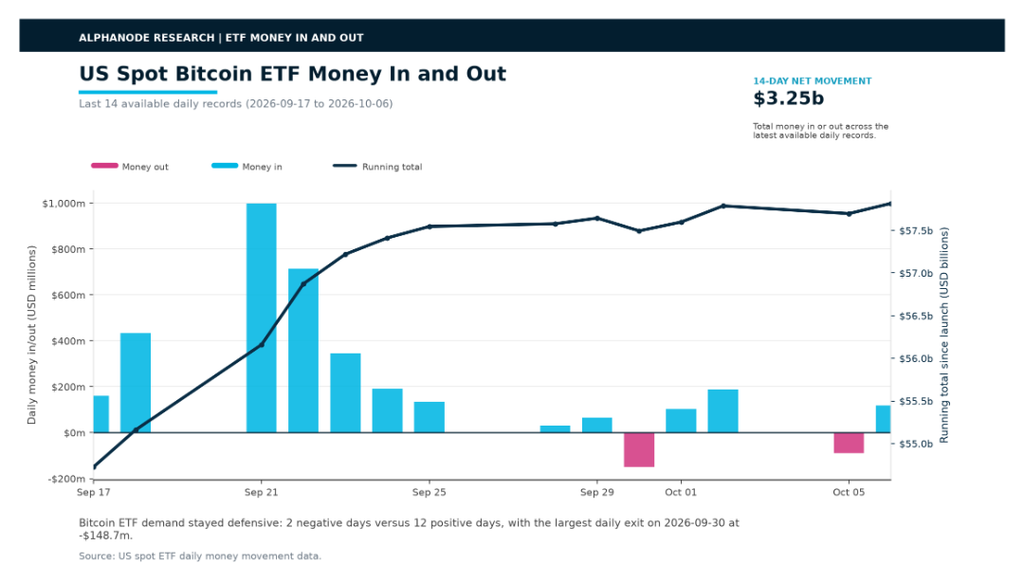
The ETF tape kept buying through the decline. Across the fourteen sessions from September 17 to October 6, US spot Bitcoin funds netted $3.25 billion over twelve positive days and two negative ones, ending at $110.68 billion in net assets and $57.82 billion of cumulative inflows since launch. The concentration is familiar: $999.0 million arrived on September 21 and $714.7 million on September 22, which together account for more than half the window’s total. September 30 removed $148.7 million and October 5 removed $89.9 million, both around the days when the long end of the Treasury curve moved. The most recent settled session, October 6, added $118.9 million, so the buyer was still present on the eve of the selloff.
The macro backdrop did the damage. An oil rally pushed risk assets lower on October 7, $547 million of leveraged positions were closed out, and Bitcoin traded under $84,000 for the first time since early in the window. Against that, Robinhood added $25 million of Bitcoin to its own balance sheet and Bitmine used the week to say it is close to its self-imposed ceiling on Ether. Corporate balance sheets are still buyers, which is a different composition of demand from the one that drove the 2021 cycle.
Watch $82,787, this week’s low. A close beneath it would put the breakout structure above $83,000 in doubt and shift the argument from consolidation to correction, with $75,000 as the next reference. Resistance sits at $87,220 and then $90,000, where the breakout target and prior option interest converge. The $83,302 close is close enough to $83,000 that the level is a live decision point, not a formality.
Ethereum Market Analysis
Ether’s most reliable buyer just announced a finish line. Tom Lee told Token2049 in Singapore that Bitmine will stop accumulating once it holds 5% of supply, describing it as a hard cap rather than a target. The company sits at more than 6 million Ether, about 4.9% of supply, worth roughly $15 billion, and needs close to 100,000 more to reach the ceiling. It began the treasury strategy in June 2025 and has bought through every price since, which is what made it useful to the market: a bid that did not check the price. A cap does not sell anything. It removes the standing bid, and what replaces it will be a buyer watching the same chart as everyone else.
Source: https://altfins.com/technical-analysis
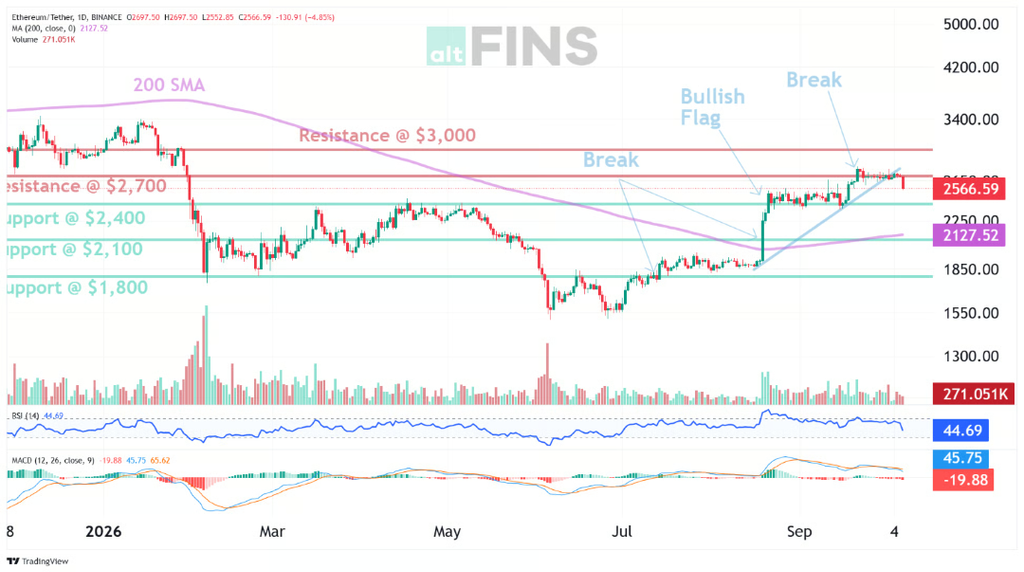
Price fell 4.93% over the window, from $2,706 on October 2 to $2,573. The range ran from $2,538 to $2,777, and almost all the damage came in one session: October 7, when Ether lost 4.57% and took out the previous two weeks of gains in a day. The October 4 high of $2,740 was never revisited. Four sessions of small moves preceded the drop, and the close was within a dollar of the low.
Momentum is weaker than Bitcoin’s. RSI-14 sits at 31.2, at the edge of oversold, and the MACD histogram reads minus 24.42. ATR-14 of $67.28 and a Bollinger spread of $2,587 to $2,778 put price below the lower band, which describes a market that has moved faster than its own recent volatility. Price is 4.09% under the twenty-day average and 0.77% above the fifty-day, and the stochastic sits at 14.6. AltFins reads the setup as a failed break above $2,700 and waits for a pullback to $2,400, with the nearest support at $2,400 and then $2,100, and resistance at $2,700 and $3,000.
Source: https://sosovalue.com/assets/etf/us-eth-spot
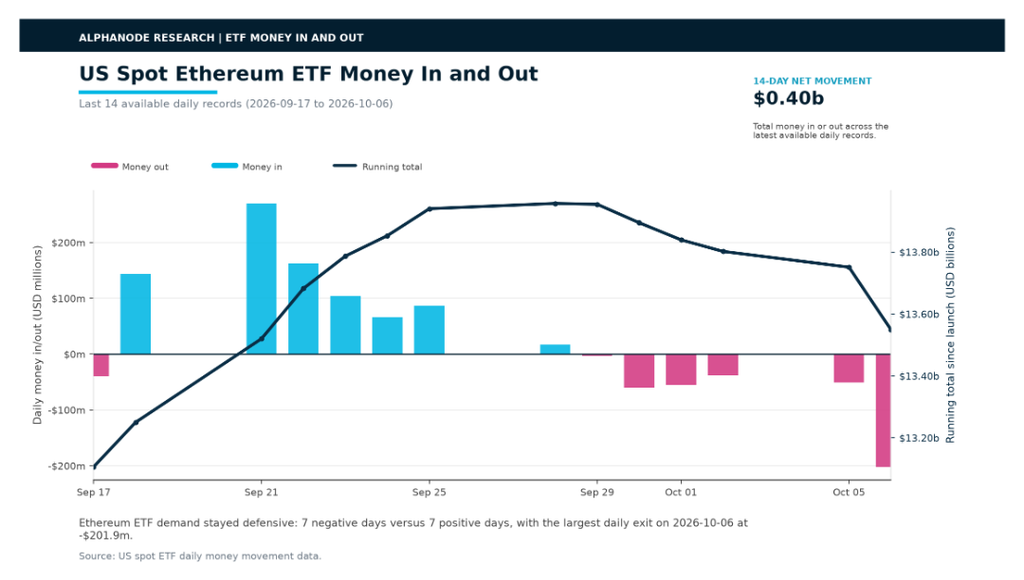
The flows told a different story from the price. US spot Ether funds added $403.8 million across the fourteen sessions to October 6, with seven positive days against seven negative ones, ending at $17.36 billion in net assets and $13.55 billion of cumulative inflows. The shape is the concern. September 21 brought $270.0 million and September 22 brought $162.3 million, and the last eight sessions included six outflows, finishing with October 6 at minus $201.9 million. The Bitcoin funds took in $118.9 million on the same day, so the divergence on the final session was about $320 million in favour of the larger asset. Money left Ether funds on the day before Ether fell hardest.
Valuation keeps the recovery honest. Ether trades 47.99% below its August 2025 record of $4,956.67 and 71.24% above its 52-week low. Its three-month gain of 43.20% is ahead of Bitcoin’s 29.83%, so the rotation into Ether held its edge through the quarter even as the weekly tape turned. The tokens bought at the 2021 and 2024 peaks still sit above the current price, and that supply is what any move toward $3,000 has to absorb.
What happens next depends on whether Ether’s balance-sheet use catches up with its price. S&P’s new vault framework grades a $10 billion market that runs largely on Ethereum rails, and GSR’s $100 million commitment to Aave-powered vaults is the same bet on the same infrastructure. Watch $2,538. Holding it keeps the pullback inside the range AltFins describes and leaves a path back to $2,700; losing it points at $2,400 and then $2,100, the levels that did not matter a week ago.
Ethereum Switches Off The Layer It Sold
Blast said on October 2 that it will shut its network down, because the cost of running the chain now exceeds the revenue it earns and the team sees no credible route to sustainability. The project came to market in November 2023 on a $20 million round led by Paradigm and Standard Crypto and had more than $2 billion of deposits committed before its February 2024 mainnet launch. Roughly $32 million remains. Annualised fees run to about $755,500 against about $22,700 of chain revenue, which is the arithmetic behind the decision. Users can withdraw through the normal interface until October 26, after which exits require calling the bridge contracts on Ethereum directly. Withdrawals paused first so the team could unwind its Lido position, a process expected to take about a week. The BLAST token fell 17% on the announcement, taking its market value to roughly $23 million.
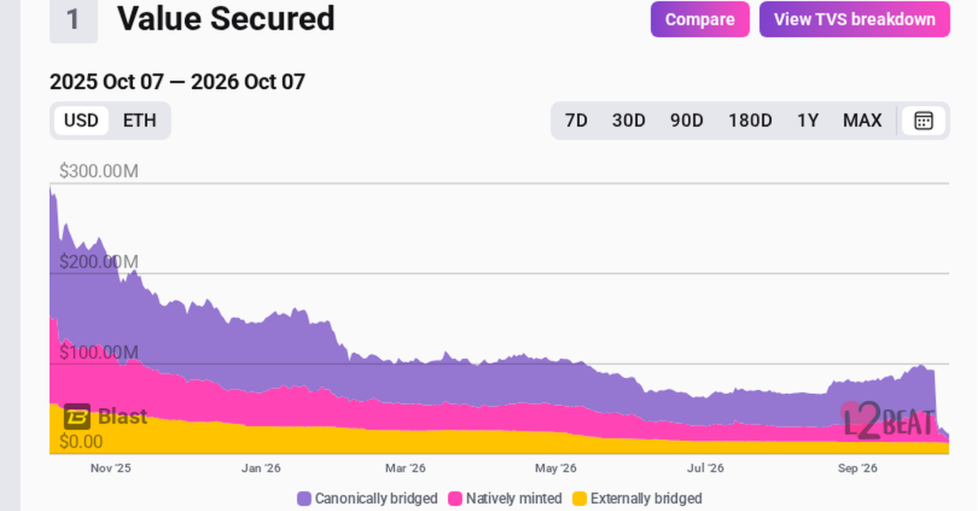
The chart shows the same collapse in slower motion. Value secured on the network fell from about $250 million in November 2025 to roughly $50 million by the end of the window, and the composition barely changed as it fell: the bulk of what remains is canonically bridged rather than freshly minted on the chain. L2BEAT also flags that 78.9% of the value sits under additional trust assumptions and that the proof system is not fully functional, which is a different problem from an empty chain. What closed was not a network that ran out of users in a single quarter. It was a network that could not convert usage into enough fee revenue to cover the fixed cost of producing blocks.
Abstract reached the same conclusion four days later. Igloo, the company behind Pudgy Penguins, will close the chain on December 15 after spending tens of millions over eighteen months, and will not issue a token to extend it. Value locked peaked near $58 million in August 2025 and now sits around $8.4 million, with several hundred million dollars of cumulative transactions already behind it. Both networks were built to sell Ethereum scalability, and both are being switched off by their operators rather than their users, which is the part worth carrying into next quarter. Fee competition on the second layer now narrows to fewer venues, and each survivor’s revenue depends on whether the activity it hosts is activity that pays.
Source: L2BEAT, Blast project page, value secured and value secured breakdown, daily data through October 2026.
Onchain Credit Gets A Rating Agency
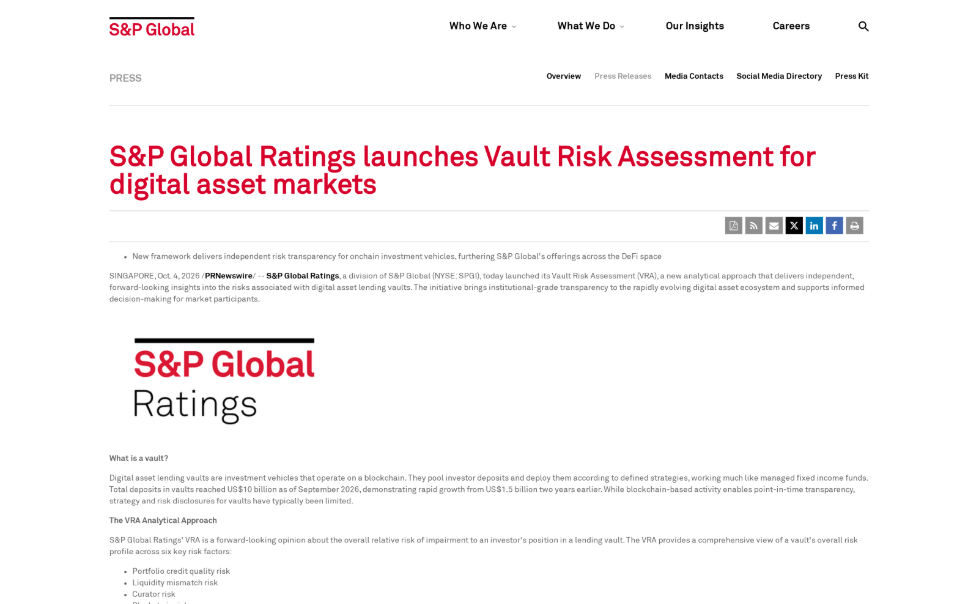
S&P Global Ratings launched a Vault Risk Assessment on October 4, covering digital asset lending vaults that pool depositor money and deploy it under defined strategies. Deposits across the sector reached about $10 billion in September, up from $1.5 billion two years earlier. The framework scores six risk factors: portfolio credit quality, liquidity mismatch, curator, blockchain, protocol, and vault security and governance. The strongest outcome is AAA(v) and the weakest is CCC(v), and the agency is explicit that these are not credit ratings and say nothing about advertised yields. The first assessments have not been published yet.
The maths is the part that explains the timing. A market that triples in two years to $10 billion without a third-party check is a market that institutions cannot allocate to, because most investment committees will not sign off on a strategy they cannot compare against a peer set. S&P has been building toward this for three years: it has published Stablecoin Stability Assessments since December 2023, put them onchain through Chainlink from October 2025, and in August 2025 became the first rating agency to rate a DeFi protocol when it assigned Sky Protocol a B-minus. Its current stablecoin scale puts USDT at 5, the weak end of an eleven-asset list. Vaults inherit the same logic. The six categories include curator risk, which grades judgment rather than code, and that is the factor no dashboard can replace.
The money is already moving to meet the framework. GSR committed $100 million of its own capital to Hare, a vault business built with Turtle, with the first two products running on Aave and one taking Paxos gold. Two Prime launched a Bitcoin lending vault with $10 million behind it, and Galaxy’s curator platform connects Fireblocks’ 2,400 institutional clients to onchain yield. As of July, the sector held $8.6 billion across 788 curated vaults with about 1.4 million depositors. The consequence of a public scorecard is that yield stops being the only thing on the table, and curators start defending their risk choices in a language allocators already read. The open question is who pays for the assessment, because a curator buying its own grade is a structure the last financial crisis had opinions about.
Source: S&P Global Ratings, “S&P Global Ratings launches Vault Risk Assessment for digital asset markets”, press release, 4 October 2026.
Mark Your Calendars
Economic Data Releases:
- October 14, 2026 (Wednesday): US consumer price index for September, the final inflation reading before the next Federal Reserve decision.
- October 15, 2026 (Thursday): US producer price index for September.
- October 15, 2026 (Thursday): US advance retail sales for September.
Token Unlock
- October 8, 2026 (Thursday): Stable (STABLE) unlocks US$23.77 M (3.42% of released supply).
- October 13, 2026 (Tuesday): Peaq (PEAQ) unlocks US$3.29 M (3.18% of released supply).
- October 14, 2026 (Wednesday): Starknet (STRK) unlocks US$11.11 M (3.27% of released supply).