Inflation Reprices Rates As Settlement Goes Digital
15th October 2026 • 8 mins read
This Week’s Recap
- US September CPI comes in hot, sending bitcoin sharply lower: Headline inflation hit 3.7% against a 3.6% forecast and core rose to 2.6% against 2.5%. Bitcoin fell from about $83,860 to roughly $82,700 within minutes of the 8:30am release, and traders pushed the implied odds of a Federal Reserve rate hike to about 55%.
- BNY, Citadel Securities complete Treasury repo in first use of tokenized assets on major triparty platform: A two-year Treasury note settled in minutes on BNY’s private ledger rather than the standard next-day cycle, then served as collateral in an overnight repo. The transaction moves tokenised collateral into the funding market that underpins the Treasury curve.
- Standard Chartered unlocks direct bitcoin and ether trading for affluent UAE clients: The bank built a closed-loop service inside existing accounts, regulated by VARA, with a spread of up to 2% and no external wallet transfers. Access needs a banking relationship of at least AED 4 million, so the product is aimed at wealth clients rather than retail.
- Kraken parent Payward to become first crypto firm to buy a EU bank: The acquisition of Lithuania’s Saldo Bank would upgrade Payward from an Irish e-money licence to an EU banking licence, unlocking deposits, lending and card issuance. Terms were not disclosed and the deal is expected to close in 2027.
- UK High Court rules Chinese law governs claims to $5 billion in seized bitcoin: Justice Mark Turner held that Chinese law decides whether thousands of fraud victims hold property rights in more than 61,000 bitcoin seized from Zhimin Qian, because the fraud, the losses and the money all originated in China. The ruling improves the British government’s chances of keeping assets now worth about $5 billion, and the claimants are appealing.
- South Korea blocks 27 unregistered crypto exchange websites: The Financial Intelligence Unit ordered access blocks on KuCoin, MEXC, BitMart, BingX and Phemex after reviews on 6 and 7 October, extending last year’s restrictions on their mobile apps. Unregistered operators serving Korean users face up to five years in prison or a fine of 50 million won.
- US and UK sanction 146 targets and cut Huione Group out of the dollar system: OFAC designated 146 people and entities tied to Cambodia’s Prince Group, and FinCEN finalised a section 311 rule barring US banks from holding correspondent accounts for Huione Group, which laundered at least $4 billion between August 2021 and January 2025. The enforcement landed on the firm that converts crypto into bank money, not on the coins.
- FSB warns cross-border stablecoin rules remain untested: Chair Andrew Bailey wrote that cross-border cooperation is “still in its infancy” and that multi-issuer structures can strand reserves in one jurisdiction while redemption demands arrive in another. A run could reach banks through forced sales of reserve assets and deposit withdrawals.
- Ledger confirms hardware implant in CryptoBilis reseller units as MediaMarkt suspends sales in Europe: The implant reads seed words off the device screen and transmits them over LTE, and the compromise has been linked to an $86 million theft. Resellers across several Southeast Asian markets were asked to pause sales while the supply chain is checked.
- Strive buys $235 million in bitcoin as warrant exercises yield $369 million: The purchase lifted the corporate treasury to 32,773 BTC, making it the fifth-largest public holder. Warrant exercises supplied the cash, so the buying was funded by equity-linked demand rather than debt, and a second preferred class, SATS, is now being raised for up to $500 million at a fixed 15% dividend.
- Solana sets Oct. 21 for Alpenglow upgrade targeting 150-millisecond finality: The upgrade replaces TowerBFT and moves validator votes off the blockchain, which could cut Solana’s reported transaction count even if activity holds. Validators need an Agave 4.3 client and 0.8 SOL in their vote accounts before the switch.
- AI agents make 138 million crypto payments as U.S. dominates spending on AI models: AI agents completed more than 138 million payments through the x402 protocol on Base in the twelve months to July 2026, and the median time between funding a wallet and its first payment fell from 73 days to 18 minutes. United States wallets made 88.1% of geolocated model-inference payments.
- Dutch central bank grants Qivalis e-money license for MiCA-compliant euro token: The licence, backed by BBVA, BNP Paribas and ING, lets the consortium issue a regulated euro token on European rails. Three of the largest euro-area banks building settlement infrastructure together is a distribution advantage a crypto-native issuer cannot match.
- Polygon Labs completes Coinme acquisition, bringing regulated payments coverage across 48 US states: The buyout gives Polygon licensed money-transmission coverage in 48 jurisdictions. The chain is buying regulatory reach rather than technology, which is the scarce input for payments.
- Proposed 31.4% French tax on regulated stablecoins could drive crypto traders offshore: The draft law would levy 31.4% on stablecoin transactions inside France, and industry groups warn the activity would simply move to venues outside the country. A rate that high on a settlement instrument pushes volume toward unregulated venues rather than raising revenue.
- Kyrgyzstan winds up its state-issued stablecoin and first state-owned exchange: The issuer’s own notice confirms USDKG, a gold-backed dollar peg launched in November 2025 with about 50 million tokens issued, has stopped operating, including on blockchain networks. The cabinet has ordered the liquidation of issuer OJSC EVA and Coin Nomad Exchange, whose creditors have until 14 October to file claims, and holders can redeem for fiat or USDT with no published deadline.
- Hex and PulseChain founder Richard Heart detained in Istanbul: Turkish authorities held the founder under an Interpol warrant and seized electronic devices. The case tests how cross-border enforcement reaches founders of tokens sold into multiple jurisdictions.
- Russia clears Sberbank for crypto trading ahead of December launch: The state-backed bank won authorisation to run direct trading for major tokens, with a first product planned for December. A licensed bank channel puts digital assets inside the same rails as conventional accounts, while the ban on using crypto to pay for goods stays in place.
Bitcoin Market Analysis
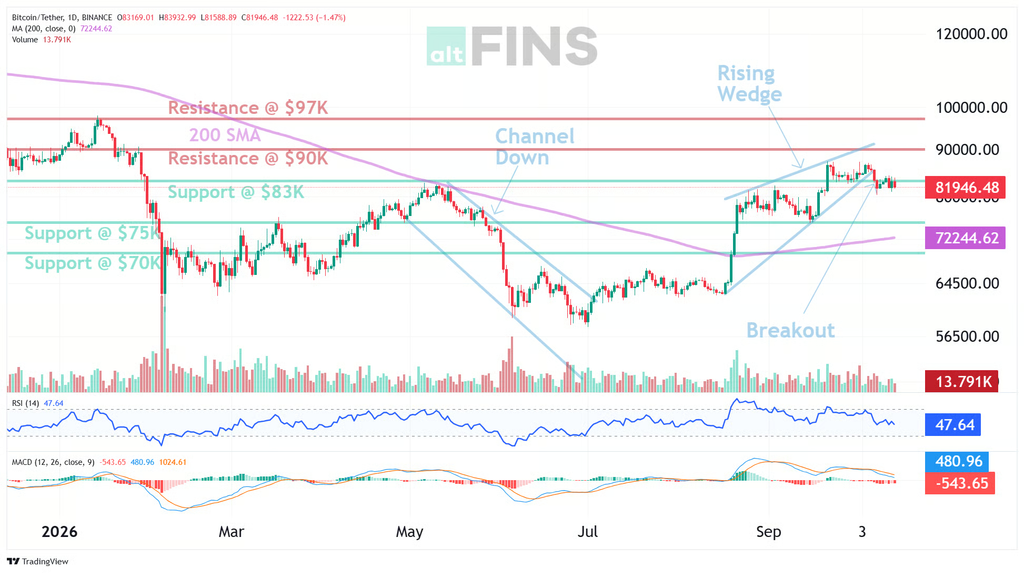
Bitcoin opened the window at $81,754 on October 9 and closed October 15 at $81,710, a 0.05% decline that flatters the path in between. Price rose through the first three sessions to $83,773 on October 11, and October 12 gave back 2.30% in a single move down to $81,850. A 1.61% recovery to $83,169 on October 13 set up the week’s turn: the September inflation print landed on October 14 and Bitcoin fell 1.79% to $81,682, giving back the whole advance. The final session barely traded, finishing $28 higher.
Source: https://altfins.com/technical-analysis
Momentum sits at the weak end without tipping into a flush. RSI-14 reads 38.6 and the MACD histogram is negative at minus 564.82 after the signal line crossed lower 28 days ago. ATR-14 of $1,996 describes a wider daily range than the previous week, and the Bollinger band spread of $80,996 to $86,462 leaves price in the lower third, with the stochastic reading at 19.3 of the recent fourteen-day range. Price is 2.41% below the twenty-day average and 0.57% above the fifty-day, so the short-term averages have rolled over while the longer ones hold. AltFins describes a bearish breakout from a rising wedge and below the $83,000 shelf, framing the move as a correction inside a longer uptrend, with the next reference at $75,000.
The longer frame keeps the recovery intact. Bitcoin is up 8.02% over one month and 27.81% over three, and it sits 35.36% below its October 2025 record of $126,217.71 while holding 41.16% above the 52-week low. Those two distances describe a market that has travelled a long way off the bottom and still has not threatened the old high. The $83,000 line matters because it was the shelf the recovery was built on, and the week closed $1,290 below it.
Source: https://sosovalue.com/assets/etf/us-btc-spot
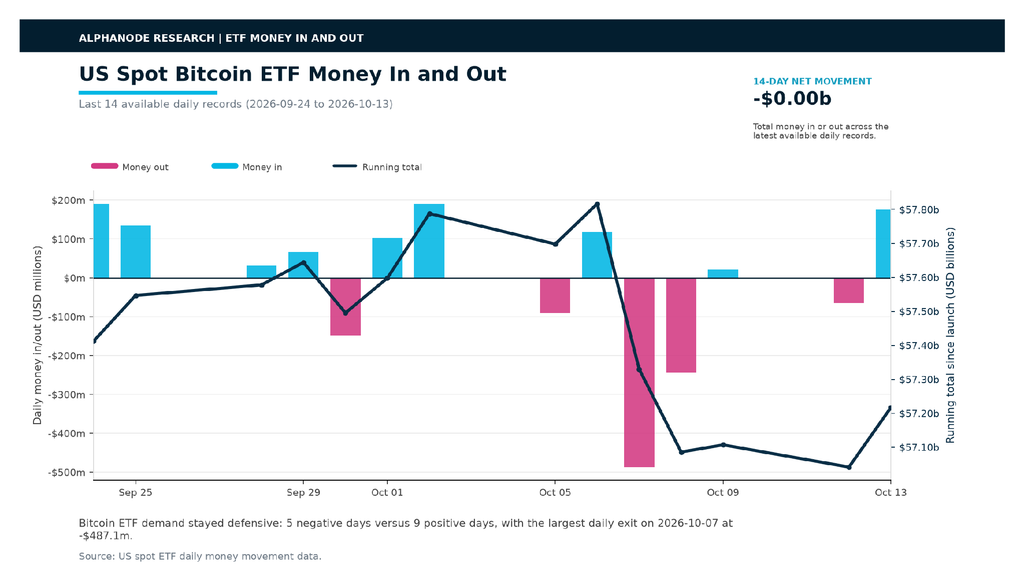
The fund tape turned just before the macro print. United States spot Bitcoin funds took in $175.6 million on October 13, the largest single day of the week and the first sizeable inflow since October 7, when $487.1 million left. Across the fourteen sessions to October 13 the funds are roughly flat at minus $4.7 million, with nine positive days against five negative ones, and net assets stand at $106.98 billion on $57.22 billion of cumulative inflows. The three settled sessions inside this report’s window netted $131.3 million, so the buyers were present going into the inflation release rather than after it.
The macro did the damage and the market did the rest. A hot September CPI print lifted the odds of a Federal Reserve rate hike and pulled the price lower within minutes of the release, with equities losing about $1 trillion of value on the day. Against that, BNY and Citadel Securities settled a tokenised Treasury through the repo market and Standard Chartered opened direct bitcoin trading to wealthy UAE clients, two markers that the institutional build-out did not pause for the data.
Watch $81,034, the week’s low, and the $81,247 fifty-day average that sits just above it. A close below both would move the argument from a correction inside an uptrend to a test of the $80,394 twenty-day low and then the $75,000 zone AltFins flags. Resistance is $84,352, the week’s high, and then $86,462 at the upper band. The $83,000 shelf is the level that matters most, because the recovery was built on it and the week ended below it.
Ethereum Market Analysis
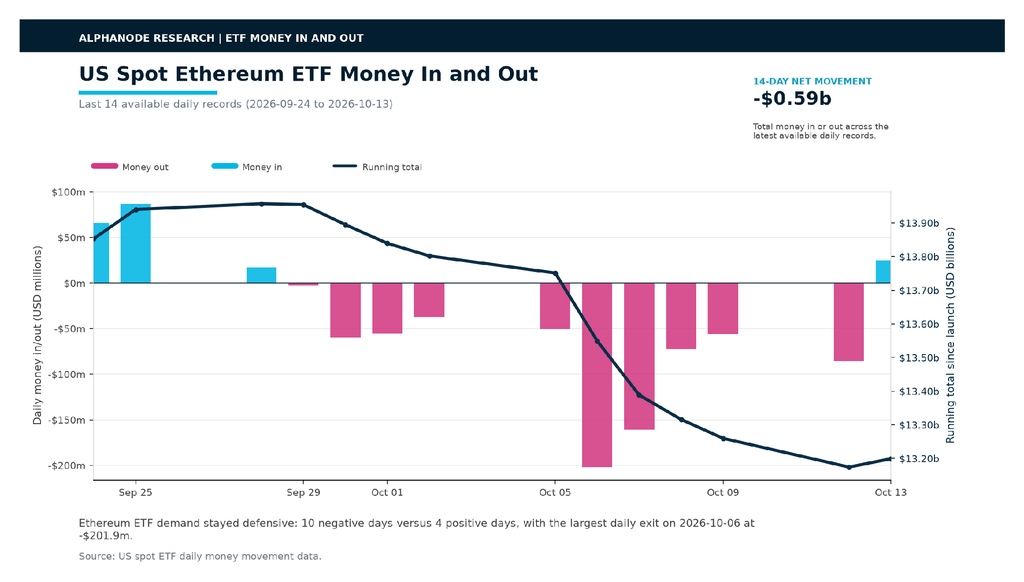
Ether finished near the bottom of its range while Bitcoin finished flat, and the flows explain most of the gap. Ether closed at $2,423, down 2.10% from $2,475 on October 9, against Bitcoin’s 0.05% decline. United States spot Ether funds lost $587.7 million across the fourteen sessions to October 13, a period in which only four of fourteen days were positive, and net assets fell from $17.70 billion on September 24 to $15.83 billion.
Source: https://altfins.com/technical-analysis
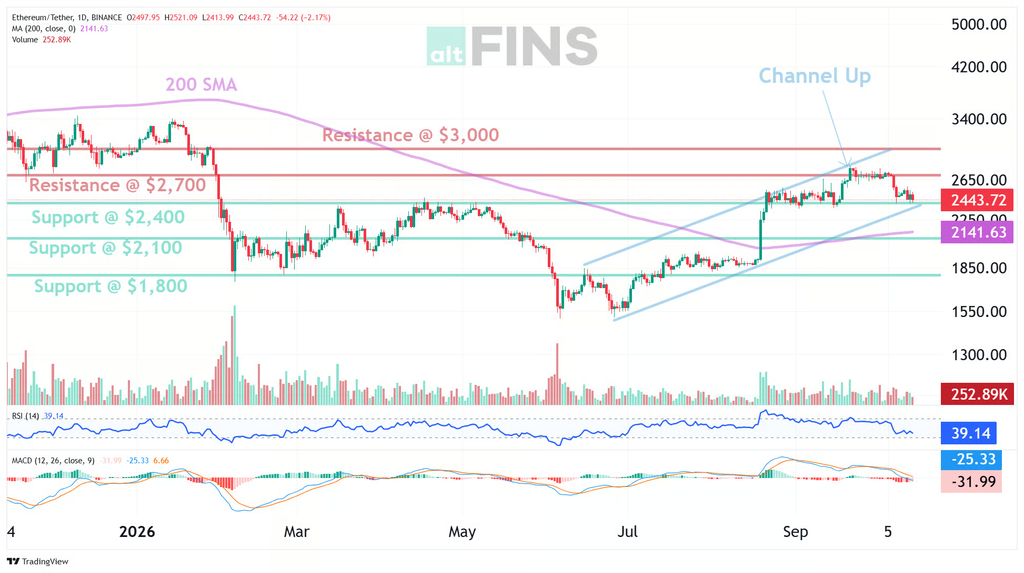
The price path carried the same rejection the weekly move suggests. Ether traded up to $2,580 on October 12 before the macro turn, then gave back 3.54%, and October 14 brought a further 3.06% decline to $2,422. The seven-day range of $2,404 to $2,580 is wide against a close near the low, and the final session was almost flat. The $2,700 level the weekly high sat beneath has now been tested and rejected, which leaves the pullback rather than the breakout as the story.
Momentum is weaker than Bitcoin’s on every short-term measure. RSI-14 sits at 27.4, inside oversold, and RSI-9 is lower still at 22.7, while the MACD histogram reads minus 32.35. ATR-14 of $84.44 and a Bollinger spread of $2,382 to $2,819 put price close to the lower band, and the stochastic reading of 5.1 says the move has few sellers left in the immediate range. Price is 6.82% under the twenty-day average and 5.16% below the fifty-day, a deeper discount than Bitcoin’s. AltFins reads a failed break above $2,700 and a channel-up structure, with the nearest support at $2,400 and then $2,100, and resistance at $2,700 and $3,000.
Source: https://sosovalue.com/assets/etf/us-eth-spot
The fund flow was the week’s clearest signal and it flipped at the end. Ether funds had bled money for most of the fortnight, including $201.9 million out on October 6 and $160.8 million on October 7, but October 13 brought $24.8 million in, the first positive day since October 2. Net assets steadied at $15.83 billion and cumulative inflows hold at $13.20 billion. A single inflow day does not reverse a fortnight, and the composition matters: Bitcoin funds are near flat over the same window, so the rotation has favoured the larger asset.
Valuation keeps the recovery honest. Ether trades 51.19% below its August 2025 record of $4,956.67 and 60.70% above its 52-week low, and its three-month gain of 31.54% still edges Bitcoin’s 27.81% even after this week’s underperformance. The tokens bought near the peaks remain above the current price, and that supply is what any move back toward $3,000 has to absorb.
What could change the balance is onchain demand of a different kind: AI agents completed 138 million x402 payments on Base in a year, and Solana’s Alpenglow upgrade targets the same settlement speed race from the other side. Watch $2,404. Holding it keeps the channel intact and leaves a path back to $2,700; losing it opens $2,100, a level that has not traded since the recovery began.
Tokenised Treasuries Land On Wall Street’s Repo Rails
BNY completed a triparty repo workflow with Citadel Securities on October 13 using a tokenised representation of a United States Treasury, the first use of a tokenised asset on a major triparty repo platform. Citadel Securities bought a two-year Treasury note through BNY on Tradeweb, after which BNY recorded a tokenised version of the security on its private digital ledger and settled it within minutes instead of the standard next-day cycle. Citadel Securities then pledged the tokenised Treasury as collateral in an overnight repo, with BNY supplying the cash. The two legs, buying the security and financing against it, ran inside one connected workflow rather than across separate systems.
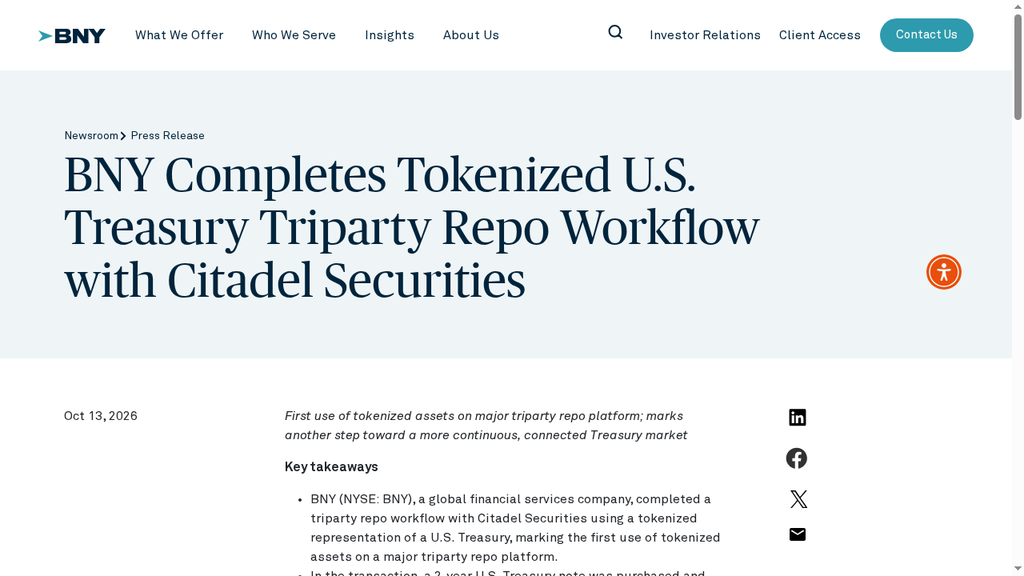
The chart carries the claim in the firms’ own words. A triparty repo puts a third party between the cash borrower and the lender to manage collateral, and BNY already sits in that role as a settlement agent and collateral manager for United States Treasuries. That position is why the tokenised note slotted into existing infrastructure rather than a new venue: the collateral manager could represent the security digitally and accept it as margin without changing the financing agreement around it. Carolyn Weinberg, BNY’s chief innovation and market transformation officer, said the transaction shows what becomes possible when tokenised assets are used in institutional workflows, and that a tokenised Treasury across settlement and financing supports a more connected and always-on system.
The consequence is about hours and settlement risk rather than novelty. BNY plans to add digital cash and tokenised deposit capabilities for institutional clients and to extend the operating hours of its Fed-eligible securities and triparty settlement platforms into European and Asian trading hours in 2027. That is a smaller change on its face than a live tokenised market and a larger one underneath, because the repo market’s closed hours are what force firms to hold buffers they would rather not. The DTCC has its own tokenisation service scheduled for rollout this month, and the two efforts point the same way: collateral that moves in minutes and settles around the clock, which compresses the operational risk that the current next-day cycle forces everyone to price.
Source: BNY, “BNY Completes Tokenized U.S. Treasury Triparty Repo Workflow with Citadel Securities”, press release, 13 October 2026.
Solana Swaps Consensus Engines On A Live Network
Solana will activate Alpenglow on mainnet in epoch 1064, expected to begin at about 15:00 UTC on October 21, replacing TowerBFT, the consensus protocol the network has run since it launched. The upgrade targets transaction finality in roughly 150 milliseconds against the current 12.8 seconds. Finality is the point at which a transaction can no longer be reversed, and the change happens on a running network through a handoff rather than a restart, which Anza, the team behind the Agave validator client, describes as 18 months of work for a migration that takes one slot.
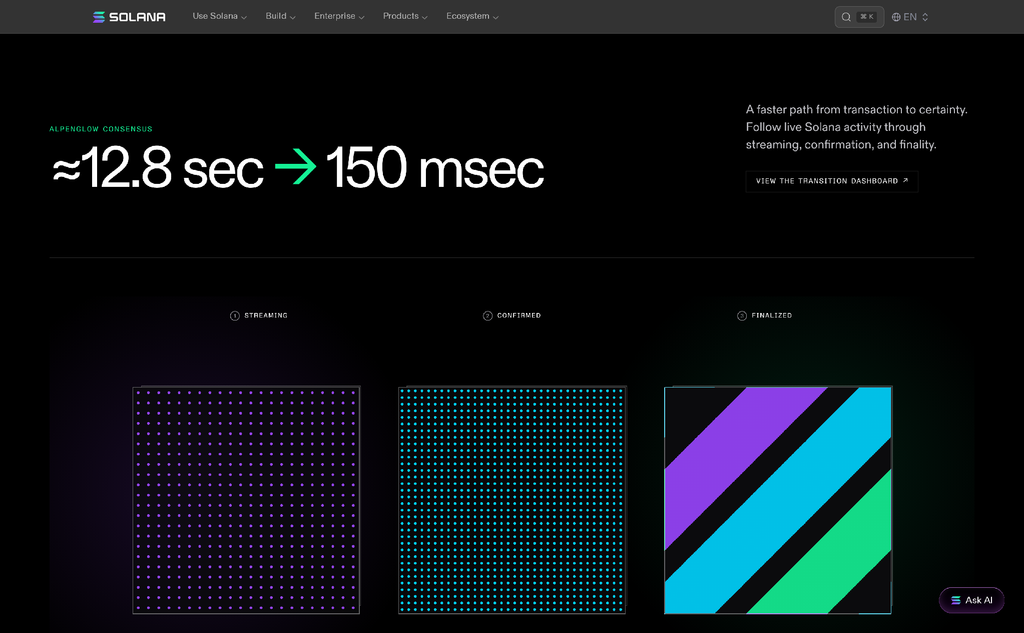
The mechanism explains the speed. Under TowerBFT, validators vote by putting vote transactions inside blocks, and a block is final once those votes stack up over 32 slots. Alpenglow moves votes off the chain: validators send them directly to one another and bundle enough approvals into a certificate that finalises a block in one or two rounds, tolerating 20% malicious stake plus 20% offline stake. Block time was cut separately, from 400 to 200 milliseconds, in stages that completed this month. The migration runs in two parts. The feature gate activates at an epoch boundary, then 5,000 slots later blocks stop carrying user transactions and hold only votes before consensus hands over to the new engine. Validators need an Agave 4.3 client and 0.8 SOL in their vote accounts, and operators running Firedancer or Frankendancer must switch clients before the gate flips.
A 150-millisecond finality target changes what the network can be used for. Card and ledger settlement clears in seconds to days, and cash settles in hours; a chain that finalises in milliseconds can settle a payment outright instead of reconciling against an intermediary later, which is the property the x402 agentic-payment flow on Base is already testing at 138 million transactions a year. The migration also produces a reporting wrinkle: because validator votes leave the blocks, Solana’s headline transaction count could fall sharply on activation day even if activity is unchanged, so the number to watch afterward is fee-paying activity rather than raw transactions. The first pressure test is whether the two-round consensus holds 150 milliseconds as stake distribution shifts, because the figure is an expectation measured against one stake layout, not a constant.
Source: Solana, Alpenglow consensus page, finality architecture and mainnet activation detail, accessed 15 October 2026.
Mark Your Calendars
Economic Data Releases:
- October 16, 2026 (Friday): US industrial production and capacity utilisation for September.
- October 20, 2026 (Tuesday): US housing starts and building permits for September.
- October 23, 2026 (Friday): University of Michigan final consumer sentiment reading for October.
Token Unlock
- October 17, 2026 (Saturday): deBridge (DBR) unlocks US$11.81 M (10.25% of released supply).
- October 17, 2026 (Saturday): zkSync Era (ZK) unlocks US$2.65 M (2.46% of released supply).
- October 20, 2026 (Tuesday): LayerZero (ZRO) unlocks US$45.24 M (3.61% of released supply).