Bitcoin Price Drop as AI Funding Competes for Capital
19th November 2026 • 9 mins read
This Week’s Recap
- Bitcoin, stocks wobble as Fed’s Waller talks of ‘shock’ 50-point rate hike: Bitcoin broke below $63,000 as Waller argued for double the consensus move at the December meeting. CME FedWatch still showed a quarter point priced above 95%, which leaves the risk in the tail rather than the base case.
- Bitcoin ETFs lose $240M as CryptoQuant flags bearish market phase: IBIT carried $210 million of the $240 million exit on 17 November. CryptoQuant’s analyst consensus index fell to its most bearish since November 2025 and its demand measure is contracting at the fastest pace since 1 July.
- Wells Fargo’s reported BlackRock bitcoin ETF holdings double to $2.35 billion: The bank reported 49.58 million IBIT shares at 30 September, up from 24.4 million worth $812 million in June, equal to about 28,070 bitcoin. The filing includes client positions and stops at the quarter end, before the run of redemptions.
- CoinShares sells all treasury ETH, halves SOL holdings for buybacks: The manager raised $19.3 million in October, $16.6 million from ether and $2.7 million from solana, against a $40 million buyback authorisation. Revenue fell 45% to $27.7 million and the shares are down 63% from their April debut.
- Strategy buys $33M in Bitcoin, spends $228M on STRC buybacks: The company added 485 bitcoin at an average of $68,887, taking holdings to 850,849 coins, and spent nearly seven times as much repurchasing preferred stock. MSCI confirmed it will drop Strategy from its global indexes after the 30 November close.
- Ethereum’s Glamsterdam upgrade risks breaking up to 15,000 automated apps: An Ethereum Foundation developer told a core call that gas repricing could alter the behaviour of up to 15,000 contracts, a tiny share of roughly 90 million, with a few hundred thousand dollars at risk. Audits by ChainSecurity and Dedaub found hundreds of separate compatibility problems.
- U.S. judge says Ethereum has ‘no terms of use,’ clears MIT brothers of $25 million fraud: Judge Jessica Clarke granted judgment of acquittal on 16 November, ending the first criminal MEV prosecution. Wire fraud needs a material misrepresentation, and a bait transaction on a public mempool is not one.
- Nvidia board rejects Huang comeback despite record $116B quarter: Revenue of $115.8 billion beat the $109.3 billion consensus by 5.6% and the current quarter is guided to $130 billion. The board said it does not intend to reinstate the founder, leaving Colette Kress as interim chief executive.
- Ondo to launch tokenized Anthropic stock on IPO day: ANTon will be mintable and redeemable around the clock for non-US investors from the first session, joining more than 450 tokenised stocks and ETFs on a platform that has passed $1 billion of total value locked. Holders get price exposure, not shares.
- Circle turns to DBS as banks build rival digital payment systems across Asia: Qualified corporate clients can mint and redeem USDC directly through Singapore’s largest bank, around the clock. DBS and JPMorgan’s Kinexys launched 24/7 tokenised deposit transfers between Singapore and the United States two days earlier.
- World Bank Group taps Circle and Citi to test stablecoin-based fund disbursements: The group will pilot an intermediated stablecoin rail alongside correspondent banking, with borrower countries participating. Disbursement cost and settlement time are the two numbers the pilot is designed to move.
- Variational raises $110 million at $1.5 billion valuation to expand onchain derivatives: Bain Capital Crypto led the round. Omni has processed $475 billion of volume since early 2025 and carries $1.3 billion of open interest, with traditional markets more than half of daily flow.
- Solana Foundation takes majority interest in crypto data firm CoinGecko: The foundation confirmed a majority position without disclosing terms. A chain foundation owning the pricing reference that allocates capital across the market is a conflict the industry has not had to price before.
- XRP whales moved $270 million during the selloff. The coins didn’t go to exchanges: Two wallets received 281 million XRP as the token slid from $1.29 to about $0.97, and neither is an exchange deposit address. Both were opened weeks earlier and tested with small transfers, which reads as custody rather than an exit.
- Lighter suspends all withdrawals after $10.4 million crypto exploit: A leaked trading API key was enough to drain the exchange while its contracts stayed intact. Investigators traced the funds to Hyperliquid, and the pause shows how quickly an operational key becomes a solvency event.
- German judge proposes dropping Movie2k case if operator hands over $2.56 billion in bitcoin: The proposed settlement asks for 40,000 bitcoin and EUR38 million, leaving the defendant about 16,000 of the 56,000 coins prosecutors say he holds. A forfeiture that size is supply the market has to price.
Bitcoin Market Analysis
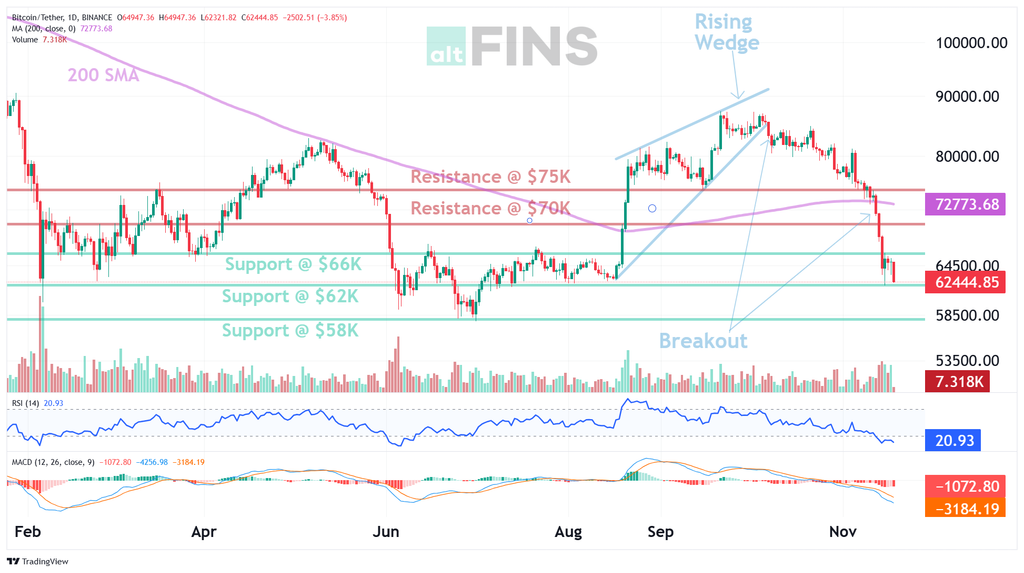
Bitcoin gave up the whole of November in five sessions. It opened the window at $71,460 on 13 November, lost 4.40% that day to $68,314 and another 6.10% on 14 November to $64,150, then printed the low of $62,006 on 15 November before closing that session at $65,351. Two quiet days followed near $65,000, and 18 November took 2.89% back to $63,068. The high of $71,514 came on the first day and was never tested again. Volume ran $2.05 billion on 13 November, $2.15 billion on the day of the second leg down, and $1.19 billion on 18 November, which is what a market looks like when sellers have stopped needing to hurry.
Source: https://altfins.com/technical-analysis
Momentum is at the bottom of its range without a reversal signal. RSI-14 reads 11.8 and RSI-9 10.7, the lowest readings of 2026 and far below the 30 line that usually marks capitulation. The MACD line at minus 4,356.96 sits $946.19 below its signal, and AltFins notes the histogram has begun to rise, which is the first mechanical sign that the decline is decelerating rather than accelerating. ATR-14 of $2,454 puts a normal day at 3.9% of the price, the Bollinger range of $60,664 to $83,501 leaves the close 3.7% above the lower band, and a stochastic reading of 6.4 says the last fortnight has been sold almost without interruption.
Every average above the price is now resistance. Bitcoin trades 2.03% below its five-day average, 12.69% below the twenty-day at $72,082, 19.58% below the fifty-day at $78,255 and 13.43% below the 200-day at $72,698, which it lost on 13 November along with the $75,000 shelf. The one-month loss of 24.20% against a three-month loss of 19.66% means the entire quarter’s damage happened in the last thirty days. AltFins reads the structure as a bearish break from a rising wedge, with $62,000 the first support because price held there in February, $58,000 the August low behind it, and resistance at $70,000 and then $75,000. The record of $126,217.71 from October 2025 is 50.14% away and the 52-week low of $57,793.56 is 8.89% below.
Source: https://sosovalue.com/assets/etf/us-btc-spot
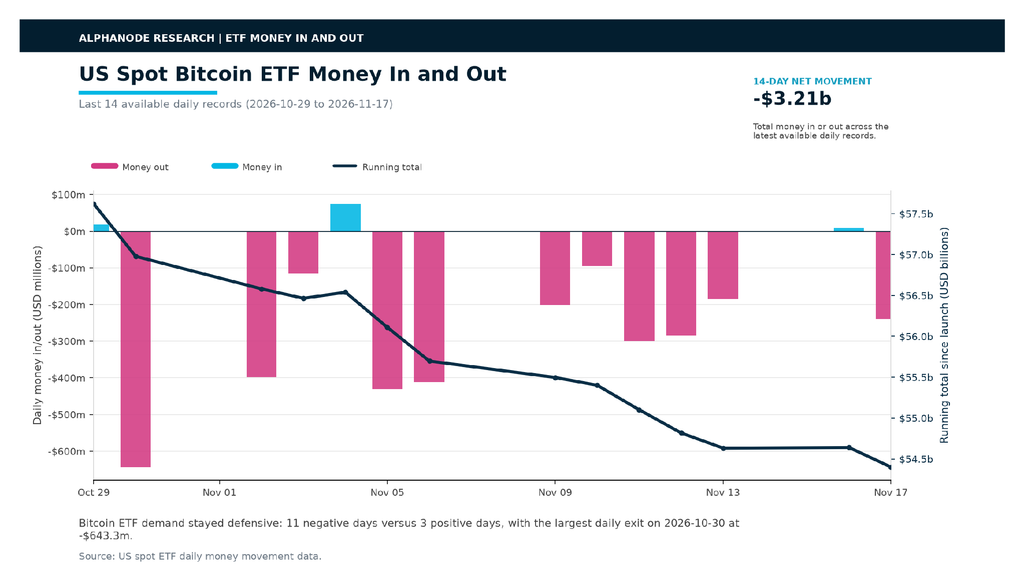
The funds have not stopped selling into the fall. Across the fourteen sessions to 17 November, United States spot bitcoin funds are net minus $3.21 billion, positive on three days and negative on eleven, and the money inside them fell to $79.65 billion from $104.27 billion on 29 October. The week itself was minus $417.4 million: $185.5 million out on 13 November, then a $76.5 million inflow into IBIT on 16 November that ended an eleven-session, $2.35 billion streak, then $239.9 million out on 17 November with IBIT carrying $210 million of it. Cumulative inflows of $54.40 billion are still intact, so this is a mark-to-market retreat rather than a run on principal. The direction is what matters: the marginal buyer of 2025 has become the marginal seller.
The macro case tightened again. Waller’s argument for a 50 basis point move in December is a deliberate attempt to reprice the front end, and the market has taken the hint while keeping the base case at a quarter point. October CPI at 0.4% and a core rate of 0.3% already removed the argument for patience, and the next PCE print on 25 November is the last inflation number before the 9 December meeting. CryptoQuant now reports thirty-day net capital outflows of $8.7 billion and a demand measure contracting at its fastest since July, which is the flow side of the same story the price is telling.
The supply side turned as well. Strategy bought 485 bitcoin for $33.4 million at an average of $68,887, less than a fifth of what it spent repurchasing its own preferred stock, and MSCI will remove it from its global indexes after 30 November. CoinShares sold its entire ether treasury and half its solana to fund buybacks, and MARA is borrowing again after liquidating $1.1 billion of coins. The levels that decide the next move are close: $62,006 the weekly low, $60,664 the lower Bollinger band, then $58,000. A close above $64,237 would clear the five-day average, and only $70,000 changes the trend.
Ethereum Market Analysis
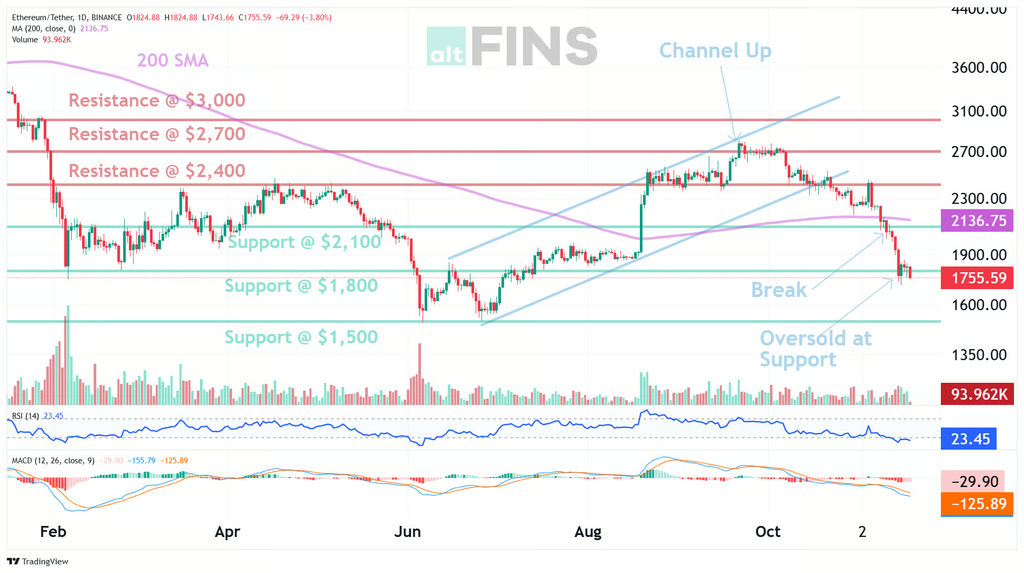
Ether lost the floor that had held for a year. The $2,100 to $2,150 zone and the 200-day average at $2,134 had contained every test since the spring, and the break below both on 14 November turned the uptrend channel into a downtrend in a single session. Price fell 8.33% that day to $1,769 from $1,930, having opened the window at $2,020, and the low of $1,711 came on 15 November. The recovery to $1,835 the same day did not hold, and the close at $1,775 leaves the token 64.19% below its August 2025 record of $4,956.67.
Source: https://altfins.com/technical-analysis
The weekly path was more violent than bitcoin’s at every step. Ether lost 4.45% on 13 November, 8.33% on 14 November and 2.61% on 18 November, and the two positive sessions added 3.73% and 0.23%, which is a market that can rally for a day but not for two. Volume of $0.87 billion on 14 November was the heaviest of the window against $0.52 billion on 18 November, so the biggest day was the break and the follow-through lighter. The high of $2,021 on the opening session is the only level the week did not revisit.
The oversold readings are deeper than bitcoin’s on every measure. RSI-14 at 13.3 and RSI-9 at 17.3 are both below bitcoin’s, and RSI-25 at 26.8 says the selling has run for a month rather than a week. The MACD line at minus 156.27 sits $24.58 below its signal, ATR-14 of $96.64 puts a normal day at 5.4%, and the stochastic reading of 11.8 is nearly double bitcoin’s, which is the difference between a market that has stopped falling and one that is still being sold. Ether is 14.09% below its twenty-day average, 23.14% below the fifty-day at $2,310 and 16.83% below the 200-day at $2,134.
Source: https://sosovalue.com/assets/etf/us-eth-spot
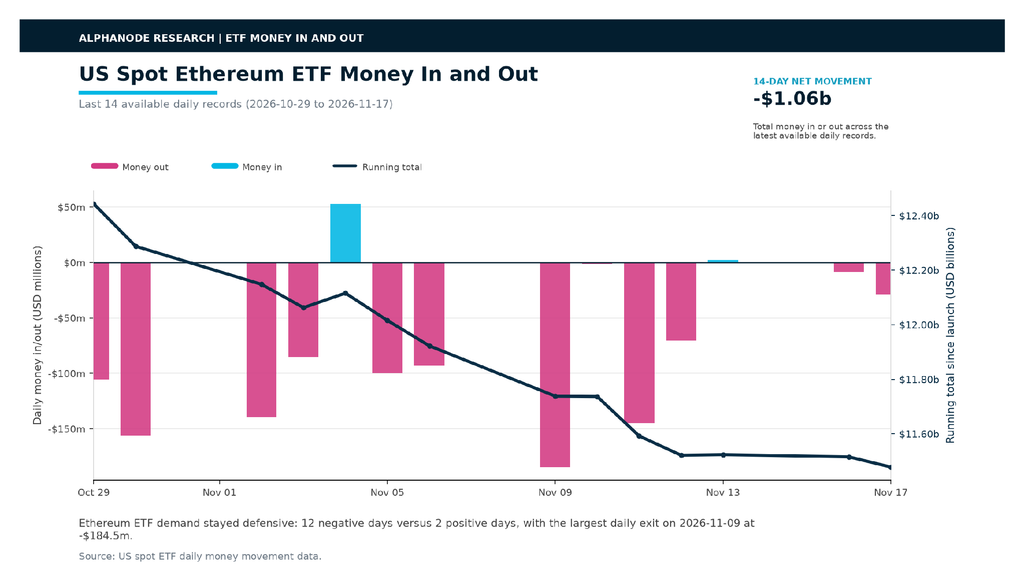
Ether funds are shrinking faster than the price. Across the fourteen sessions to 17 November they lost $1.06 billion, negative on twelve days, and net assets fell to $9.97 billion from $13.98 billion on 29 October, a 28.7% decline against bitcoin’s 23.6%. The week was small in dollar terms at $35.0 million net, because a $2.4 million inflow on 13 November and $29.1 million out on 17 November nearly cancelled, but the level is the point: the funds hold less than half the assets they held at the start of the year. Cumulative inflows of $11.48 billion mean the redemption is coming out of this year’s mark.
The structural news is not helping. Glamsterdam’s gas repricing could change the behaviour of up to 15,000 contracts, and core developers were due to decide on 19 November whether to keep the changes or delay the fork by four to six months. Against that, staking reached a record 36.3% of supply with a queue of 2.42 million ether waiting to enter, which locks coins but also signals that holders expect little from price in the near term. CoinShares sold its whole ether treasury at a loss in October, and the corporate treasury bid that supported the token through 2025 has become a source of supply.
The chart sets the boundaries. AltFins puts the nearest support zone at $1,500, with the $1,800 shelf above it where the first bounce would have to start, and resistance at $2,400 and then $2,700. The 200-day average at $2,134 is now 20% above the price rather than beneath it. The first thing to watch is whether $1,711 holds on a closing basis, because the lower Bollinger band at $1,658 sits directly behind it and the 52-week low of $1,505.52 is 17.9% below. A bounce that fails at $1,875, the nine-day average, would confirm the break rather than repair it.
The AI Listing Takes The Money Crypto Needed
Anthropic will price its initial public offering on 18 November and start trading on Nasdaq as ANT on 19 November, selling 825 million Class A shares at $70 to $78 each. That range values the company at about $1.02 trillion on shares outstanding and $1.404 trillion on a fully diluted basis, and the offering raises $57.75 billion to $64.35 billion before a concurrent $26 billion private placement of non-voting Class N stock, in which Nvidia and Google each take $10 billion. Net proceeds land between $84.6 billion and $93.7 billion. The order book was reported as covered at the range and oversubscribed several times over, with underwriters weighing a price at or above $78.
Source: Nvidia, “NVIDIA Announces Financial Results for Third Quarter Fiscal 2027”, revenue and GAAP summary table, quarter ended 25 October 2026, captured 19 November 2026.
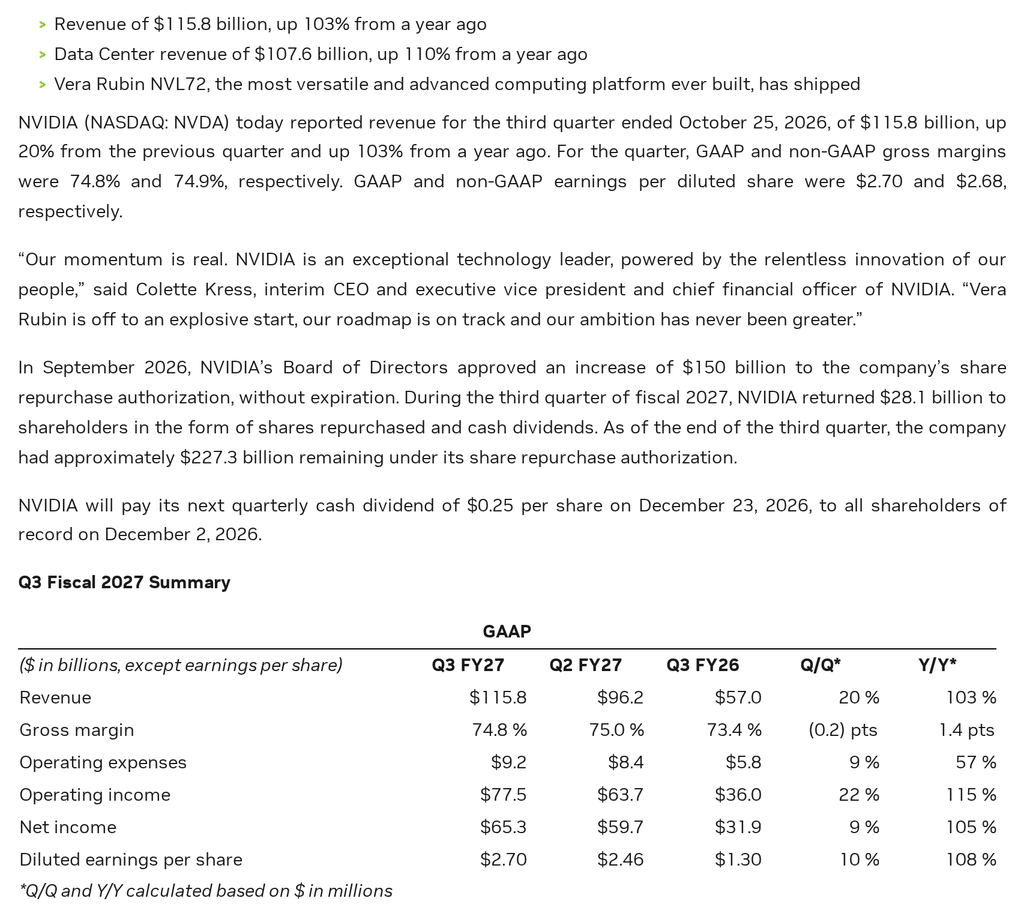
The visual shows where the money on the other side of that trade is being made. Nvidia reported $115.8 billion of revenue for the quarter to 25 October, up 103% from $57.0 billion a year earlier and 20% from the previous quarter, with data centre revenue of $107.6 billion and a $130 billion guide for the current quarter. Gross margin held at 74.8%, operating income reached $77.5 billion and net income $65.3 billion, and the company returned $28.1 billion to shareholders in the quarter while adding $150 billion to its buyback authorisation. One quarter of Nvidia revenue is 2.13 times the $54.40 billion that United States spot bitcoin funds have gathered since they launched in January 2024.
That comparison is the whole argument. Crypto’s institutional bid was built on a flow story: an ETF wrapper, a treasury company, a pension allocation, each adding a few hundred million a month. The artificial intelligence complex does not need that flow, because it generates the cash and then issues equity against it. Anthropic’s own filing shows run-rate revenue of $81 billion at the end of October, up from $47 billion in May, and commitments for compute and infrastructure of $900.9 billion. Capital that was looking for a growth asset in 2024 now has a listed one with audited revenue and a trillion dollar mark.
The consequence for digital assets is a bid that thins whenever the calendar is crowded. Bitcoin’s demand measure is contracting at its fastest pace since July while the largest listing in a decade prices, and the correlation runs through liquidity rather than narrative: an investor funding an IPO allocation sells the most liquid risk asset in the book, and bitcoin is that asset. The pressure points are the first ANT trade on 19 November, the PCE print on 25 November and the December FOMC, where Waller wants a 50 basis point move. A quiet calendar in December would do more for bitcoin than any crypto-specific catalyst on offer this month.
A Judge Finds Ethereum Has No Terms Of Use
Judge Jessica G. L. Clarke of the Southern District of New York granted judgment of acquittal to Anton and James Peraire-Bueno on 16 November, dismissing wire fraud, conspiracy to commit wire fraud and conspiracy to commit money laundering. The government alleged the brothers exploited a bug in relay software to see pending trades and took $25 million in twelve seconds in April 2023. A jury could not reach a verdict a year ago and the court declared a mistrial. The 46-page opinion ends the first criminal prosecution built on maximal extractable value.
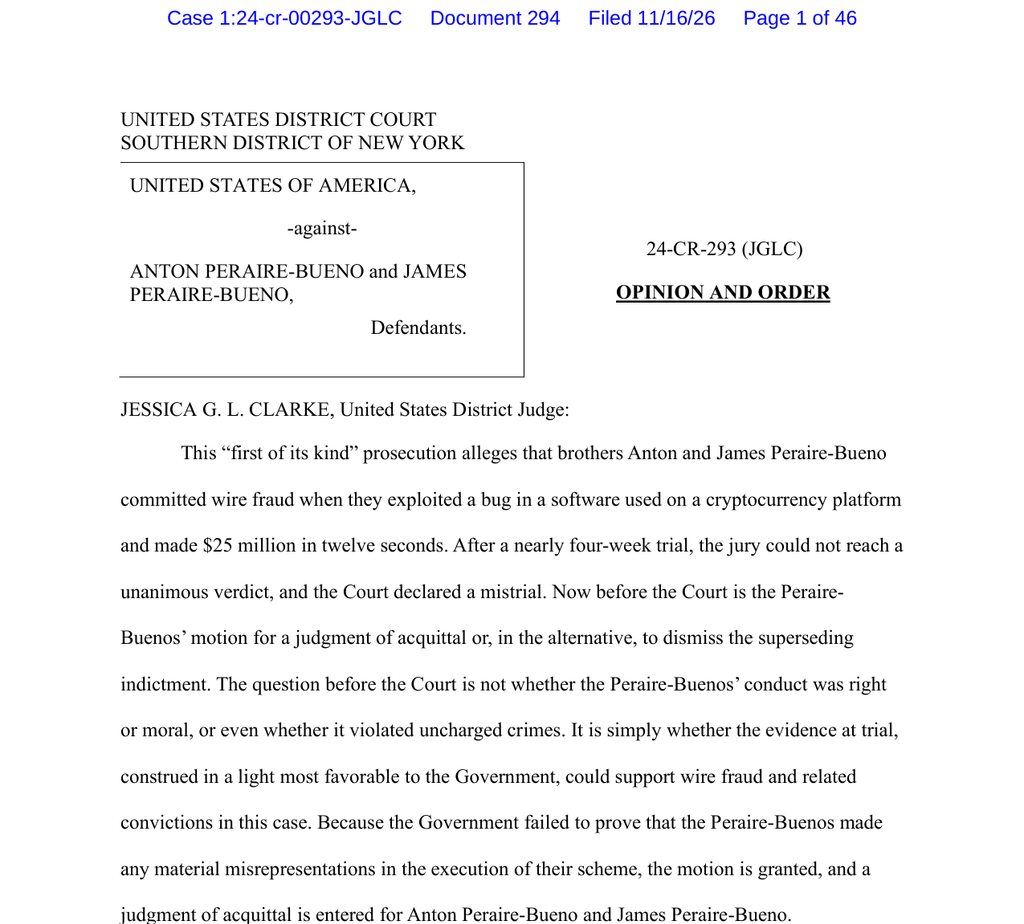
Source: United States District Court, Southern District of New York, United States v. Peraire-Bueno, opinion and order, page 1 of 46, filed 16 November 2026.
The first page carries the holding. The case is 24-CR-293 (JGLC), filed 16 November 2026, and the judge frames the question narrowly: not whether the conduct was right or moral, but whether the evidence, construed in the light most favourable to the government, could support a conviction. It could not, because wire fraud requires a material misrepresentation, and the government’s theories did not supply one. The brothers’ bait transactions were never a promise about execution order, and the falsified field in the proposed block had no effect because the relay never checked it before releasing the data.
The reasoning reaches past the defendants. Clarke describes Ethereum as “a trustless, highly adversarial environment with no terms of use”, which is the sentence every protocol lawyer will now have to work around. If there are no terms, there is no representation for a counterparty to rely on, and the traditional spoofing analogy fails because the orders were real, visible and never withdrawn. The court also noted in a footnote that the prosecution raised due process concerns without ruling on them. The practical effect is that code-level expectations are not contractual ones, and a market built on automated strategies now has a ruling that says outsmarting another bot is not fraud. Protocols that want recourse will have to publish terms, because a court has now confirmed that silence is not a promise.
Mark Your Calendars
Economic Data Releases:
- November 25, 2026 (Wednesday): October PCE price index, and the second estimate of third quarter GDP.
Token Unlock
- November 19, 2026 (Thursday): LayerZero (ZRO) unlocks US$32.01 M (3.48% of released supply).
- November 24, 2026 (Tuesday): Monad (MON) unlocks US$242.19 M (33.45% of released supply).