
Bitcoin Holds as Wall Street Buys Yield
13th August 2026 • 8 mins read
This Week’s Recap
- Goldman Sachs agreed to acquire NEOS for up to $2.25 billion: NEOS manages roughly $30 billion, including the Bitcoin High Income ETF. Goldman is buying a working options-income platform instead of building one fund at a time.
- US CPI eased to 3.4% in July: The reading matched forecasts and pulled Treasury yields lower. Bitcoin held near $64,000, but softer inflation did not clear the $65,000 resistance that stopped several attempts this month.
- Harmony’s ONE plunged after a suspected four-billion-token mint: The alleged mint equalled roughly a quarter of supply and pushed the team to study a patch and possible rollback. The technical fix now carries a governance decision over which transactions survive.
- Russia proposed tighter limits for retail crypto buyers: Non-qualified investors would be limited to Bitcoin, Ether, and USDT, with purchases capped at 300,000 rubles per intermediary each year. The rule concentrates retail access in the three most liquid assets.
- Fidelity outlined staking and quarterly payouts for its Ether fund: FETH would keep 85% of gross staking rewards after a 15% service fee. Cash distributions would turn protocol rewards into a conventional income stream for brokerage accounts.
- Wintermute mapped a $1 billion expansion beyond crypto: The market maker wants traditional and AI-linked markets to produce half of revenue by 2027. Crypto-native trading infrastructure is becoming a launch point into broader electronic markets.
- CoreWeave reported $2.58 billion in quarterly revenue: Shares rose 16% as demand for AI capacity lifted the power-and-data-centre trade. Bitcoin miners with grid access are being valued against that revenue opportunity.
- Public miners sent an estimated $1.78 billion of Bitcoin into the market: Treasury sales added supply while price struggled below $65,000. The AI pivot can raise equity valuations and still create near-term Bitcoin selling when construction needs cash.
- Kalshi supplied a 15-millisecond data feed to a Solana trading venue: The integration targets institutional order books where stale quotes are unacceptable. Prediction markets are borrowing the market-data standards of equities and futures.
- The Bank of England moved stablecoins into its Digital Pound Lab: Polygon, NOBO Finance, and Dun & Bradstreet will test a cross-border trade-finance flow using both private and central-bank money. The experiment puts interoperability ahead of a winner-takes-all currency design.
- Crypto.com introduced tokenised stock derivatives: The exchange entered a segment reported to have grown 600% in a year. Crypto venues are competing for equity exposure without waiting for cash shares to move fully onchain.
- Miden introduced the privacy-focused stablecoin USDCx: Users can shield transaction histories while applications enforce compliance rules through zero-knowledge proofs. The design attacks the disclosure problem that keeps corporate payment flows off public ledgers.
- Bitwise cut 14% of its workforce: The reduction lands while ETF assets continue to grow but crypto prices remain well below last year’s highs. Product expansion has not removed the cost pressure inside asset managers.
- Jupiter added fee-earning collateral through Smart Debt: Borrowed assets can remain in liquidity pools and earn trading fees against their financing cost. The structure improves capital use and adds another path for losses when liquidity shifts quickly.
- Shipfinex set out a $500 million vessel-tokenisation pipeline: The partnership plans to bring 35 ships onto ADI Chain. Maritime finance gives tokenisation a hard asset, contracted cash flow, and an ownership structure that can be tested against existing law.
Bitcoin Market Analysis
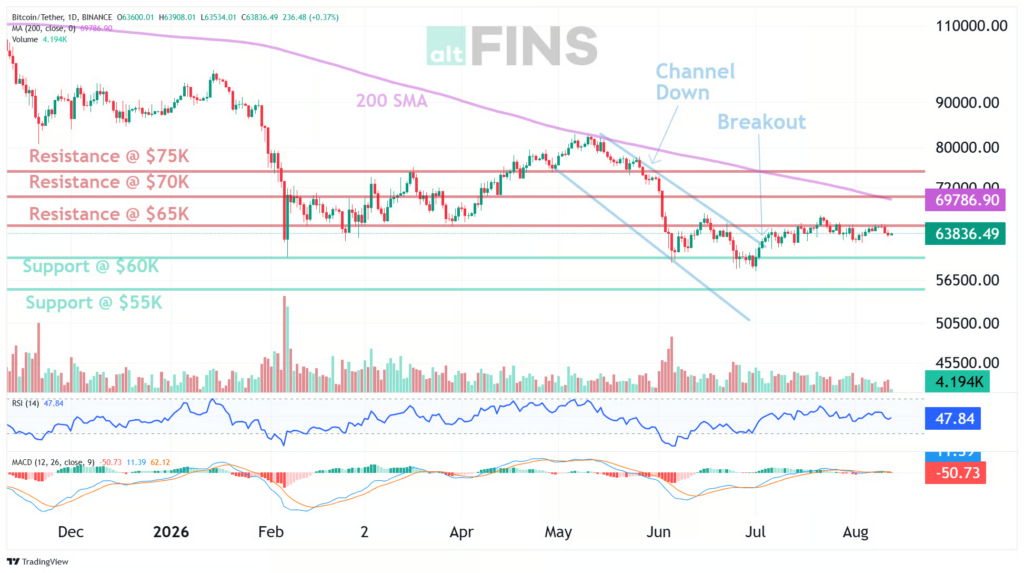
Bitcoin opened the seven-day window at $64,324 and traded near $63,595 early on August 13, a 1.13% decline on the open candle. The range stayed narrow by recent standards. Friday’s $65,391 high led into another rejection at $65,474 on Sunday, while Tuesday set the week’s $63,238 low.
Source: https://altfins.com/technical-analysis
The short-term trend remains down and the medium-term picture is mixed. BTC sits below its 5-day, 10-day, 20-day, and 30-day simple moving averages, with RSI-14 near 41 and a negative MACD histogram. Price is still marginally above the 50-day average at $63,444. That thin cushion is doing most of the work.
$63,238 is the first support inside the weekly range, followed by the AltFins invalidation level at $62,400. The broader chart zones sit at $60,000 and $55,000. Resistance begins at $65,000 and then $70,000. Repeated failures around $65,000 have turned a clean daily close above it into the test for any reversal claim.
Source: https://sosovalue.com/assets/etf/us-btc-spot
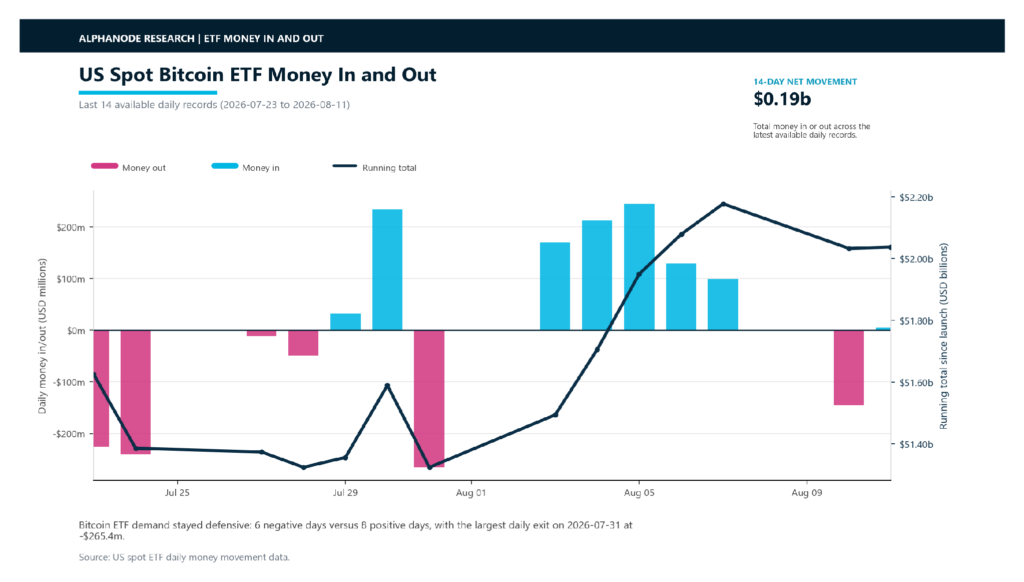
US spot Bitcoin ETFs added $187.0 million across the latest 14 available sessions, with eight positive days and six negative days. The sequence carried more force than the total. Funds took in $244.4 million on August 5, then lost $144.7 million on August 10 before eking out $4.9 million on August 11. Net assets ended at $77.46 billion.
Public miners added an estimated $1.78 billion of selling pressure while several operators redirected power and capital toward AI infrastructure. Those sales help explain why steady ETF demand did not lift price through resistance. A miner can believe in Bitcoin and still sell it to fund the higher-valued business next door.
Goldman’s NEOS agreement changes the wrapper around that demand. BTCI sells call options against Bitcoin-linked exposure and pays monthly distributions. Wall Street is packaging Bitcoin’s volatility as income while spot price goes nowhere. That was the week’s sharper institutional signal.
Ethereum Market Analysis
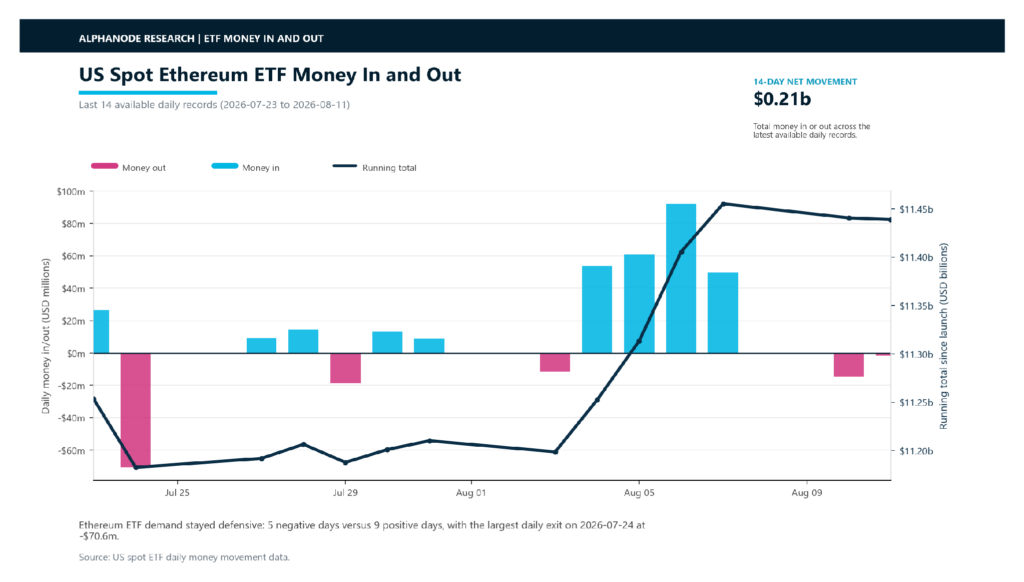
ETF demand gave Ethereum the stronger underlying bid. US spot Ether funds added $211.7 million across the latest 14 available sessions, with nine positive days and five negative days. Four consecutive inflow sessions from August 4 through August 7 contributed $256.4 million before two small outflows. Net assets finished at $10.48 billion.
Source: https://altfins.com/technical-analysis
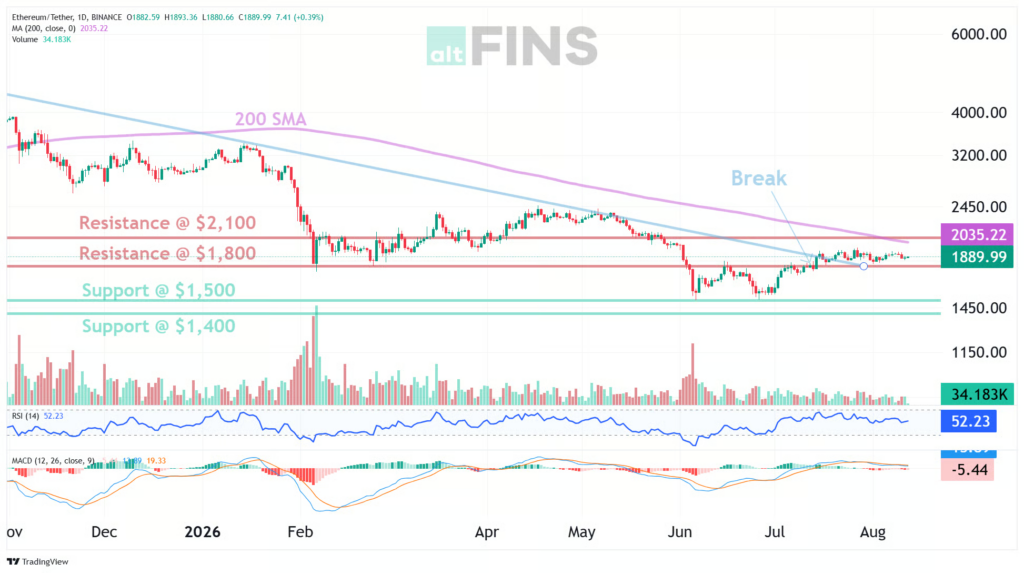
AltFins still treats the move above $1,800 and the descending trendline as a resistance breakout. The medium-term trend is up, although the short- and long-term trends remain down. RSI-14 sits near 43, MACD has turned bearish, and price is clustered around its short moving averages. Buyers have improved the structure without taking control of momentum.
ETH opened at $1,904 on August 7 and traded near $1,882 early Thursday, down 1.19%. Sunday reached $1,938 before Monday’s 1.96% fall knocked price to a $1,873 close. Tuesday set the $1,854 weekly low, and Wednesday’s push to $1,925 faded before the close.
Source: https://sosovalue.com/assets/etf/us-eth-spot
The immediate floor sits between $1,854 and the lower Bollinger Band near $1,842. The reclaimed $1,800 level is the larger breakout boundary, followed by structural support at $1,500. Resistance starts at the $1,943 weekly high, then $1,981 and $2,100. Ethereum needs to hold $1,800 long enough for the medium-term uptrend to matter.
Fidelity’s amended fund proposal would stake available Ether, charge 15% of rewards, and distribute the remaining cash flow quarterly after expenses. The wrapper solves custody and operational work for investors. It also turns validator exits, slashing, and redemption liquidity into fund-management risks.
Vitalik Buterin’s updated roadmap raised native privacy and quantum safety in the protocol’s priorities. Fidelity is making today’s staking yield easier to own as Ethereum plans for a security model that must last much longer. Product maturity and protocol uncertainty arrived together.
Bitcoin Yield Became a Bank Product
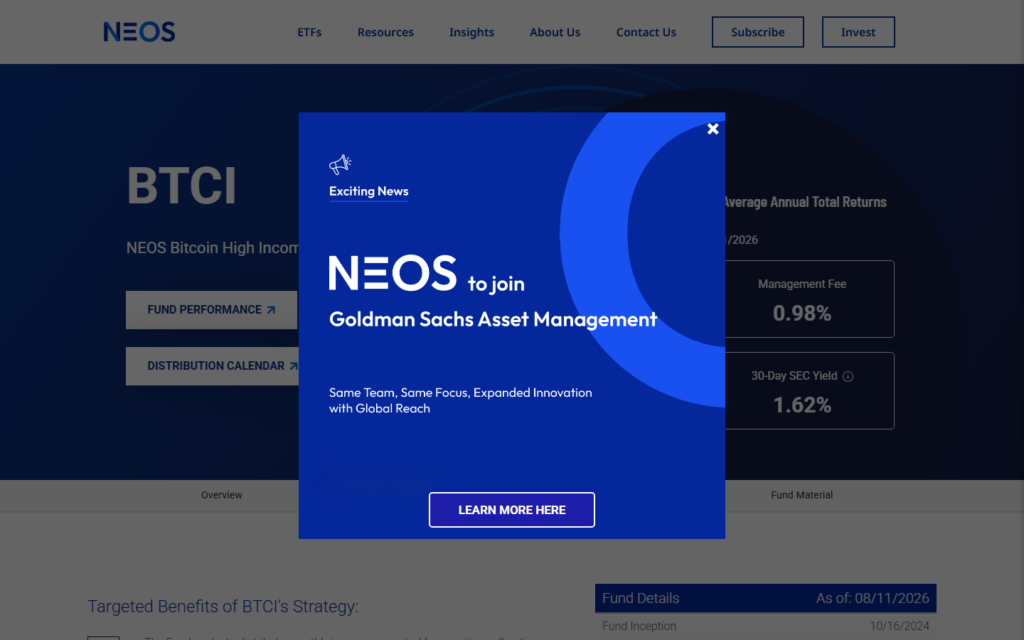
Goldman Sachs is paying up to $2.25 billion for NEOS, a manager built around option-income ETFs. The target brings roughly $30 billion under Goldman’s umbrella and gives the bank a live Bitcoin product with more than $1.1 billion in net assets. Scale arrived before the acquisition.
Source: https://neosfunds.com/btci/
BTCI generated monthly distributions by holding Bitcoin-linked exchange-traded products and writing call options. Its July 31 distribution rate was 26.73%, while the 30-day SEC yield was 1.62%. Most of the headline payout comes from the options structure and return-of-capital treatment, not cash interest produced by Bitcoin.
The deal says more about volatility than direction. Bitcoin can remain trapped below $65,000 and still produce a marketable income stream for advisers. Goldman bought the machinery that turns those price swings into a product.
Stablecoins Entered the Central Bank Lab
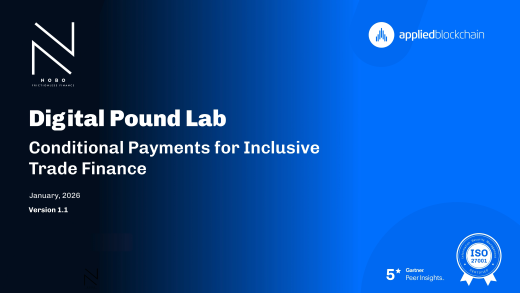
The Bank of England’s Phase 2 test puts a digital pound and stablecoins inside the same cross-border trade-finance flow. Polygon supplies programmable settlement, NOBO Finance brings the financing workflow, and Dun & Bradstreet adds business data. Each piece handles a different source of friction.
Source: https://www.bankofengland.co.uk/the-digital-pound/lab/phase-1-update
The earlier NOBO and Applied Blockchain demonstration used conditional payments for small-business trade finance. Payment locks, verifiable credentials, and shared standards can reduce the gap between approving an invoice and releasing cash. The new test adds interoperability between public and central-bank money.
The experiment does not require stablecoins to replace deposits or a digital pound to replace private money. It tests whether both can settle one transaction with fewer handoffs. Trade finance is a hard place to prove that claim because identity, credit, documents, and payment must all agree.
Mark Your Calendars
Economic Data Releases:
- August 14, 2026 (Friday): US advance retail sales for July and manufacturing and trade inventories for June.
- August 18, 2026 (Tuesday): US import and export price indexes for July, new residential construction for July, and the second-quarter retail e-commerce report.
Token Unlock
- August 16, 2026 (Sunday): YZY (YZY) unlocks US$35.65 M (22.83% of released supply).