
JPMorgan Bitcoin Forecast: 10% a Year as BTC Recovers
22nd October 2026 • 9 mins read
This Week’s Recap
- Elon Musk confirms SpaceX and Tesla merger talks that would unite 30,221 bitcoin: Independent directors at both companies are assessing a tie-up that would combine SpaceX’s 18,712 BTC with Tesla’s 11,509. Musk said the committees have not agreed terms and shareholders would have to approve any deal, so this is a proposal rather than a transaction.
- JPMorgan sees 10% annual bitcoin returns, topping stocks, bonds and gold over the next decade: The bank’s 2027 Long-Term Capital Market Assumptions set a base case of 10% a year for bitcoin against 7.5% for United States large-cap equities and 5.5% for gold, with a bear case of minus 9.7% and a bull case of 17%.
- US spot bitcoin ETFs just saw their biggest day in a month, thanks entirely to BlackRock: The funds added $526.6 million on 19 October, with IBIT pulling in $665.2 million while Fidelity’s FBTC lost $83.6 million and Grayscale’s GBTC shed $54.9 million. Ether funds lost $103.3 million in a fourth consecutive negative session.
- Ether ETF outflows continue, passing $1 billion in October: United States spot ether funds have recorded $1.08 billion in net redemptions this month, with only one positive day in fourteen. The sustained selling is the clearest single difference between the two largest assets this week.
- MSCI makes it official, and bitcoin treasury firms Strategy and Metaplanet are on notice: Companies that mostly hold investments will be ineligible for the MSCI Global Investable Market Indexes after 30 November. JPMorgan analysts estimate Strategy’s removal could move about $2.8 billion of stock, though the selling hits the shares rather than the bitcoin.
- OCC’s final rule to start fresh in weighing stablecoin rewards against the GENIUS Act ban: The OCC is the first federal regulator to finish a rule under the GENIUS Act, due live on 18 January. It gives no safe harbour to existing stablecoin rewards programmes and will assess each arrangement case by case.
- Standard Chartered signs definitive agreements to acquire Zodia Custody: The bank moved from minority investor to full owner of the digital asset custodian. Taking custody in-house removes a third-party dependency for a firm that has been extending its digital asset services across several markets.
- Mastercard opens early access to AI agent payments after pilots with Coinbase, Base and Cloudflare: Card infrastructure is being extended to autonomous agents that transact onchain. Putting a major network behind agent-initiated payments gives the flow a distribution channel it did not have.
- Anza’s Alpenglow goes live on Solana, cutting finality to 150 milliseconds: The consensus swap activated on the running network on 21 October and replaced TowerBFT. Validator votes now move off the blockchain, which can cut Solana’s reported transaction count even if activity holds.
- JPMorgan brings JPM Coin, representing dollar deposits, to Ethereum: The bank is putting its deposit token on a public chain for round-the-clock institutional settlement. A token that represents a bank liability rather than a reserve-backed stablecoin sits closer to the deposit system it comes from.
- Microsoft, Alphabet and Goldman Sachs join objections to OKX-ICE tokenised stock trading: Sixteen listed issuers have now filed formal opt-outs against the tokenised venue. Corporate pushback is becoming organised while more than 360 tokenised stock products already trade.
- France’s parliament approves a 31% tax on crypto-to-stablecoin trades: The measure removes the tax deferral from stablecoin swaps starting January 2027. Taxing the conversion rather than the holding pushes activity toward venues outside France.
- Stablecoins move over $400 million per hour as off-hours transfers dominate: Adjusted quarterly transfer volume reached $891 billion, and 73% of screened volume settled outside United States banking hours. The pattern is the strongest evidence yet that stablecoins are being used for payments rather than only for parking dollars.
- Drift exploiter sends $109 million in ether to Tornado Cash in two days: Addresses tied to the April security incident moved the funds through mixers. Tracing value after a bridge or protocol exploit remains the hard part, and the mixers are the reason.
- Utah attorney-general sues Kalshi over prediction markets: The state filed against Kalshi and market makers over unregistered wagering. A state-level challenge to event contracts adds to the federal fight over who regulates them.
- Grayscale expands in-kind subscriptions to 10 crypto ETFs and trusts: In-kind creation lets large holders move crypto into fund shares without a cash leg. It is a mechanical change, but it lowers the friction and cost of institutional position building.
- Crypto vault deposits top $10 billion as lending risks draw regulatory scrutiny: Curator-managed lending vaults have crossed $10 billion in deposits, and supervisors are asking about collateral quality and liquidity mismatch. Growth of that size moves onchain credit closer to the shape of the money market funds it takes deposits from.
- Monero futures are heating up with leverage, raising volatility risks: Open interest crossed $300 million as spot climbed back above $600. A thin market with rising leverage is where sharp moves start, and privacy coins have few reliable hedges when one arrives.
Bitcoin Market Analysis
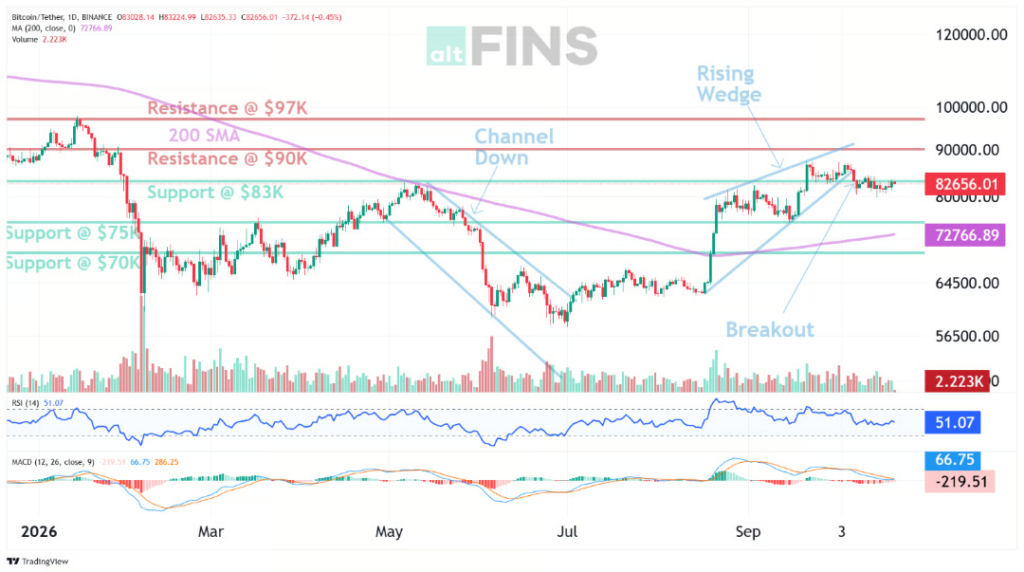
Bitcoin opened the window at $82,246 on 16 October and closed at $84,215 on 22 October, up 2.39%, but the path mattered more than the total. The week started soft, with 16 and 17 October both lower and 18 October printing the low of $80,684. From there the tape turned: 20 October rose 1.33% to $83,028 and 21 October added 1.28% to $84,093, tagging a high of $84,898 before the final session settled a little higher.
Source: https://altfins.com/technical-analysis
Momentum has climbed out of the weak zone without clearing the top. RSI-14 sits at 61.0 and RSI-9 at 58.9, both neutral. The MACD histogram is barely negative at minus 19.61, with the line at 284.75 against a signal of 304.36, so the crossover has flattened rather than reversed. ATR-14 of $1,855 and a Bollinger range of $80,277 to $86,175 put price in the upper half of the band, and the stochastic reading of 86.6 says the move has run into overbought territory on the fourteen-day range. Price is 1.19% above the twenty-day average and 2.85% above the fifty-day.
The recovery sits well inside a larger advance. Bitcoin is up 31.30% over three months and 8.49% over six, against a 2.31% decline over one month, which is what a pause after a fast run looks like. The price holds 15.60% above the 200-day average and 33.30% below the October 2025 record of $126,217.71. Those two distances describe an asset that has travelled a long way from its lows and still has a wide gap to its high, with the $80,684 low and the $86,175 upper band framing the range that has to break. AltFins still frames the setup as a correction inside a longer uptrend, with a reference zone at $75,000 and resistance at $90,000, which lines up with the Binance picture of a pause rather than a reversal.
Source: https://sosovalue.com/assets/etf/us-btc-spot
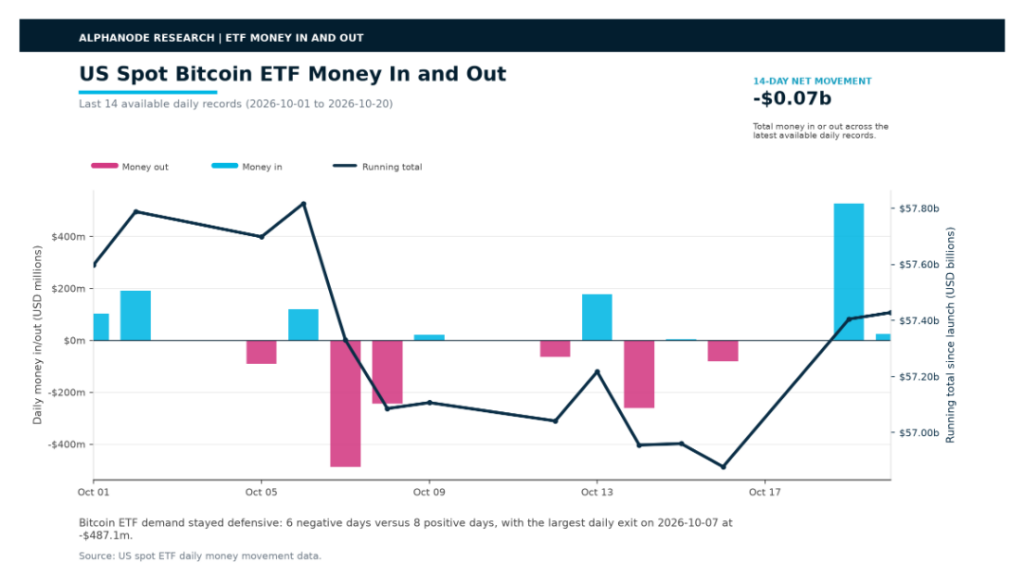
Money came back into the bitcoin funds just as price turned. United States spot bitcoin funds added $526.6 million on 19 October, the largest daily inflow in about a month, and BlackRock’s IBIT accounted for $665.2 million of it while Fidelity’s FBTC lost $83.6 million and Grayscale’s GBTC lost $54.9 million. Across the fourteen sessions to 20 October the funds are net minus $67.4 million, with eight positive days against six negative, and net assets stand at $106.28 billion. The buying was concentrated in one issuer, which is a narrower base than the headline figure suggests.
The week’s tone came from outside crypto as much as inside it. SpaceX’s quarterly revenue of $14.58 billion beat consensus and revived risk appetite across technology shares, and the same call carried Musk’s confirmation of merger talks that would pool 30,221 bitcoin. The institutional signal ran the other way in places: MSCI finalised a rule that could push index funds out of the largest corporate holders’ shares, a reminder that demand for bitcoin through equities is not unconditional. The same stretch brought the counterweight: Standard Chartered agreed to buy Zodia Custody outright, and JPMorgan put its deposit token on Ethereum, two more markers that the institutional build-out kept moving regardless of the price.
Watch $80,684, the week’s low, and the $83,226 twenty-day average just below the close. Holding both keeps the rebound intact and leaves the $84,898 high and then $86,175 as the levels to beat. Losing $80,684 would put the $79,800 twenty-day low back in play, and below that the $75,000 zone that sits under the whole recovery. The first long-term number from JPMorgan, a 10% base case, is a decade argument rather than a level, so the range is decided by flows and the next macro print.
Ethereum Market Analysis
Ether’s week was a fight between a price that wanted to recover and a flow that would not stop leaving. United States spot ether funds have lost $1.08 billion across October, with only one positive day in fourteen, and net assets have fallen to $14.98 billion. Against that, the price still closed 1.46% higher at $2,478, up from the week’s low of $2,329, because the selling in the funds did not translate into relentless selling in the spot market.
Source: https://altfins.com/technical-analysis
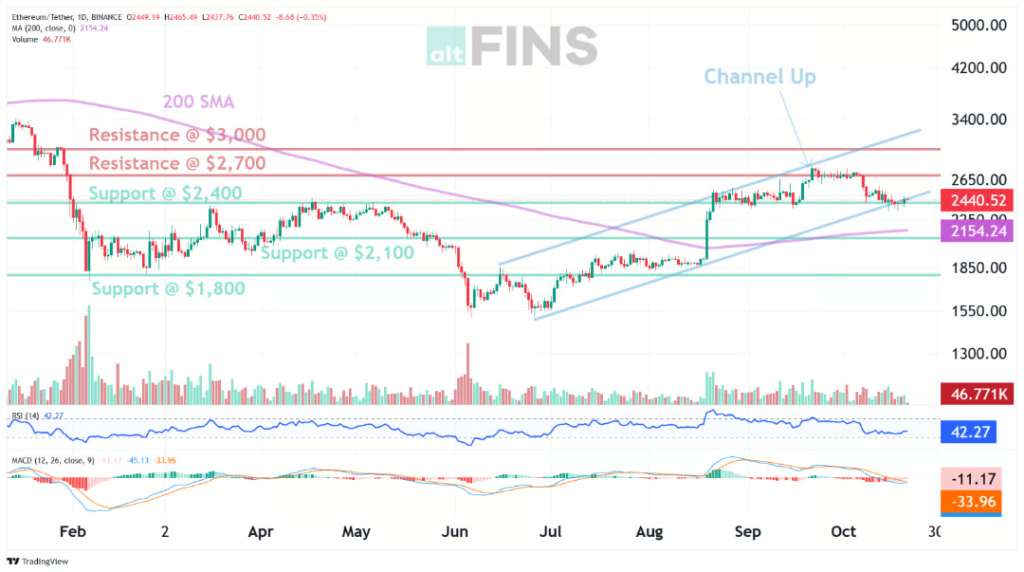
The path was flat for three sessions before it turned. Ether opened at $2,442 on 16 October, slipped to $2,403 on 17 October and $2,410 on 18 October, then found a bid: 20 October rose 1.71% to $2,449 and 21 October added 1.00% to $2,474, touching a high of $2,527. The final session was almost unchanged at $2,478, which leaves the recovery intact but short of the ceiling it met.
Momentum is weaker than bitcoin’s and just beginning to turn. RSI-14 reads 50.3 and RSI-9 45.3. The MACD line is still below its signal, at minus 38.41 against minus 34.42 for a histogram of minus 3.98, and the detail that matters is the direction: the bars have been narrowing, which is what an asset looks like when it stops falling. Price sits 1.40% below the twenty-day average and 2.98% below the fifty-day, a deeper discount than bitcoin’s, while holding 14.91% above the 200-day. AltFins reads an uptrend inside a channel-up pattern whose momentum is inflecting back to bullish, which fits a base forming above $2,400 rather than a trend that has broken
Source: https://sosovalue.com/assets/etf/us-eth-spot
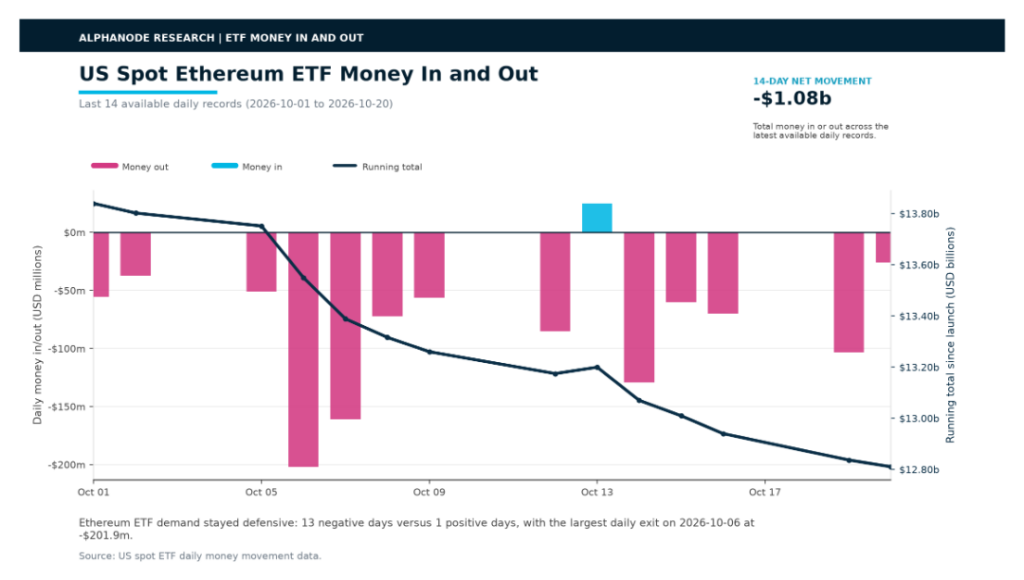
The fund figure is the counterweight. Ether funds lost $103.3 million on 20 October, a fourth consecutive negative session, with BlackRock’s ETHA responsible for $95.4 million of it. Over the fourteen sessions to 20 October the funds are net minus $1.08 billion, positive on one day and negative on thirteen, and cumulative inflows hold at $12.81 billion. Bitcoin funds were close to flat over the same period, so the rotation has favoured the larger asset, and one good day in ether funds would be the first real change in that pattern.
Valuation keeps the recovery honest. Ether trades 50.08% below its August 2025 record of $4,956.67 and 64.37% above its 52-week low of $1,505.52, and its three-month gain of 33.10% edges bitcoin’s 31.30%, so the underperformance is short-term rather than structural. What could change the balance is onchain demand: Mastercard opened early access to AI agent payments after pilots on Coinbase and Base, and stablecoin transfer volume reached $891 billion with 73% settling outside banking hours, both of which run on rails that compete with blockspace and depend on it at the same time.
Watch $2,329, the week’s low, and $2,400, which AltFins marks as the nearest support. Holding both keeps the channel intact and leaves a path back to the $2,700 resistance the price has now failed twice. Losing $2,329 opens $2,150, the level that lines up with the 200-day average and has not traded since the recovery began. The ether fund outflow figure is the number that decides which of those levels is tested first.
JPMorgan Puts A Decade Number On Bitcoin
JPMorgan Asset Management published its 2027 Long-Term Capital Market Assumptions on 20 October, the 31st edition of the report and the first to include bitcoin. The bank’s base case is a 10% annualised return for bitcoin over the next decade, with a bear case of a 9.7% annual loss and a bull case of a 17% annual gain. It projects 7.5% for United States large-cap stocks, 7.7% for small caps, between 5.6% and 6.6% for bonds and 5.5% for gold, so the bitcoin figure tops every comparable asset the bank covers.
The report is careful about what the number means. In its own language, the bank put a range on bitcoin returns for the first time while keeping the asset out of its main covariance matrices, the model of how assets move together. It carries bitcoin at 55% annualised volatility against about 17% for gold, and it notes that the arithmetic average return, near 20.9%, is more than double the compound figure an investor would keep after the swings. The gap between those two numbers is the honest part of the exercise. The bank also separates bitcoin from the assets in its main models, building a smaller comparison matrix instead, because unstable correlations make the asset hard to place in a standard portfolio.
The team behind it keeps its distance. Portfolio manager Sheena Shah and head of digital asset strategy Dennis Cristallo describe bitcoin as a speculative asset and a hedge against monetary easing, and write that it lacks a strategic role in portfolios other than as a bet on fiat expansion or future trading on blockchains. That is the tension a decade number creates: the largest United States bank has now published a benchmark return for an asset it still will not put in its models, and allocators have a figure to argue with that did not exist a week ago.
Source: J.P. Morgan Asset Management, 2027 Long-Term Capital Market Assumptions, “U.S. equity upgrades, a global bond renewal and a first look at bitcoin”, data as of September 2026.
MSCI Turns The Index Screen On Bitcoin Treasuries
MSCI finalised rules on 15 October that will treat investment-heavy companies as ineligible for its Global Investable Market Indexes, taking effect at the close of 30 November. A company first fails a core screen if operating assets are too small a share of total assets, then faces five financial ratios covering expenses, cash flow, fair-value changes and reliance on outside financing; it is ineligible if it trips four of the five. The final list of affected firms is due on 11 November. The rule was proposed in August and adopted with minor modifications.
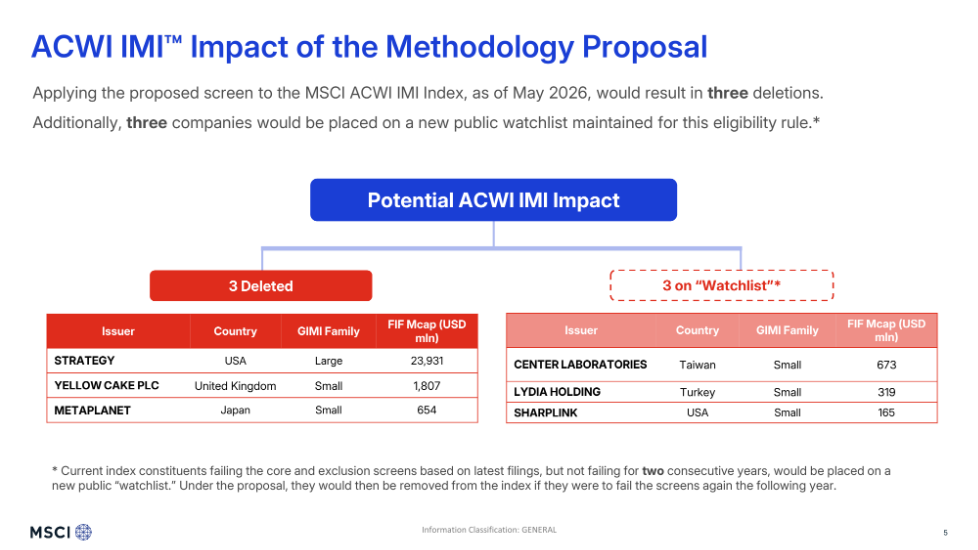
The impact is concentrated and named. MSCI’s own consultation material flags Strategy, Yellow Cake and Metaplanet as potential deletions from the ACWI Investable Market Index, with Center Laboratories, Lydia Holding and SharpLink on a watchlist. Strategy is the largest publicly listed bitcoin holder, with 848,250 BTC, and it funds purchases by selling preferred shares and equity, so index membership is not a side issue for the model. MSCI built in buffers: existing constituents must fail the screen in two consecutive filing periods before removal, which spreads the effect across reviews rather than landing it at once. MSCI ran the screen against May 2026 filings and found three potential deletions, which tells you how few companies actually trip the test even among treasury-heavy names.
The pressure lands on the shares rather than on bitcoin. JPMorgan analysts estimate that removing Strategy from the indexes could move about $2.8 billion of stock, because funds that track an index have to sell a name the index drops whatever the manager thinks of it. Strategy would not have to sell bitcoin to meet that selling, but a weaker share price makes the equity and preferred issuance that funds its purchases more expensive and narrower. That is the mechanism to watch: an index rule aimed at how a company is built can tighten the capital a treasury uses to keep buying.
Source: MSCI, “Consultation on the Eligibility of Non-Operating Companies for the MSCI Global Investable Market Indexes”, potential ACWI IMI impact, August 2026.
Mark Your Calendars
Economic Data Releases:
- October 29, 2026 (Thursday): United States advance third-quarter GDP estimate and September personal income and outlays, including the PCE price index.
Token Unlock
- October 23, 2026 (Friday): Humanity (H) unlocks US$17.37 M (7.34% of released supply).
- October 25, 2026 (Sunday): Plasma (XPL) unlocks US$18.94 M (5.02% of released supply).
- October 27, 2026 (Tuesday): Kinetiq (KNTQ) unlocks US$5.44 M (4.45% of released supply).