DTCC Opens Tokenisation To Thirty Trillion Dollars
29th October 2026 • 7 mins read
This Week’s Recap
- Wall Street backbone DTCC brings $30 trillion securities closer to blockchain with major banks: DTC went live on Canton Network and its own private Besu chain with 34 United States equities, ETFs and Treasuries and 20 signed participants. Each token is backed one-for-one by a security held at DTC and carries the same rights as the underlying share.
- JPMorgan, Coca-Cola, Dell also say ’no’ to OKX-ICE tokenized stock trading plan: Seven more issuers objected on October 27, lifting the total to 33 and taking opt-outs past half the venue’s original roster. JPMorgan said it still backs tokenisation but needs clarity on how its shares are represented.
- Fed leaves interest rates unchanged, as expected: The FOMC held at 3.75% to 4% in a 10-2 vote, with governor Lisa Cook and Cleveland’s Beth Hammack pushing for a quarter point increase. The statement kept the emphasis on inflation that remains elevated.
- Bitcoin ETF inflows climb to $176M as BTC rebounds above $80K: Two sessions of buying added $286 million and cut October’s net outflows to about $26 million. BlackRock’s IBIT took $151.5 million of the October 27 figure.
- Ripple gets a final go-ahead to launch its own U.S. national trust bank: The OCC granted final approval for Ripple National Trust Bank, which will manage the segregated reserves behind RLUSD and offer fiduciary custody. RLUSD stays under New York supervision while adding a federal layer.
- Bitcoin will now stop hiding bugs an AI can find in one prompt: Bitcoin Core merged a policy change on October 22 that creates an “easily discoverable” class of bug, patched and disclosed at once rather than held under embargo. Maintainers accept those fixes will get less testing before release.
- Bithumb hacked through employee system as South Korean financial firms face cyberattacks: The exchange isolated its trading systems after a breach through an internal work tool, one of 16 incidents reported across the South Korean sector.
- CoinDCX Confirms $15.99 Million Loss After Earlier Dismissal of Breach Reports: India’s largest exchange confirmed a 15.99 million USDT loss after an automated transfer service failed on retired wallet addresses, reversing its earlier denial.
- Bitcoin treasury Datavault AI plunges 50% after firm says it can’t access its BTC: The company cut reported assets by $92.2 million after withdrawals stalled, a reminder that a holding on a balance sheet is only useful if the owner can move it.
- Google to preview crypto custody security system as AI threats grow: Alphabet showed a multi-party computation framework for custody, already running on Ethereum and Solana.
- Nearly 90% of large businesses are embracing tokenized cash to speed up payments: DBS: A commercial survey found stablecoin adoption at 63% and tokenised deposit use at 53% among large firms.
- Strategy pauses bitcoin buys, repurchases $205 million of STRC preferred shares: Strategy spent $204.9 million buying back 2,068,459 STRC shares and left its treasury at 848,517 BTC.
- HSBC rolls out its first stablecoin to over 3 million everyday app users: The bank put its Hong Kong dollar stablecoin into its PayMe app, taking a retail payments token to a base of three million users.
- Brazil’s largest lender becomes first bank to formalize crypto brokerage under new rules: Itaú Unibanco registered digital asset trading and custody with the central bank ahead of an October 30 deadline.
- USDC overtakes USDT in euro stablecoin trading as EU rules reshape market: Kaiko: USDC took a 56% share of euro-denominated volume as exchanges delisted tokens that fell outside the MiCA framework.
- Aviva Investors, Ripple launch tokenized share class of $29 billion sterling fund on XRP Ledger: The manager tokenised a £22 billion liquidity fund and seeded the share class with £50 million of its own capital.
- Crypto wallet maker Keystone to destroy almost 19,000 devices after security breach: An attacker compromised an internal verification key and leaked 25,964 customer records. Destroying the stock removes the risk to unopened units that a firmware patch cannot reach.
Bitcoin Market Analysis
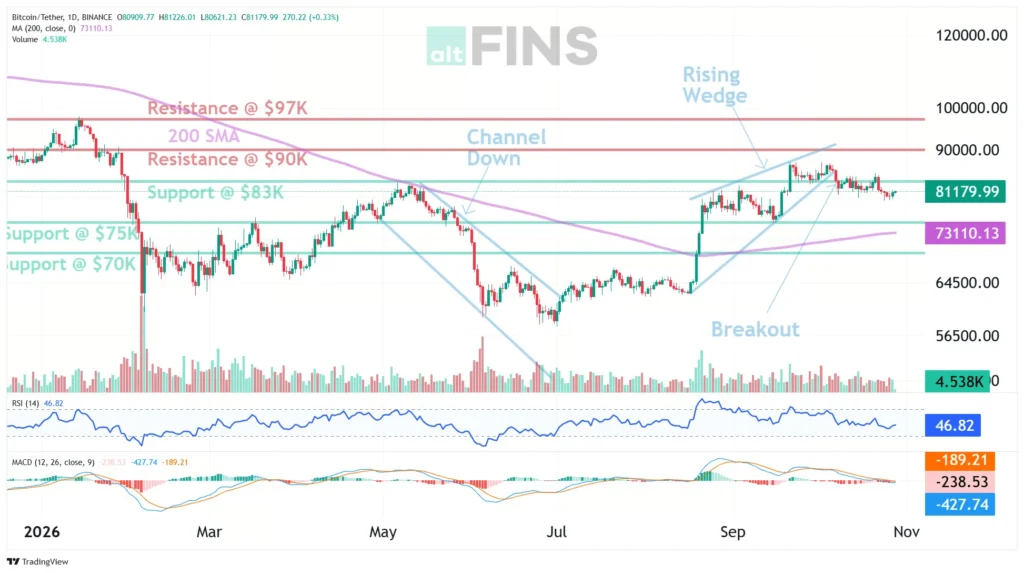
Bitcoin opened the window at $81,416 on October 23 and closed at $81,379 on October 29, a 0.05% decline that hides a $2,840 swing. The first three sessions drifted lower and October 24 printed the low of $79,221. From there the tape firmed, with October 27 up 0.95% to $80,910, October 28 up 0.54% to $81,344 and the final session almost unchanged. The high of $82,061 came on the opening day, so the week recovered ground without ever threatening its own ceiling.
Source: https://altfins.com/technical-analysis
Momentum sits below neutral and still leans down. RSI-14 reads 45.1 and RSI-9 36.8. The MACD line is at minus 388.84 against a signal of minus 227.01, a histogram of minus 161.83, so the bars are widening to the downside rather than closing. ATR-14 of $1,679 and a Bollinger range of $79,761 to $83,982 put price in the lower half of the band, and the stochastic reading of 38.0 leaves room before the move looks stretched. Bitcoin trades 0.60% below its twenty-day average, 0.76% below the fifty-day, and 11.23% above the 200-day at $73,164. It sits a touch above the nine-day exponential average at $81,274 and a touch below the twelve-day at $81,431, the shape of a market that has stopped falling without yet turning up.
Zoom out and the week looks like a pause rather than a break. Bitcoin is up 29.40% over three months and 3.42% over six, against a 2.73% fall over one month. Trading thinned as price drifted, with the October 25 session turning over $0.50 billion of spot volume, the lightest of the seven days, before October 26 and October 27 both cleared $1 billion as buyers returned. Bitcoin holds 11.23% above the 200-day average and sits about 35% below the October 2025 record of $126,217.71. The twenty-day high of $84,898 and the thirty-day high of $87,220 are the levels that capped the October advance, and the $79,221 low is the floor the pullback has found so far. AltFins frames the setup as a correction inside a longer uptrend, with support in the mid-$70,000s and resistance near $90,000.
Source: https://sosovalue.com/assets/etf/us-btc-spot
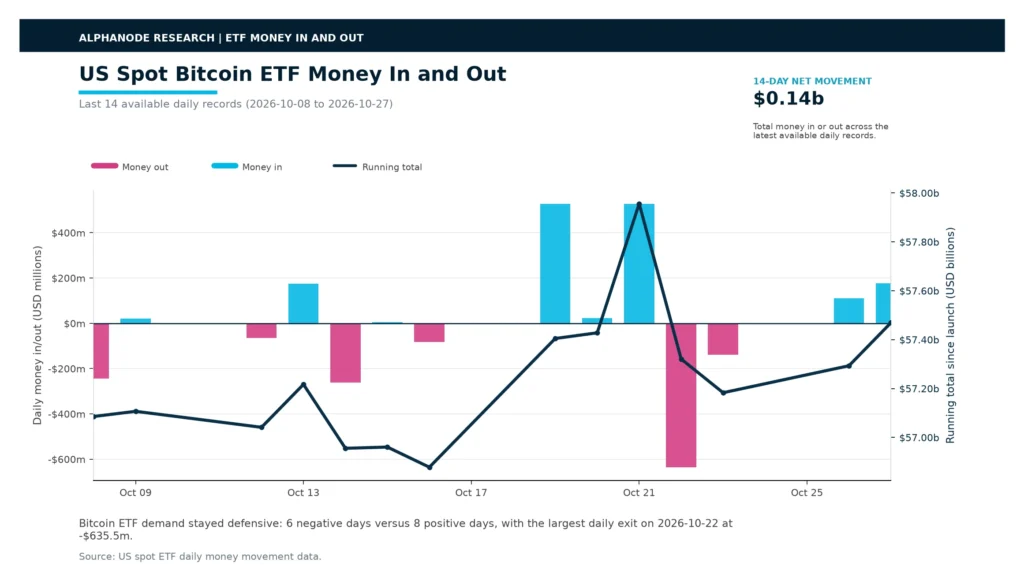
Institutional flows turned back up after a rough stretch. United States spot bitcoin funds took in $176.0 million on October 27, with BlackRock’s IBIT contributing $151.5 million and Fidelity’s FBTC $24.5 million, after $110.3 million the previous session. IBIT alone supplied 86% of the day’s inflow, so the buying was narrower than the headline suggests. Across the fourteen sessions to October 27 the funds are net plus $139.5 million, up on eight days and down on six, with net assets at $103.94 billion and cumulative inflows at $57.47 billion. The monthly picture is still fragile. A $635.5 million exit on October 22 and $137.9 million on October 23 had pushed October’s net position to roughly minus $26 million before the two-day bounce, which is a narrow margin for a month that saw a $528 million inflow on October 21.
The week’s direction came from policy and from company balance sheets as much as from flows. The Federal Reserve held rates at 3.75% to 4% on October 28 in a 10-2 vote, its last decision before the midterm elections, and bitcoin pushed back above $81,000 in the hours that followed. The stress showed up in the treasury model that carried so much of the year’s institutional demand. Strategy paused its purchases to spend $204.9 million buying back preferred shares, and Datavault AI halved after telling investors it could not access $92.2 million of the bitcoin on its balance sheet. A balance sheet holding is only as good as the wallet behind it.
Watch $79,221, the week’s low, and the $81,871 twenty-day average just above the close. Holding both keeps the range intact and leaves $82,061 and then $83,982, the upper Bollinger band, as the levels to clear. Losing $79,221 would put the $79,761 lower band in play, and below that the mid-$70,000s that AltFins marks as support. The Bitwise ten-year target of $1.6 million is a forecast rather than a level, so the range will be decided by flows and the November 6 jobs report.
Ethereum Market Analysis
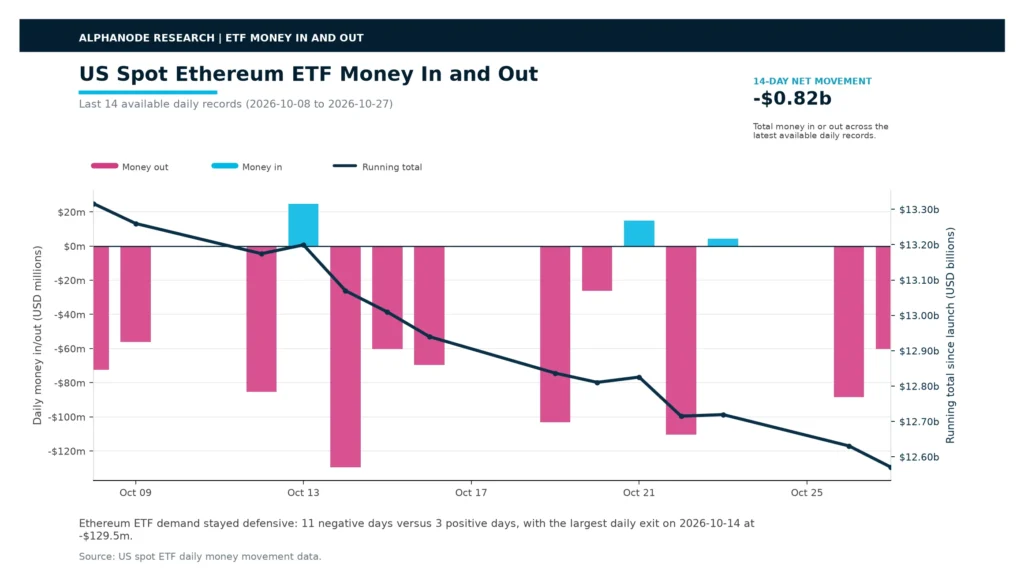
Ether spent the week losing a fight it nearly won. United States spot ether funds have now shed $818 million across the fourteen sessions to October 27, negative on eleven of them, with net assets down to $14.18 billion. The price held up better than the flow. Ether closed at $2,361, down 1.16% on the week, after a low of $2,282 that was never retested. A price that held while the funds kept selling is the simplest description of ether’s month, and it leaves the two measures pointing in different directions.
Source: https://altfins.com/technical-analysis
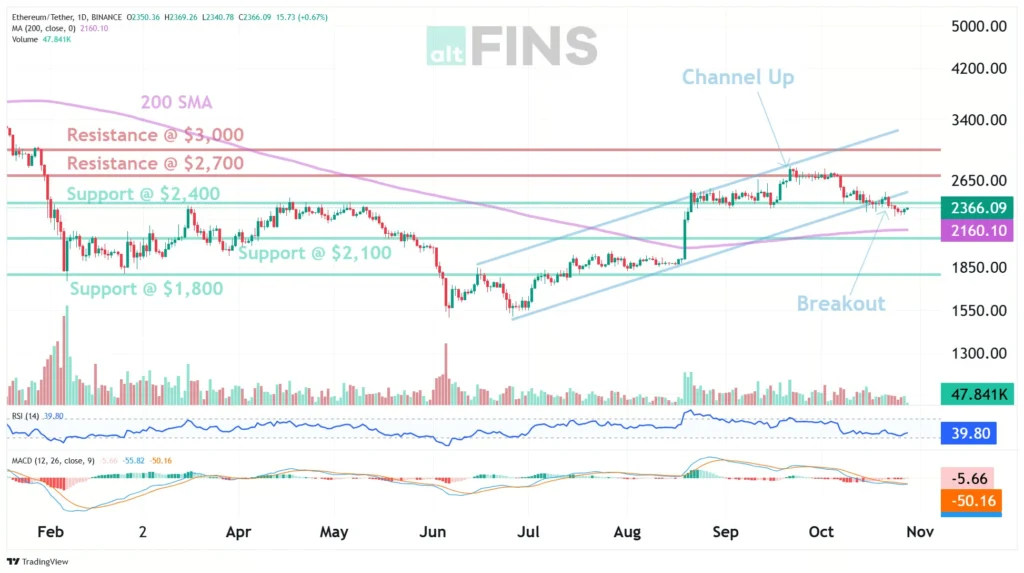
The path was soft for the first four sessions. Ether opened at $2,389 on October 23, slipped to $2,359 on October 24 and $2,330 on October 25, and printed the low of $2,282 on October 24. The turn came on October 27, up 1.11% to $2,350, followed by October 28 up 0.40% to $2,360. The week’s high of $2,418 also landed on the opening day, which leaves the recovery real but well short of where it started. Volume echoed the drift, and the October 25 session was the quietest at $0.27 billion.
Momentum is weaker than bitcoin’s. RSI-14 reads 36.6 and RSI-9 29.1, the nine-day reading close to oversold. The MACD line sits at minus 54.31 against a signal of minus 51.08 for a histogram of minus 3.24, so the gap is narrowing even as both stay negative. ATR-14 of $77.88 and a Bollinger range of $2,298 to $2,530 frame the move, and the stochastic reading of 32.3 leaves room below. Ether trades 2.18% under its twenty-day average and 6.79% under the fifty-day, while holding 9.28% above the 200-day at $2,161.
Source: https://sosovalue.com/assets/etf/us-eth-spot
The fund flow is the drag. Ether funds lost $60.2 million on October 27, a fourth negative session in five, and $88.6 million on October 26. Over the fourteen sessions to October 27 they are net minus $818 million, positive on three days and negative on eleven, with cumulative inflows at $12.57 billion. The three positive days in that span total less than $45 million, which is the scale of the problem. Bitcoin funds were net positive over the same stretch, so the rotation kept favouring the larger asset. One clean inflow day would be the first real change in that pattern, and it has not arrived.
Valuation and onchain demand give the other side of the argument. Ether trades about 52% below its August 2025 record of $4,956.67 and 57% above its 52-week low of $1,505.52, and its three-month gain of 26.78% trails bitcoin’s 29.40%. The tokens built on it kept compounding. Aviva Investors put a $29 billion sterling fund on the XRP Ledger in a tokenised share class, Janus Henderson and Centrifuge launched a Nasdaq-100 fund on Stellar, and Coinbase added Ripple’s RLUSD across its venues. None of those is Ethereum-specific, which is the point. Tokenised funds are settling on whichever chain fits, and ether’s fee and staking economics have to compete for that business rather than assume it.
Watch $2,282, the week’s low, and $2,298, the lower Bollinger band just above it. Holding both keeps the base intact and leaves $2,414, the twenty-day average, as the first ceiling, then the $2,530 upper band. Losing $2,282 opens the mid-$2,000s that AltFins marks as support. The Fed’s next moves will decide whether the funds return before the price tests either edge.
DTCC Opens The Door On Thirty Trillion Dollars
The Depository Trust Company went live with its tokenisation service on October 28, the first time the clearing house at the centre of United States securities markets has put DTC-custodied assets onto a blockchain rail. The launch covers 34 securities at the outset, drawn from the Russell 1000, exchange-traded funds and United States Treasury bills, notes and bonds, representing roughly $30 trillion of the $114 trillion in securities the depository holds.
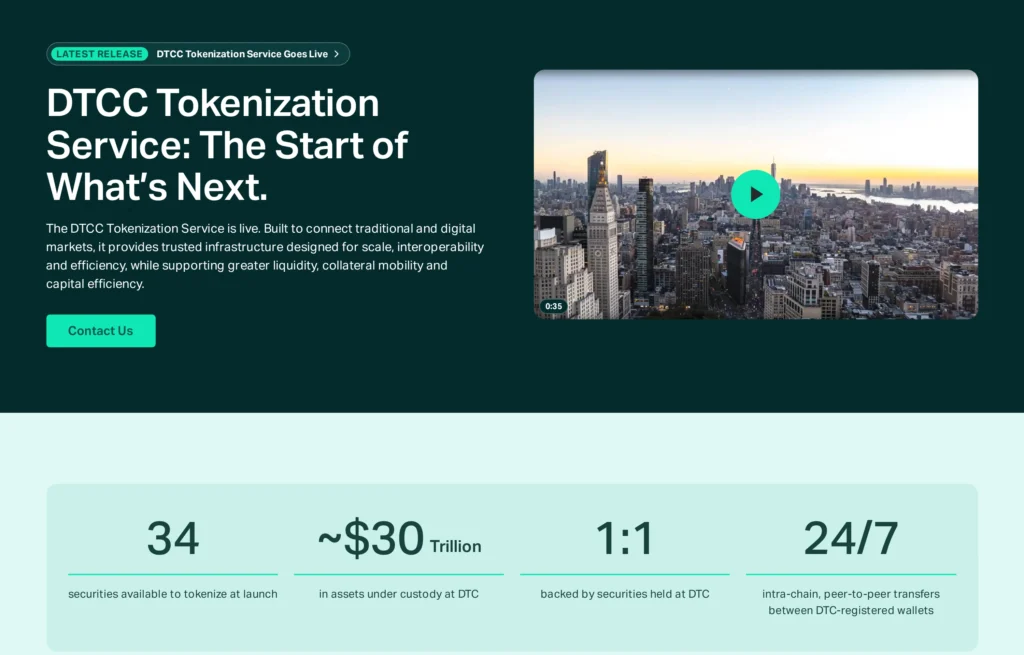
The design keeps the token tethered to the security. Each token is backed one-for-one by an asset held at DTC, carries the same ownership rights and protections as its book-entry equivalent, and converts between traditional and tokenised form. Conversion orders run from 2am to 6pm New York time on business days and target fifteen minutes or less, while peer-to-peer transfers between DTC-registered wallets run around the clock. The service is live on Canton Network and DTCC’s own private Besu network, with Stellar and Circle’s Arc added in 2027.
The demand side is already lined up. Twenty DTC participants have signed agreements to access the service, among them J.P. Morgan, Citi, Morgan Stanley, Bank of America, Barclays, BNP Paribas, State Street, UBS, Fidelity Investments and Citadel Securities, with brokers, clearing firms and wealth managers filling out the list. The service follows a July pilot in which DTC and more than 30 firms ran limited-production trades and on-chain transactions, and DTC received a Securities and Exchange Commission no-action letter authorising the model in December 2025. The consequence runs past this launch. Once the largest securities depository treats a token as the same asset as a share, the argument over whether tokenised securities are a parallel market or the market itself gets harder to avoid.
Source: DTCC, Tokenization Service scope at launch, dtcc.com, service live from 28 October 2026.
Thirty Three Issuers Shut The Tokenised Door
The tokenised-equity venue run by Intercontinental Exchange and OKX has now been refused by 33 listed companies. The two firms built it as a 50-50 joint venture to trade tokenised versions of United States-listed stocks around the clock, and its public notice dated October 27 names JPMorgan Chase, Advanced Micro Devices, Applied Materials, Coca-Cola, Adobe, Dell Technologies and Sandisk as the newest objectors, taking the count from 26 a day earlier. The list has grown at every revision, from a single name on October 4 to nine by the middle of the month, sixteen on October 19, 22 on October 23 and 33 now. About half of the roughly 62 companies originally proposed for the venue have opted out, and the names span technology, banking, defence, healthcare and consumer brands.
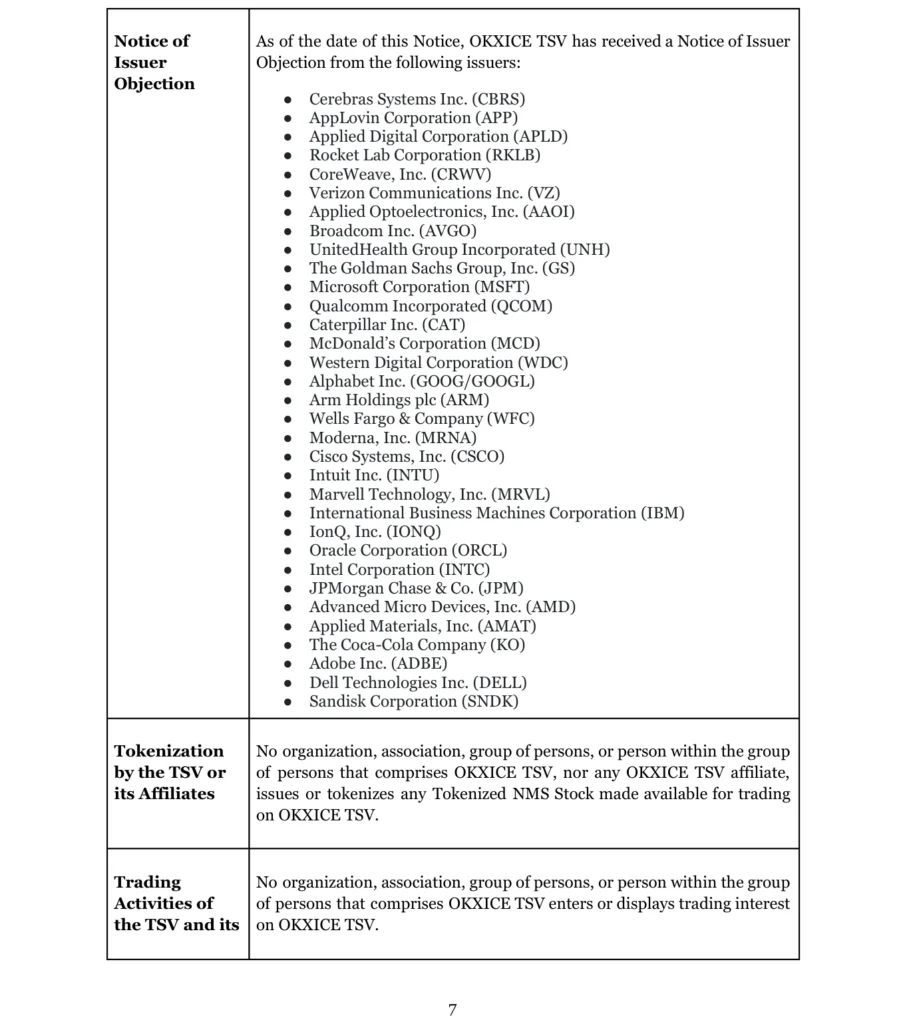
The mechanism is the SEC’s Innovation Exemption, finalised on September 17 as a five-year experiment. Before a venue lists a tokenised version of a United States-listed stock created by an unaffiliated third party, it must give the issuer 30 days’ written notice. A timely objection removes the stock from that venue alone. Another platform would have to send its own notice and could be refused in turn. The venue has five business days to disclose each objection in an amended notice. OKXICE has not disclosed the reasons, and it gives no start date.
The refusals are not a verdict on tokenisation itself. JPMorgan said it remains interested in the technology but needs to be clear about how its shares are represented and traded before joining this venue. Applied Optoelectronics, one of the first objectors, told the Wall Street Journal it could not see a benefit that justified uncertainty over its share price, liquidity and volatility. The venue itself plans to run approved participants through permissioned Uniswap v4 pools on OKX’s X Layer, with stablecoin settlement and round-the-clock trading. That is the tension the week set up. The same fortnight that brought the DTCC rail online also showed how quickly issuers will use a regulatory window to keep third-party tokens off their stock.
Source: OKXICE TSV, Public Notice dated 27 October 2026, okx.com.
Mark Your Calendars
Economic Data Releases:
- October 30, 2026 (Friday): United States employment cost index for the third quarter, alongside the Chicago business barometer for October.
- November 2, 2026 (Monday): United States ISM manufacturing index for October.
- November 3, 2026 (Tuesday): United States job openings and labour turnover survey for September, on the day of the midterm elections.
- November 4, 2026 (Wednesday): United States ISM services index and ADP employment report for October.
- November 6, 2026 (Friday): United States October employment report, covering nonfarm payrolls, the unemployment rate and average hourly earnings.
Token Unlock
- October 29, 2026 (Thursday): Falcon Finance (FF) unlocks US$19.19 M (6.07% of released supply).
- October 31, 2026 (Saturday): EigenCloud (EIGEN) unlocks US$7.45 M (4.08% of released supply).
- November 1, 2026 (Sunday): MemeCore (M) unlocks US$58.68 M (2.76% of released supply).